• KGS/USD = 0.01144 0%
  • KZT/USD = 0.00194 -0%
  • TJS/USD = 0.10834 -0.09%
  • UZS/USD = 0.00008 0%
  • TMT/USD = 0.28490 0%
  • KGS/USD = 0.01144 0%
  • KZT/USD = 0.00194 -0%
  • TJS/USD = 0.10834 -0.09%
  • UZS/USD = 0.00008 0%
  • TMT/USD = 0.28490 0%
  • KGS/USD = 0.01144 0%
  • KZT/USD = 0.00194 -0%
  • TJS/USD = 0.10834 -0.09%
  • UZS/USD = 0.00008 0%
  • TMT/USD = 0.28490 0%
  • KGS/USD = 0.01144 0%
  • KZT/USD = 0.00194 -0%
  • TJS/USD = 0.10834 -0.09%
  • UZS/USD = 0.00008 0%
  • TMT/USD = 0.28490 0%
  • KGS/USD = 0.01144 0%
  • KZT/USD = 0.00194 -0%
  • TJS/USD = 0.10834 -0.09%
  • UZS/USD = 0.00008 0%
  • TMT/USD = 0.28490 0%
  • KGS/USD = 0.01144 0%
  • KZT/USD = 0.00194 -0%
  • TJS/USD = 0.10834 -0.09%
  • UZS/USD = 0.00008 0%
  • TMT/USD = 0.28490 0%
  • KGS/USD = 0.01144 0%
  • KZT/USD = 0.00194 -0%
  • TJS/USD = 0.10834 -0.09%
  • UZS/USD = 0.00008 0%
  • TMT/USD = 0.28490 0%
  • KGS/USD = 0.01144 0%
  • KZT/USD = 0.00194 -0%
  • TJS/USD = 0.10834 -0.09%
  • UZS/USD = 0.00008 0%
  • TMT/USD = 0.28490 0%
10 December 2025

Japanese Company to Build Tunnel on Kyrgyzstan’s Strategic Bishkek-Osh Highway

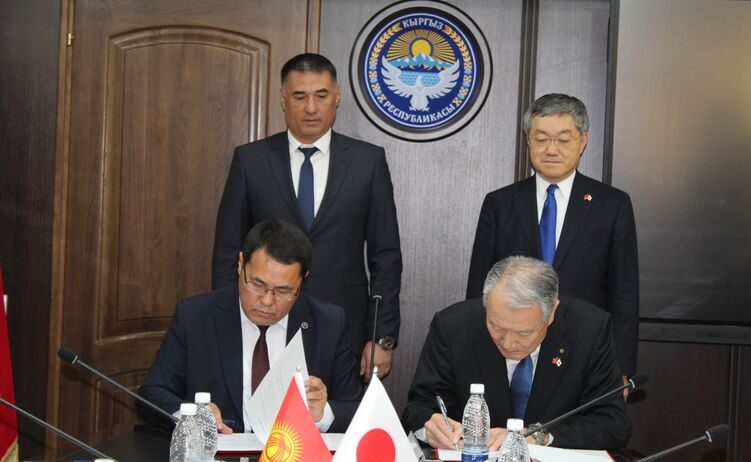
Kyrgyzstan’s Ministry of Transport and Communications has signed a contract with Japan’s Takenaka Civil Engineering Co. for the construction of a 750-meter tunnel along the critical Bishkek-Osh highway. The project will be carried out at the highway’s 400-kilometer mark and is scheduled to begin in June 2025.

The signing ceremony on April 15 was attended by Kyrgyz Transport and Communications Minister Absattar Syrgabayev, Japanese Ambassador to Kyrgyzstan Hideki Goda, and Kawamoto Hiroyuki, Permanent Representative of the Japan International Cooperation Agency (JICA) in Kyrgyzstan.

Minister Syrgabayev expressed gratitude to the Japanese government and JICA for their ongoing support in developing Kyrgyzstan’s transport infrastructure.

Strategic Significance

The Bishkek-Osh highway is the only overland route linking Kyrgyzstan’s north and south, making it vital to the country’s economic, social, and political cohesion. The 655-kilometer artery cuts through four western regions, Chui, Talas, Jalal-Abad, and Osh, connecting the capital Bishkek with Osh, the country’s second-largest city.

In addition to its domestic role, the Bishkek-Osh highway is a key part of several international transport corridors, linking Kyrgyzstan to Kazakhstan, Uzbekistan, Tajikistan, and China. Enhancing the reliability and safety of this route is a top infrastructure priority for the Kyrgyz government.

Delays to Alternative Route

As reported by The Times of Central Asia, Kyrgyz authorities have postponed the opening of the long-anticipated North-South alternative highway to 2026. Originally set for completion in May 2025, the 433-kilometer project has been delayed to allow for additional infrastructure development.

China and Russia Remain Kyrgyzstan’s Largest Foreign Investors

The National Statistical Committee of Kyrgyzstan has released updated figures on foreign direct investment (FDI), revealing that China and Russia remained the country’s largest investors in 2024.

According to the data published on April 15, Kyrgyzstan received $872.6 million in FDI in 2024, marking an increase from $844.9 million in 2023.

China accounted for 23.9% of total FDI, followed by Russia with 22.7%, Turkey (10.2%), Luxembourg (8.8%), Kazakhstan (5.7%), the Netherlands (4.9%), and Azerbaijan (3.4%). The remaining 20.4% came from a mix of other countries.

Compared to the previous year, Kyrgyzstan saw increased investment from Azerbaijan, Luxembourg, Germany, Turkey, the Netherlands, and Russia, while inflows from the UK, UAE, Kazakhstan, and China declined.

Sector Breakdown

The manufacturing sector attracted the largest share of foreign investment, receiving 33.2% of total FDI. This was followed by the financial sector (20.6%), wholesale and retail trade (18.7%), the mining industry (11.3%), and geological exploration (8.3%).

Sharp Rise in Overall Investment

The total volume of investments in fixed assets from all sources in the first quarter of 2025 reached 56.8 billion Kyrgyz som, reflecting a 90.6% increase year-on-year. This marks a significant acceleration compared to the 63.9% growth recorded during the same period in 2024.

Officials attribute the sharp rise primarily to a 2.1-fold increase in domestic financing, while the volume of foreign investment in fixed assets during the same period decreased by 1.5 times compared to the first quarter of 2024.

U.S. Cancels $2.5 Million Civic Engagement Grant for Uzbekistan

The U.S. State Department has canceled a $2.5 million grant intended to support civic engagement programs in Uzbekistan. The decision comes as part of a broader review of foreign aid expenditures initiated by U.S. Senator Marco Rubio and the Department of Government Efficiency.

The Uzbekistan program was one of 139 foreign aid grants, totaling $215 million, that were recently scrapped. Other canceled initiatives include $5.2 million for a media diversity project in the United Kingdom, $2 million for newsroom sustainability efforts in Moldova, and nearly $1 million for women’s organizations in Mauritania. Additional cuts affected projects focused on disinformation, media freedom, and gender equity in Europe, Brazil, and North Africa.

Continued U.S.-Uzbekistan Engagement

Despite the funding cut, bilateral ties between the United States and Uzbekistan continue to strengthen. A draft of Uzbekistan’s 2025 government program, currently open for public discussion, outlines plans to deepen cooperation with Washington. These include a proposed high-level visit to the U.S. and the inaugural round of the Enhanced Strategic Partnership Dialogue, scheduled to take place in Tashkent. In March 2025, Uzbekistan’s Ambassador to the U.S., Furkat Sidikov, also hosted a Congressional Breakfast, which focused on trade, investment, and U.S.-Uzbekistan relations. Over 300 American companies are currently operating in Uzbekistan

Uzbekistan recently hosted the first EU-Central Asia summit in Samarkand, though the prospects of a U.S.-Central Asia C5+1 summit in 2025 remain uncertain.

Daniel Runde, a senior official at the Center for Strategic and International Studies, has emphasized the importance of a strong U.S.-Uzbek partnership. Runde noted that Uzbekistan plays a critical role in maintaining stability in Central Asia and in balancing the regional influence of Russia and China.

U.S. Commission Again Cites Turkmenistan for Religious Freedom Violations

The U.S. Commission on International Religious Freedom (USCIRF) has once again designated Turkmenistan as a “Country of Particular Concern” (CPC), citing ongoing and systematic violations of religious freedom in its 2024 annual report.

Persistent State Control and Persecution

The USCIRF report emphasizes that religious freedoms in Turkmenistan remain severely restricted, with the state maintaining tight control over religious life and prosecuting individuals whose beliefs deviate from officially sanctioned interpretations. Notably, the commission highlighted the imprisonment of ten Muslims for participating in peaceful religious activities, a case that underscores the regime’s repressive stance toward nonconforming Islamic practices.

Turkmenistan’s legal framework continues to draw criticism. The 2016 Religion Law prohibits unregistered religious groups and heavily restricts the distribution of religious literature, instruction, and rituals. The 2015 Law on Combating Extremism also remains a concern, as its vague provisions allow for the prosecution of peaceful religious activity.

Harassment of Religious Minorities

The report also documents the continued harassment of Protestant Christians and Jehovah’s Witnesses. In one case, a mosque official in Lebap province reportedly threatened to “shut down” a pastor of an unregistered Protestant church, prompting a visit from the Ministry of National Security. The pastor’s relatives later received anonymous threats.

In January, law enforcement officers raided a Jehovah’s Witnesses’ home in the village of Sakara, detaining five individuals who were subjected to eight hours of interrogation.

Restrictions on Religious Travel

The Turkmen authorities also restrict international travel on religious grounds. In January 2024, Pygamberdy Allaberdyev, a lawyer and activist from Balkanabat, was barred from traveling to Iran to attend a relative’s funeral. According to USCIRF, he was informed by Department of Homeland Security officials that he was under surveillance and would be prohibited from leaving the country for five years.

Religion and the Cult of Personality

The commission’s report also criticizes the use of religion to reinforce the cult of personality surrounding former president Gurbanguly Berdimuhamedov. Although he currently serves as chairman of the Khalk Maslahaty, his influence remains widespread. Officials in Balkanabat and Turkmenbashi reportedly interfered with wedding ceremonies, mandating the exclusive use of Turkmen music, including songs from the former president’s personal repertoire.

Authorities have also targeted religious expression among civil servants. Men have been forced to shave their beards, and women have been ordered to remove their hijabs. Ahead of the Berdimuhamedov family’s vacation in Avaza, police carried out raids targeting religious symbols. In October, women in Ashgabat wearing hijabs were reportedly detained, had their belongings confiscated, and were banned from traveling abroad. They were also lectured about the secular nature of the state.

Policy Recommendations

In its conclusions, USCIRF recommends targeted sanctions against officials and agencies responsible for egregious violations of religious freedom, including asset freezes and visa bans. The commission also urged the U.S. Congress to take a more active role in addressing these issues through hearings and delegations to the region.

Turkmenistan has consistently appeared on USCIRF’s CPC list since 2000, reflecting its entrenched policies of religious control, suppression of non-state-approved faiths, and ongoing violations against believers. The 2024 report reaffirms the country’s status as one of the world’s most restrictive environments for religious freedom.

Kyrgyzstan Sets Date for 2027 Presidential Election

Kyrgyz President Sadyr Japarov has submitted a draft law to parliament establishing the official date for the country’s next presidential election. The parliamentary committee on constitutional legislation has approved the proposal in all three readings.

According to the newly adopted law, the presidential election will take place on January 24, 2027, in line with amendments that designate the fourth Sunday of January as the official election date in the year the president’s term expires.

Under the current Constitution, the president of Kyrgyzstan is elected for a single six-year term, with no possibility of re-election. President Japarov was elected on January 28, 2021, and later initiated constitutional reforms, including a nationwide referendum that expanded presidential powers.

Changes to Parliamentary Elections

The same parliamentary committee has also approved a second reading of a draft law altering the electoral system for members of the Jogorku Kenesh (parliament). The reforms would eliminate single-mandate constituencies, moving to an entirely majoritarian, multi-member district model.

Under the new system, 30 electoral constituencies will be established, with three deputies elected in each, bringing the total to 90 MPs, all elected on a majoritarian basis. Both political parties and self-nominated individuals will be able to field candidates. Notably, 30 of the 90 seats will be reserved for women, aimed at enhancing gender representation.

Currently, Kyrgyzstan’s parliament is composed of 54 deputies elected by party lists and 36 by single-mandate districts. If approved in its final reading, the draft law would overhaul the country’s mixed electoral model in favor of a purely constituency-based approach.

Kazakhstan Bans Use of Public Funds to Pay Foreign Athletes

President Kassym-Jomart Tokayev has signed a new law prohibiting the use of state budget funds and funds from the quasi-governmental sector, to finance the participation of foreign athletes in Kazakh sports clubs. Under the legislation, foreign “legionnaires” may now only be contracted using money from private sponsors.

The move aims to refocus state support on domestic talent in professional sports. According to the presidential administration, athletes holding Kazakhstani passports who compete at elite levels, including in Olympic, Paralympic, Deaflympic, Asian, and national sports, will remain eligible for public funding.

Funding Priorities and Implementation

“The priority sports will be defined based on achievements on the international stage,” Akorda stated. These will include sports featured in the programs of major multi-sport events, along with traditional national disciplines.

Budget allocations will also continue for state-run physical culture and sports organizations, grassroots sports initiatives, and the development of sports infrastructure. The final list of high-performance priority sports, along with detailed budget allocation procedures, will be finalized by the Ministry of Tourism and Sports.

In addition to the funding changes, the new law introduces unified standards for athlete training and outlines measures to promote traditional values and patriotic education. A new concept, “national standards of sports training”, has been formally introduced into legislation.

Financial Impact and Transition Period

Deputy Minister of Tourism and Sports Serik Zharasbayev previously estimated that Kazakhstan allocates around 400 billion tenge (approximately $797 million) annually to high-performance sports through national and regional budgets.

Currently, football and hockey clubs can receive up to 1.2 billion KZT ($2.4 million) per year, while basketball and volleyball clubs are limited to 450 million KZT ($897,000). The new rules, however, will not affect existing contracts, as Kazakh law is not retroactive. Nevertheless, authorities have advised clubs across all sports not to sign new agreements with foreign athletes in 2025.

Potential Legal Challenges

Observers note that the restrictions may conflict with Kazakhstan’s obligations under the Eurasian Economic Union (EAEU) Treaty, which guarantees the free movement of labor among member states. The move could impact the future participation of Russian and Belarusian athletes, in particular, in Kazakhstan’s domestic leagues.

As previously reported by The Times of Central Asia, legal interpretations of the EAEU Treaty’s provisions may play a decisive role in how these new restrictions are implemented in practice.