• KGS/USD = 0.01144 0%
  • KZT/USD = 0.00196 -0%
  • TJS/USD = 0.10899 -0%
  • UZS/USD = 0.00008 -0%
  • TMT/USD = 0.28490 0%
  • KGS/USD = 0.01144 0%
  • KZT/USD = 0.00196 -0%
  • TJS/USD = 0.10899 -0%
  • UZS/USD = 0.00008 -0%
  • TMT/USD = 0.28490 0%
  • KGS/USD = 0.01144 0%
  • KZT/USD = 0.00196 -0%
  • TJS/USD = 0.10899 -0%
  • UZS/USD = 0.00008 -0%
  • TMT/USD = 0.28490 0%
  • KGS/USD = 0.01144 0%
  • KZT/USD = 0.00196 -0%
  • TJS/USD = 0.10899 -0%
  • UZS/USD = 0.00008 -0%
  • TMT/USD = 0.28490 0%
  • KGS/USD = 0.01144 0%
  • KZT/USD = 0.00196 -0%
  • TJS/USD = 0.10899 -0%
  • UZS/USD = 0.00008 -0%
  • TMT/USD = 0.28490 0%
  • KGS/USD = 0.01144 0%
  • KZT/USD = 0.00196 -0%
  • TJS/USD = 0.10899 -0%
  • UZS/USD = 0.00008 -0%
  • TMT/USD = 0.28490 0%
  • KGS/USD = 0.01144 0%
  • KZT/USD = 0.00196 -0%
  • TJS/USD = 0.10899 -0%
  • UZS/USD = 0.00008 -0%
  • TMT/USD = 0.28490 0%
  • KGS/USD = 0.01144 0%
  • KZT/USD = 0.00196 -0%
  • TJS/USD = 0.10899 -0%
  • UZS/USD = 0.00008 -0%
  • TMT/USD = 0.28490 0%
08 December 2025

Central Asia’s Crypto Gamble: Growth Amid Uncertainty

Central Asian countries are approaching the cryptocurrency and crypto-mining industry at varying speeds. While some are just beginning to explore the sector, others have already taken significant, albeit sometimes contradictory, steps.

Kazakhstan: From Mining Powerhouse to Regulatory Caution

Kazakhstan once emerged as a global leader in bitcoin mining. Between mid-2021 and early 2022, the country ranked third in the world in terms of bitcoin mining capacity, accounting for 13.22% of global computing power, trailing only the United States and China. This boom was fueled by low electricity costs, favorable tax conditions, and an influx of miners fleeing stricter regulations in China.

However, the rapid growth strained Kazakhstan’s energy infrastructure. The Ministry of Energy reported that while annual electricity consumption had previously grown by an average of 2%, in 2021 it surged by 6.1% and up to 12% in the densely populated southern energy zone. Digital mining was cited as the primary cause.

By early 2025, Kazakhstan’s share of global mining capacity had dropped to just 1.4%, placing it outside the top five globally. Although around 60 companies are currently active in the sector, some operations have stalled. Tax legislation has tightened since 2022, with miners required to pay 1-2 tenge per kilowatt-hour depending on the energy source. Illegal mining and unlicensed exchanges remain a challenge; in 2024 alone, 12 criminal cases were launched against underground platforms.

Despite these setbacks, experts see potential for a more sustainable and regulated industry. The Astana International Financial Center (AIFC) has become the hub for cryptocurrency operations. A 2023 law on digital assets and updated rules from the Astana Financial Services Authority (AFSA) in 2024 have laid a more comprehensive legal foundation, including provisions on cybersecurity and anti-money laundering.

Over 10 licensed cryptocurrency exchanges now operate in Kazakhstan, including global names like Binance, Bybit, and Bitfinex Securities. New initiatives such as the digital tenge and the Cryptocard aim to further integrate blockchain into daily financial transactions.

President Kassym-Jomart Tokayev reaffirmed the government’s commitment to digital transformation in March 2025:

“The development of the digital asset industry and blockchain technology plays a major role. Urgent measures must be taken to liberalize regulation, ensure the legal circulation of digital assets and crypto exchanges, and attract investment in digital mining,” he said.

Uzbekistan: State-Supported Growth

Uzbekistan has made blockchain and digital assets a policy priority. The National Agency for Perspective Projects (NAPP) is the main regulatory body. Between 2022 and 2024, the agency issued 14 licenses to cryptocurrency companies.

The UzNEX exchange, an internationally licensed platform, has played a key role in developing the crypto market in both Uzbekistan and the wider region. Its services include crypto asset trading, staking, and NFT transactions. In 2024, it expanded its list of supported cryptocurrencies (including Toncoin) and plans to launch a digital art platform. Total trading volume exceeded $1 billion in 2024.

Kyrgyzstan: Building a Legal Framework

Since 2022, Kyrgyzstan has actively developed its regulatory environment for digital assets. The key legislation is the Law on Virtual Assets, which outlines rules for the issuance, circulation, and mining of cryptocurrencies. It mandates licensing for exchanges and mining companies.

By 2024, Kyrgyzstan had registered 75 virtual asset exchange operators and seven full-fledged crypto exchanges. The volume of cryptocurrency transactions reached $4.2 billion.

Tajikistan: Cautious Progress

Tajikistan has yet to formalize regulations on cryptocurrency. While mining is not banned, it operates in a legal gray area. Miners are required to pay taxes, but the absence of comprehensive legislation remains a barrier.

However, in March 2024, Tajikistan established an Agency for Innovations and Digital Technologies, with a mandate to develop digital legislation.

Turkmenistan: Minimal Engagement

Turkmenistan currently has no legal framework governing cryptocurrency. The national banking system does not recognize digital assets as legal tender, which complicates access for users and potential investors.

Drive, Prudence, and Innovative Regulation

Central Asia’s engagement with the cryptocurrency and crypto-mining industries reflects a mix of ambition, caution, and regulatory experimentation. While Kazakhstan and Uzbekistan lead in infrastructure and adoption, Kyrgyzstan is quickly catching up with clear legal reforms. Tajikistan remains in early or exploratory phases. As global demand for digital assets continues to grow, Central Asia’s ability to balance innovation with regulation will determine its role in the next chapter of the crypto economy.


Uzbekistan at the 2025 Venice Biennale: Ekaterina Golovatyuk on the Modernist Legacy of a Soviet-Era Solar Furnace

Is it possible to preserve architectural heritage while working towards sustainability? And what to make of the architectural relics of the past century? Can they somehow take on new meaning rather than remaining a representation of dystopias and utopias of the past?

All these questions and more are addressed by the Uzbekistan Pavilion at the 2025 Venice Architecture Biennale. Running alternate years with the Art Biennale, this is undoubtedly one of the most important architectural events in the international arena.

Promising to be a thought-provoking exploration of Soviet-era scientific ambition, modernist architectural heritage, and the challenges of sustainability in a rapidly changing world, the pavilion hosts the research of GRACE studio – an architectural firm established by Ekaterina Golovatyuk and Giacomo Cantoni – which operates at the intersection of built heritage, contemporary urbanism, and cultural production.

Commissioned by the Uzbekistan Art and Culture Development Foundation (ACDF), the pavilion responds to the theme of the Biennale’s curator, Carlo Ratti’s overarching Biennale concept of ‘Intelligens‘.

The pavilion focuses on the Sun Institute of Material Science, originally known as the Sun Heliocomplex, a vast Soviet-era solar furnace built outside Tashkent during the Cold War to test materials at high temperatures. What emerges is the paradox of a structure designed for technological advancement that now faces questions of obsolescence and adaptation in contemporary discourse.

TCA spoke with Ekaterina Golovatyuk to understand how the pavilion evolved from years of research into Tashkent’s modernist legacy and why this solar furnace has become the focal point of Uzbekistan’s presence at the Biennale.

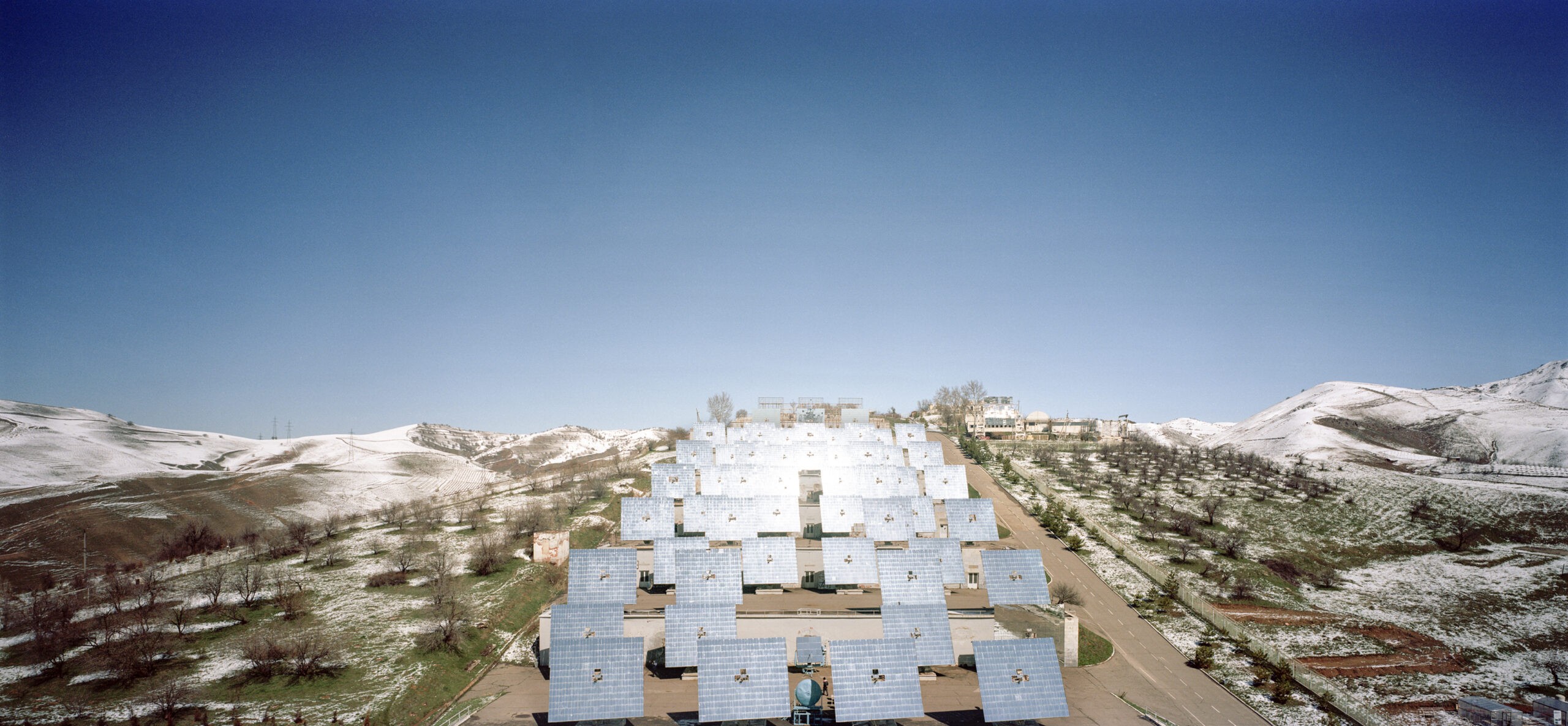
Heliocomplex Sun, field of heliostats, Tashkent, Uzbekistan; image: Armin Linke

TCA: The Uzbekistan Pavilion for the 2025 Venice Biennale builds on your previous research, Tashkent Modernism XX/XXI. Can you tell us how this project began?

This is a project commissioned and initiated by Gayane Umerova of the Uzbekistan Art and Culture Development Foundation that works with cultural heritage, museums, and other culture-related initiatives in Uzbekistan but also promotes Uzbekistan’s culture abroad. They have curated large exhibitions in the Louvre, in the British Museum, showing historical artifacts from Uzbekistan, but also art of the 20th century, and Tashkent Modernism is part of their mission in regards to architecture.

The Tashkent Modernism XX/XXI project began in 2021, when it became clear that Tashkent had started to change so rapidly that special tools had to be put in place in order to protect the recent architectural heritage that, at the time, was mostly not listed and therefore at risk. Our project team consisted of multiple experts from Uzbekistan and abroad, including a historian, Boris Chukhovich, a team of preservation specialists from Politecnico di Milano led by Davide Del Curto, urbanists Laboratorio Permanente, and an artist [photographer], Armin Linke.

For this project, we started by selecting 40 buildings and then narrowed it down to 24, for which we created monographs and statements of significance that described the important values of the building as well as what parts should be absolutely kept and what parts could eventually be transformed and adapted. An important message of our project was that given the diversity of Tashkent’s architecture and the different states of its preservation, our approach was very nuanced and specific for each building, providing a repertoire of solutions that ranged from almost doing nothing to restoration or adaptation.

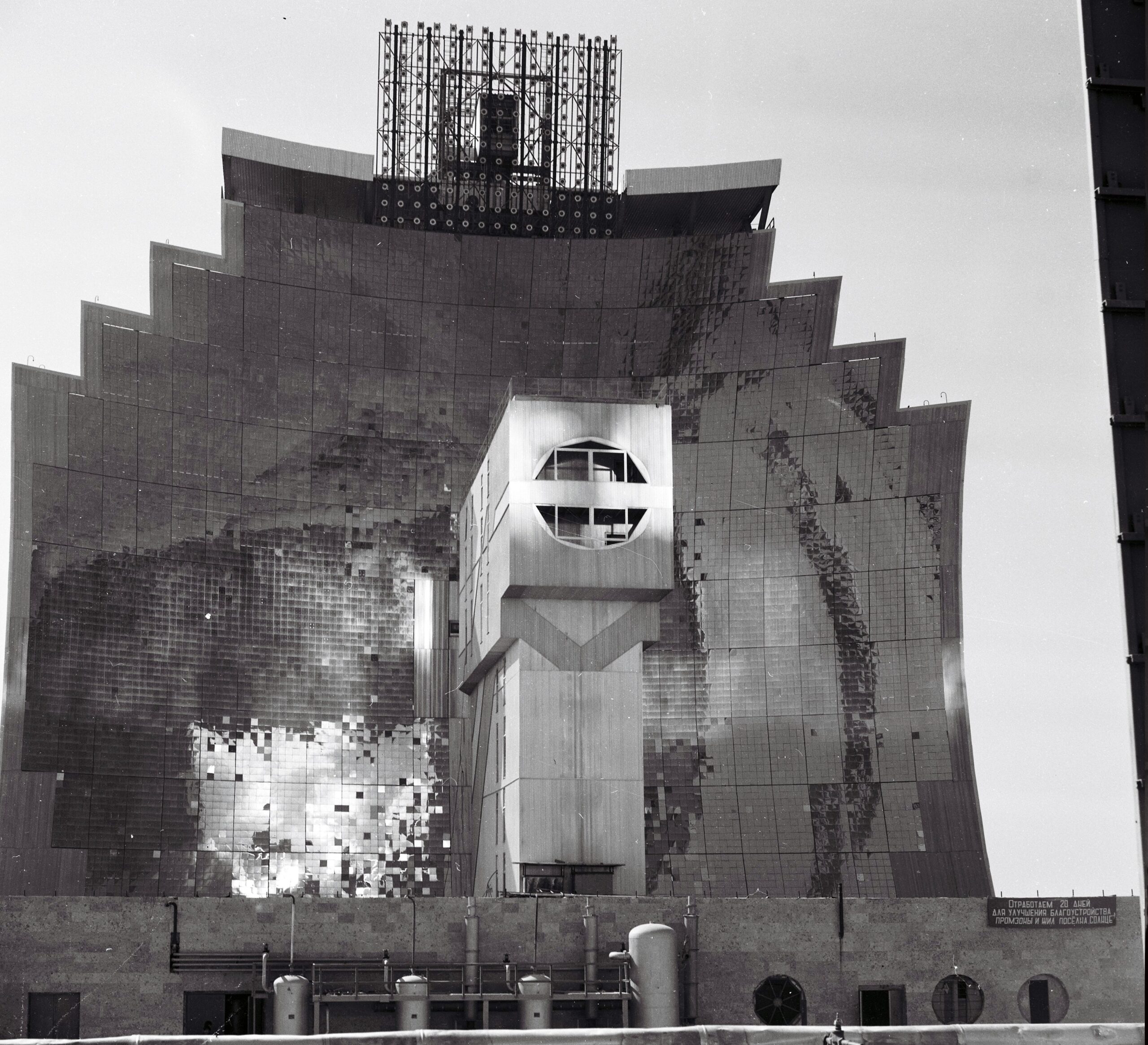
View towards the concentrator and solar furnace, 1986. From the private archive of the Azimov family

TCA: How did the focus on the Sun Institute of Material Science emerge as the central theme for the pavilion?

This complex emerged as the central theme because of all modernist buildings in our research, it was the one that responded to sustainability and the circularity manifesto proposed by Biennale’s curator Carlo Ratti. The Institute’s big solar furnace uses pure solar energy to heat materials to very high temperatures, nearly 3,000 degrees Celsius. We found this scientific infrastructure quite exceptional in terms of its technology, architectural scale, and quite peculiar functional ambiguity.

TCA: What was the original function of the solar furnace, and how did it change after 1991?

The project was born during the Cold War. France built the first prototype of such a furnace in the late sixties, and the Soviet one followed in 1987. The furnace was initially conceived as a tool to test materials at very high temperatures or to synthesize new materials.

After construction, the furnace was used mainly for the space and defense industries. When the Soviet Union fell apart, the complex lost many of its commissions. The furnace’s scale reflects the level of ambition of a large country such as the Soviet Union, and then it ended up being used in Uzbekistan, which is, of course, a much smaller country with different resources. It received basic funding for maintenance but could not function at full scale. The scientists tried to find applications in local industries and the agricultural sector, but the furnace was still, in a way, too big for any local tasks.

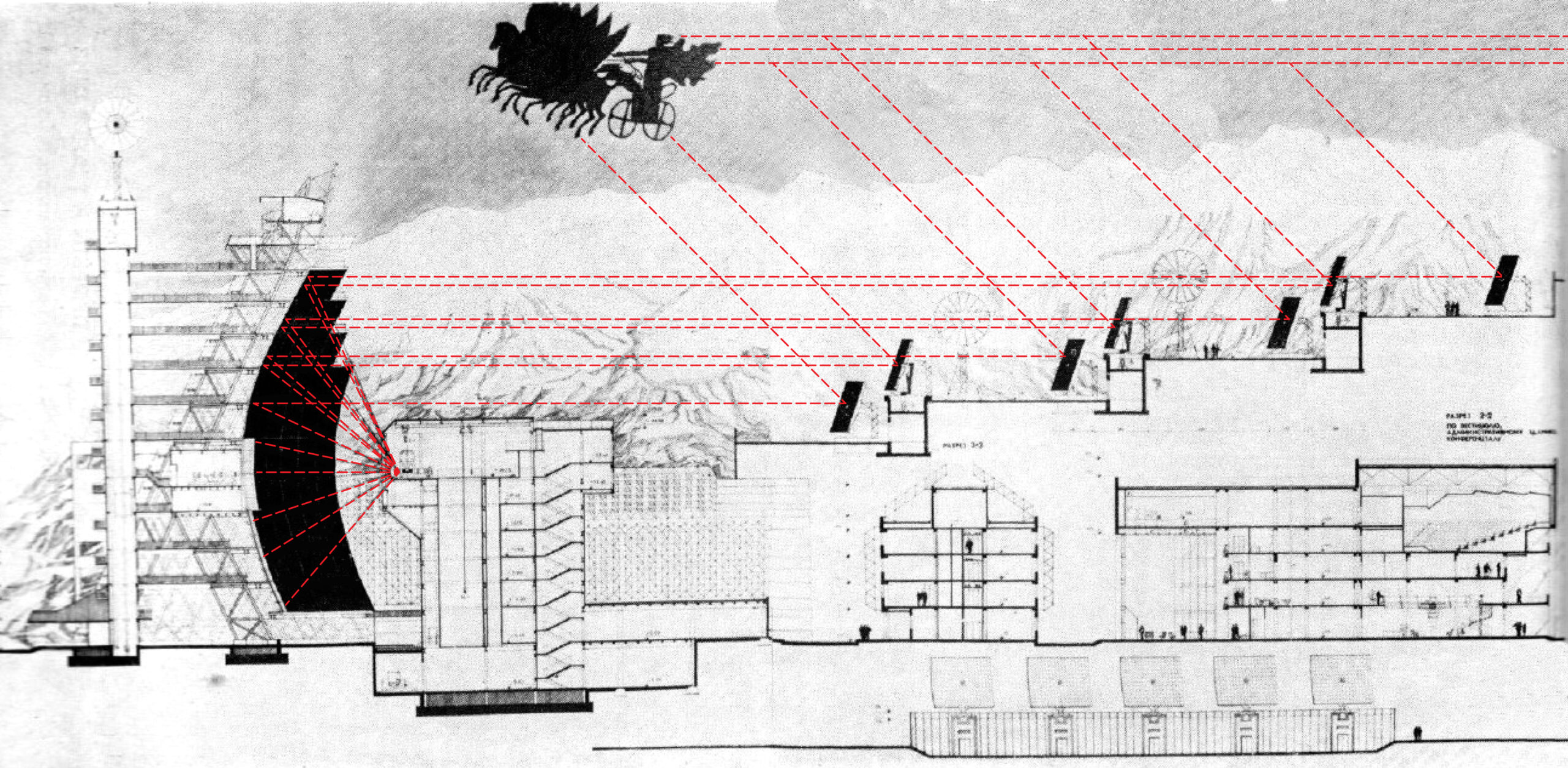
Section of the helisostatic field and the Process tower; Source: Architecture of USSR, n. 3-4, 1988

TCA: How does the pavilion address the history and paradoxes of this building?

The Pavilion’s narration departs from the point that the combination of massive scale that was part of its original idea and the historic events the entire region went through in the 1990s led to the fact that the scientists who ran this furnace had to continually reinvent new applications for it, because the original scope disappeared after just a few years.

So, the pavilion suggests that the large scale generates a kind of indeterminacy of use that is, in a way, a burden but also a guarantee of its possibility to adapt to shifting necessities of science or production. The pavilion narrates this ambiguity through fragments either reconstructed or brought from Parkent.

TCA: How does the pavilion fit into the overarching theme of the 2025 Venice Biennale, ‘Intelligens,’ curated by Carlo Ratti?

Among all the 24 modernist buildings we focused on during the Tashkent Modernism XX/XXI research project, we chose the big solar furnace precisely because it addresses the use of solar energy and is the best fit to help pose critical questions on sustainability. We don’t try to claim that the building is very sustainable, but we try to provide a more critical picture and a broader reading of what can be considered sustainable when you deal with a historic artefact.

All objects from the exhibition in Venice will travel to Uzbekistan in November 2025 and will continue to be used at the ‘Sun’ Institute.

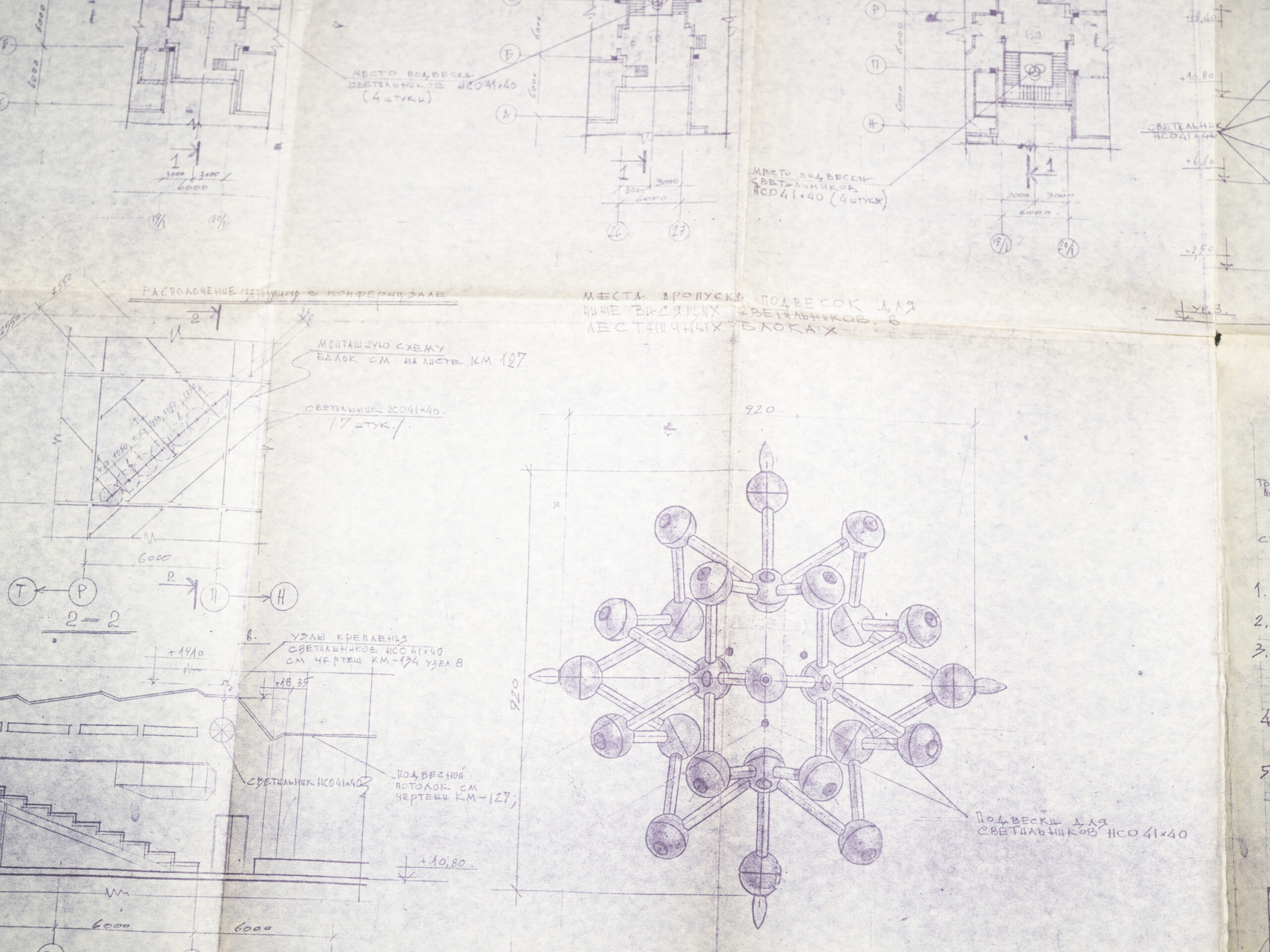
Heliocomplex Sun, lighting design, detail, Parkent, Uzbekistan; image: Armin Linke

TCA: You’re integrating artistic interpretations alongside scientific research; can you tell us more about this approach?

Already, the ‘Sun’ institute itself is an interesting hybrid of science, architecture, and art. The building has many beautiful works of monumental art that were part of the original project, so in the pavilion, we wanted to disclose the interdisciplinary nature of the complex by inviting different figures, from writers and artists to a theatre group from Tashkent, to engage with the furnace through their imaginations and different media.

TCA: What do you hope visitors will take away from the Uzbekistan pavilion?

Through this pavilion, we hope to inspire deeper discussions about how heritage and technology coexist in our changing world. Can you think of technology in terms of preservation? Is the latent role of this complex to formulate complex questions about science and technology? Is the large scale the reason for or an impediment to its survival?

Ekaterina Golovatyuk; image: Grace

The 19th International Venice Architecture Biennale will be open from Saturday, 10 May, to Sunday, 23 November.

Kyrgyzstan Begins Domestic Printing of National Currency Banknotes

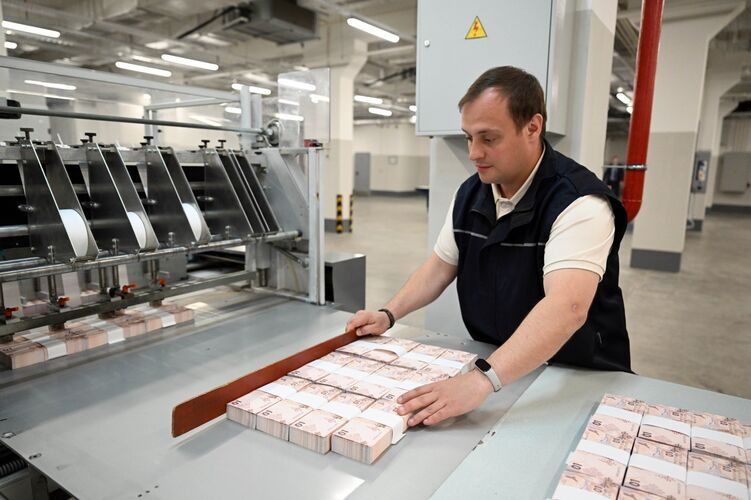
For the first time since gaining independence, Kyrgyzstan has begun printing its national currency, the som, within the country. Previously, Kyrgyz banknotes were produced in various European countries.

The new notes are produced by the Bishkek-based Open Joint Stock Company Uchkun.

Starting with Small Denominations

Chairman of the National Bank Melis Turgunbayev announced that production has begun with small-denomination bills. This approach will enable a quicker replacement of worn or damaged notes scheduled for withdrawal from circulation.

Turgunbayev stressed that the new banknotes adhere to the highest international standards for counterfeit protection.

A Modernized National Printing Facility

Uchkun has recently undergone a major modernization effort, acquiring state-of-the-art printing equipment. In addition to currency, the facility now produces passports, excise stamps, and educational materials.

According to Uchkun’s Director Bakytbek Sultanov, the enterprise has already begun printing passports and excise stamps. He stated that in his opinion the security features of Kyrgyz passports rank among the top ten globally for protection against counterfeiting.

In 2024 alone, Uchkun produced over 770,000 passports and nearly one million books, marking a significant step forward in Kyrgyzstan’s self-reliance in secure printing technologies.

Uzbek Minister: Afghans Have the Right to Amu Darya Water Too

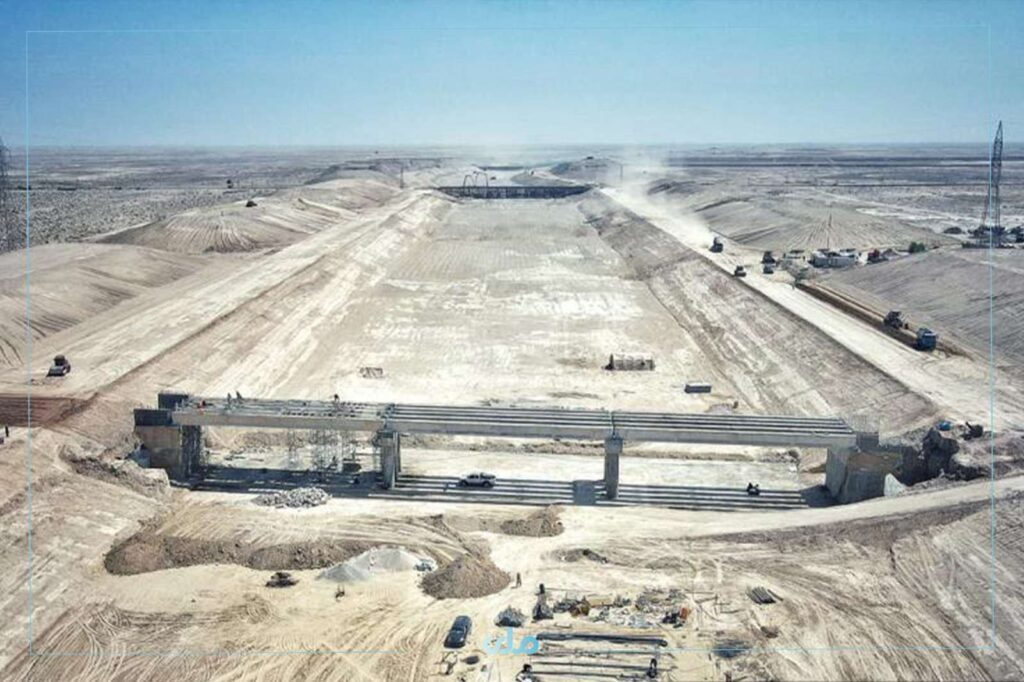
The construction of the Qosh Tepa Canal in northern Afghanistan has attracted growing attention from neighboring countries, particularly Uzbekistan. The ambitious project, initiated by the Taliban to divert water from the Amu Darya River, is expected to be completed by 2028. Uzbekistan’s Minister of Water Resources, Shavkat Khamraev, addressed the issue during a public meeting on March 18, according to Gazeta.uz.

When asked about the canal’s potential impact on Uzbekistan, Khamraev emphasized that Afghanistan has a legitimate right to access the Amu Darya’s waters. He dismissed speculation that the project represents a hostile act, urging a focus on diplomacy and cooperation.

“Afghans are our relatives. They also have the right to take water from the Amu Darya. Should we take up arms and fight? No, we are building better relations,” said Khamraev.

He urged the public not to be swayed by rumors or misinformation, comparing such speculation to gossip that turns neighbors against each other. Khamraev also noted that he had visited Afghanistan multiple times recently and was warmly received, which he sees as a sign of improving bilateral relations.

Rising Concerns About Regional Water Security

Despite the minister’s reassurances, experts warn that the canal could exacerbate water shortages across Central Asia. Over 80% of the region’s water resources are used for agriculture, but nearly 40% is lost due to outdated and inefficient infrastructure. If water availability from the Amu Darya decreases, greater pressure may be placed on the Syr Darya River, potentially deepening existing water disputes.

Strategic and Geopolitical Implications

The canal project has also drawn attention from international observers. A report by the Center for the National Interest, a Washington, D.C.-based think tank, suggests that the United States could leverage the project to expand its influence in the region.

Stretching 287 kilometers with a depth of 8.5 meters and a width of 100 meters, the Qosh Tepa Canal aims to irrigate over 1.2 million acres of farmland and create approximately 200,000 jobs in Afghanistan’s northern provinces.

As construction progresses, the canal’s environmental, political, and economic impacts are likely to remain a key topic in regional diplomacy.

Chinese Investor to Launch $400 Million Cotton Cluster in Southern Kazakhstan

Chinese company Xinjiang Lihua (Group) Co., Ltd. plans to invest nearly $400 million to establish a cotton-textile cluster in Kazakhstan’s Turkestan region. The announcement was made by Zhang Qihai, Chairman of the Board of Directors of Xinjiang Lihua, during a meeting with Kazakhstan’s Prime Minister Olzhas Bektenov.

The large-scale investment project will be implemented within the TURAN Special Economic Zone, located in southern Kazakhstan. It envisions a vertically integrated cotton agro-industrial complex, from cultivation to the production of finished textile goods, including yarn, fabric, and clothing.

More than 50,000 hectares of land have been allocated for cotton cultivation. The project also includes the construction of ten factories. Two of these will manufacture drip irrigation systems using modern water-saving technologies. Four others will handle the primary processing of cotton near the fields. The remaining four facilities, including garment, dyeing, and finishing factories, will produce the final textile products.

The total investment exceeds 200 billion tenge (approximately $398 million), and the cluster is expected to create 3,000 permanent jobs in the region.

To support the project’s needs, a plant for producing polyvinyl chloride (PVC) pipes has already been launched, and construction of the textile factories is underway. Xinjiang Lihua is also developing an irrigation system, including a canal network fed by a dedicated pumping station.

Chairman Zhang Qihai praised Kazakhstan’s favorable investment climate and the region’s suitable agricultural conditions. He noted that the first finished products from the cluster are scheduled for release by October this year.

“The creation of a cotton-textile cluster in Turkestan Region contributes to increasing the added value of domestic products, promoting agricultural development through processing, and enhancing the country’s export potential,” said Prime Minister Olzhas Bektenov. “The government will provide all necessary support for this initiative.”

As previously reported by The Times of Central Asia, China also plans to support the establishment of a Scientific and Technical Innovation Center for Hydrogen Energy in Kazakhstan.

Uzbekistan Looks to Nuclear Power for Energy Security

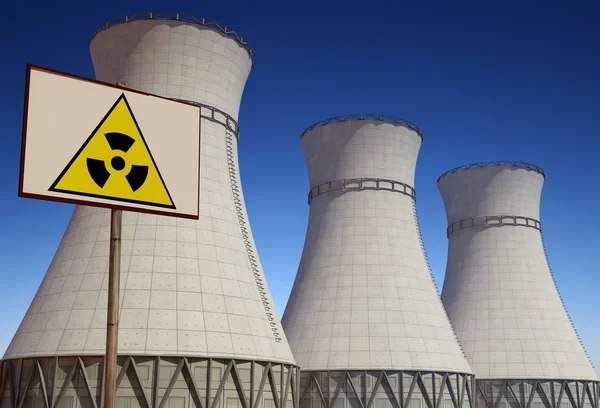
Uzbekistan is moving forward with plans to build its first nuclear power plant, a project that officials say is critical to the country’s long-term energy security. In an interview with the Alter Ego YouTube project, Azim Akhmadkhodjaev, head of Uzbekistan’s Atomic Energy Agency, argued that nuclear power is the only viable alternative to continued reliance on imported fossil fuels.

“Let’s continue to import high-calorie coal, burn it, and poison our environment. Let’s import tens of billions of cubic meters of gas and spend money on it. Or we can build a few nuclear power plants, reduce the cost of electricity, and become energy independent. Will we achieve energy independence? Undoubtedly, yes,” Akhmadkhodjaev said.

A Strategic Partnership with Global Players

The nuclear power project is being developed with Russian technical support, but Akhmadkhodjaev emphasized that this does not compromise Uzbekistan’s sovereignty. The plant will be fully owned and operated by Uzbekistan, with local specialists overseeing daily operations.

“The nuclear island will be Russian because this technology is the most reliable and proven. However, the automated control system will be based on European technology, and the turbine equipment will be made in Europe or China,” he explained.

In addition to Russian expertise, Uzbekistan is engaging with several French companies. Negotiations are ongoing with Assystem for technical support, Bureau Veritas for training specialists, and Framatome for managing key technical aspects of the project.

Balancing Energy Sources

While pursuing nuclear energy, Uzbekistan is also working to boost the share of renewables in its energy mix, from 16% today to 54% by 2030. Energy analysts say that a diversified portfolio, combining nuclear and renewable sources, will help the country meet its energy needs while minimizing environmental harm.