• KGS/USD = 0.01144 0%
  • KZT/USD = 0.00212 0%
  • TJS/USD = 0.10432 0%
  • UZS/USD = 0.00008 0%
  • TMT/USD = 0.28490 0%
  • KGS/USD = 0.01144 0%
  • KZT/USD = 0.00212 0%
  • TJS/USD = 0.10432 0%
  • UZS/USD = 0.00008 0%
  • TMT/USD = 0.28490 0%
  • KGS/USD = 0.01144 0%
  • KZT/USD = 0.00212 0%
  • TJS/USD = 0.10432 0%
  • UZS/USD = 0.00008 0%
  • TMT/USD = 0.28490 0%
  • KGS/USD = 0.01144 0%
  • KZT/USD = 0.00212 0%
  • TJS/USD = 0.10432 0%
  • UZS/USD = 0.00008 0%
  • TMT/USD = 0.28490 0%
  • KGS/USD = 0.01144 0%
  • KZT/USD = 0.00212 0%
  • TJS/USD = 0.10432 0%
  • UZS/USD = 0.00008 0%
  • TMT/USD = 0.28490 0%
  • KGS/USD = 0.01144 0%
  • KZT/USD = 0.00212 0%
  • TJS/USD = 0.10432 0%
  • UZS/USD = 0.00008 0%
  • TMT/USD = 0.28490 0%
  • KGS/USD = 0.01144 0%
  • KZT/USD = 0.00212 0%
  • TJS/USD = 0.10432 0%
  • UZS/USD = 0.00008 0%
  • TMT/USD = 0.28490 0%
  • KGS/USD = 0.01144 0%
  • KZT/USD = 0.00212 0%
  • TJS/USD = 0.10432 0%
  • UZS/USD = 0.00008 0%
  • TMT/USD = 0.28490 0%

On International Women’s Day, Shakhnoza Mirziyoyeva Names Uzbekistan’s Female Athletes an “Inspiration”

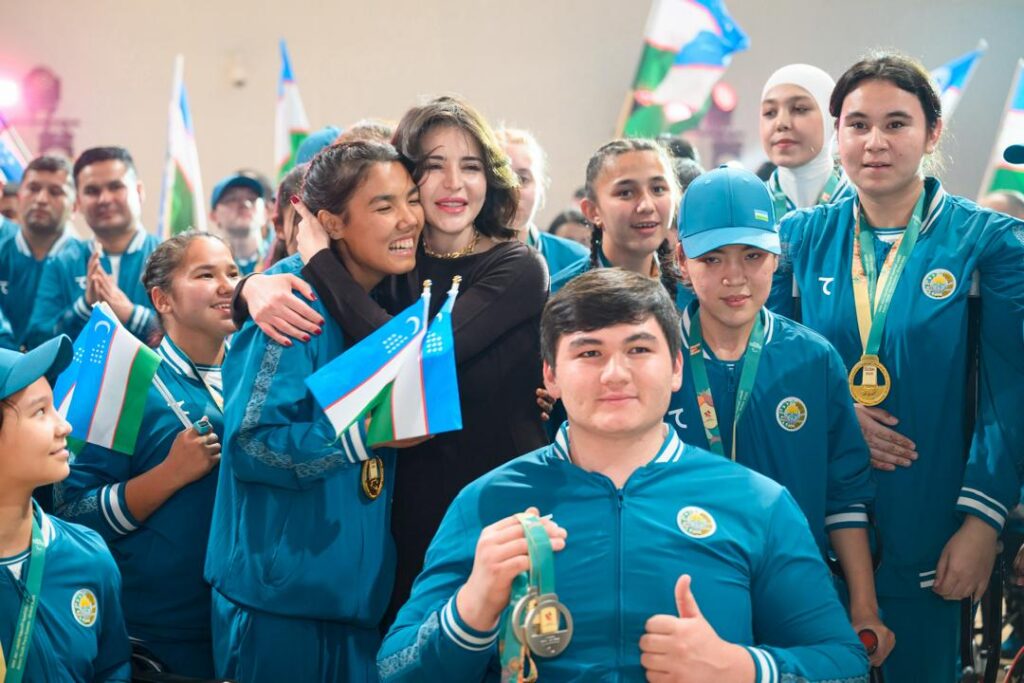
For International Women’s Day on 8 March, Shakhnoza Mirziyoyeva, First Deputy Director of Uzbekistan’s National Agency for Social Protection, has shared comments with The Times of Central Asia in which she gives particular praise to the country’s sportswomen.

Mirziyoyeva said: “As we celebrate International Women’s Day, I would like to praise Uzbekistan’s female athletes for inspiring more girls and women and giving them the confidence to pursue their dreams.”

Fitness and active pursuits are increasingly at the forefront of government policy, as the country’s Soglom inson – soglom millat (“Healthy Person, Healthy Nation”) initiative – introduced by Mirziyoyeva’s father, President Shavkat Mirziyoyev – gains momentum.

Mirziyoyeva added that sport enables women and girls to become leaders, namechecking Olympic gold medalist judoka Diyora Keldiyorova and taekwondo athlete Svetlana Osipova among those who promote active lifestyles.

Mirziyoyeva was involved in establishing the Association of Adaptive Sports in Uzbekistan – a platform to unify and develop Uzbek parasports, and create opportunities for athletes with disabilities. She is First Deputy Chairperson of Uzbekistan’s Paralympic Committee, whose athletes are currently competing at the 2026 Paralympic Winter Games Milano Cortina.

“To the female athletes currently competing in Milano Cortina, your perseverance is an inspiration to us all,” her message to The Times of Central Asia continues, mentioning long-jumper Asila Mirzayorova and taekwondo athlete Guljonoy Naimova as Uzbek competitors carrying the country’s hopes at the Paralympics.

“May your performances in Italy continue to build a legacy of inclusion and excellence that inspires generations to come – not only in Uzbekistan, but around the world.”

Shakhnoza Mirziyoyeva’s message comes at the start of a standout year for Uzbek sports. The country’s football team will make its first appearance at a FIFA World Cup at the tournament in North America this summer. Samarkand will host the World Triathlon Championship Series on 25-26 April, then the 46th Chess Olympiad in September. The World Aquatics Swimming World Cup comes to Tashkent in October.

Kazakhstan Says Iranian President’s Statement is Step to Easing Mideast Tensions

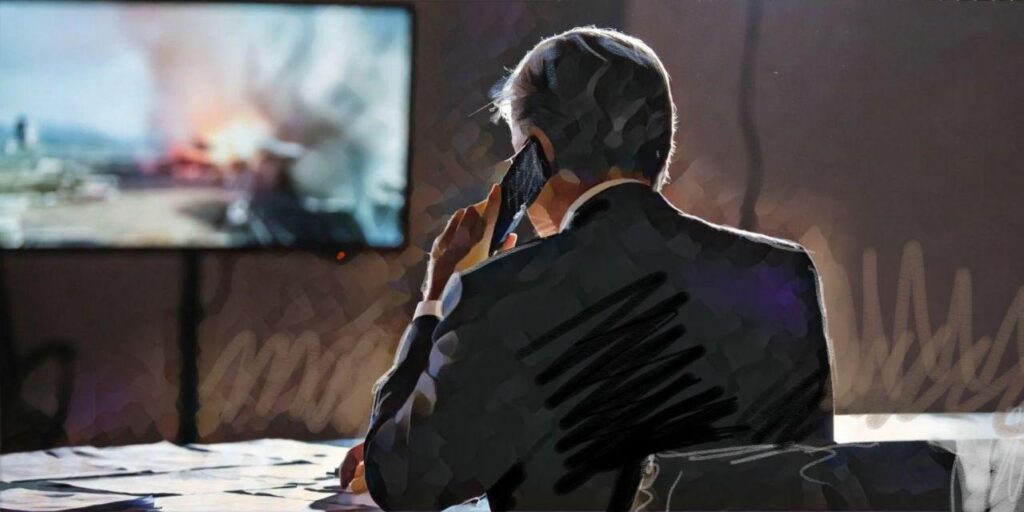
Kazakhstan has welcomed a statement by Iranian President Masoud Pezeshkian about ending Iranian missile and drone attacks on neighboring countries, though some Gulf Arab states reported continuing attacks on Saturday.

President Kassym-Jomart Tokayev of Kazakhstan noted the statement by Pezeshkian, “who conveyed the decision of the Interim Governing Council to renounce attacks on neighboring countries,” said Aibek Smadiyarov, spokesman for Kazakhstan’s presidency.

Tokayev “considers this an important step aimed at easing tensions in the Middle East,” Smadiyarov said.

In a video message, Pezeshkian apologized “on my own behalf” for Iranian attacks on neighboring countries, including Azerbaijan, where two drones struck near an airport and a school. The Iranian president said Iran should not attack those countries unless they attack Iran.

Iran has been governed by an interim council since Supreme Leader Ali Hosseini Khamenei was killed in an air strike at the start of the war a week ago. U.S. and Israeli forces have kept up intense bombardments since then and President Donald Trump is demanding that the Iranian government unconditionally surrender. Pezeshkian rejected Trump’s demand in his message on Saturday.

Azerbaijan Orders its Diplomats to Leave Iran after Drone Attacks

Azerbaijan said on Friday that it is evacuating staff from its embassy in Tehran as well as its consulate in the Iranian city of Tabriz, one day after accusing Iran of drone attacks on its territory.

Azerbaijani Foreign Minister Jeyhun Bayramov said an order has been issued to evacuate the diplomatic missions in Iran because of safety concerns, the state news agency Azertac reported. Bayramov spoke at a briefing in Baku with Moldovan counterpart Mihai Popşoi.

Azerbaijan has also submitted a report to the International Civil Aviation Organization, a United Nations body, about the attack on the airport in the exclave of Nakhchivan, according to another outlet, the Azerbaijani Press Agency, or APA.

Another Iranian drone landed near a school in Nakhchivan. Several civilians were injured in the attacks. Iran has told Azerbaijan that it is investigating.

While the Azerbaijani military is on high alert, the government said social media reports that it had deployed heavy weapons along the border with Iran were false. Also, some cargo trucks are now crossing the border between Azerbaijan and Iran after a suspension because of the drone attacks.

Azerbaijan has thanked dozens of countries, including some in Central Asia, for expressions of support following the attacks.

The USSR Is Gone, the Story Isn’t: Joe Luc Barnes On the Road Across the Former Soviet Union

On a foggy but mild London evening, The Times of Central Asia joined journalist and contributor Joe Luc Barnes to celebrate the launch of his new book,  Farewell to Russia: A Journey Through the Former USSR. As the wine flowed, the conversation ranged from Silk Road cities to Soviet ghosts. It was exactly the sort of evening you might expect from a book that explores one of the world’s most complex regions with both political sharpness and a healthy sense of humor.

Barnes’ book begins with a deceptively simple question: What actually happened to the fifteen countries that emerged following the Soviet Union’s collapse in 1991? The clichés are familiar: snow, concrete, and the KGB. Nevertheless, Barnes’ depiction reveals that the real story is stranger, funnier, and far more human. In the years since Russia’s invasion of Ukraine, he has crossed the former Soviet states from Estonia’s tech hubs to Uzbekistan’s minarets and Azerbaijan’s flame towers, gathering stories from taxi drivers, activists, nomads, and anyone willing to converse over a drink.

The result is part travelogue and part political detective story, with a strong dose of dark comedy about life after empire. Barnes moves easily between epic scenery and the absurdities of everyday life. Georgian wine and Armenian brandy make an appearance alongside Silk Road bazaars, smoky bars, and long railway excursions. At times there is also the lingering suspicion that someone, somewhere, is still listening. It is a portrait of a region that the West often reduces to geopolitics but which, as Barnes shows, is full of resilience, generosity, and a distinctly post-Soviet sense of humor.

Image: TCA

Barnes is well placed to tell the story, as a journalist who has spent more than a decade working across China and the former Soviet space. Since the full-scale invasion of Ukraine in 2022, he has visited all fifteen former Soviet republics, a journey that has taken him from former gulag sites in Kazakhstan to Tajikistan’s notorious Anzob Tunnel and through the shifting political landscape of the region.

The book was released on March 5, a date heavy with Cold War symbolism. It marks the anniversary of Joseph Stalin’s death in 1953 and Winston Churchill’s Iron Curtain speech in 1946. With 2026 also marking thirty-five years since the collapse of the Soviet Union, Barnes’ journey arrives at a moment when questions about territory, independence, and Russia’s continuing influence feel newly urgent.

Farewell to Russia: A Journey Through the Former USSR by Joe Luc Barnes is available now in hardback, audiobook, and ebook.

Shell Signs New Exploration Deal in Kazakhstan Amid Legal Disputes

British energy company Shell has launched a new exploration project in Kazakhstan despite previously announcing that it would pause new investments in the country. On March 5, it was announced that Shell had signed a contract for geological exploration in the Aktobe region. The company has been involved in several legal disputes with Kazakhstan over subsoil use and had stated that it did not plan to invest further in the country’s energy sector.

Geological Exploration Contract

The Zhanaturmys site, which has attracted Shell’s interest, covers an area of 1,377 square kilometers and is located in one of Kazakhstan’s most actively developed oil and gas basins.

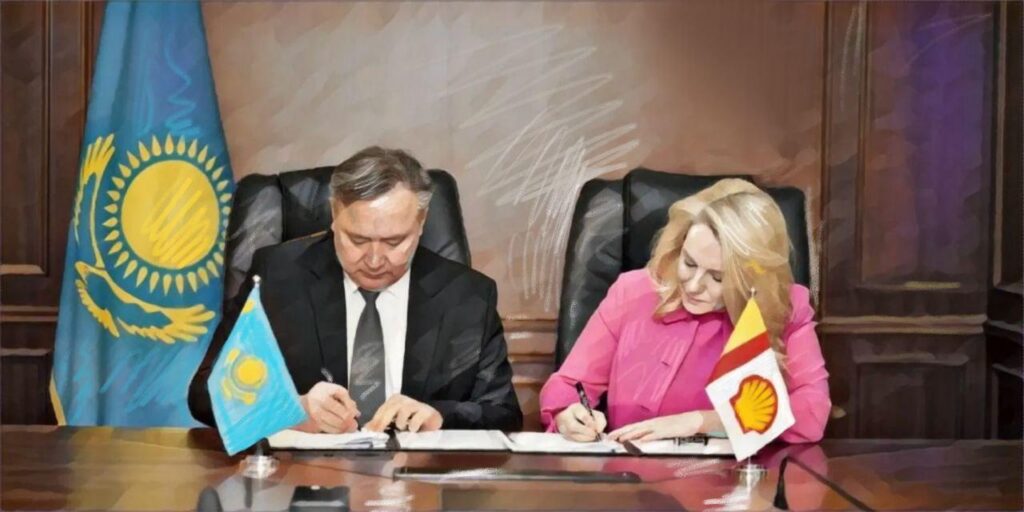
The document was signed by Kazakhstan’s Deputy Energy Minister, Yerlan Akbarov, and Shell’s Senior Vice President and Chair in Kazakhstan, Suzanne Coogan. The contract provides for seismic exploration, data collection, and technical assessments.

“The signing of today’s contract for geological exploration is further confirmation of Shell’s commitment to long-term cooperation with the Republic of Kazakhstan. Drawing on our global experience and advanced technologies, we intend to continue contributing to geological exploration and the expansion of the country’s resource base,” Coogan said.

The agreement will remain in force until 2032. The project will be implemented under the terms of an improved model contract. According to Kazakhstan’s Energy Ministry, the company will allocate at least 100 million tenge (about $200,000) to finance socio-economic development in the region where the site is located.

Shell is currently involved in three projects in Kazakhstan: the North Caspian Production Sharing Agreement (NCOC, 16.81% stake); the Karachaganak Production Sharing Agreement (29.25% stake); and the Caspian Pipeline Consortium (7.4% stake).

Kazakhstan produces around 1.8–1.9 million barrels per day and hosts some of the world’s largest offshore reserves in the Caspian Sea. Western energy majors, including Shell, Chevron, ExxonMobil, and Eni, have operated in the country for decades through complex production-sharing agreements.

Legal Disputes

In February, Shell CEO Wael Sawan said the company would suspend new investments in Kazakhstan while legal proceedings with the government were ongoing. Numerous lawsuits filed by Kazakhstan, with claims amounting to billions of dollars, have reduced the company’s willingness to invest in the country, he said.

“This affects our desire to continue investing in Kazakhstan. Although we see many opportunities for investment in the future, we will wait until we have a clearer picture of how things will turn out,” Sawan stated.

Karachaganak and Kashagan

Kazakhstan is currently involved in several legal disputes with Western oil companies, both in national courts and international arbitration. The cases concern two major oil and gas projects.

One of them is Karachaganak. In 2023, the Kazakh government filed a lawsuit against the field’s developers over cost deductions. The initial claim amounted to $3.5 billion but later increased to $6 billion after additional claims were filed.

The project is operated by a consortium led by Eni and Shell, each holding a 29.25% stake. Other partners include Chevron (18%), Lukoil (13.5%, which has agreed to sell its stake), and KazMunayGas (10%).

In January, it was reported that Shell and its partners, Eni, Chevron, and Lukoil, had lost a dispute over cost deductions. Payments to Kazakhstan could reach $4 billion, although the consortium still has the right to appeal the decision.

Previously, investors had proposed settling the dispute by building a gas processing plant to meet Kazakhstan’s domestic needs.

Another dispute concerns the Kashagan project. The Kazakh government has challenged the terms of the long-term agreement for the Kashagan field and filed arbitration claims related to the Kashagan project that together could amount to about $160 billion.

Kazakh officials have argued that under the current terms, oil companies involved in the project, including Shell, ExxonMobil, Eni, TotalEnergies, CNPC, Inpex, and KazMunayGas, receive up to 98% of the revenue from oil production at Kashagan, leaving the country with only symbolic royalties.

There is also an ongoing dispute over sulfur storage at the Kashagan field, which authorities say constitutes an environmental violation. According to some reports, Kazakhstan’s total claims related to this project may reach $13.5 billion.

Nevertheless, Shell’s management appears to be continuing to seek new projects in Central Asia. The region’s importance for Europe has increased significantly following the war in Ukraine and the reduction of energy supplies from Russia.

Kyrgyzstan Signs Deal to Acquire Two Airbus A321 Aircraft

Kyrgyzstan has signed an agreement to acquire two Airbus A321ceo aircraft as part of efforts to expand the country’s civil aviation sector and launch new international routes.

The signing ceremony took place on March 5 in Bishkek, where the agreement was signed by Manasbek Samidinov, chairman of the board of Airports of Kyrgyzstan OJSC, and Maurice Prendergast, senior vice president of BBAM Aircraft Leasing & Management.

The event was attended by Johan Pelissier, president of Airbus Europe, and Kyrgyz Prime Minister Adylbek Kasymaliev.

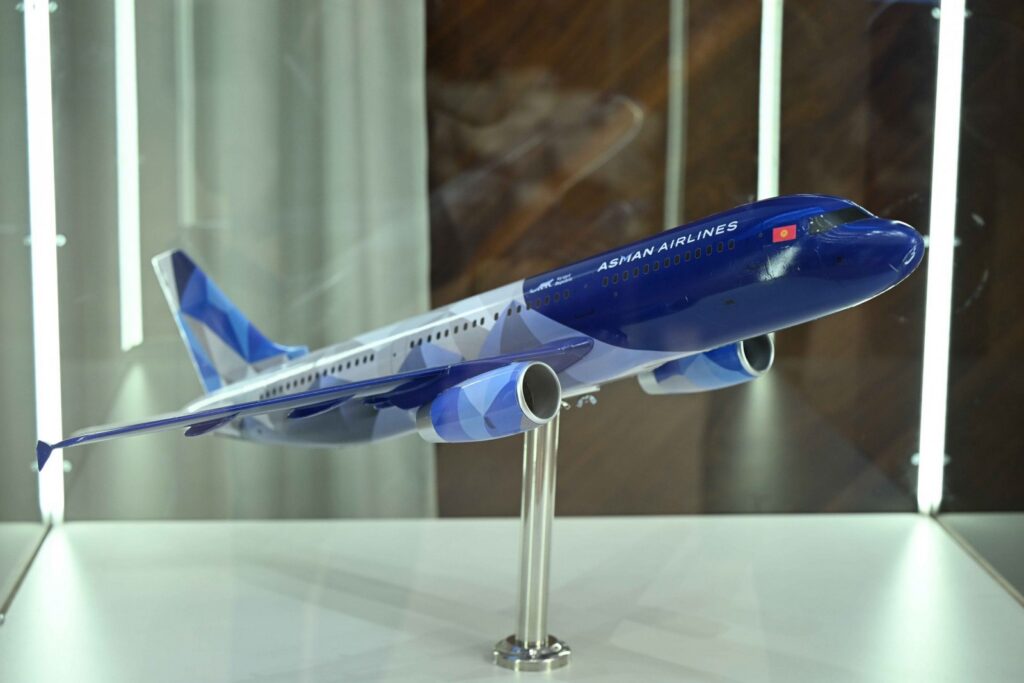
According to the agreement, the aircraft will be delivered to Kyrgyzstan by the end of 2026. They are intended for the state-owned carrier Asman Airlines, a subsidiary of Airports of Kyrgyzstan. The new aircraft are expected to support the launch of international flights and improve operational capacity.

Asman Airlines currently operates three Dash 8 Q400 aircraft, Canadian-made short-haul turboprop planes capable of carrying up to 80 passengers over distances of up to 2,000 kilometers. These aircraft serve domestic routes across Kyrgyzstan after the airline recently restored air connections between Bishkek and several remote regional centers.

Speaking at the ceremony, Kasymaliev said that the acquisition of modern and efficient aircraft would help raise Kyrgyzstan’s civil aviation sector to a new level of development.

He added that between 2021 and 2025 the number of passengers served at Kyrgyzstan’s airports on domestic and international routes increased by 52%, while the number of flights rose by 53%.

Kasymaliev also noted that audits conducted by the International Civil Aviation Organization (ICAO) in 2023-2024 confirmed that Kyrgyzstan’s aviation system complies with international standards. According to the latest audit, the aviation security compliance rate reached 85.76%, a significant improvement compared with previous results.

“These achievements create the necessary conditions for Kyrgyzstan to be removed from the European Union’s aviation safety blacklist,” the prime minister said, adding that the final audit by the European Commission is expected in the coming days.

Later the same day, President Sadyr Japarov met with Johan Pelissier and Maurice Prendergast to discuss the development of Kyrgyzstan’s aviation sector.

During the meeting, Japarov highlighted the rapid modernization of airport infrastructure and the expansion of domestic air routes. While previously only four airports in the country were fully operational, all 11 airports in Kyrgyzstan are now functioning. Construction of a new international airport in Jalal-Abad is also underway.

The president also confirmed that Kyrgyzstan is in the final stage of the process to be removed from the European Union’s aviation safety blacklist, with the final inspection expected later this month.