• KGS/USD = 0.01144 0%
  • KZT/USD = 0.00194 0%
  • TJS/USD = 0.10879 0%
  • UZS/USD = 0.00008 0%
  • TMT/USD = 0.28571 0%
  • KGS/USD = 0.01144 0%
  • KZT/USD = 0.00194 0%
  • TJS/USD = 0.10879 0%
  • UZS/USD = 0.00008 0%
  • TMT/USD = 0.28571 0%
  • KGS/USD = 0.01144 0%
  • KZT/USD = 0.00194 0%
  • TJS/USD = 0.10879 0%
  • UZS/USD = 0.00008 0%
  • TMT/USD = 0.28571 0%
  • KGS/USD = 0.01144 0%
  • KZT/USD = 0.00194 0%
  • TJS/USD = 0.10879 0%
  • UZS/USD = 0.00008 0%
  • TMT/USD = 0.28571 0%
  • KGS/USD = 0.01144 0%
  • KZT/USD = 0.00194 0%
  • TJS/USD = 0.10879 0%
  • UZS/USD = 0.00008 0%
  • TMT/USD = 0.28571 0%
  • KGS/USD = 0.01144 0%
  • KZT/USD = 0.00194 0%
  • TJS/USD = 0.10879 0%
  • UZS/USD = 0.00008 0%
  • TMT/USD = 0.28571 0%
  • KGS/USD = 0.01144 0%
  • KZT/USD = 0.00194 0%
  • TJS/USD = 0.10879 0%
  • UZS/USD = 0.00008 0%
  • TMT/USD = 0.28571 0%
  • KGS/USD = 0.01144 0%
  • KZT/USD = 0.00194 0%
  • TJS/USD = 0.10879 0%
  • UZS/USD = 0.00008 0%
  • TMT/USD = 0.28571 0%
16 December 2025

Kazakhstan Tops Central Asia in Global E-Governance Rankings

Kazakhstan has risen to 24th place out of 193 countries in the 2024 UN E-Government Development Index, up from 28th in 2022. This achievement reaffirms Kazakhstan’s position as the regional leader in e-governance, surpassing its Central Asian neighbors. Globally, Denmark, Estonia, and Singapore secured the top three spots.

Legislative Advances in Digital Transformation

To further bolster its digital transformation, President Kassym-Jomart Tokayev signed a landmark law on July 5, focusing on digitizing statistics and improving data management systems. This legislation is set to reduce statistical reporting requirements by 40-50% through amendments to various laws concerning state control, statistics, and data management.

Regional Comparisons

Other Central Asian countries also demonstrated progress in e-governance, albeit at different rates:
• Uzbekistan rose to 63rd place from 69th, exceeding the 2025 targets outlined in its “Digital Uzbekistan 2030” strategy, according to Minister of Digital Technologies Sherzod Shermatov.
• Kyrgyzstan improved to 78th place from 81st.
• Tajikistan made significant strides, climbing from 141st to 123rd place.
• Turkmenistan, however, experienced a decline, dropping to 145th place from 137th in 2022.

Kazakh Rituals Included in UNESCO’s Intangible Cultural Heritage List

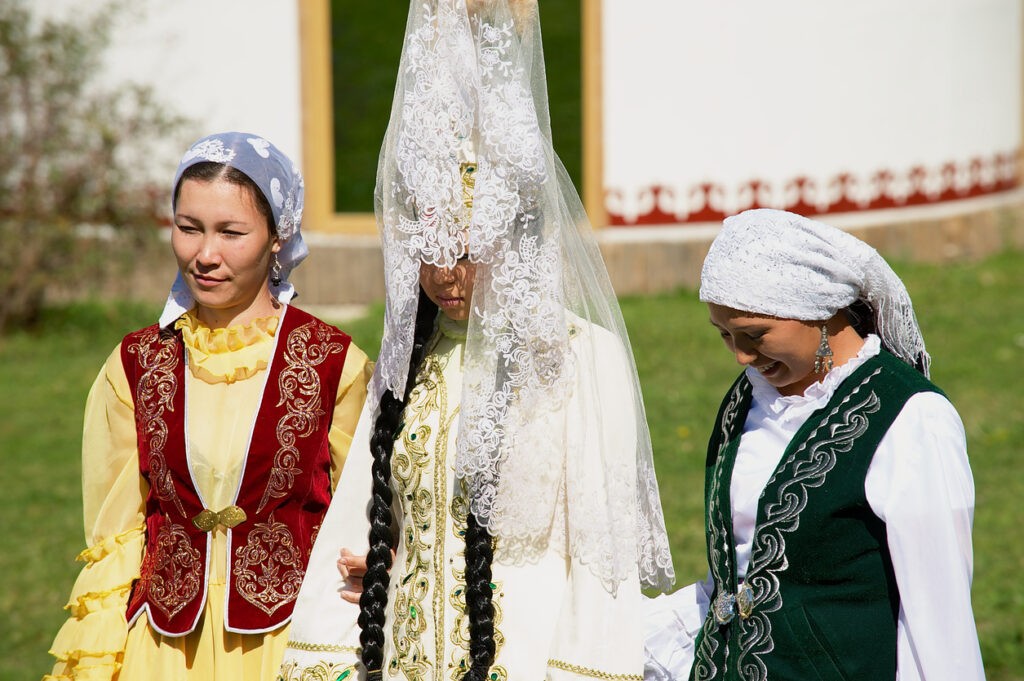
The Kazakh wedding ritual of Betashar has been officially recognized by UNESCO as part of the Representative List of the Intangible Cultural Heritage of Humanity. This inclusion highlights the enduring beauty and cultural significance of Kazakhstan’s ancient traditions. In this article, we explore the Betashar ritual, other celebrated customs, and the challenges posed by certain archaic practices in modern times.

Betashar: Revealing the Bride’s Face

During the UNESCO Committee for the Safeguarding of the Intangible Cultural Heritage meeting in Asunción, Paraguay, Betashar was officially added to the list of intangible cultural heritage. State Counselor Yerlan Karin announced the decision, which underscores Kazakhstan’s commitment to preserving its rich cultural legacy.

Kazakhstan ratified UNESCO’s Convention for the Safeguarding of the Intangible Cultural Heritage in 2011, pledging to protect and promote cultural traditions. Today, 13 Kazakh practices are on UNESCO’s list, including kiiz үi (yurt), kүi (instrumental music), aitys (improvised poetry duels), Nauryz (spring festival), kүres (wrestling), and togyzkymalak (a traditional board game).

Betashar—literally “revealing the face”—is a wedding rite introducing the bride to her husband’s family. Historically, the bride spent three days secluded with the women of her community before being ceremonially presented to her new family. Her face, hidden under a large cloth, was uncovered in front of the gathered relatives while a zhirshy (singer-improviser) performed the betashar zhyry, a song introducing the family members. In return, they pledged gifts to the couple. The ritual concluded with the bride serving tea to her in-laws. While modern weddings often simplify Betashar, its symbolic meaning remains deeply cherished.

Preserving Other Traditions

Another ritual presented to UNESCO is Salburyn, an ancient hunting custom. Hunters once gathered on horseback for multi-day expeditions, accompanied by falcons and hounds. These hunts began with feasts and competitions, emphasizing camaraderie and skill. Today, while hunting is less necessary, Salburyn is celebrated as part of cultural events, such as during the Nauryz festivities in Kyzylorda region.

The custom of Tusau Kesu—cutting a child’s “fetters”—is a joyous milestone in Kazakh culture. When a child begins to walk, their legs are symbolically tied with a colorful string, which is then cut by a respected relative. The ceremony includes laying out a symbolic “white path” (ak zhol), representing a prosperous future. Items such as money, a whip, a dombra, or a book are placed along the path to hint at the child’s potential destiny.

Addressing Harmful Practices

Not all traditions are compatible with contemporary values or legal norms. Bride kidnapping, an archaic practice still occurring in some regions, has drawn criticism and calls for stricter legal measures.

Mazhilis deputy Murat Abenov recently urged tougher penalties for bride abduction, highlighting gaps in the Criminal Code that leave many cases unresolved. “Many victims are coerced into claiming they went voluntarily,” Abenov explained, citing examples where cultural products like songs and videos romanticize the practice. Despite its criminalization after the October Revolution, the issue persists.

In 2023, there were 13 officially recorded cases of bride abduction, though Abenov believes the real figure is higher due to underreporting. He called for a dedicated Criminal Code article addressing the issue, a proposal supported by Mazhilis Speaker Yerlan Koshanov.

Following Corruption Arrests in Kyrgyzstan, MP Calls for PM Japarov to Resign

At a recent parliamentary session, Kyrgyz MP Elvira Surabaldiyeva called for the resignation of Prime Minister Akylbek Japarov following the arrest of senior officials from the State Tax Service (STS). The arrests stemmed from allegations of a corruption scheme involving electronic invoices that reportedly cost the state 3.2 billion KGS (approximately U$37 million).

Accusations Against the Government

Surabaldiyeva directly accused Japarov and his government of corruption. Addressing the Minister of Economy and Commerce present at the session, she questioned the administration’s inability to curb bribery.

“You collect money from the people, but you cannot eliminate bribery in your country. Why are you surprised that people don’t trust you?” she said. “The Deputy Chairman of the Cabinet of Ministers has acknowledged that the corruption scheme caused 3.2 billion KGS in damage. This is a colossal amount. At the very least, the Prime Minister should resign, and the head of the tax service should face jail time.”

Government Response

Deputy Prime Minister Edil Baisalov responded to Surabaldiyeva’s claims on social media, defending the government’s record and arguing that tax collections in Kyrgyzstan have nearly tripled over the past five years due to improved governance and administration.

“The people see what their taxes are used for and recognize the state’s development,” Baisalov stated. He added that the era of bribing tax inspectors is over, emphasizing the government’s commitment to a “relentless struggle” against corruption within the state apparatus.

Background on Corruption Arrests

Earlier, Kyrgyz special services arrested three senior tax officials from the STS, accusing them of orchestrating a systematic corruption scheme. The officials face charges under the article “Abuse of official position”.

Despite these measures, the accusations against Japarov’s administration have sparked broader discussions about the government’s ability to effectively combat corruption and restore public trust.

EDB Forecasts Strengthening of the Tenge in 2025

The Eurasian Development Bank (EDB) has projected a strengthening of Kazakhstan’s national currency, the tenge, in 2025. This forecast was presented by Aigul Berdigulova, a senior analyst at the EDB’s Country Analysis Center, during the bank’s macroeconomic outlook for the Eurasian Economic Union (EAEU) member states.

Exchange Rate Outlook

The tenge’s exchange rate has been under significant pressure, depreciating from 495 KZT per U.S. dollar in mid-November to 523.58 KZT by December 5, according to Kazakhstan’s National Bank. Exchange offices have reported rates as high as 525 KZT per dollar. The National Bank attributes this decline to external factors, such as fluctuating global commodity prices – critical to Kazakhstan’s export economy – and the weakening of the Russian ruble, a key trade partner’s currency. Internal factors, including heightened demand for foreign currency, have further contributed to the tenge’s volatility. To stabilize the market, the National Bank intervened with $1.2 million from the National Fund in November.

Despite these challenges, EDB analysts anticipate a rebound in 2024 and beyond. “We believe the current volatility in Kazakhstan’s currency market is temporary,” said Berdigulova. She emphasized that the National Bank and government are employing timely measures, including mandatory sales of 50% of foreign currency earnings by quasi-governmental entities and increased transfers from the National Fund.

The EDB forecasts the average annual exchange rate in Kazakhstan to reach 486 KZT per dollar in 2025, a slight depreciation from the projected 466 KZT per dollar in 2024. By 2026-2027, the tenge is expected to stabilize at around 497 KZT per dollar.

Inflation and Monetary Policy

High inflation remains a concern. The EDB predicts inflation in Kazakhstan will decline to 7.3% by the end of 2025, hindered by rising tariffs for housing and utilities. To manage inflation, the National Bank is likely to maintain a high prime rate, above 15%, through the first quarter of 2025. However, as inflationary pressures ease, the rate may decrease to 11.25% by late 2025.

External Influences and Oil Revenues

Marina Sobolevskaya, head of the EDB’s Country Analysis Center, acknowledged that the Russian ruble’s depreciation would continue to impact the tenge, with the ruble expected to weaken from 92.5 per dollar in 2024 to 104 per dollar in 2025 and 107 per dollar by 2027.
On the other hand, Kazakhstan’s currency could gain support from increased oil production, particularly from expanded operations at the Tengiz oil field. Higher exports and foreign currency inflows could mitigate currency fluctuations in the domestic market.

Short-Term Recovery

The possibility of a short-term recovery for the tenge was also suggested by Murat Temirkhanov, an advisor at Halyk Finance. He attributed recent volatility to a surge in demand for dollars, driven by sanctions-induced ruble depreciation. Temirkhanov argued that the tenge-dollar exchange rate’s sensitivity to the ruble is overstated, given the relatively small share of ruble settlements in Kazakhstan’s foreign trade.

Halyk Finance estimates the tenge’s current exchange rate of 525 KZT per dollar is above its fundamental value, which should be closer to 505 KZT per dollar. However, the firm withheld a long-term forecast, pending developments such as oil price trends and potential policy shifts under incoming U.S. President Donald Trump.

Floating Exchange Rate Policy

National Bank Governor Timur Suleimenov reaffirmed Kazakhstan’s commitment to a floating exchange rate regime during a Senate session. He argued that fixed rates, historically used to stabilize the tenge, exacerbate economic imbalances and necessitate abrupt devaluations.

“A fixed exchange rate in our context leads to inevitable devaluations,” Suleimenov explained. He cited the 2014-2015 period when the government spent 30 billion KZT ($58 million) in reserves to defend the tenge, only to resort to devaluation eventually.
Kazakhstan’s floating rate policy, Suleimenov concluded, is essential for maintaining long-term economic stability.

Kyrgyzstan to Enshrine Concept of “Women’s Entrepreneurship” in Law

Kyrgyzstan’s Jogorku Kenesh (parliament) has approved, in its third reading, a bill to introduce the term “women’s entrepreneurship” into the country’s Law on the Protection of Entrepreneurs’ Rights.

The amendments, proposed by deputies Kamila Talieva, Eldar Abakirov, Daniyar Tolonov, Taalaibek Masabirov, Elvira Surabaldieva, and Nilufar Alimzhanova, aim to recognize women entrepreneurs as a distinct category within small and medium-sized businesses (SMEs). The initiative is expected to drive the growth of small and microbusinesses in Kyrgyzstan, following the example of international practices.

Employment Disparities

According to the explanatory note accompanying the bill, the employment rate for working-aged women in 2020 was 43%, compared to 70.9% for men. In urban areas, women’s employment stood at 46.8%, while in rural areas, it dropped to 40.6%. Additionally, women comprise 69% of the economically inactive population, with 97% of them engaged in household work.

A Path to Economic Empowerment

The bill’s authors emphasize that legislative recognition of women’s entrepreneurship will expand access to state support for women-led businesses. This could enhance women’s participation in the business sector, improve their economic standing, and contribute to the overall wellbeing of families and society.

The proposed measures aim to address gender barriers, encourage women’s economic activity, and create favorable conditions for their full participation in the development of SMEs. Lawmakers believe such changes will not only bolster economic stability but also strengthen social cohesion.

A Rare Legislative Step

Kyrgyzstan’s effort to enshrine women’s entrepreneurship in law is rather rare in the global context. While other countries have some framework to support  entrepreneurship among women, provisions are often more vague. For example:

– In Uzbekistan, the Law On Guarantees of Freedom of Entrepreneurial Activity provides broad protections but does not specifically address women’s entrepreneurship.

– In Russia there is no legal definition of women’s entrepreneurship, though various programs support women in business.

– In the United States the Women’s Business Ownership Act of 1988 offers significant support to women entrepreneurs but does not explicitly define the term.

By taking this legislative step, Kyrgyzstan positions itself as a leader in fostering gender-inclusive economic policies, potentially serving as a model for other nations.

Uzbekistan and IAEA Agree on Roadmap for Peaceful Nuclear Cooperation

Uzbekistan and the International Atomic Energy Agency (IAEA) have agreed on a comprehensive roadmap to expand cooperation in peaceful nuclear development. The agreement was reached during the meeting on December 4 between Uzbekistan’s President Shavkat Mirziyoyev and IAEA Director General Rafael Grossi, where they discussed broadening bilateral cooperation and exploring new areas of practical partnership.

A History of Collaboration

Uzbekistan has been a member state of the IAEA since 1994. Over the past three decades, more than 40 joint projects have been implemented with the technical assistance of the agency. Currently, five active projects focus on strengthening Uzbekistan’s legal framework and institutional capacity, as well as advancing nuclear science, healthcare, and related sectors.

Mirziyoyev praised the productive results of the IAEA delegation’s meetings with Uzbekistan’s ministries, agencies, and scientific organizations. He also welcomed the upcoming International Conference on Nuclear Energy, which will be held in Samarkand on December 5 with the participation of leading experts in the field.

Priority Areas for Cooperation

The meeting outlined several key priorities for Uzbekistan-IAEA cooperation, including:

• Enhancing the capacity and competence of national agencies.
• Preparing high-skilled personnel for nuclear-related fields.
• Developing nuclear energy, agriculture, water use, healthcare, and ecological programs under the IAEA’s guidance.

Adoption of a Joint Roadmap

As a result of the meeting, Uzbekistan and the IAEA agreed to adopt a joint roadmap to strengthen multidimensional cooperation in peaceful nuclear development.

Nuclear Power Plant Construction

In related developments, The Times of Central Asia has previously reported that Russia’s Atomstroyexport and Uzbekistan’s Directorate for NPP Construction have signed a contract to build a small-capacity nuclear power plant (SCNPP) in the Jizzakh region. The plant will feature a Russian-designed ASMP with a total capacity of 330 MW, consisting of six 55 MW reactors. Rosatom will serve as the primary contractor, with contributions from local Uzbek companies.

The collaboration between Uzbekistan and the IAEA, along with the planned nuclear power plant, highlights the country’s commitment to advancing nuclear technology for peaceful purposes while addressing energy and sustainability challenges.