• KGS/USD = 0.01144 0%
  • KZT/USD = 0.00213 0%
  • TJS/USD = 0.10456 0.19%
  • UZS/USD = 0.00008 0%
  • TMT/USD = 0.28490 0%
  • KGS/USD = 0.01144 0%
  • KZT/USD = 0.00213 0%
  • TJS/USD = 0.10456 0.19%
  • UZS/USD = 0.00008 0%
  • TMT/USD = 0.28490 0%
  • KGS/USD = 0.01144 0%
  • KZT/USD = 0.00213 0%
  • TJS/USD = 0.10456 0.19%
  • UZS/USD = 0.00008 0%
  • TMT/USD = 0.28490 0%
  • KGS/USD = 0.01144 0%
  • KZT/USD = 0.00213 0%
  • TJS/USD = 0.10456 0.19%
  • UZS/USD = 0.00008 0%
  • TMT/USD = 0.28490 0%
  • KGS/USD = 0.01144 0%
  • KZT/USD = 0.00213 0%
  • TJS/USD = 0.10456 0.19%
  • UZS/USD = 0.00008 0%
  • TMT/USD = 0.28490 0%
  • KGS/USD = 0.01144 0%
  • KZT/USD = 0.00213 0%
  • TJS/USD = 0.10456 0.19%
  • UZS/USD = 0.00008 0%
  • TMT/USD = 0.28490 0%
  • KGS/USD = 0.01144 0%
  • KZT/USD = 0.00213 0%
  • TJS/USD = 0.10456 0.19%
  • UZS/USD = 0.00008 0%
  • TMT/USD = 0.28490 0%
  • KGS/USD = 0.01144 0%
  • KZT/USD = 0.00213 0%
  • TJS/USD = 0.10456 0.19%
  • UZS/USD = 0.00008 0%
  • TMT/USD = 0.28490 0%

Kazakhstan Senate Approves Ban on Budget Funding for Foreign Athletes

The Senate, Kazakhstan’s upper house of parliament, has passed amendments to the Law on Physical Culture and Sports that ban the use of state funds to finance foreign athletes, commonly known as “legionnaires.” The bill is now awaiting President Kassym-Jomart Tokayev’s signature to become law.

Ending State Support and Introducing Salary Caps

Kazakhstan’s efforts to reduce foreign dominance in national sports date back to 2020. Initial measures included capping the number of foreign players allowed on the field in football and hockey, as well as restricting their funding through state budgets. However, according to Vice-Minister of Tourism and Sports Serik Zharasbayev, these regulations, embedded in competition rules and government resolutions, have not been consistently enforced at the regional level. The new legislation aims to enshrine these restrictions in law.

“Regarding the financing of legionnaires: the bill prescribes a prohibition on funding these individuals from the state budget and quasi-governmental sector. However, funding from extra-budgetary sources, such as sponsorships, remains permissible,” Zharasbayev explained.

The law will also empower the Ministry of Tourism and Sports to set financial limits for clubs in football, hockey, and other team sports.

“This legislation will allow us to define how much each club is eligible to receive from the budget and to cap salaries of football and hockey players accordingly,” the Vice-Minister said. He added that the savings would be redirected to support grassroots youth sports, although he could not specify the projected amount.

Budget Caps for Sports Clubs

While specific funding limits have yet to be determined, Zharasbayev noted that the combined annual allocation from national and regional budgets is about 400 billion KZT (approximately $797 million). Currently, football and hockey clubs may receive up to 1.2 billion KZT (around $2.4 million) annually, while other sports, such as basketball and volleyball, are capped at 450 million KZT ($897,000).

“For the 14 clubs in the Kazakhstan Premier League, a cumulative 30 billion KZT was allocated in 2024. It’s within this sum that we aim to identify potential savings,” Zharasbayev said.

He reported that 325 foreign players competed in Kazakhstan’s three professional football divisions last year. Some have since obtained Kazakhstani citizenship, making them eligible for state funding. The new law, however, will apply only to future contracts.

“Existing contracts will remain in effect until their expiration, as the law is not retroactive. Still, we have advised clubs not to sign new contracts with foreign players starting in 2025,” Zharasbayev stated.

He also emphasized the need to regulate domestic athletes’ salaries, citing “unreasonably high payments” as a growing concern. A separate legal act is in development to address the issue.

Scandals Within the Football Federation

The legislation comes amid ongoing investigations into financial misconduct under the previous leadership of the Kazakhstan Football Federation. The Prosecutor General’s Office reported violations amounting to 3 billion KZT (nearly $6 million), including unjustified bonuses, misused funds for infrastructure, questionable player transactions, and embezzlement related to athlete meals.

Specifically, over 300 million KZT ($597,000) in unwarranted bonuses were issued, and more than 350 million KZT ($697,000) was paid for incomplete construction work at facilities in Talgar. Additional irregularities included dubious expenditures on strategic documents and standards.

Audits of top-tier clubs – Ordabasy, Aktobe, and Zhetysu – revealed inflated player contracts, undervalued sales, overpriced acquisitions, and other financial discrepancies. These occurred under the leadership of Adilet Barmenkulov, the federation’s former president.

In March, the Agency for Financial Monitoring of Kazakhstan launched a pre-trial investigation into the federation’s former leadership, though details remain undisclosed. The agency and the Prosecutor General’s Office may be examining overlapping allegations.

Potential Conflict with EAEU Commitments

As previously reported by The Times of Central Asia, the new restrictions may contradict Kazakhstan’s obligations under the Treaty on the Eurasian Economic Union (EAEU), which ensures the free movement of goods, services, capital, and labor among member states.

Kazakhstan has, in recent years, attracted global football talent at the twilight of their careers. Notable examples include former Arsenal midfielder Andrei Arshavin, who played for Kairat Almaty; Bayern Munich’s Anatoliy Tymoshchuk, who joined the same club in 2015; and Serbian midfielder Zoran Tošić, a former Manchester United player who played for Tobol Kostanay.

Kazakh Table Tennis Star Praised by Fan of the Game – President Tokayev

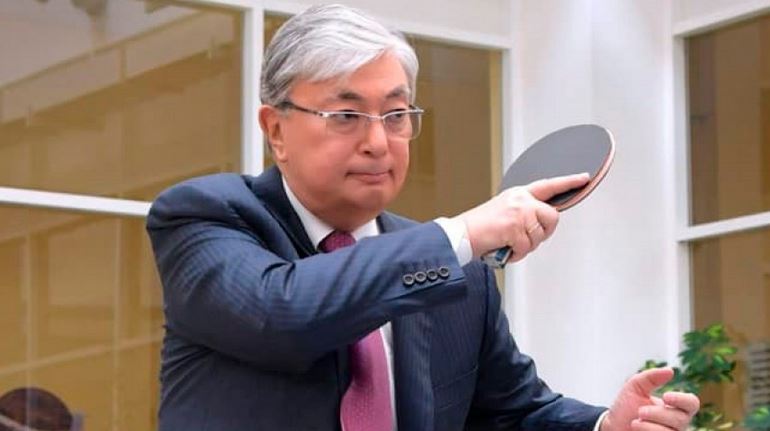
President Kassym-Jomart Tokayev of Kazakhstan knows a few things about table tennis topspin.

Wearing a suit and tie, he has displayed a solid forehand while sparring with a young athlete. He once smashed a ball past Turkish leader Recep Tayyip Erdogan. The Kazakh president was head of the national table tennis federation for more than a decade and has attended the openings of centers for the game in the country.

So perhaps it wasn’t a surprise that Tokayev took notice when Kazakhstan’s Kirill Gerassimenko, a three-time Olympian table tennis player, notched another accomplishment this month. Gerassimenko won gold in the individual, doubles and mixed categories at the national championships in Almaty.

Image: Olympic.kz

Tokayev congratulated the 28-year-old Kazakh on his three-title run and noted that he had made a big contribution to the promotion of table tennis in Kazakhstan and elsewhere.

Gerassimenko, currently ranked 56 in the world, has drawn the praise of the state in the past. After he placed ninth in singles at the Paris Olympics last year, the Table Tennis Federation of Kazakhstan gave him a two-room apartment in Astana.

The Kazakh champion’s father was his first coach and Gerassimenko later trained at the Werner Schlager Academy in Germany. Coach Dmitrij Levenko, who was a junior champion in Ukraine and the Soviet Union, also had a major impact on the Kazakh star.

Answering a few questions on Instagram, Gerassimenko encouraged young players to believe in themselves, be patient and train hard. He said he scouts opponents by watching their games on the internet to check for any weaknesses, and talks to other players who might have already played the opponents.

“And then choose your own tactic,” he said.

Gerassimenko’s success and, no doubt, Tokayev’s enthusiasm have helped to increase the popularity of the game in the Central Asian nation.

Kazakh Lawmakers Propose Creation of National Cryptobank

Azat Peruashev, leader of the Ak Zhol political party’s faction in the Mazhilis, the lower house of Kazakhstan’s parliament, has proposed the establishment of a national cryptobank. The initiative would involve the National Bank of Kazakhstan and second-tier commercial banks.

In a formal inquiry addressed to Prime Minister Olzhas Bektenov, Peruashev highlighted the growing interest among Kazakhstanis in digital currencies, which are increasingly viewed as tools for investment, capital preservation, and peer-to-peer transactions. However, Kazakhstan currently lacks a legal framework for the use of digital assets, and the circulation of cryptocurrencies remains officially prohibited.

Peruashev warned that this prohibition has driven the crypto market underground, with up to 90 percent of cryptocurrency transactions taking place outside the legal economy. “The ban has only fostered a shadow market, illegal exchanges, grey schemes, tax evasion, and the financing of illicit activities,” he said. “Citizens are losing vast sums to scammers, pyramid schemes, and unregulated platforms. Billions in crypto assets are being transferred abroad without oversight, and the state is losing out on substantial tax revenues.”

Peruashev believes that establishing a cryptobank, a state-recognized institution for the regulation, exchange, and storage of digital assets, could serve as a vital tool for bringing the crypto sector into the legal domain. He proposed involving the National Bank and select commercial banks that already employ digital financial instruments.

Such a system, he argued, would allow the state to reclaim control over the majority of crypto-assets circulating within the country and better protect users from fraud.

The MP pointed to international precedents. In the United States, Anchorage Digital Bank, Kraken Bank, and Custodia Bank operate with federal oversight. Switzerland is home to SEBA Bank and Sygnum Bank both pioneers in integrating traditional finance with digital assets.

“If something can’t be resisted, there’s only one solution, engage and lead. In this case, that means legalize and regulate,” Peruashev stated.

As previously reported by The Times of Central Asia, Binance has officially launched operations in Uzbekistan, while Kyrgyzstan is considering legislation to establish licensed cryptobanks to manage digital assets within a regulated framework.

Kazakhstan Cracks Down on Crimes Against Children and Women

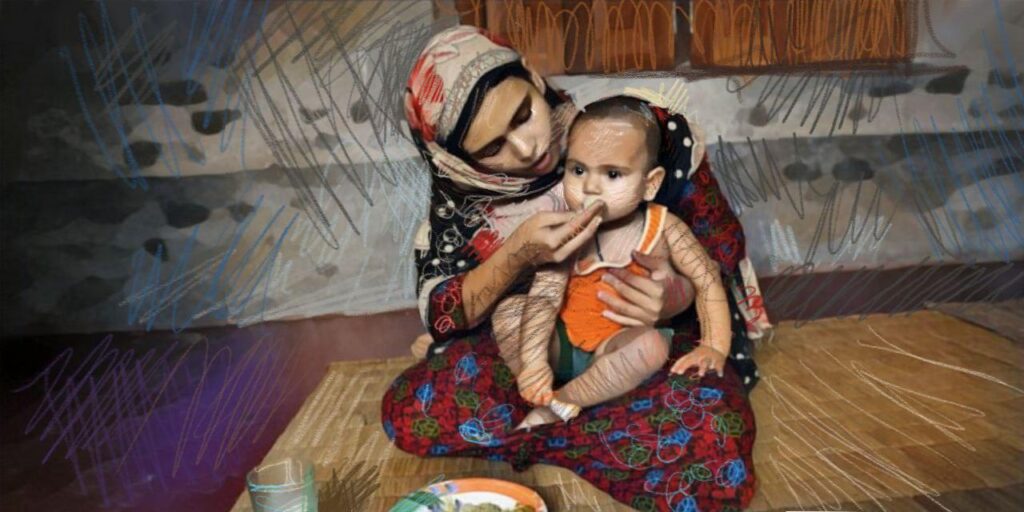
Kazakhstan’s Commissioner for Children’s Rights, Dinara Zakiyeva, has outlined the scale of sexual violence against minors and the state’s efforts to combat it by strengthening legislation and support systems.

Legislative Changes

In April 2024, Kazakhstan introduced sweeping amendments to its criminal legislation, significantly increasing penalties for crimes against women and children. On April 15, 2024, President Kassym-Jomart Tokayev signed into law the On Amendments and Additions to Some Legislative Acts of the Republic of Kazakhstan on Ensuring Women’s Rights and Children’s Safety.

Key changes to the Criminal Code include:

  • Prohibition of lenient sentencing for crimes involving violence against minors;
  • Elimination of reconciliation between parties in cases involving violence against minors;
  • Introduction of life imprisonment as the sole penalty for the murder of a minor (Article 99), rape of a minor (Article 120), and other violent sexual acts against minors (Article 121), removing alternative sentencing options;
  • Criminalization of sexual solicitation of individuals under 16; and
  • Legal liability for inciting or assisting in suicide.

Scope of the Problem

According to Zakiyeva, approximately 900 crimes related to the sexual abuse of minors are reported in Kazakhstan each year. Since the enactment of the new law, 25 to 27 individuals have already received life sentences for such offenses.

The highest incidence of these crimes is recorded in southern Kazakhstan, specifically Almaty, Turkestan, and Zhambyl regions, as well as West Kazakhstan and Kostanay regions. Zakiyeva notes that these areas often have high population density and conservative family structures that may conceal abuse.

Zakiyeva shared disturbing cases of underage girls who had given birth as a result of prolonged abuse. “In Zhambyl region, I met a 13-year-old girl who had been raped for six years by her two uncles. In Turkestan region, I visited a center housing 16 underage mothers, aged 13 to 15, all of whom were victims of abuse by relatives. Many didn’t even realize they were victims of a crime, they believed this was normal family life,” she said.

Prevention and Support

The children’s ombudsman emphasized that effective anti-violence strategies globally rely on four pillars: strengthening legal frameworks; promoting self-defense and awareness; working with families to identify risk factors early; and expanding support infrastructure for victims.

Kazakhstan’s new legislation supports preventive measures such as deploying mobile teams to identify at-risk families and establishing family support centers in every district. Currently, 112 such centers are operational, with another 109 underway. In Turkestan region alone, the number of centers has grown from one to 13, with four more soon to open.

Helpline and Awareness

In a single month, Kazakhstan’s national children’s helpline received 120 phone calls and 11,145 text messages. According to Zakiyeva, these messages often reveal the deep emotional isolation children feel.

“Children feel alone. They’re scared to speak out. They’re afraid to tell anyone that they’re being threatened, blackmailed, or approached by strangers. Many can’t talk to their parents, teachers, or psychologists,” she said.

Turkmenistan Bets on Dairy Industry and Coffee Business

Turkmenistan is ramping up its investments in the food processing sector, with two prominent companies announcing major expansions in the dairy and coffee industries. The developments were unveiled during an exhibition marking the 17th anniversary of the Union of Industrialists and Entrepreneurs of Turkmenistan.

Erkin Agro Launches Dairy Expansion with European Cattle

Erkin Agro, a member of the Union, announced plans to construct a large-scale milk processing plant and associated livestock farms. Deputy Director General Begench Chariev shared the news at the exhibition​.

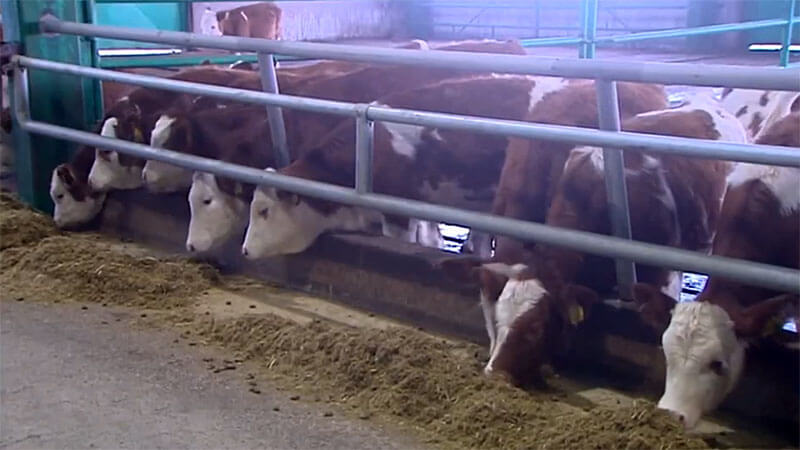
The company is finalizing its business plan and preparing to procure dairy cattle from Europe. Representatives will soon travel to Germany, Hungary, and the Netherlands to negotiate with suppliers. The initial phase involves importing 300 to 400 cows, with a total of 2,000 head planned. The first shipment is expected by the end of spring, with a second to follow in the fall.

The project emphasizes environmental sustainability. Erkin Agro is adopting organic farming practices and minimizing the use of chemicals, including fertilizers and pesticides. These efforts aim to ensure not only high-quality dairy products but also ecologically responsible livestock operations.

NesilCoffee Ventures into Freeze-Dried Coffee

Meanwhile, entrepreneur Tedjenmurat Bayramdurdyev, owner of NesilCoffee, announced the company’s entry into premium coffee production with the launch of a freeze-dried coffee line. The announcement was made during the same exhibition, according to Business Turkmenistan​.

Freeze-dried coffee, considered a high-end product, is made through lyophilization, a process in which frozen coffee is vacuum-dried to preserve its flavor, aroma, and nutrients. This method distinguishes it from standard instant coffee, which is produced via spray drying.

The new production facility is located in Ak-Bugday etrap, Ahal province. Outfitted with Italian and German equipment, the plant sources coffee beans from Europe, Colombia, Guatemala, Ethiopia, and Tanzania. NesilCoffee manages its own Arabica–Robusta blend ratios and monitors quality through an in-house laboratory.

Currently, the company produces five varieties of whole-bean coffee (Espresso, Intenso, Classic, La Crema, Special) and four types of instant coffee (Caramel Latte, Vanilla Latte, Coffee Latte, and Cappuccino). The production process adheres to ISO 9001, ISO 22000, and Halal standards. The facility has an annual production capacity of 4,000 tons, with plans to scale up to 10,000 tons.

Growing Food Industry

Since launching one of Central Asia’s largest coffee plants in 2024, NesilCoffee has secured a leading position in the domestic market and is now pursuing export opportunities.

These developments reflect a broader national strategy to diversify and strengthen Turkmenistan’s food sector. With investments in livestock and high-quality food processing, companies like Erkin Agro and NesilCoffee are positioning Turkmen business for sustainable, internationally competitive growth.

Kazakhstan Considers Resuming Saiga Culling Amid Ecological and Agricultural Tensions

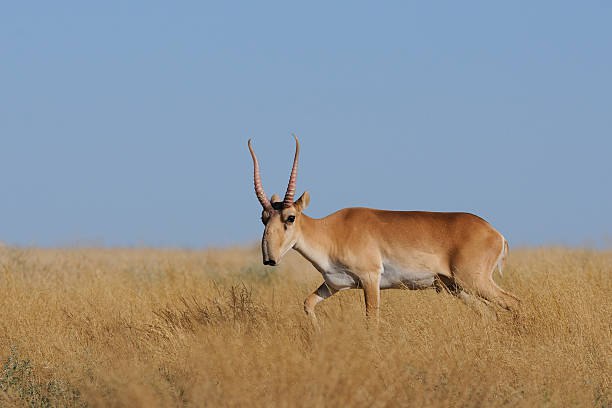
Kazakhstan’s Minister of Ecology and Natural Resources, Yerlan Nysanbayev, has addressed the growing debate over the potential resumption of saiga culling, acknowledging that while no decision has yet been made, consultations with scientists and environmental experts are ongoing​.

Conservation or Population Control?

Speaking at a government briefing, Nysanbayev emphasized the complexity of the issue. “We expect a second meeting. Science needs time to comprehensively study the situation, assess obligations, and determine whether population regulation is necessary or if alternative measures are viable,” he said.

The minister acknowledged that the conflict between wildlife and agricultural interests is becoming increasingly apparent. “There are epizootic risks involved. A very balanced decision is required here,” he added.

Regulation Methods: Culling or Capture?

When asked about potential population control methods, Nysanbayev responded candidly. “It could be corral-based capture or shooting, what other options are there? But the final decision is still under scientific review.”

The idea of regulating saiga populations first stirred controversy in 2022 when farmers in West Kazakhstan and Akmola regions reported widespread crop damage caused by the animals. Fields were trampled, fences destroyed, and harvests consumed. Some farmers even called for a state of emergency​.

By autumn 2023, saigas were added to the official list of animals subject to population control. Authorities initially aimed to capture 200,000 saigas, but technical challenges led to a shift toward culling. Meat processing plants began producing canned saiga meat for local consumption​.

Shifting Policies and Political Pressure

However, on February 10, 2024, the Ministry of Ecology suspended the population control initiative following consultations with Kazakh and international experts​. In April, President Kassym-Jomart Tokayev declared his intent to ban saiga culling altogether, calling the antelope a “symbol of the Kazakh steppe”​.

Yet the issue resurfaced in March 2025 during a meeting of the National Kurultai. Tokayev again urged the government to reassess the situation, citing appeals from the AOYL political party and local residents. “Agriculture is suffering. Epizootic risks are growing. Overall, pressure on the ecosystem has increased,” he said​.

Global Context and Local Dilemma

According to Energyprom.kz, global wildlife populations have declined by an average of 73% over the past 50 years. While Kazakhstan’s saiga population has rebounded significantly thanks to anti-poaching efforts and conservation policies, the country now faces a new dilemma: how to reconcile ecological preservation with agricultural stability​.

Minister Nysanbayev confirmed that a final decision will be made later this year but what form it will take remains uncertain.