• KGS/USD = 0.01144 0%
  • KZT/USD = 0.00193 -0%
  • TJS/USD = 0.10811 -0.28%
  • UZS/USD = 0.00008 0%
  • TMT/USD = 0.28490 0%
  • KGS/USD = 0.01144 0%
  • KZT/USD = 0.00193 -0%
  • TJS/USD = 0.10811 -0.28%
  • UZS/USD = 0.00008 0%
  • TMT/USD = 0.28490 0%
  • KGS/USD = 0.01144 0%
  • KZT/USD = 0.00193 -0%
  • TJS/USD = 0.10811 -0.28%
  • UZS/USD = 0.00008 0%
  • TMT/USD = 0.28490 0%
  • KGS/USD = 0.01144 0%
  • KZT/USD = 0.00193 -0%
  • TJS/USD = 0.10811 -0.28%
  • UZS/USD = 0.00008 0%
  • TMT/USD = 0.28490 0%
  • KGS/USD = 0.01144 0%
  • KZT/USD = 0.00193 -0%
  • TJS/USD = 0.10811 -0.28%
  • UZS/USD = 0.00008 0%
  • TMT/USD = 0.28490 0%
  • KGS/USD = 0.01144 0%
  • KZT/USD = 0.00193 -0%
  • TJS/USD = 0.10811 -0.28%
  • UZS/USD = 0.00008 0%
  • TMT/USD = 0.28490 0%
  • KGS/USD = 0.01144 0%
  • KZT/USD = 0.00193 -0%
  • TJS/USD = 0.10811 -0.28%
  • UZS/USD = 0.00008 0%
  • TMT/USD = 0.28490 0%
  • KGS/USD = 0.01144 0%
  • KZT/USD = 0.00193 -0%
  • TJS/USD = 0.10811 -0.28%
  • UZS/USD = 0.00008 0%
  • TMT/USD = 0.28490 0%
10 December 2025

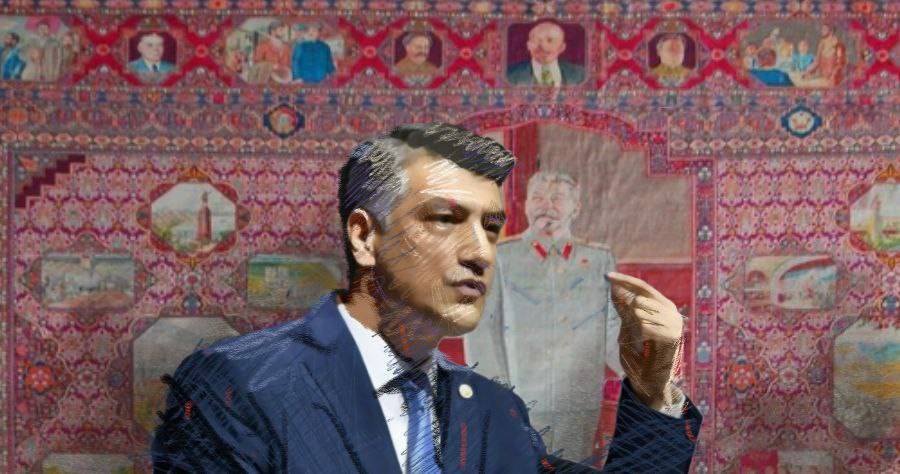
Uzbekistan’s Point Man Against Russian “Chauvinism”

Alisher Qodirov is 49 years old, the leader of Uzbekistan’s Milli Tiklanish (National Revival) party, the deputy speaker of the lower house of parliament, and a former presidential candidate.

And Qodirov is also a leading critical voice in Uzbekistan regarding the country’s Soviet past and comments of current Russian chauvinists.

On September 4, Qodirov wrote on his Telegram account that Soviet ideological propaganda should be banned in Uzbekistan. He was responding to a court verdict earlier that day against a 74-year-old pensioner in Samarkand who was found guilty of “encroaching on the constitutional order of Uzbekistan.”

Specifically, the man advocated the restoration of the Soviet Union and said Uzbekistan’s independence was superficial.

Qodirov wrote that Uzbekistan’s time as a Soviet republic was a “sad period of our history.” The Milli Tiklanish leader said even suggesting a recreation of the USSR was a “betrayal of our people and our ancestors, who became victims of the bloody regime.”

Qodirov continued that calls for Uzbekistan‘s reincorporation into some sort of a resurrected USSR “should be considered a crime against the constitutional order of the country.” The Milli Tiklanish leader said such thinking was a “betrayal of our people and our ancestors, who became victims of the bloody regime.”

Qodirov has expressed his opinion on the Soviet Union before.

When Uzbekistan marked May Day on May 1, 2021, the Soviet flag was raised during a concert of “Songs of Victory” in Tashkent.

Posting on Telegram, Qodirov called the incident “an insult and a provocation… to the Uzbek people to raise the flag of the Soviet occupying state in the very center of the capital, which is soaked in the blood of… our ancestors.”

Russian chauvinism has been rising since the Kremlin launched its full-scale war on Ukraine, and so have irredentist remarks from people on Russian television and officials in the State Duma. Kazakhstan, which shares a 7,800-kilometer border with Russia, is usually the target, but in the last year, Uzbekistan has been mentioned.

On December 20, 2023, Russian writer, nationalist, and co-chairman of the A Just Russia – For the Truth party, Zakhar Prilepin spoke about migrant laborers at press conference in Moscow.

The majority of migrant laborers in Russia are from Central Asia and Prilepin said, “These territories, from where migrant workers come to us, should simply be annexed entirely.”

Prilepin specifically mentioned Uzbekistan, as more than half the Central Asian migrant laborers in Russia come from there.

“Uzbekistan, for example… since two million of your citizens are on our territory, we claim your territory,” Prilepin told a press conference, and added, “Who will forbid us to do anything useful on the territory of the Eurasian territory after the parade in Kyiv? No one.”

Less than one month later, on January 22, 2024, Russia’s NTV television station showed an interview with a person identified as Mikhail Smolin, a historian. Smolin absurdly claimed the Uzbek nation never existed until after the Bolshevik Revolution of 1917. Smolin said the same about Kazakhs and Azerbaijanis.

That was apparently too much for Qodirov. On January 25, he called for cutting Russian television programming to Uzbekistan.

“Lately we hear nothing but chauvinistic statements in Russian,” Qodirov said, noting that such remarks from Russia were heard often enough that “it seems [the Russian authorities] are interested in such rhetoric.”

Qodirov pointed out only some three percent of Uzbekistan’s population comprises ethnic Russians, so Russian television is disproportionately represented in Uzbekistan.

In May, Qodirov offered a slight clarification to these statements.

He said he was a “Sovietophobe,” not a Russophobe, but added that the history of the USSR should remain “in the black pages of the history” of Uzbekistan and “should not be part of our future.”

Qodirov is known for making some sensational statements. When he was running for president in 2021, he suggested taxing remittances from migrant laborers.

Since some four million citizens are migrant laborers, and millions of family members back home depend on the money they send, the proposal was widely unpopular and might have been made intentionally to help ensure the overwhelming re-election of incumbent President Shavkat Mirziyoyev.

Which brings us back to the matter of Qodirov’s comments on Russia and the Soviet Union.

With the exception of the president, Uzbekistan’s political system does not allow officials to freely voice their opinions publicly, especially on foreign policy matters, and especially concerning Russia.

Qodirov would not be saying the things he is without approval from people high up in the government.

Some Russian officials and celebrities talk about taking back land from Central Asia, or make disparaging remarks about Central Asian people. Russian authorities downplay these comments as the opinions of individual Russian citizens that do not conform with the views of the Russian government.

Qodirov is in a similar position.

What he is saying about Russia is not the official view of the Uzbek government, but it is probably the message some people in the government want sent to Russia.
China-Europe Trade Could Disrupt Saiga Migration, Group Warns

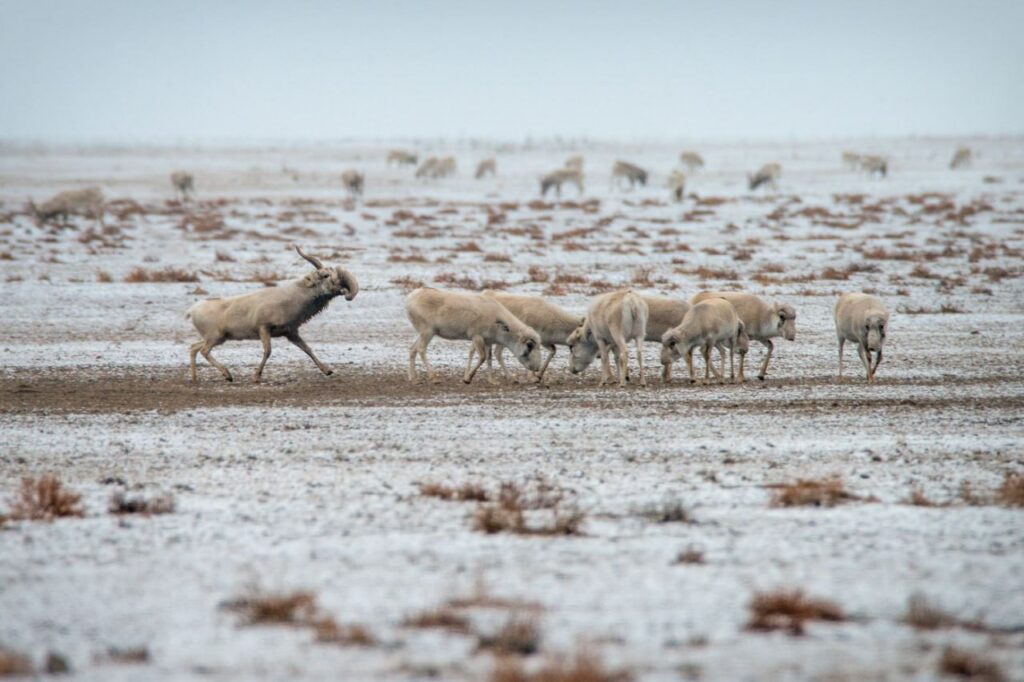
Once close to extinction, the saiga antelope has made a big recovery in numbers in recent years, marking a major conservation success in Central Asia. However, a group that promotes Kazakhstan’s grasslands and wildlife says plans to develop business corridors between China and Europe are likely to affect the saigas, which migrate long distances to find water and pasture.   

“Kazakhstan is projected to see significant development of roads and railways in the next decade, as multilateral businesses and governments aim to better connect trade routes between China and Europe through Central Asia. Much of this development is slated to impact saiga range,” the Altyn Dala Conservation Initiative said in a statement on Friday.

The conservation group believes its participation in a global project to map migration corridors of ungulates – hoofed mammals – can help to offset the impact of an expected rapid expansion of trade networks on saiga populations, whose numbers in Kazakhstan reached nearly three million in a survey conducted earlier this year. The vast majority of saigas are in Kazakhstan.

The Ustyurt saiga population, one of three big concentrations of the species in Kazakhstan, is now among 20 mapped populations, including reindeer in Norway and Finland and zebras in eastern and southern Africa, in an atlas compiled by the U.N.-backed Global Initiative on Ungulate Migration. The project aims to provide tracking and migration corridor information for review by state agencies and others so that the easily available data can be taken into account while planning development.  

“We are now focused on mitigation measures for existing developments and assessing if crossing structures will facilitate saiga movements safely across roads and railways, and whether truncated movements can be restored,” the Altyn Dala Conservation Initiative said.

Trade between China and the European Union reached 739 billion euros last year, a drop of 14 percent from 2022, according to the European Commission.  China is the EU’s second largest trading partner for goods after the United States. Currently, there are trade tensions between China and the EU. 

Galloping Traditions: Kokpar and Kok Boru Unleash Cultural Pride at the World Nomad Games

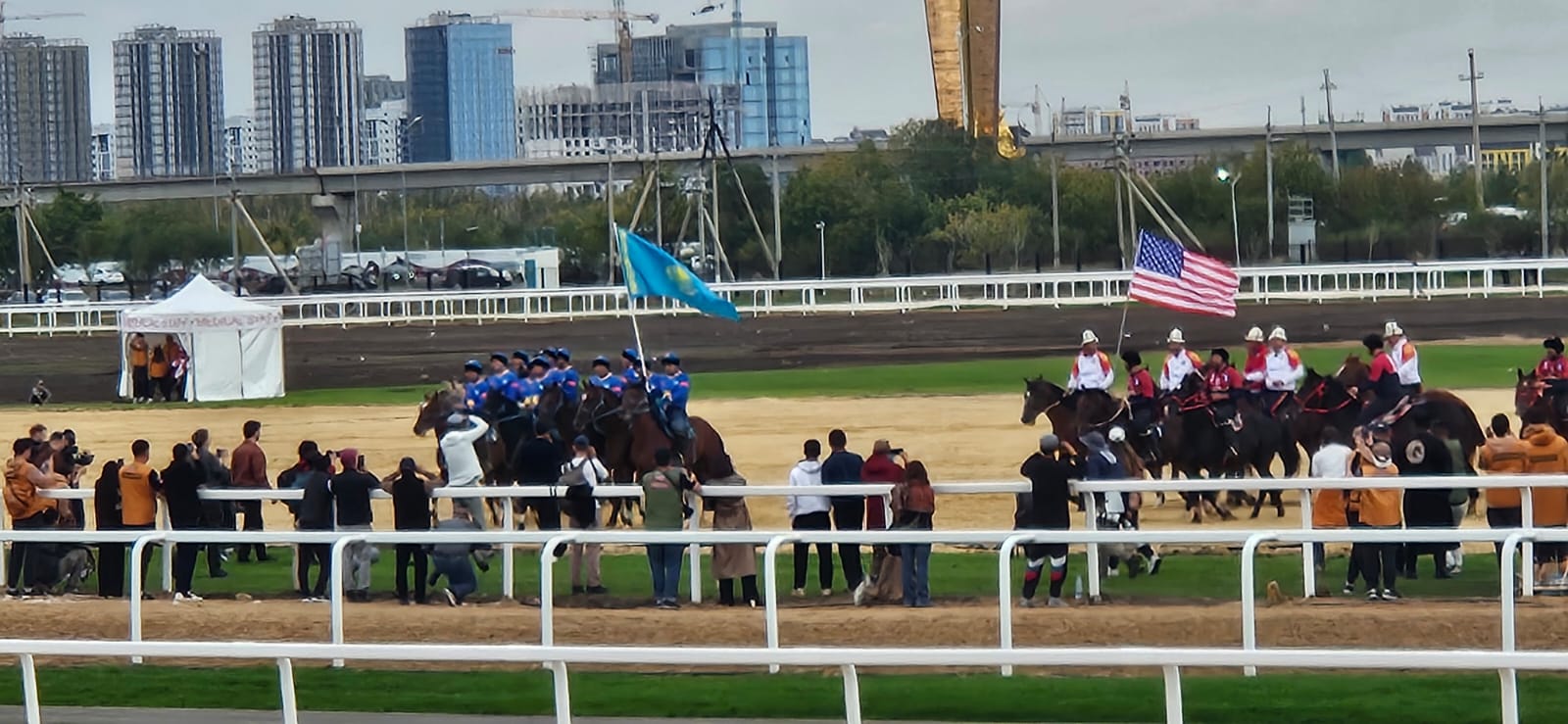
The Kazanat Hippodrome, with a track length of 1,800 meters, and the Astana Grand Mosque — the biggest mosque in Central Asia — dominating the background, hosted the preliminary kokpar and kok boru games, known for their respective pursuits of a headless goat carcass, on day two of the World Nomad Games.

Image: TCA, K. Krombie

The layout of the Hippodrome track presents a great divide. The distance between the field and the spectators means that distinguishing the traditional headless goat carcass from the PC dummy version (serke) of the Games is an eye-squinting challenge if one doesn’t engage with the obligatory big screen. The two games, which appear to be very similar if not identical, are separated by cultural nomadic origins. Kokpar is Kazakh, while kok boru is from Kyrgyzstan. The Kyrgyz origins of kok boru (gray wolf) are rooted in an ancient post-wolf hunting tradition, where the carcass of the animal would be passed around — as in taken — among the hunters as a sporting activity while riding back to their village.

To the unacquainted spectator, kok boru (and kokpar) is where various other sports — equestrianism, polo, hockey, and football — merge in a rugged horseback chase and scrum. The aim of the game is to steer the goat carcass into the donut-shaped tai kazan — or goal — of the opposing team. Each team has twelve horses and players, while four players from each team play for three 20-minute spurts with 10-minute breaks in between. In those 20-minute periods, not a single minute is wasted.

Image: TCA, K. Krombie

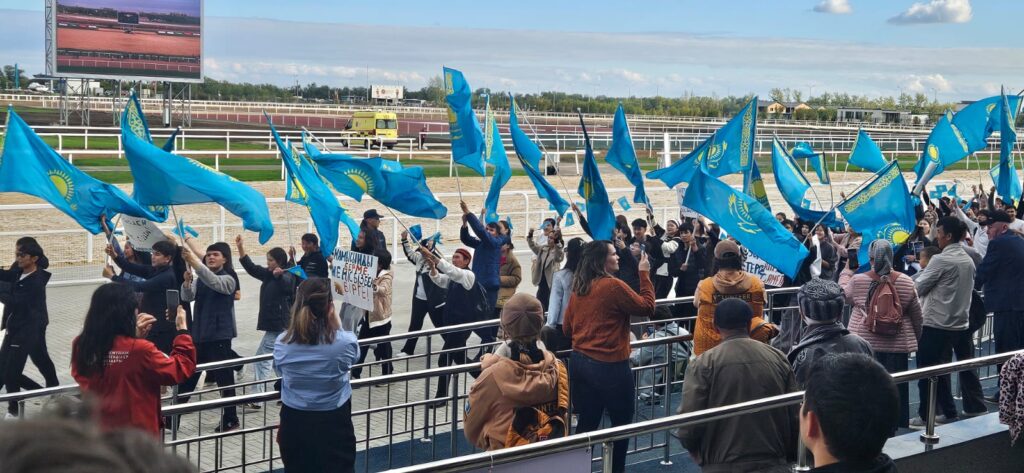
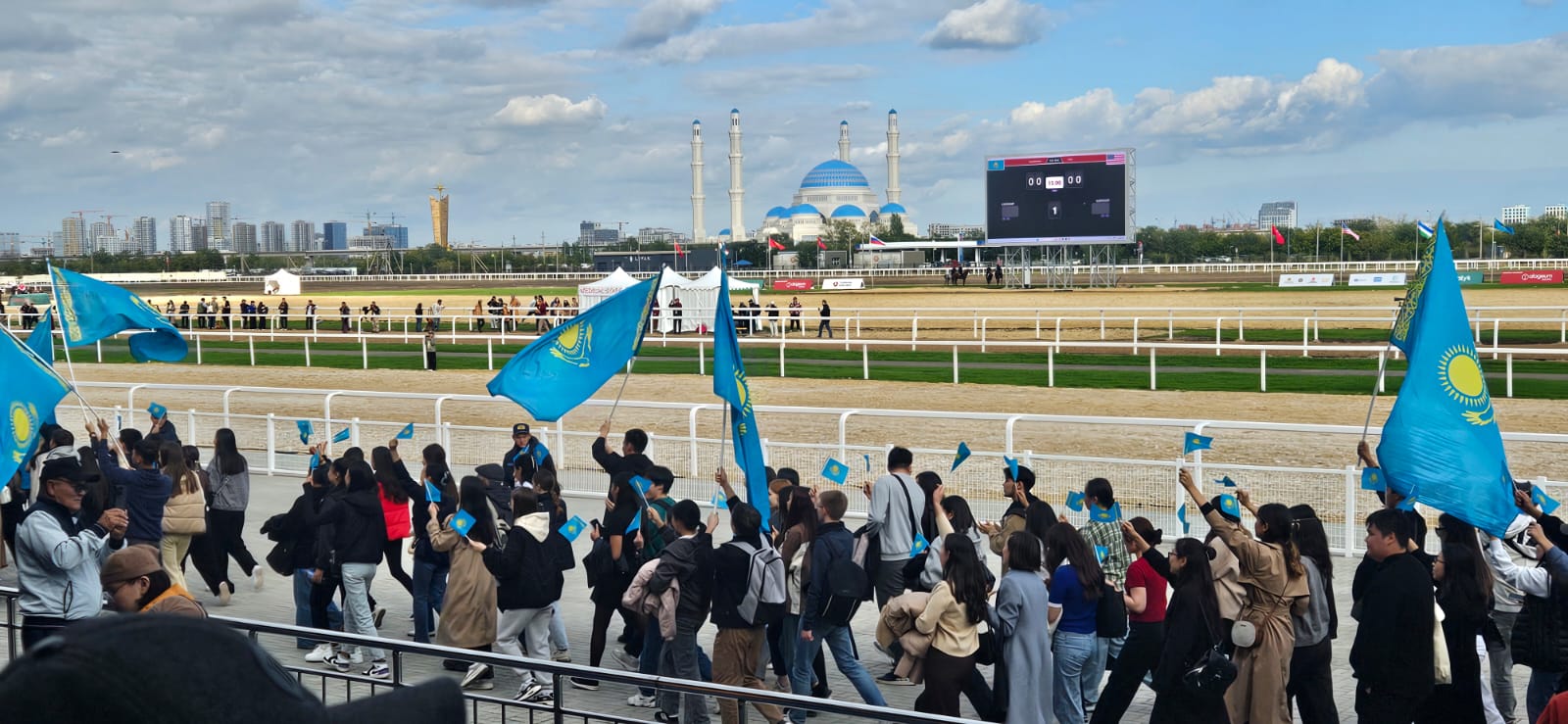
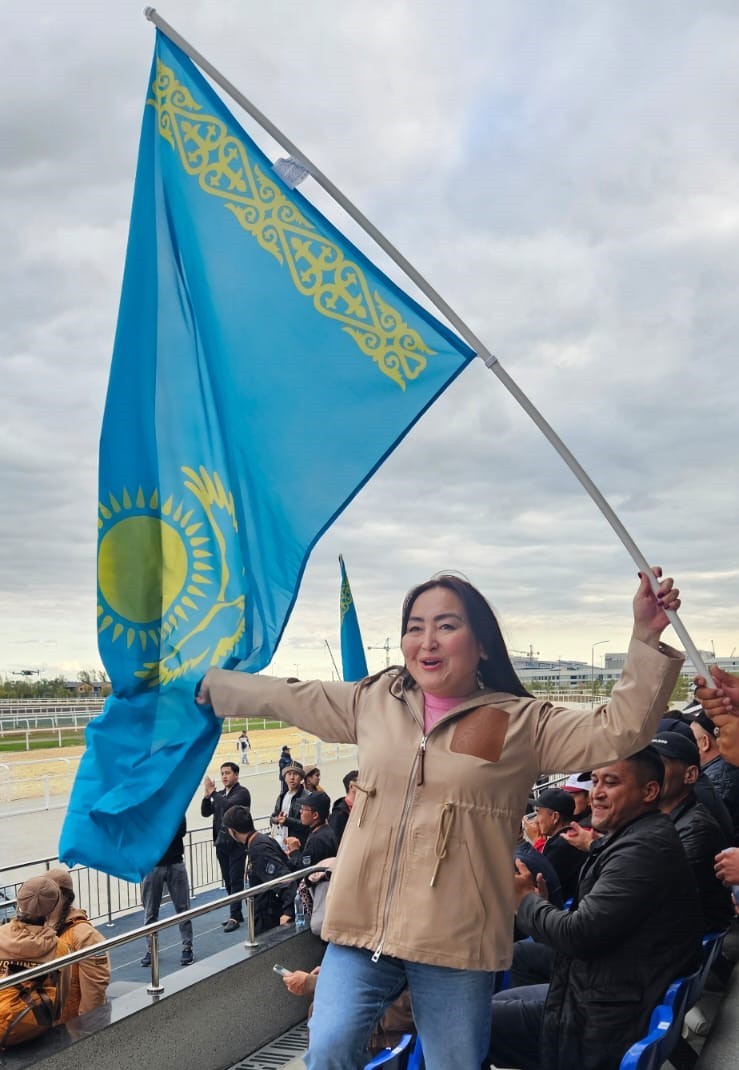
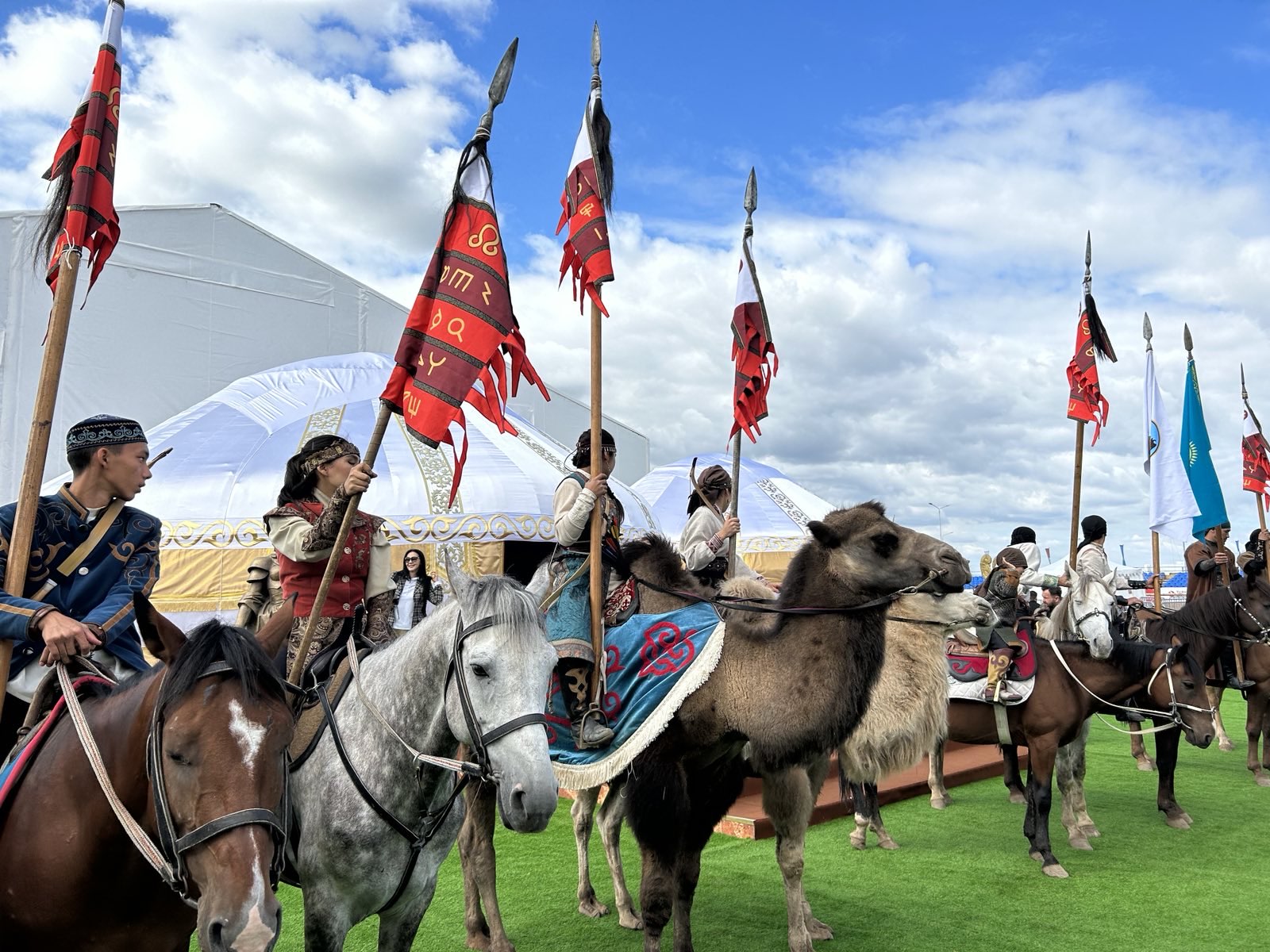
In the kok boru games, following Turkey’s 1 – 0 win with Hungary, the mostly home crowd reserved their audible enthusiasm for Kazakhstan versus the United States in a literal East versus West match (U.S. team player and MMA fighter Nick Willert is also a competitor in horseback wrestling at the neighboring Ethnoaul). Much fanfare accompanied a parade of marching, flag-waving Kazakhs ahead of the game.

From the off, the Kazakhs wiped the sandy floor with the American Cowboys. Almost every member of the Kazakh team scored points in quick succession, following taut human/horse throngs in the final stages of maneuvering the serke into the tai kazan. A general impression of the U.S. team was that they accepted their defeat with grace and humor, and were happy to be where they were. The same sentiment appeared to be shared by the Kazakh spectators, who are proud that these Central Asian games are gaining recognition on the international stage.

Image: TCA, K. Krombie

In the 2024 WNG, representation from the West is a growing trend for both the participants and the observers. American spectator Lisa Wagner, who was present at the kok boru games with friends and family specifically to support her fellow countrymen remarked that the Kyrgyzstan spectators in her midst were just as enthusiastic for the American team. Wagner said the U.S. team member who was “dragged off his horse” added to the “pretty interesting” overall spectacle. She cheerfully added that elements of the horseback wrestling at next door’s Ethnoaul looked like men “slapping each other.”

By the end of the final 20 minutes, unlike the raucous “Ka-zakh-stan” chant at the end of the second round, the energy from the mostly Kazakh crowd, on comfortable home turf, was one of calm assurance. With a score of 18 – 0 in their favor, it isn’t hard to see why.

World Nomad Games Day Two: An Air of Celebration – An Interview With Team Australia

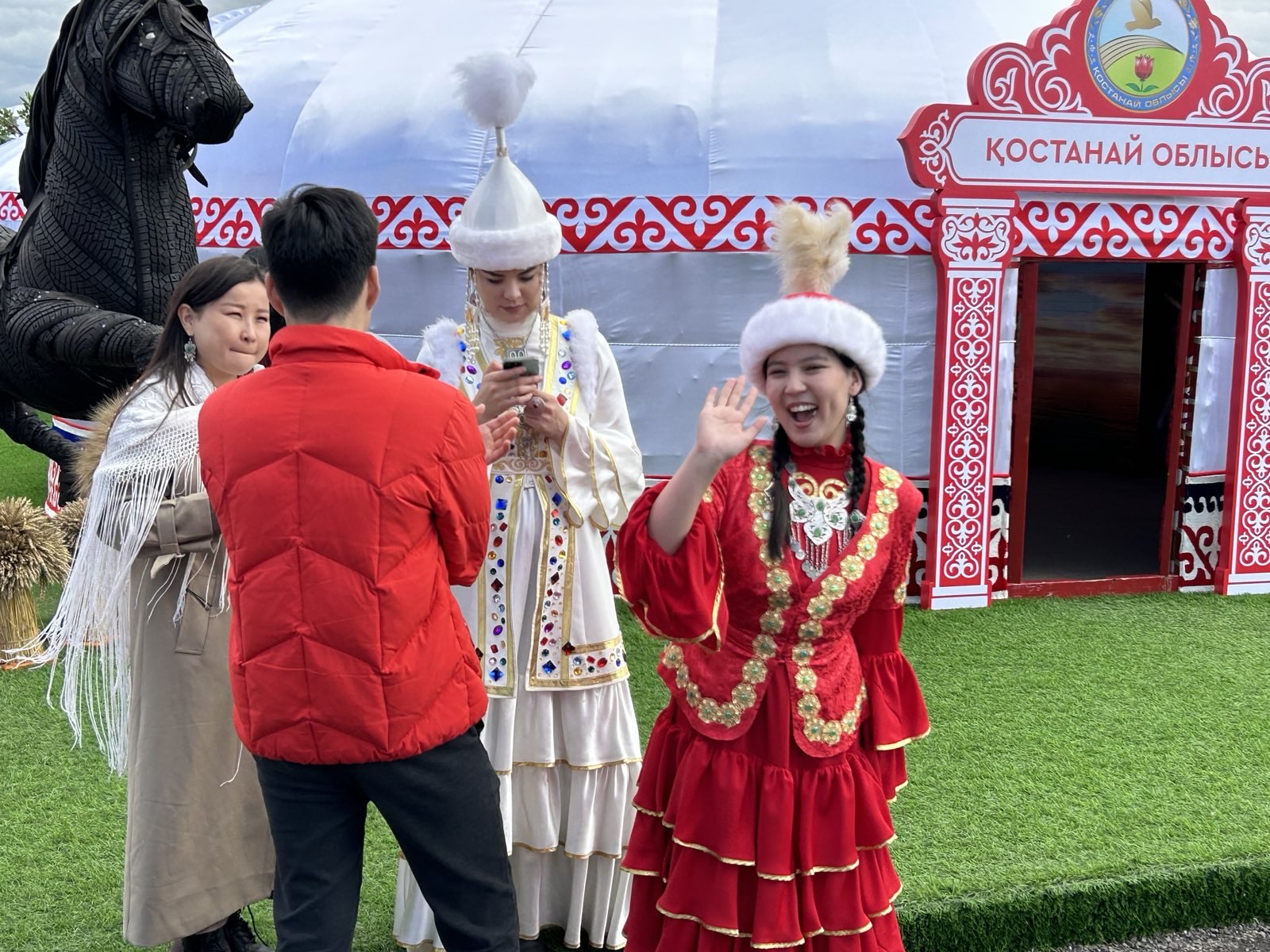
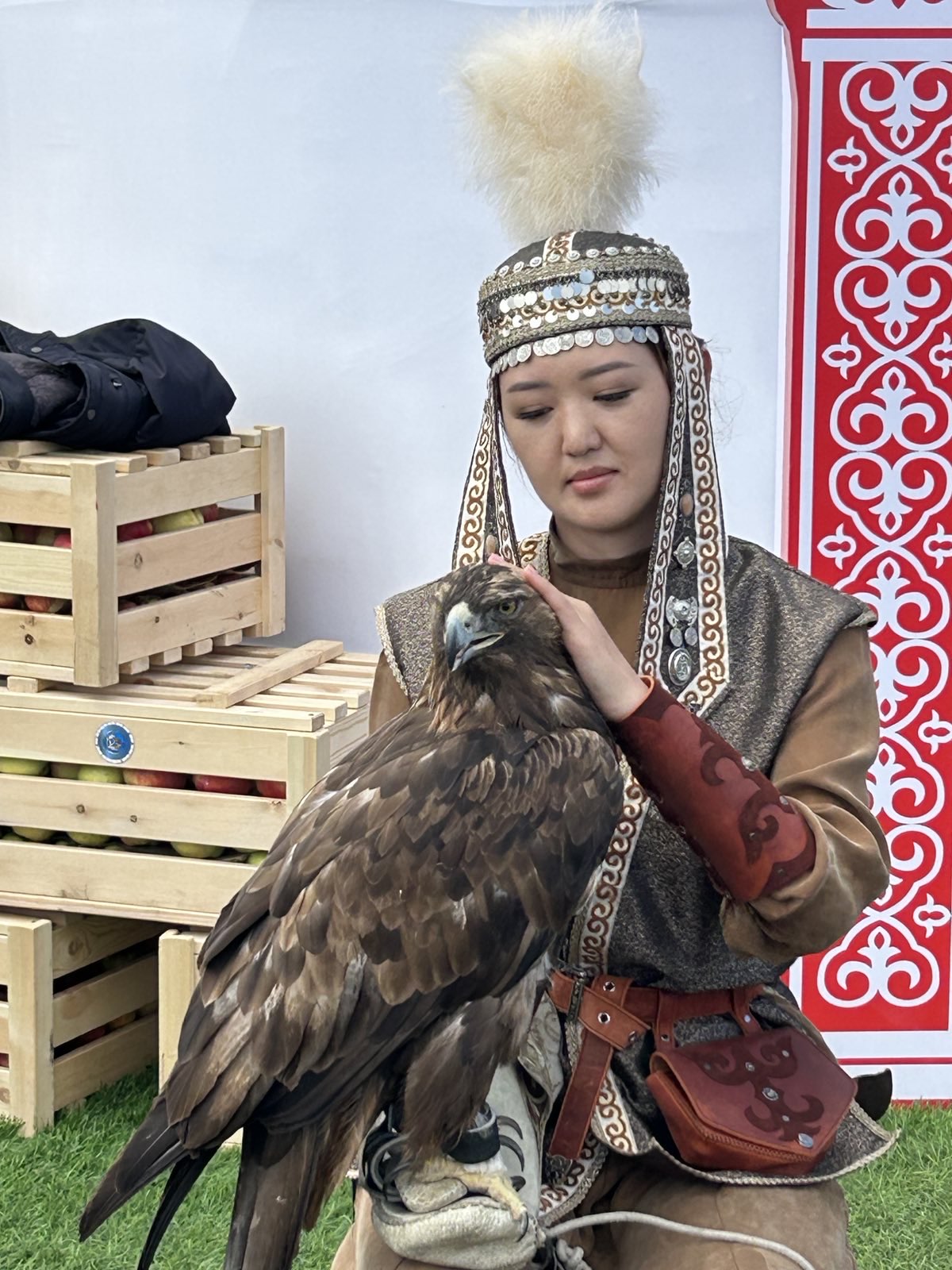
The second day of the World Nomad Games saw a plethora of events taking place across Astana. TCA visited the Hippodrome and the Ethnoaul – home to numerous exhibits and competitions – where the excitement was palpable. A mélange of colors and sights filled the Ethnoaul arena, from traditional music and costumes to camels, Tazy dogs, and eagles. A deep sense of national pride and hospitality permeated proceedings, with visitors and athletes alike warmly greeted.

Image: TCA, Stephen M. Bland

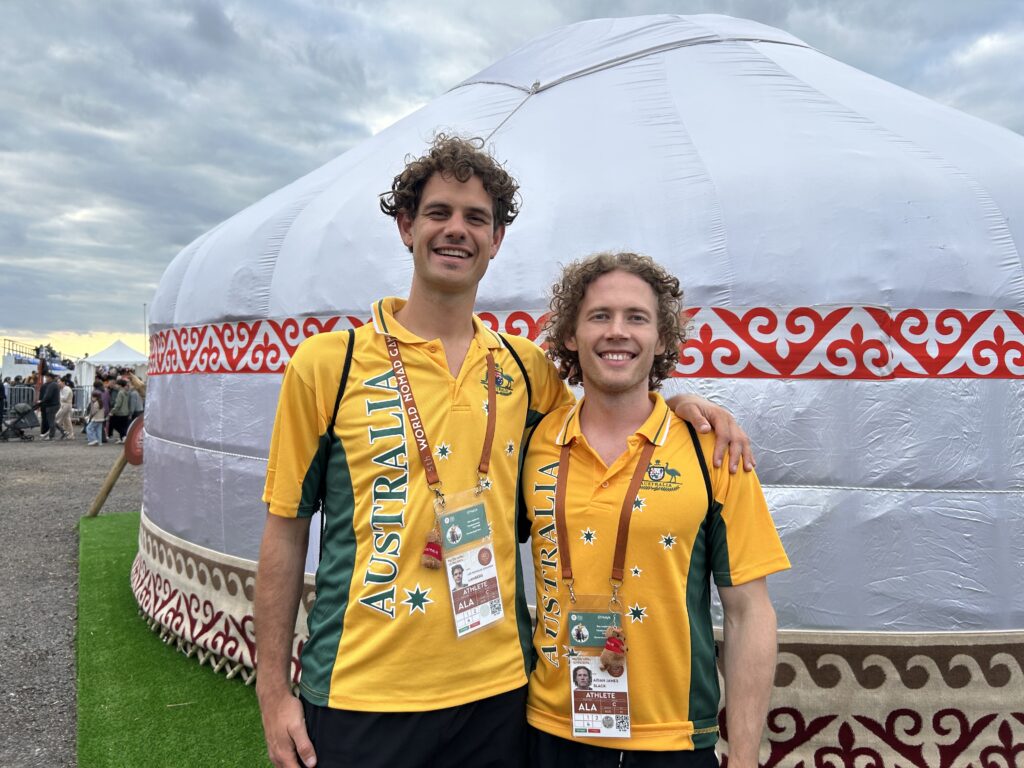
At the horseback wrestling, where a flag-waving home crowd whipped up a frenzy as competitors emerged in their flowing capes, TCA caught up with Leo Lambers and Aiden Slack from Team Australia, a doctor and a consultant originally from Melbourne, respectively.

“There are twelve athletes from Australia in total,” Lambers told TCA; “ten are participating in the archery, they’re all from Sydney, and there’s just us two doing the mas-wrestling. My brother came to Kyrgyzstan about six years ago, and he met some locals and did mas-wrestling for fun. When he came back, he challenged us to do it, and we’ve really loved it since then. We only do it socially – there’s no competitions we know of in Australia. So, we just do it with friends whenever we get the chance. We knew these Games were going to happen, so we thought we’d come. It’s actually our first competition, so it’s a pretty big jump for us.”

Image: TCA, Stephen M. Bland

“We’ve never been to Central Asia before, so it’s a good opportunity for us to visit and experience more of the culture as well as completing,” Slack said. “We’re going to fly down to Almaty afterwards for a week and do some trekking as well, which will make it even more enjoyable. I competed today against two opponents, one from Pakistan and one from Kyrgyzstan, and hats off to them; they were very strong athletes. So, I’m out of the competition for now, but Leo’s competing tomorrow.”

“There are different weight categories. I was hoping to lose a few more kilos than I have and get down below 90 kilos, but I’m in the highest weight category, 105 kilos, and the world champion is in my category,” Lambers told TCA. “It’s down to the luck of the draw; there’s some really, really big people in there, but it’s amazing to even be here.”

Image: TCA, Stephen M. Bland

TCA asked if Australia has any medal hopefuls.


“We have high hopes for the Australian archers,” Slack said; “they’re a pretty good bet to at least get a medal. Hopefully, they can pull through for us.”


“The Games are probably more established than I thought they would be, but also more chaotic,” said Lambers. “There’s a lot of sports I’d never looked into it, there’s the scientific program, board games and intellectual games, as well as the physical sports. And the people are really, really proud of their culture. That’s the biggest thing, that everyone wants to share and talk about it all.”


“We’ve really noticed how friendly and open everyone is, how they want to take photos and engage with us in this amazing atmosphere,” Slack concluded. “So, it’s great to be part of it.”


Join us tomorrow for coverage from day three of the World Nomad Games.

Nursultan Nazarbayev Poses for the Cameras – in Uzbekistan

Nursultan Nazarbayev, the former longtime president of Kazakhstan whose legacy was tarnished by accusations of autocracy and corruption, has made a rare public appearance, visiting several sites in the historic Uzbek city of Bukhara.  

Uzbekistan24 television showed Nazarbayev with Uzbek President Shavkat Mirziyoyev as the pair walked, prayed and posed for cameras together on Friday. Local media reports said they discussed the preservation of cultural heritage and the education of young people. Mirziyoyev returned to Tashkent on Saturday and was in Astana, Kazakhstan on Sunday to attend the opening of the World Nomad Games, an international event celebrating traditional sports in Central Asia.  

Nazarbayev’s appearance resembled more of a stroll with an old friend than a formal event. But it was unusual to see the 84-year-old former leader out and about because he has tended to keep a low profile in recent years. The government of his successor, President Kassym-Jomart Tokayev, has distanced itself from parts of Nazarbayev’s legacy, promising to be more responsive to people’s concerns and launching corruption investigations of some of the former leader’s relatives in order to recover state assets. 

Nazarbayev had ruled Kazakhstan since the collapse of the Soviet Union in 1991, burnishing his reputation with the help of the young country’s massive oil wealth and skilled outreach to foreign investors and governments. 

However, as inequality and economic pressures grew, he resigned in 2019 while retaining some powerful roles in government. He was stripped of those posts as Tokayev grappled with fallout from protests and riots in January 2022 in which Nazarbayev was condemned as an authoritarian holdover. More than 200 people were killed in the violence, which ended after troops from Russia and other regional countries intervened.

Kyrgyzstan Forecasts Five-Year Budget Surplus

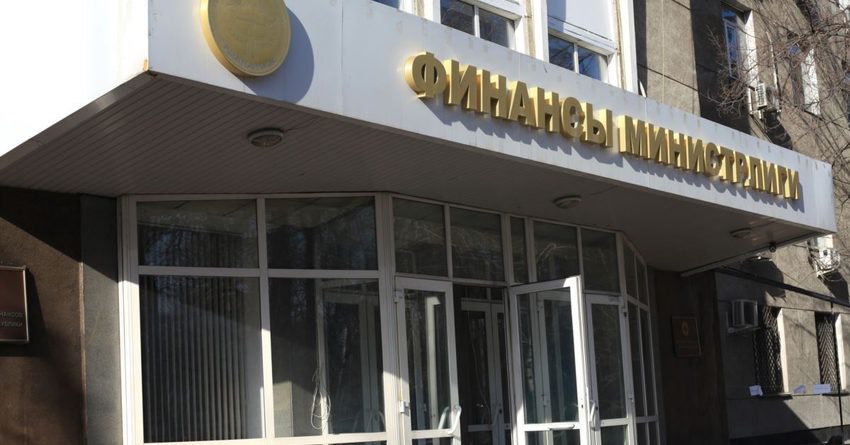
The Ministry of Finance of Kyrgyzstan has published a forecast of total revenue for the next five years, indicating that by 2029, the country’s state budget revenue will grow to KGS 655 billion ($7.8 billion).

At the end of 2024, Kyrgyzstan’s state budget surplus will amount to KGS 11.2 billion ($131.7 million), while revenue this year amounted to KGS 414 billion ($4.8 billion).

As  previously reported by TCA, the introduction of cash registers and the fight against crime have impacted on growth.

Another contributing factor was mentioned by Head of the Cabinet of Ministers, Akylbek Japarov, who stated, “In fiscal policy, we are adopting technology that is fit for the times. Taxpayers are pleased with these changes. They no longer have to wait in queues; they can quickly file reports and receive the necessary documents online.”

He also commended the promotion of domestic and foreign investments and the development of Kyrgyzstan’s industrial sector which facilitate the growth of the republic’s economy and, in turn, state budget revenue: “Since the beginning of 2024, 29 enterprises have been put into operation. Major projects are being implemented, such as constructing the Kambarata hydroelectric power plant and the China-Kyrgyzstan-Uzbekistan railroad. There are plans to develop the tourism sector.”

The Kyrgyz Finance Ministry said in a report that the annual growth in state budget revenue will provide a surplus which will be used to repay public debt.  The state budget is currently projected to receive KGS 414.5 billion ($4.8 billion) in 2024, KGS 465 billion ($5.4 billion) in 2025, KGS 505 billion ($5.9 billion) in 2026, and KGS 655 billion ($7.7 billion) in 2029.

In a statement to TCA, the Finance Minister explained, “Large expenditures are projected for the medium term to pay down public debt. The projected budget surplus will be used for expenditures related to activities of economic orientation and covering the state’s liabilities.”