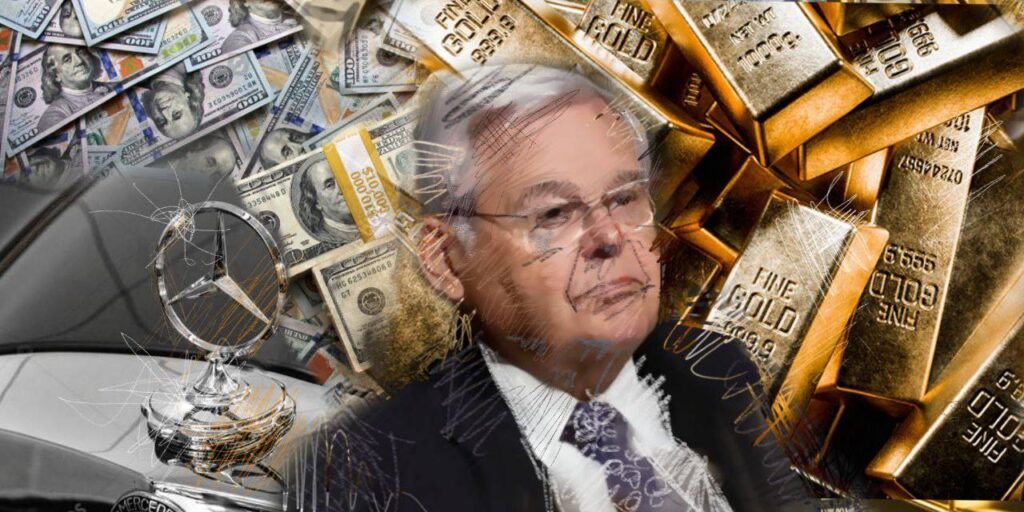
On July 16, a federal court in New York found United States Senator Robert “Bob” Menendez (D) guilty on 16 counts in a corruption trial, including charges of accepting bribes to benefit the governments of Egypt and Qatar, obstruction of justice and extortion. He is the first U.S. senator to be convicted as a foreign agent and the charges collectively carry a potential sentence of 222 years in prison.
Bribery charges involved receiving gold bars worth over $100,000 and more than $480,000 in cash as well as a Mercedes-Benz for his wife. “This wasn’t politics as usual. This was politics for profit,” summarized Damian Williams, an attorney for the Southern District of New York. According to federal prosecutors, among other things, Menendez helped secure millions of dollars of U.S. aid for Egypt and used his office to assist a multi-million-dollar deal with a Qatari fund. Egypt’s intelligence and military officials are said to have bribed him and his wife at a time when U.S. military aid to the country would have paused due to human rights concerns. Menendez also used his official position “to protect and enrich” individuals in exchange for payments, including helping a New Jersey businessman secure a halal certification monopoly with regards to U.S. meat exports to Egypt.
Striking similarities to another recent “influence-for-sale” scandal
For many Europeans, this U.S. case resembles the European Union’s own Qatargate scandal, which broke out in 2022 and unveiled how foreign governments (Qatar, Morocco and Mauritania) have been channeling hundreds of thousands of euros to a ring of elected European Parliament officials who, in turn, were leveraging their authority to benefit these clients. The services included “attempts to manipulate the Parliament” and “scheming to kill off six parliamentary resolutions condemning Qatar’s human rights record” as Politico reports.
In his plea deal, Antonio Panzeri, the chief of the European Parliament’s Subcommittee on Human Rights (DROI), admitted to receiving bribes as well as to leading and participating in a criminal organization. This criminal organization reportedly doled out bribes to EU officials through two NGOs named Fight Impunity and No Peace Without Justice, which were allegedly set up to launder money and help fund the scheme. In Menendez’s case, the money ran through his wife’s consultancy.
Qatargate allegations extended beyond the Middle East and North Africa. For instance, Atlantico.fr reported that Panzeri and his associates may have been corrupted by at least two Kazakh criminal figures.
Europeans appeared lenient on corruption as Panzeri only received a five-year prison sentence, of which four would be suspended and the one year he’d serve would be under house arrest with an electronic bracelet. Momentum behind investigations of key suspects has since waned, leading the EU Observer to call Qatargate “a missed opportunity to bring Europe to justice”.
Foreign policy priorities pushed by Senator Menendez need to be re-examined
When public officials are found to have used their office to promote external interests, their past policy activities should be closely examined.
Bob Menendez has been a member of U.S. Congress since 1993 and chaired the Senate Committee on Foreign Relations from 2013 to 2015, and again from 2021 to 2023. As the chairman, he held significant influence over shaping U.S. foreign policy by overseeing legislation, treaties, and diplomatic issues. The position allowed him to set the agenda for policy discussions, influence strategies, and advocate for specific approaches to international affairs, all of which had an impact on global alliances and challenges.
In Menendez’s defense, most of his calls for support and condemnation with regards to foreign governments appear to be evidence based and endorsed by other U.S. law makers. However, given recent revelations in his court case, it is fair for the public to question whether his actions were scoped, scripted, sourced, timed, or targeted in a fashion to serve a particular paying client.
Sarah Leah Whitson, Executive Director of the American non-profit organization Democracy for the Arab World Now, believes that Senator Menendez’s conviction is an “important step in accountability” but adds that the U.S. government “must do much more to investigate, root out and punish these naked acts of corruption and undue influence by Middle East dictatorships that are rotting our democratic institutions”.
Menendez was indeed consistently critical of Middle Eastern regimes associated with authoritarian rule such as Iran and Saudi Arabia. On the other hand, he remained favorable towards Qatar, which is not surprising given that the federal charges against him included receiving bribes from Qatar and activating the office of the U.S. President to arrange a meeting with a member of Qatar’s royal family. Judicial Watch has reported that Qatargate’s “metastasizing corruption scandal” reached the U.S., involving politicians and political operatives, mentioning Menendez as being caught in the “Qatargate crosshairs”.
Menendez was also an outspoken champion of Armenia and sided against its adversaries, namely Azerbaijan and Turkey. On September 21, 2023, he led bipartisan legislation banning most assistance to the government of Azerbaijan while authorizing foreign military financing for Armenia. He also led campaigns for the U.S. to recognize the WWI-era massacre of Armenians in present day Turkey as “genocide”. Addressing the Senate floor on November 13, 2023 about the humanitarian crisis in Armenia, he warned against the influence of “malign actors” of Turkey, China, Russia, and Iran. Following news of his conviction, on 18 July, Turkey’s Hurriyet news outlet trumpeted the headline “Anti-Türkiye Senator may receive life sentence: Menendez burned.” His wife since 2020, Nadine Menendez, was born in Lebanon to Armenian parents and has been an advocate for Armenia.
Why the Menendez case is relevant for Central Asia
Central Asian news outlets have shown limited interest in the U.S. Senator’s conviction and his activities in the region. Many of his criticisms of, and condemnations for, Central Asian states were consistent with those raised by other U.S. government offices. On the other hand, as it has become evident that Menendez commercialized his office, the details behind his political activities including his meetings and correspondence with those representing foreign interests as well as any funds received (campaign finance or other) should be under further scrutiny.
We have compiled the below brief chronology of some of his key political actions impacting Central Asian states:
- On July 29, 2019, Menendez co-led a letter to the President of Kazakhstan asking for the release of a prisoner accused of being involved in a multi-billion-dollar bank fraud, which was orchestrated by a notorious fraudster and opposition figure named Mukhtar Ablyazov. Ablyazov faces three concurrent 22-month sentences in the U.K. (2018) and has other judgements against him in the U.K. and U.S. exceeding $5 billion overall (2015, 2022, 2023 and 2024). The senators’ letter also gave credence to claims put forth by a murky Europe-based NGO that has lobbied for at least one other money launderer in addition to Ablyazov, and has links to Russia’s defense industry through the family of its founder and president.
- On May 7, 2020 and June 29, 2020, the presidents of Kazakhstan, Kyrgyzstan, Tajikistan, Turkmenistan and Uzbekistan each received a letter from Menendez and other U.S. senators asking for the “release” of “detainees imprisoned for peaceful activism who are also at high risk of contracting COVID-19”. Each letter named one to three detainees and expressed reasons why they should be released.
- On December 6, 2021, Menendez and five other senators urged the U.S. Secretary of State to “ensure human rights are at the center of the United States’ developing partnership with Uzbekistan during the upcoming Strategic Partnership Dialogue”. The senators wrote that despite much-lauded reforms, Uzbekistan remained among the world’s most repressive countries and was at risk of reversing recent gains.
- On October 7, 2022, Menendez and three other senators pressed U.S. Secretary of State to establish an international investigation mechanism, under the auspices of the United Nations Human Rights Council (UNHRC) or the OSCE, to probe Kazakhstani security forces’ actions during the January 2022 violent protests which left over 200 people dead. Two weeks later, on October 25, 2022, UNHRC issued an opinion based on a single source, focusing on the detention of Karim Massimov, the former head of Kazakhstani intelligence, who was arrested for his alleged role in plotting the violent unrest that transformed into a coup attempt. UNHRC asked to “take urgent action to ensure the immediate unconditional release of Mr. Massimov”. In 2023, Massimov was sentenced to 18 years in Kazakhstan for high treason, attempting a coup and misuse of power. There are reports on his alleged links to grand scale bribery and embezzlement. In the letter, Menendez and other senators also asked for a review of U.S. security assistance to Kazakhstan.
- On November 22, 2022, Menendez and another senator sent a letter to the President of Tajikistan, Emomali Rahmon, expressing “concerns over an escalation of violent harassment of journalists and the government’s failure to protect freedoms of speech and press” and mentioning appreciation for the accreditation for Radio Ozodi journalists, an affiliate of Radio Liberty.
- On August 8, 2023, Menendez sent a letter to Kyrgyzstan’s President Sadyr Japarov asking him to investigate allegations of assisting Russia or its proxies in evading international sanctions imposed in response to Russia’s unlawful invasion of Ukraine. He criticized the country for “democratic backsliding and widespread human rights violations” and urged the president to “lift all restrictions on independent media and journalists, release imprisoned human rights defenders, and repeal measures restricting fundamental freedoms such as the freedom of association.” Japarov denied the accusations.
Public opinion should remain vigilant against corrupt influence
While it is legal for U.S. senators to meet with registered lobbyists working on behalf of foreign governments and to receive campaign contributions from non-foreign donors, it is not legal for them to use their official position to bestow favors in exchange for bribes.
As a senior lawmaker in a powerful position, Menendez not only engaged in corruption but also thwarted important legislation intended to strengthen the ability of U.S. federal officials to combat foreign influence. His conviction could be the tip of the iceberg if more cases are revealed of him acting at the behest of foreign interests, whether these are governments or individuals. The Department of Justice appears determined to stop covert foreign influence in the U.S. regardless of the countries or individuals involved. Given that America’s international policies have wide-reaching consequences for the world, repercussions of this case and others like it should be followed closely by global audiences.