South Korea is expanding support for Kyrgyzstan’s transition to electric mobility through new investments in charging infrastructure and the electrification of government vehicles.
Blue Networks Co., Ltd., a South Korean company specializing in electric vehicle (EV) charging infrastructure that has installed more than 3,500 charging stations in South Korea, plans to install 300 EV charging stations across Kyrgyzstan by July 2026.
The initiative was discussed during a March 3 meeting between Kyrgyz Energy Minister Taalaibek Ibraev and representatives of Blue Networks.
Cooperation between Kyrgyzstan and Blue Networks began in 2024, when the state-owned energy company Chakan HPP and the South Korean firm signed a memorandum on the joint development and operation of EV charging stations.
In 2025, the partners signed a framework agreement to establish a manufacturing facility in Kyrgyzstan to assemble EV charging stations. As part of the agreement, a joint venture has already been established, and the launch of the assembly plant is scheduled for April 2026.
Digitalization was also a key topic during the meeting. Blue Networks said it is developing software to manage EV charging infrastructure and agreed to provide Kyrgyzstan’s Ministry of Energy with access to the system to ensure transparency, monitoring, and efficient management of the future charging network.
The initiative forms part of broader support from South Korea for Kyrgyzstan’s transition to electric mobility.
On March 3, the Korea International Cooperation Agency (KOICA) handed over electric vehicles under the project “Electric Vehicle Transition Project for Public Service Fleet to Realize Green Mobility in the Kyrgyz Republic.”
The ceremony was attended by Kyrgyz Deputy Minister of Economy and Commerce Mederbek Tumanov, South Korean Ambassador to Kyrgyzstan Kim Kwangjae, KOICA Country Director Lim Soyeon, and representatives of participating government institutions.
According to the KOICA Kyrgyzstan office, ten electric SUVs will be distributed among key government institutions during the first phase of the project.
The initiative, which runs from 2024 to 2027 with a budget of about $11 million, aims to reduce greenhouse gas emissions and support the adoption of electric vehicles in the public sector through the provision of vehicles, charging infrastructure, and training programs.
These initiatives align with the Kyrgyz government’s strategy to promote environmentally friendly transport and reduce air pollution in Bishkek and other major cities.
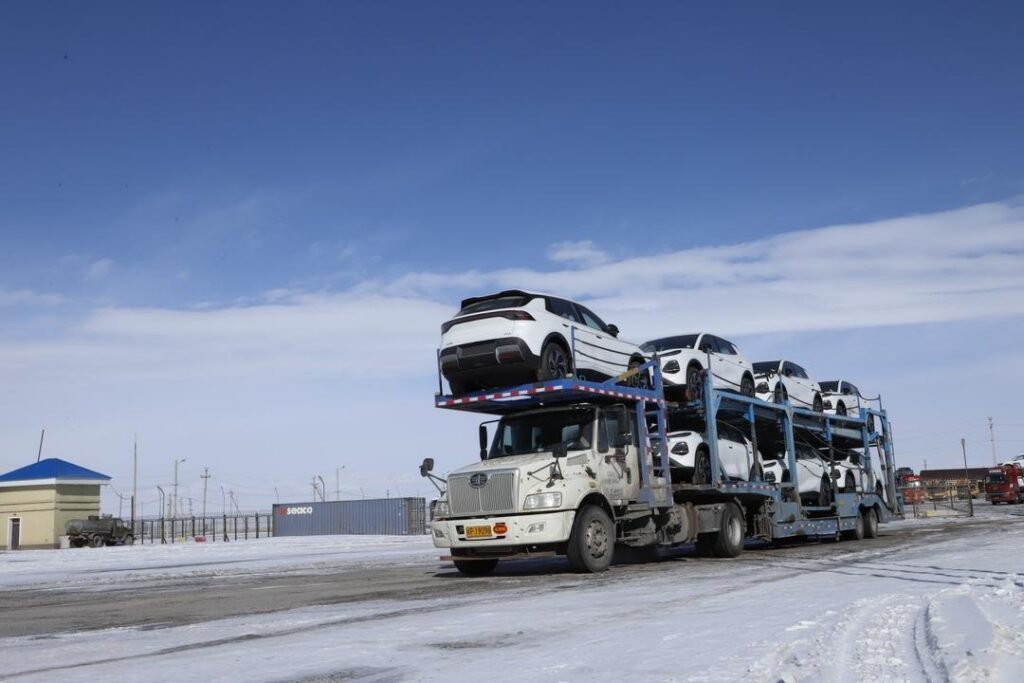
The number of electric vehicles in Kyrgyzstan has been steadily increasing. According to First Deputy Prime Minister Daniyar Amangeldiev, more than 200 electric vehicles are imported into the country daily under a VAT exemption scheme.
As a member of the Eurasian Economic Union (EAEU), Kyrgyzstan also benefits from an annual quota allowing the duty-free import of up to 15,000 electric vehicles.
Despite this rapid growth, electric vehicles still represent a small share of the national vehicle fleet.
According to the Ministry of Natural Resources, Ecology, and Technical Supervision, Kyrgyzstan had more than 1.9 million registered vehicles as of early 2026, a 13% increase compared with 2024.
Of these vehicles, 972,000 run on gasoline, 339,000 on diesel, 56,900 on gas, and 37,000 are hybrids. Electric vehicles account for about 0.8% of the national fleet, or approximately 15,200 vehicles.