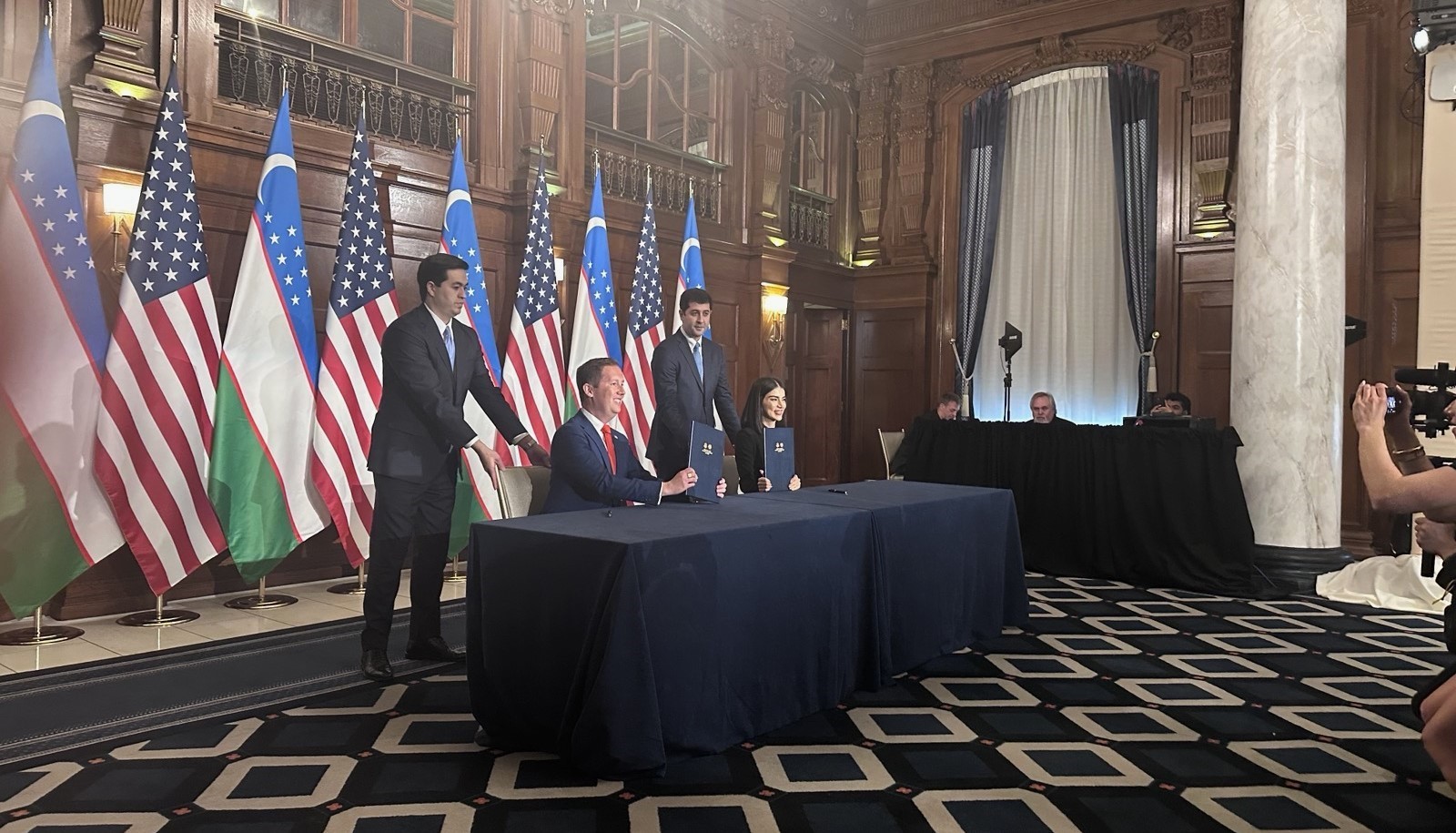
Washington D.C. – At the launch of the American-Uzbek Business and Investment Council in Washington on April 6, the most revealing line came early. Ambassador Sergio Gor, the White House’s special envoy for South and Central Asia, and Co-Chair of the Council, did not begin with trade statistics or a list of deliverables. He began with a blunt assessment of how the region has been treated in Washington. “For too long, this region has not found the attention that it deserves,” he said.
That observation is hardly novel to anyone who follows Central Asia. What made it notable was the speaker and the setting. U.S. policy toward the region has often been episodic, driven at different times by Afghanistan, by Russia, by sanctions enforcement, or by concern over Chinese influence rather than sustained by a coherent regional economic strategy. Gor’s remarks suggested an attempt, at least by the current administration, to correct for that pattern. He was equally clear, however, that this was a political opening, not yet a settled doctrine. “Take this opportunity that the next two and a half years present,” he told the room, an unusually candid acknowledgment that Washington’s attention may be real without yet being durable.
His other key formulation explained how the administration wants to make that attention count. “Never before in the history of the U.S. government has commercial diplomacy been such a major pillar of U.S. foreign policy,” Gor said. Whatever the phrasing, the intended shift was clear. Washington is signaling that in Central Asia, economic statecraft will not be treated as a side channel to politics, but as a primary instrument of policy. In that sense, the new council is less a ceremonial bilateral upgrade than a mechanism for turning political attention into projects, financing, and institutional follow-through.
Saida Mirziyoyeva, head of Uzbekistan’s presidential administration and the Uzbek co-chair of the council, answered that shift with a line that was just as pointed. “We are no longer at the stage where we speak about potential,” she said. “We are at the stage where we must deliver.” For a government that has spent years presenting Uzbekistan as a reforming economy open to outside capital, that was a significant change of emphasis. The argument is no longer that Uzbekistan deserves credit for opening up but that it now expects to be judged by execution.
Her most substantive remarks were about institutions rather than ambition. The council matters, she said, because it should help “solve problems quickly, without unnecessary bureaucracy” and ensure that “no project is lost along the way.” That is a more serious claim than the language of partnership that usually fills these forums. Mirziyoyeva was effectively acknowledging the gap that often opens between political endorsement and project delivery. Uzbekistan’s challenge is no longer simply attracting attention from foreign partners but getting projects through financing, approvals, and implementation without losing momentum inside the state apparatus.
The rest of the program put practical detail behind those two opening keynotes. Laziz Kudratov, Uzbekistan’s minister of investments, industry and trade, argued that bilateral engagement had moved “from dialogue to implementation,” pointing to projects and negotiations across energy, petrochemicals, transport, agriculture, and digital infrastructure. David Fogel, the U.S. assistant secretary of commerce, gave the American version of the same story that bilateral trade has crossed the $1 billion mark, U.S. exports are up, and several billion dollars in deals remain in the pipeline. Those are not transformative figures in themselves, but they matter in a region where the U.S. economic presence has often lagged behind its diplomatic interest.
More important than the trade numbers was the repeated focus on financing mechanisms. Across the program, officials on both sides described the same operating model in different terms: build a pipeline, de-risk projects, align export credit and development finance, and move from political endorsement to bankable transactions. The language of the meeting may have been diplomatic, but its logic was financial.
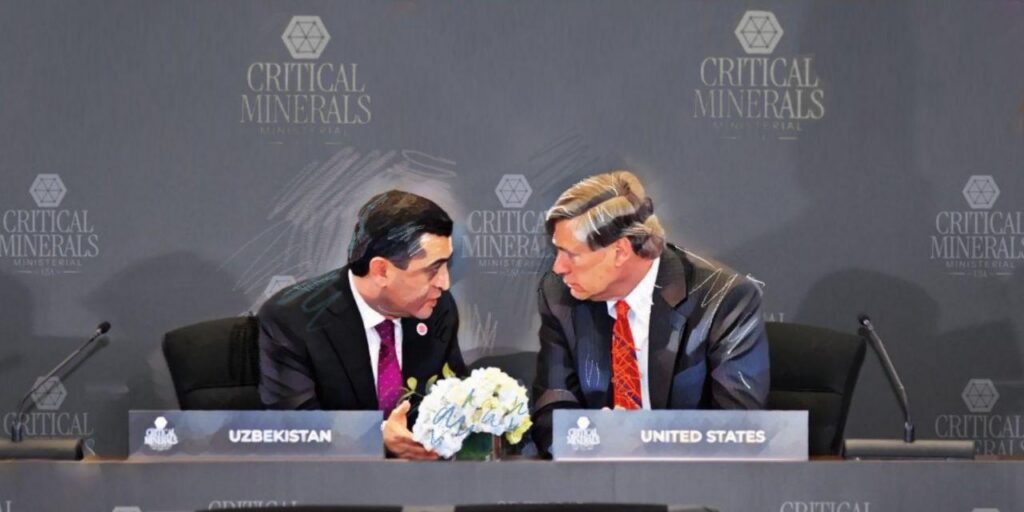
The sector where strategy and commerce most clearly intersected was mining. Bobir Islamov, Uzbekistan’s mining minister, laid out the country’s ambitions in gold, copper, uranium, tungsten, and rare earth elements, but he was careful to stress that Tashkent does not want to remain merely an exporter of raw material. The objective, he said, is processing and higher value-added production inside Uzbekistan. Caleb Orr from the State Department connected that directly to U.S. priorities, arguing that rising demand for copper and uranium makes Uzbekistan a relevant candidate to a wider push for more diversified and resilient supply chains.
The launch of the council reflects Washington’s broader, deepening economic engagement in Central Asia. C5+1 remains the principal regional framework, but U.S. commercial diplomacy in the region also advances through country-specific relationships and business platforms alongside it. In that wider setting, the American-Uzbek Business and Investment Council gives one strand of that regional push a more formal bilateral vehicle in Uzbekistan, anchoring it in financing, coordination, and project delivery.
The presence of private-sector participants helped ground the discussion. Melissa Schaeffer of Air Products pointed to the company’s existing industrial footprint in Uzbekistan, including projects in industrial gas and hydrogen. Mirziyoyeva, for her part, highlighted changes in digital regulation and the push to create conditions for global payment and technology platforms to operate more fully in the Uzbek market. Those details broadened the picture beyond mineral access and strategic signaling to include the less visible work of making commercial activity function.
The significance of the council lies in its attempt to translate Washington’s renewed attention to Central Asia into working mechanisms—financing tools, project pipelines, and institutional coordination—while allowing Tashkent to anchor that attention in implementation. Gor’s opening line acknowledged a long-standing reality that the region has often been underprioritized. Mirziyoyeva’s shifted the focus to delivery. If the council proves useful, it will be because both sides manage to turn moments of political attention into structures that can outlast them.