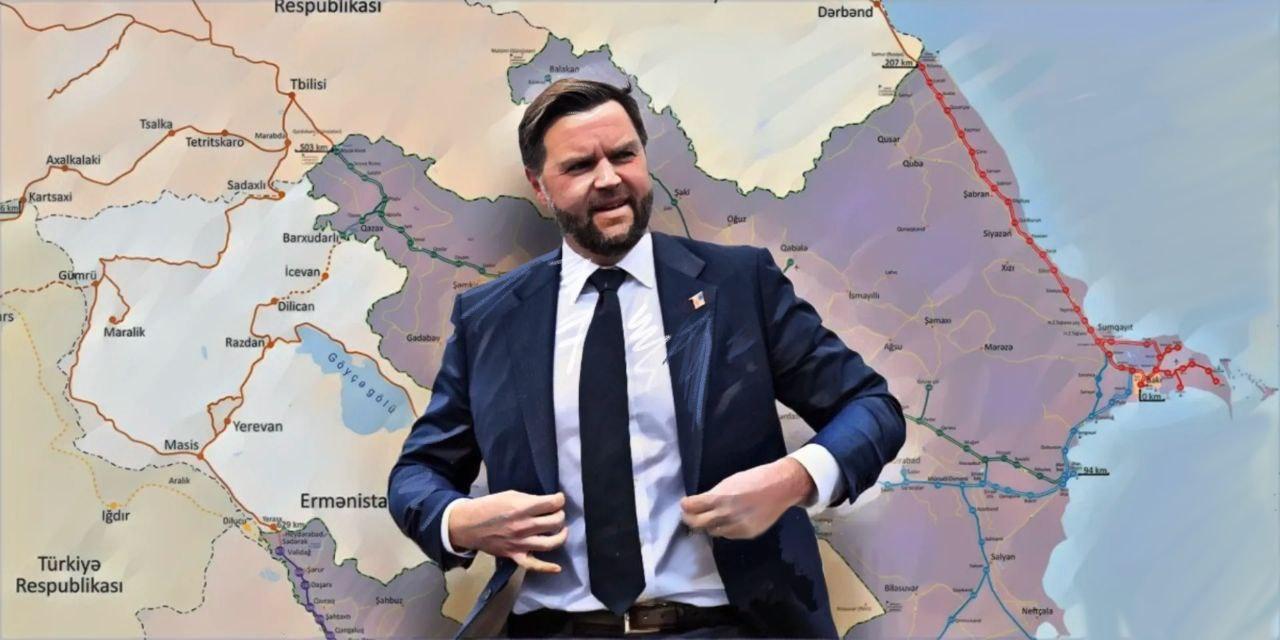
U.S. Vice President J.D. Vance’s Armenia and Azerbaijan tour is being sold as a “peace dividend” for the South Caucasus, but for Central Asia, the significance is the infrastructure potential of the Trump Route for International Peace and Prosperity (TRIPP). Vance’s trip is another move in positioning the new Caucasus transit route for the Middle Corridor. His visit necessarily focuses on the Armenia–Azerbaijan fix, but recent diplomatic context makes clear that it is at least equally a Central Asia to Europe proposition.
Current constraints on Trans-Caspian connectivity have been the shortage of dependable shipping capacity across the Caspian, port access, and border processing times. As the European Commission pointed out last week, traffic has surged since 2022, but the next jump depends on targeted investment and practical fixes along the route.
The Middle Corridor’s Central Asian Axis through Kazakhstan and Uzbekistan
Kazakhstan’s recent moves treat the bottlenecks as practical engineering and scheduling problems. The dredging project at Kuryk aims to deepen the port approach channel to five meters to support year-round navigation. Work is scheduled for early 2026 and backed by ERSAI Caspian Contractor LLC, a joint venture between Saipem and the Kazakhstan-based business group ERC Holdings. ERSAI is a major industrial port and fabrication yard operator specializing in offshore construction, logistics, and port services in the Caspian Sea. The dredging project is tied to broader terminal and shipyard expansion designed to create a key industrial hub.
Shipping capacity is the other half of that story. A plan reported late last year envisages six ferries on the Kuryk–Alat line, with the first two entering service in the first half of 2026 and additional vessels added through 2028. Even if timelines slip, the point is to create a predictable schedule.
Uzbekistan’s connectivity push has been running on two tracks at once: east to west via the Caspian, and southward toward ports beyond Central Asia. In Washington, a delegation from Tashkent, led by Foreign Minister Bakhtiyor Saidov, a week ago signed a memorandum with the United States on critical minerals and rare earths. This move treats extraction and processing as a supply-chain partnership rather than a one-off investment pitch.
At the same time, Uzbekistan has been pushing rule-making with corridor partners, not waiting for outsiders to do it. On February 10, Azerbaijan, Turkmenistan, Uzbekistan, and Georgia signed a protocol covering digitalization and freight development along the Middle Corridor, including shared methods for tracking delays and pinch points. This is in line with the necessary streamlining of paperwork.
TRIPP as the South Caucasus Link for Central Asia
TRIPP is meant to make the Caucasus segment less fragile by adding a second path, other than the recently renovated and expanded Baku–Tbilisi–Kars railway route. The U.S-backing and institutional presence are meant to create confidence and reliability. Armenia’s own published implementation framework describes a TRIPP Development Company with an initial 49-year development term and a proposed 74% U.S. share, while stating that Armenian sovereignty, law enforcement, customs, and taxation authority remain intact. This satisfies domestic Armenian political demands to move goods faster without formally transferring jurisdiction.
Vance’s Yerevan package was built to signal that the United States will underwrite Armenia’s strategic pivot with material assistance. A civil nuclear cooperation agreement is foreseen under a 123 framework, with figures that point to billions in potential exports and longer-term fuel and service ties, as Armenia looks to replace the aging Metsamor plant. A “123 Agreement” is a legally binding, negotiated framework under Section 123 of the U.S. Atomic Energy Act of 1954 authorizing significant civil nuclear trade, technology transfers, and fuel supply between the United States and a partner nation. Although this is not connectivity in the narrow sense, it is the kind of capital commitment that makes a corridor promise feel less reversible.
In Baku, the anchor was a Charter on Strategic Partnership that explicitly links cooperation to regional connectivity and the Trans-Caspian International Transport Route, alongside security and trade priorities. Local reporting and regional outlets have also highlighted maritime security cooperation, including patrol boats meant to protect Azerbaijan’s Caspian waters, which is where Middle Corridor reliability begins to look like naval policy.
For Central Asia, TRIPP’s practical meaning is as a way to reduce single-route dependence in the Caucasus segment while pulling “critical minerals” into the same conversation as rail schedules and port depth. That link was reinforced earlier this month in Washington, where Vance used a critical minerals gathering to push the idea of a U.S.-led trade bloc for minerals and rare earths, explicitly courting Kazakhstan and Uzbekistan as partners.
The Connectivity Agenda
The most useful way to read Vance’s trip is as an attempt at further integration of the South Caucasus segment into Central Asia’s already-moving connectivity agenda. Kazakhstan is increasing port access and ferry capacity; Uzbekistan is writing operating rules with partners and courting supply-chain capital; the EU is mapping where investment actually pays off. TRIPP is being introduced as the missing link that could make those efforts cohere into a route with robust redundancy.
The next phase will depend upon whether Kazakhstan’s shippers, Uzbekistan’s exporters, and logistics firms can treat the route as a normal commercial baseline rather than an episodic workaround. The EU’s effort to reduce exposure to Russia-centric routes and Central Asia’s efforts to secure more than one dependable path for goods and minerals to European buyers have made the Middle Corridor the favored link. TRIPP’s significance here is less as a U.S. initiative and more as a new routing option that Kazakhstan and Uzbekistan can use to strengthen and attract increased processing and logistics investment while reducing vulnerability to sudden disruptions.
At a strategic level, TRIPP also signals the return of corridor politics as a structuring principle for cooperative relationships. In the 1990s logic, security reassurance was paired with major transport and energy projects; this logic is now reappearing as critical minerals and supply-chain resilience now complement oil, gas, and pipeline diplomacy. Competitive responses from Russia and Iran are evident, but the point is for Armenia and Azerbaijan to manage this together, with U.S. help, and to prevent corridor development from turning into a permanent contest. For Central Asia, the outcome that matters most is TRIPP’s contribution to making trans-Caspian transit predictable enough that investment decisions in Kazakhstan and Uzbekistan treat the route as reliable.