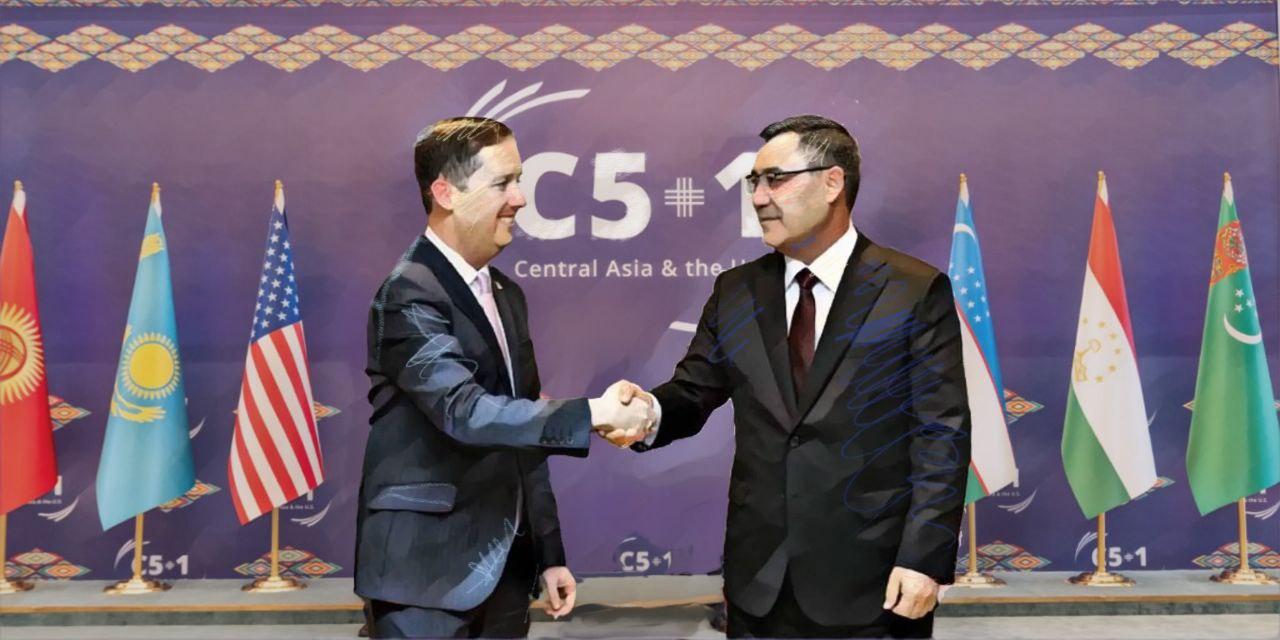
Business leaders and government officials from Central Asia and the United States gathered in Kyrgyzstan’s capital on February 4 for the start of the second B5+1 Business Forum. Co-organized by the Kyrgyz government and the Center for International Private Enterprise (CIPE), the event is intended to bring together private companies, business associations, officials, and experts interested in expanding U.S.–Central Asia commercial ties. More than 50 U.S. companies are participating in the event.
The B5+1 is the business-track counterpart to the C5+1 diplomatic format that links the United States with Kazakhstan, Kyrgyzstan, Tajikistan, Turkmenistan, and Uzbekistan. The B5+1 brings companies and policymakers together to identify barriers to investment and propose cross-border regulatory changes.
This week’s meeting in Bishkek follows the inaugural B5+1 forum held in Almaty on March 14–15, 2024, which drew more than 250 stakeholders from across Central Asia and the United States. It produced 21 private-sector recommendations aimed at easing trade, improving regulations, and building regional economic integration. The Bishkek agenda is built around reviewing progress on those recommendations and setting priorities for the next phase of work.
Central Asian officials have used the event to signal interest in region-wide coordination rather than country-by-country deals. In comments made in Bishkek, Kazakhstan’s Minister of Industry and Construction, Ersaiyn Nagaspaev, emphasized that foreign investors increasingly assess Central Asia as a single market, reflecting a push to align regulations and investment conditions across borders. Nagaspaev noted that more than 600 U.S. companies currently operate in Kazakhstan.
Kyrgyzstan, meanwhile, used the forum to highlight domestic economic performance within that regional context. In a speech at the forum, Kyrgyzstan’s First Deputy Chairman of the Cabinet of Ministers, Daniyar Amangeldiev, said Kyrgyzstan’s economy grew by 11.1% in 2025, which he described as one of the highest growth rates in the region.
Addressing the forum, U.S. Special Envoy for South and Central Asia Sergio Gor stated that the United States intends to expand its economic engagement with Central Asia. “The private sector, not intergovernmental agreements, will become the key instrument of interaction,” he told those in attendance, identifying electronic commerce, artificial intelligence, critical minerals, agriculture, and transport infrastructure as priority areas.
Gor noted that the American companies present at the forum represent the largest and most comprehensive U.S. commercial delegation ever to visit Central Asia. The U.S. recognizes the importance of Central Asia in global trade and connectivity, he stated.
“The United States is open for business. We’re open for peace. We’re opening to strengthen our ties around the world. So that’s why it’s fitting that the first C5 event in 2026 is this B5 + 1 forum,” Gor said, linking the Bishkek discussions to economic commitments made at the C5+1 summit in Washington in November 2025.
“The Transport Corridor for Peace and Prosperity will provide reliable connectivity from Central Asia through the South Caucasus to global markets,” Gor said. “This is a historic opportunity to strengthen economic integration and long-term prosperity across the region.”
During his visit to Bishkek, Gor also met with Kyrgyz President Sadyr Japarov, with the meeting covering economic cooperation and U.S. business engagement in Kyrgyzstan, including the participation of American companies in the B5+1. The Kyrgyz presidency said the two sides also discussed prospects for expanding trade, attracting investment, and developing cooperation in priority economic sectors.
Discussions in Bishkek highlighted how the B5+1 is being positioned as a standing mechanism rather than a one-off meeting. CIPE has framed the forum as part of an ongoing cycle in which private-sector proposals are developed through working groups and carried forward between annual meetings.
U.S. officials have linked the B5+1 more directly to Washington’s broader economic approach toward Central Asia. During his regional trip, which also includes Uzbekistan, Sergio Gor’s schedule has centered on business engagement and investment promotion rather than security or political consultations.
For the Kyrgyz authorities, hosting the forum is part of a broader effort to position the country as a regional convening hub. A December notice from Kyrgyzstan’s Ministry of Economy and Commerce described the B5+1 as a regional business mechanism within the C5+1 framework, rather than a Kyrgyz-specific initiative.
Previous B5+1 recommendations have focused on regulatory alignment, trade facilitation, and investment conditions, but no public timeline has been announced for publishing updated recommendations from the Bishkek meeting. CIPE has said outputs from earlier forums were compiled after consultations rather than issued as immediate communiqués.
The absence of signed agreements or joint statements on the opening day has kept attention focused on whether the forum produces measurable follow-up. Earlier B5+1 recommendations from the 2024 Almaty meeting were published weeks after the event, following additional consultations with governments and business groups.
The B5+1 concludes on February 5. Any updated recommendations or sector-specific commitments are expected to emerge after the forum rather than during the event itself.
Explore our critical minerals special coverage for a timeline of Central Asia’s growing place in U.S. supply-chain strategy.