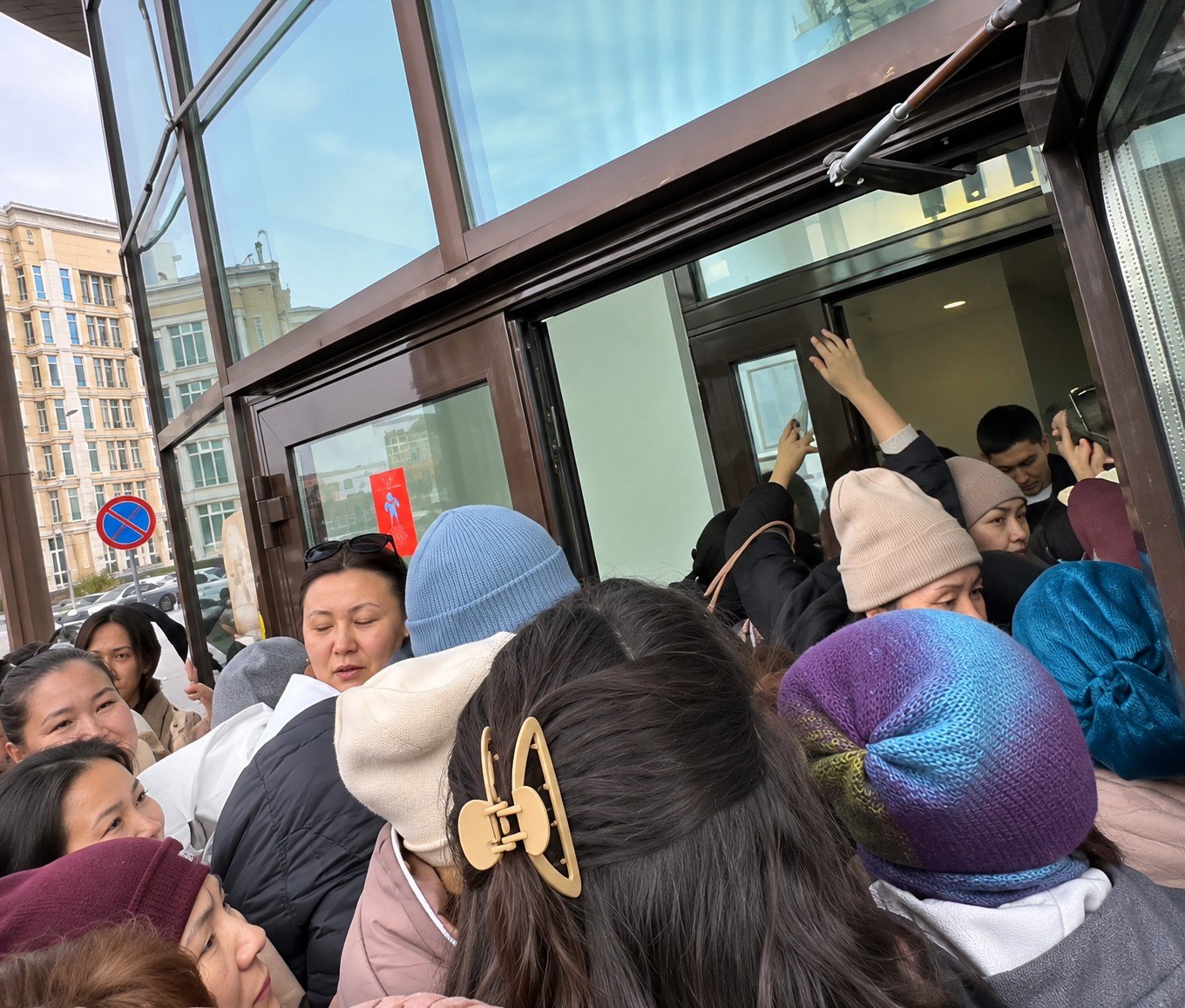
Women gathered outside a branch of Kazakhstan’s Otbasy Bank in Almaty’s Zhetysu neighborhood early on November 3, hoping to secure mortgages under a program designed to help women buy homes. Some banks drew up waiting lists, which security guards used to control entry, while others argued as the crowd pressed toward the doors. The scene was captured on video and circulated on social media.
In Astana, women faced similar difficulties. Among them was Makpal, who moved to the capital in 2022 and has rented an apartment ever since. She told Kursiv that she had saved 6 million tenge ($13,300) toward buying a home, but this was insufficient for a standard Otbasy Bank mortgage, which generally requires applicants to save half the property’s value.
For women like Makpal, the Umai mortgage program offers another route into homeownership. Yet the rush for limited financing has exposed the difficulties women face in Kazakhstan’s housing market, as well as questions about whether the program’s terms adequately serve those most in need.
In 2025, women in Kazakhstan earned an average of 372,232 tenge ($830) a month, compared with 518,259 tenge ($1,153) for men, according to the National Statistics Bureau. The gender pay gap stood at 28.2%, making it particularly difficult for women to accumulate savings for a down payment or qualify for a mortgage on their own.
How Umai Works
The Umai program, named after a protector of mothers and children in ancient Turkic mythology, was launched in 2021 by state-owned Otbasy Bank with financing from the Asian Development Bank (ADB). Between 2021 and 2023, it helped 3,661 women purchase homes before being suspended. Applications reopened in August 2026.
Unlike the bank’s standard housing savings scheme, which generally requires borrowers to accumulate 50% of a property’s value, Umai allows women to buy homes with a minimum down payment of 20% in Almaty and Astana, or 15% elsewhere.
The demand has been considerable. Applications for the first round opened on August 31, when 9 billion tenge ($20 million) was allocated. Within seven hours, the bank had received 855 applications and closed registration. By November 3, it had issued 435 mortgages totaling 8.6 billion tenge ($19.1 million).
After Otbasy Bank requested additional funding from ADB ahead of schedule, a second round opened on November 3 with 20 billion tenge ($44 million) available. It too closed after seven hours, with 850 applications receiving preliminary approval. Applicants in both rounds reported technical problems and delays.
The mortgages can be used to purchase newly built homes, qualifying properties under construction, or apartments on the secondary market in buildings completed no earlier than 2016.
The maximum loan is 50 million tenge ($111,000), with an annual interest rate of 14.8%. Including additional borrowing costs, the effective annual rate ranges from 16.3% to 16.8%. Applicants must demonstrate official income for the previous six months and have a positive credit history. Average monthly household income after taxes must not exceed 1.25 million tenge ($2,780).
The Cost of Buying a Home
Although the initial deposit is smaller than under Otbasy Bank’s standard mortgage scheme, the monthly repayments remain substantial.
In one example published by the bank, a woman purchasing a 30 million tenge ($66,700) apartment with a 24 million tenge ($53,300) mortgage would initially pay 387,200 tenge ($860) a month if she had no existing savings in an Otbasy Bank deposit account.
That is more than the average monthly salary of women in Kazakhstan. Applicants can, however, include household income and bring in up to two co-borrowers.
The program allows borrowers to move to a lower interest rate, potentially as low as 3.5%–5%, after building sufficient savings in an Otbasy Bank deposit account. Part of their monthly payments goes toward these savings, but accumulating the necessary amount can take years.
The initial down payment can also prove higher than advertised. The bank calculates a mortgage against the lower of a property’s purchase price or its appraised value. If the valuation falls short of the asking price, the buyer must cover the difference herself.
Who Benefits from Umai?
One unusual feature of the program is that applicants do not have to be first-time buyers. Women who already own homes can apply for another mortgage, with no competitive selection process based on housing need.
The ADB approved financing worth 90 billion tenge ($173.6 million at the time) in April 2026 for Umai and a separate Green Mortgage program. The combined financing is intended to benefit more than 2,000 households, with expanding women’s access to affordable housing among its objectives.
Otbasy Bank publishes figures on applications, loan amounts, and participants’ ages, but its published results do not show how many borrowers already owned property or how recipients are distributed by income and family circumstances.
The absence of a first-time buyer requirement does not mean the program is being misused. It does, however, leave open the question of how much of the limited financing is reaching women who would otherwise struggle to enter the housing market.
Otbasy Bank says further application rounds will follow as additional ADB financing becomes available, although it has not announced dates.