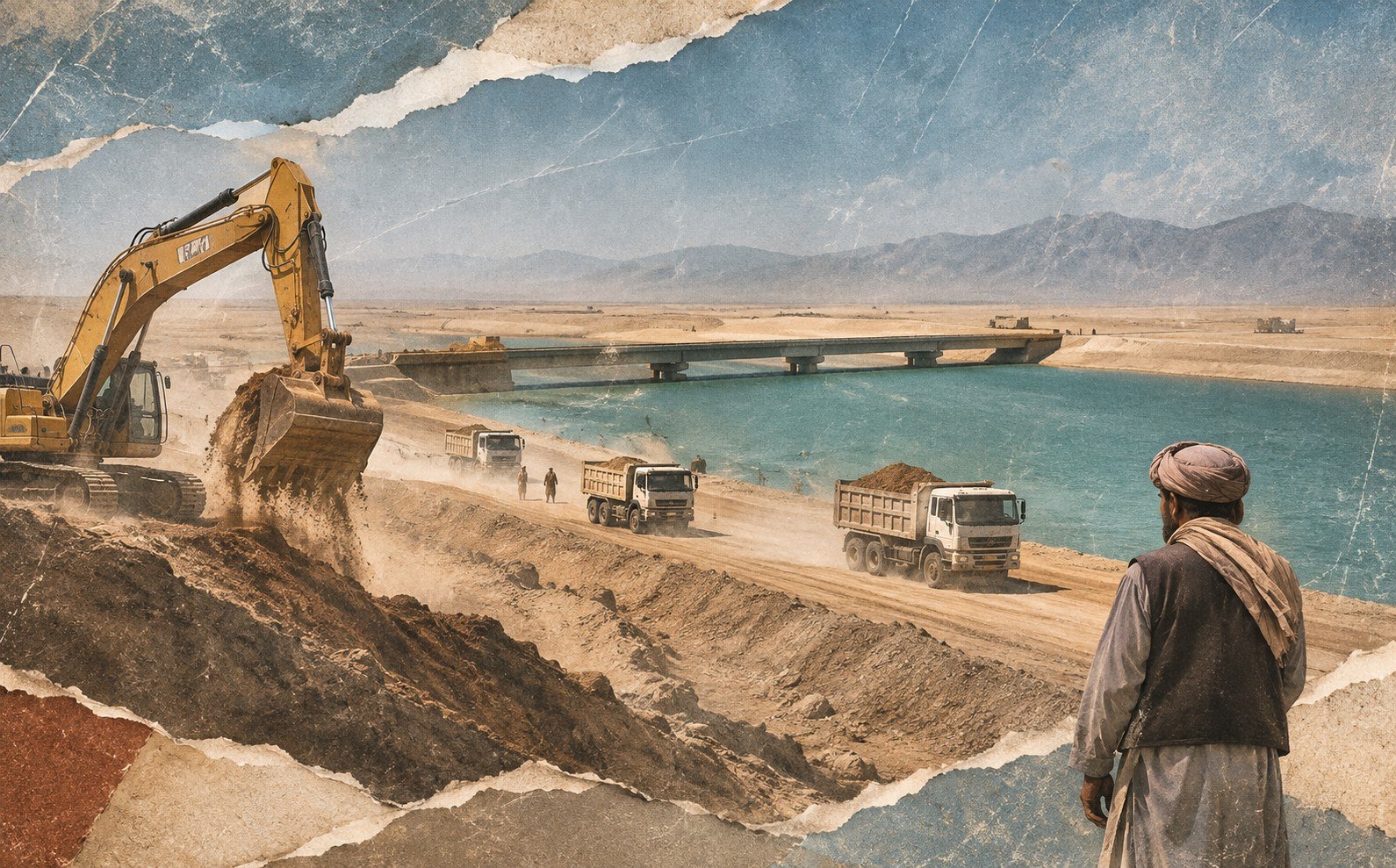
Afghanistan’s Qosh Tepa Canal poses a threat to water supplies in Uzbekistan and Turkmenistan. It could also leave less water for farms in southern Kazakhstan and complicate efforts to restore the North Aral Sea.
Kazakhstan does not use water from the Amu Darya, the canal’s source, and the canal does not draw water from the Syr Darya. Uzbekistan, however, draws on both rivers. At an international conference on Afghanistan and regional security in Almaty on November 11, I examined how Uzbekistan’s response to a shortage on the Amu Darya could affect the flow of the Syr Darya into Kazakhstan.
Water for Afghanistan
The Qosh Tepa Canal is one of the largest infrastructure projects in modern Afghanistan. It is designed to run about 177 miles (285 kilometers). Afghan officials expect it to irrigate about 550,000 hectares.
Agriculture remains a major source of employment and income in rural Afghanistan. Expanding irrigation could create jobs and allow farmers to produce more food, reducing the country’s dependence on imports. Afghanistan’s neighbors also have a stake in the sustainable development of its agricultural sector.
Once fully operational, the canal could divert 8% to 20% of the Amu Darya’s average annual flow, according to estimates cited by the Stockholm International Water Institute.
On November 19, Uzbekistan’s water resources minister, Shavkat Khamraev, said he did not expect full-scale withdrawals before 2030. He cited preliminary Afghan estimates that put annual withdrawals at about 6 billion cubic meters in dry years and up to 10 billion in wet years. The two countries are already in talks and intend to formalize water use arrangements once construction is complete.
How much water Afghanistan actually takes will depend in part on how quickly it brings new farmland under irrigation. Irrigation efficiency and the volume of water flowing through the Amu Darya will also affect withdrawals.
How Uzbekistan Links the Two River Basins
Pressure on the Amu Darya could prompt Uzbekistan to reconsider its agricultural and investment priorities. It could also speed up irrigation improvements, including the adoption of water-saving technologies. Most of these measures would directly affect the Amu Darya basin, but Uzbekistan’s water policies cover both rivers.
For Kazakhstan, the question is whether Uzbekistan would rely more heavily on the Syr Darya if it had less water from the Amu Darya. Modernizing irrigation systems and jointly forecasting water demand could ease pressure on both rivers. Prolonged droughts and too little investment in irrigation could make it harder for the two countries to reconcile their interests.
For now, the idea that the canal could affect cooperation between Kazakhstan and Uzbekistan on the Syr Darya remains a hypothesis. Testing it will require comparable data on water use and joint modeling.
What Is at Stake for the North Aral Sea
The Syr Darya supplies farms in southern Kazakhstan before it reaches the North Aral Sea. Kazakhstan’s Ministry of Water Resources and Irrigation reports that the volume of water in the sea rose from 18.9 billion cubic meters in 2022 to 23.4 billion by August 2026. With the planned reconstruction of the Kokaral Dam, the authorities aim to raise that figure to about 34 billion cubic meters.
Further restoration of the sea depends on inflows from the Syr Darya. In dry years, farmers and power producers compete for water that also sustains natural ecosystems.
It would be a mistake to attribute any future decline in inflows directly to the Qosh Tepa Canal. Precipitation and meltwater from snow and glaciers influence the flow of the Syr Darya. Reservoir operations and withdrawals for irrigation also affect how much water reaches the sea, as does compliance with agreements between countries.
Water Diplomacy With Afghanistan
On the Amu Darya, monitoring should show how much water is withdrawn as new land comes under irrigation and how efficiently that water is used. Kazakhstan needs to track inflows to the Shardara Reservoir and the North Aral Sea. It must also monitor whether water arrives on schedule and how dams and reservoirs operate from season to season. Joint analysis of these data would help distinguish any effects of the canal from those of climate variability and other causes of water scarcity.
Kazakhstan and Uzbekistan already have a basis for such cooperation. On November 15, 2025, they signed an agreement to manage their shared waters. Uzbekistan ratified it in March 2026, and Kazakhstan followed in July. The agreement provides for an intergovernmental commission and calls on the two countries to share information and coordinate the operation of water infrastructure.
A joint working group had already met in January 2026 to discuss plans for ten automated monitoring stations along the Syr Darya, five in each country. The German Agency for International Cooperation prepared the technical specifications. Once operational, the stations could give early warning of shortages and show more reliably whether each country receives its agreed share of water.
More accurate forecasts will also require technical discussions with Afghanistan. Every country in the region has an interest in knowing how much water Afghanistan plans to withdraw as it expands its irrigated farmland and how demand will vary by season. Those discussions must take Afghanistan’s own agricultural interests into account.
Kazakhstan should not wait for another period of low river flows to assess the risks to both basins. By sharing hydrological data and working with Afghan specialists, Kazakhstan and Uzbekistan could model how different levels of withdrawal from the Amu Darya might affect Uzbekistan’s water policies.
The views expressed in this article are those of the author and do not necessarily reflect the official policy or position of the publication, its affiliates, or any other organizations mentioned.