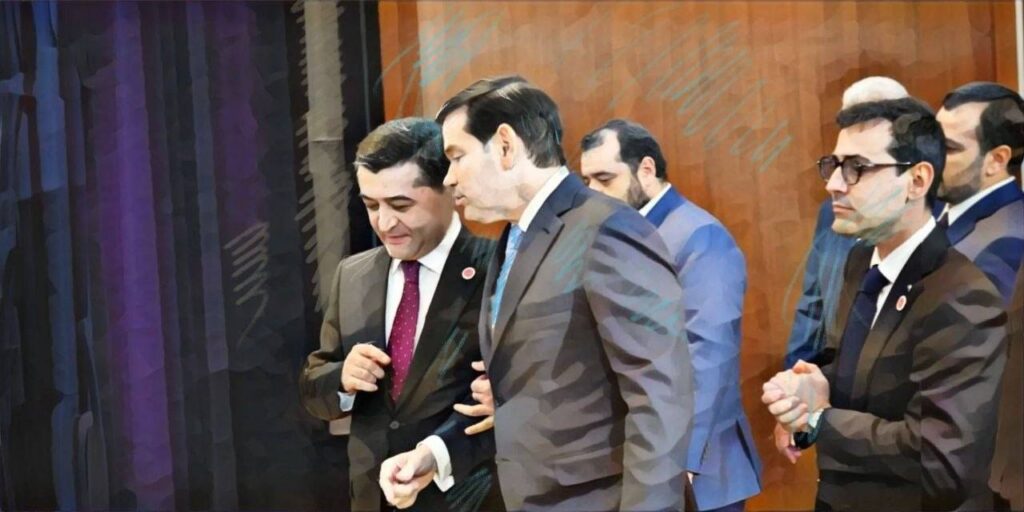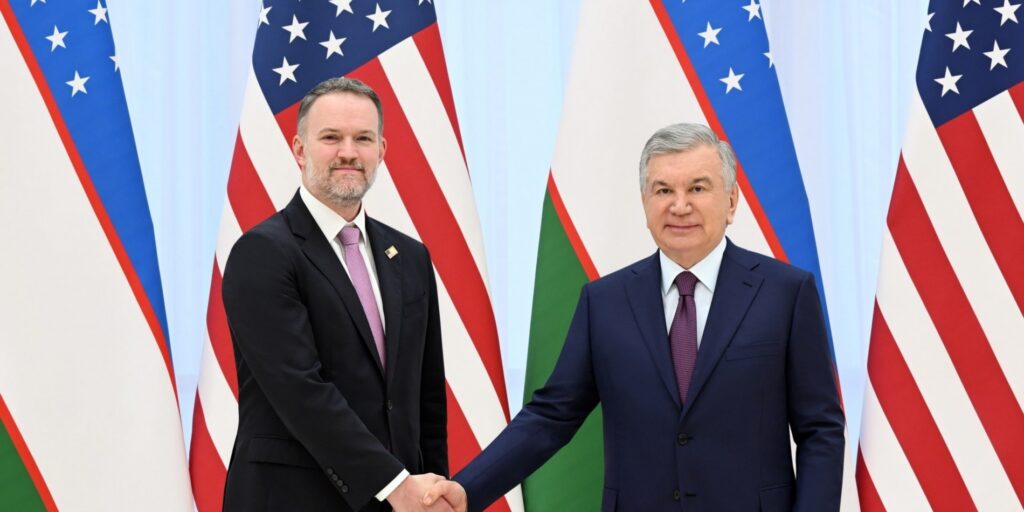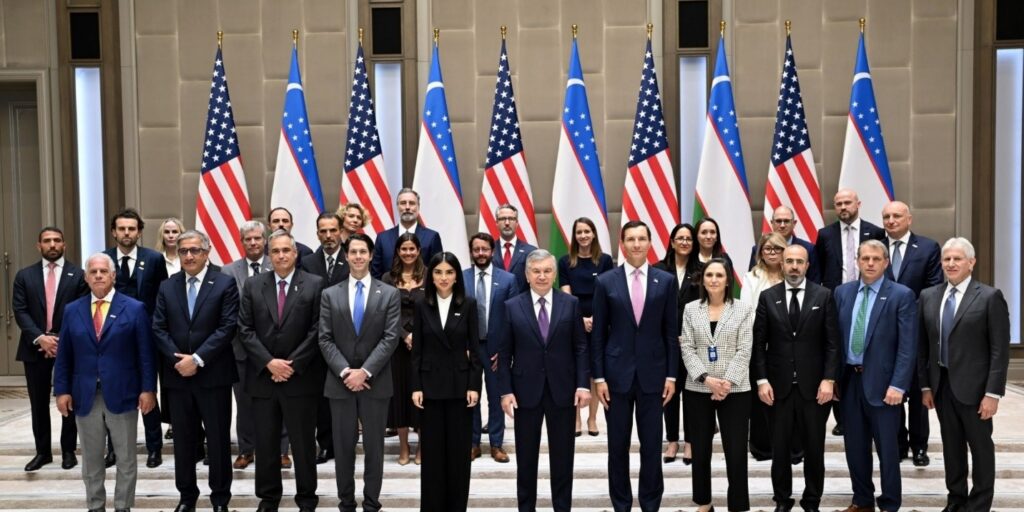
Uzbekistan sought American financing and technology for electricity networks, data centers and transport infrastructure at a Washington business roundtable on November 9.
The U.S. Chamber of Commerce breakfast, held alongside the Business 20 (B20) summit, the G20’s business engagement forum, featured a delegation led by Laziz Kudratov, Uzbekistan’s minister of investment, industry and trade. Uzbekistan’s ambassador to the United States, Furqat Sidikov, introduced the delegation, while Jennifer Miel, the Chamber’s vice president for the Middle East, Central Asia and Türkiye, moderated the discussion.
“We want to build on this momentum and develop new mutually beneficial partnerships,” Kudratov told participants.
He pointed to changes in currency conversion, profit repatriation and tax administration since reforms that began in 2017. Uzbekistan’s economy grew by 7.7% in 2025, according to the International Monetary Fund, which has also called for stronger competition and a reduced state role to support private-sector growth.
Electricity Networks and Transport Financing
First Deputy Energy Minister Umid Mamadaminov said Uzbekistan’s expansion of electricity generation had created a pressing need to strengthen the networks carrying power to households and businesses.
He estimated that transmission and distribution upgrades would require at least $5 billion over the next four to five years. New wind and solar capacity in northwestern Uzbekistan would need additional connections to major centers of demand, alongside digital modernization of the electricity system.
The next phase would involve the “digital transformation of the energy industry,” Mamadaminov said. He invited American businesses to participate through technology provision and financing, including partnerships with developers from other countries.
On October 27, the World Bank approved a $100 million loan for electricity distribution modernization, alongside $200 million approved by the Asian Development Bank. The World Bank described aging infrastructure and overloaded substations as constraints on reliable supply and the integration of renewable generation.
Mamadaminov also highlighted the proposed green electricity corridor connecting Central Asia with Europe through Azerbaijan. The initiative remains in preparation, with ADB and the Asian Infrastructure Investment Bank supporting feasibility work on the cross-border transmission project.
On transport, Kudratov discussed the China–Kyrgyzstan–Uzbekistan railway, expanded Caspian shipping connections, and feasibility work on a Trans-Afghan railway as elements of Uzbekistan’s efforts to diversify its trade routes.
He also highlighted prospective U.S. financing for Tashkent’s new international airport. The U.S. International Development Finance Corporation is considering a direct loan of up to $700 million for the airport’s construction, development and operation. The airport’s first phase is designed to accommodate up to 20 million passengers annually.
IT Exports, Data Centers and AI
Deputy Minister of Digital Technologies Rustam Karimjonov emphasized technology services as a source of employment and export earnings, identifying the United States as an important market for further expansion.
He highlighted workforce training and support for businesses operating through IT Park. Artificial intelligence, cybersecurity, education technology and data centers were among the priorities presented to prospective partners.
Official statistics show that service exports by IT Park participants rose from approximately $454.9 million in 2024 to $728.4 million in 2025. Those figures measure exports by participating businesses, rather than the entire national digital economy.
Karimjonov also highlighted the DataVolt data center development in Tashkent. According to the European Bank for Reconstruction and Development, the facility is designed for 12 megawatts of IT load. The project is intended to serve customers including businesses, government institutions and international cloud providers.
In June, DataVolt secured a financing package of up to $150 million involving the EBRD, Germany’s DEG, France’s Proparco and the OPEC Fund for International Development. The financing supports the facility’s development and operation.
Kudratov pointed to preferential electricity pricing as an incentive for further investment. Uzbekistan has announced a preferential electricity tariff of five U.S. cents per kilowatt-hour for investors committing more than $100 million to AI infrastructure in Karakalpakstan, together with other benefits.
New Tashkent and Business Missions
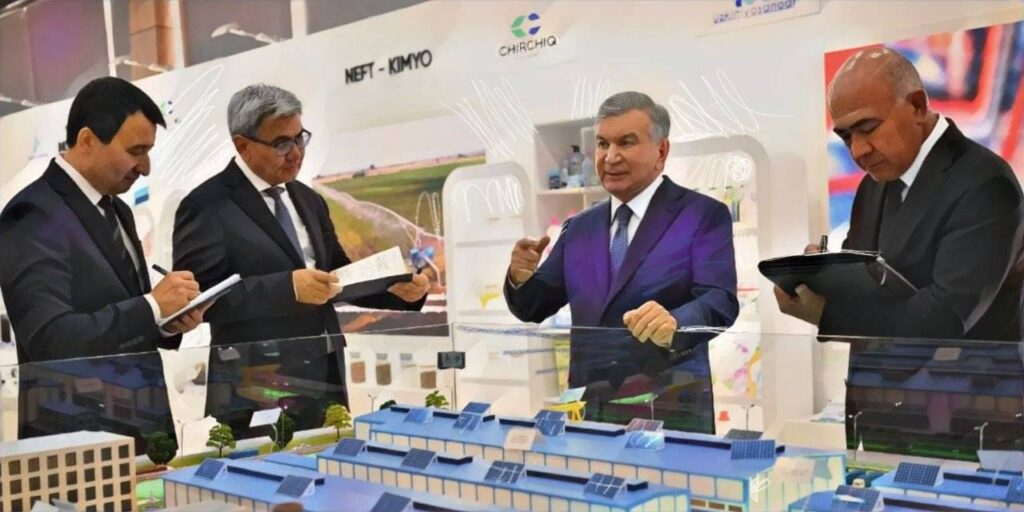
The delegation also presented opportunities in New Tashkent. Sharaf Radjabov, deputy director of the development’s construction directorate, invited U.S. companies to explore participation in the planned city.
Khush Choksy, a senior vice president at the U.S. Chamber of Commerce, said the organization was planning another business mission to Uzbekistan in 2027 and discussing a reciprocal Uzbek delegation to the United States.
Both visits would involve advance work to identify suitable companies, sectors and locations, he said. The Chamber intended to match participants with potential partners before they traveled, with the aim of producing “tangible business outcomes.”