There is no shortage of elegant phrases to describe relations between Kazakhstan and South Korea: “strategic partnership,” “immense potential,” “new prospects,” and “mutual interest.” What is still missing is South Korean investment on the scale sought for Alatau City and K-PARK, the international cultural and business center planned for the city.
For years, the Korean community in Kazakhstan has been called a “living bridge” between the two countries. But even a golden bridge fulfills its purpose only when it connects both sides.
It would be unfair to claim that South Korea is doing nothing. The Korea Overseas Infrastructure & Urban Development Corporation (KIND) is involved in planning, the K-Smart Town concept is being developed, and Korean companies and institutions are discussing possible participation.
During President Kassym-Jomart Tokayev’s September 2026 visit to Seoul, Kazakhstan presented joint initiatives with KIND, the Korea Advanced Institute of Science and Technology, and Korea Airports Corporation. They covered urban development, research and education, digital technologies, and urban air transport.
These are meaningful steps. But initial interest, a memorandum, project design, financial commitments, and actual foreign direct investment are different stages. We should not present progress at one stage as proof that the next has been achieved.
Kazakhstan Is Selling a Vision. Investors Need Projects.
The first problem is the gap between what Kazakhstan offers and what investors are prepared to finance.
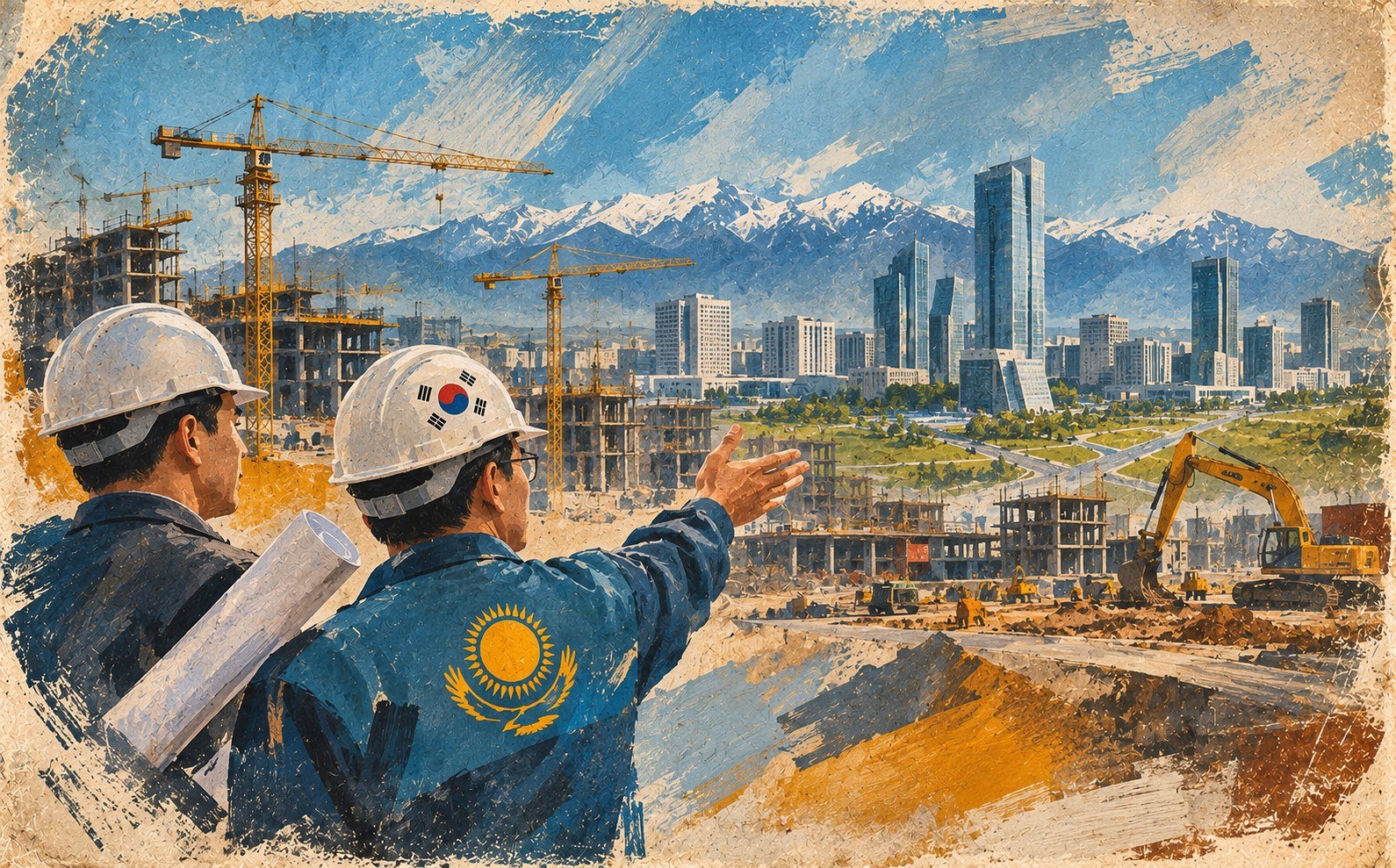
We have become adept at presenting the future. On screen, Alatau City has skyscrapers, smart districts, environmentally friendly neighborhoods, universities, medical centers, advanced transport systems, and AI.
After the presentation, Korean businesses ask different questions. Who owns the land? Who pays for electricity, water, and other essential infrastructure? What are the utility tariffs? How are investors protected against changes in legislation? Where will disputes be settled? What return can they expect, and when will they recover their capital?
At that point, an attractive rendering must give way to a carefully prepared spreadsheet. This is one of the weaknesses of our investment diplomacy. We too often sell a concept rather than an investable product.
A company cannot simply invest “in the city.” It invests in a power plant, hotel, or data center, with a defined site, infrastructure arrangements, and a clear allocation of risks.
The second problem is the scale of the undertaking. Alatau is being developed as an entirely new urban and economic environment. Investors must assess more than the prospects of a single enterprise. They must consider future population growth, demand, transport flows, energy and water supplies, and the stability of the regulatory framework.
Kazakhstan has already adopted a special legal regime for Alatau City. The constitutional law, adopted on May 8, 2026, establishes a distinct framework for the city’s accelerated development, investment, governance, and economic activity.
That is an important institutional step. Yet the existence of a law does not eliminate the need for predictable implementation. An investor must understand how the rules will operate over the next 10 or 15 years.
Capital is more conservative than diplomacy. A minister can sign a memorandum today; a company must live with the consequences of its investment for decades.
South Korea Has Its Own Investment Priorities
The third problem lies on the Korean side. South Korea’s political engagement with Central Asia is growing, but a government priority does not automatically become a corporate priority.
Korean companies compare Alatau with competing opportunities across Asia, Europe, the Middle East, and the United States. Our familiar argument that Kazakhstan has enormous potential is not enough. We must demonstrate why a dollar invested in Alatau offers a better balance of risk and return than one invested in Riyadh, Warsaw, or Jakarta.
Seoul, however, must also confront a question of its own. If Central Asia is a priority in South Korea’s economic strategy, how long can the exploration of opportunities continue without an initial investment in these projects?
State-backed development institutions exist partly to enable national businesses to enter promising markets where risks are still difficult for private investors to assess. Their next step in Alatau should be a first major project with committed financing, a construction schedule, and a company responsible for implementation. One completed Korean facility would demonstrate more than twenty memoranda of understanding.
K-Park: Historical Memory Is Not a Business Plan
The situation with K-PARK is especially revealing because its greatest strength is also its principal challenge. It draws on the memory of the 1937 deportation of ethnic Koreans from the Soviet Far East to Central Asia, the gratitude of Kazakhstan’s Korean community toward the people who received them, and the cultural ties with their ancestral homeland.
In 2027, the community will mark 90 years since the deportations. K-PARK is being developed by the Association of Kazakhstani Koreans in Alatau City’s Golden District, with an opening planned to coincide with the anniversary. Its concept includes a park, cultural facilities, and commercial spaces.
The historical foundation gives the project meaning. It does not, by itself, establish commercial profitability. We cannot expect Samsung, Hyundai, Lotte, or another Korean business group to invest millions simply because the history of Kazakhstan’s Korean community inspires sympathy. A board of directors must justify its investment to shareholders.
We should ask whether K-PARK’s commercial opportunities have been presented in a form businesses can evaluate. What exactly is available to an investor: a hotel, a Korean-themed shopping street, or a center for Korean entertainment and media?
K-PARK therefore needs two financing models. Its memorial and cultural core, including a museum, archive, monuments, Korean garden, historical research, and educational programs, should not be judged on commercial profitability.
Commercial opportunities, such as hotels, restaurants, and shops, should be offered as separate investment projects to companies with relevant experience. Instead of asking Lotte to “support K-Park,” for example, we should present a hotel project with occupancy forecasts, capital expenditure estimates, expected profitability, and management arrangements.
What Does South Korea Owe Its Diaspora?
In Kazakhstan, we sometimes assume that the historical experience of the Korean diaspora creates a moral obligation for South Korea to support our economic projects.
That expectation is misguided. The community’s language skills, professional networks, cultural knowledge, and historical connections are valuable assets in bilateral relations.
South Korea should nevertheless consider its responsibilities toward overseas Korean communities. If Seoul regards the diaspora as part of a global Korean community, its engagement should offer more than festivals, conferences, and welcoming speeches.
Korean government institutions, foundations, universities, and specialized organizations could support K-PARK’s cultural facilities and programs. Such participation would recognize the community’s historical significance without imposing noncommercial obligations on private investors.
From Roadshows to Financial Commitments
Kazakhstan needs to change how it measures investment diplomacy. The number of memoranda signed is not a meaningful measure of success. Actual capital invested, projects with financing secured, and facilities entering construction are. For Alatau City, I would begin by identifying 10–15 priority investment projects.
Each should have a clearly defined site and financial projections covering capital and operating expenditures, expected demand, returns, and the time needed to recover the investment. Investors also need to know the applicable tax regime, infrastructure guarantees, how risks will be shared, and their options for exiting the investment.
Permanent joint teams from Kazakhstan and South Korea should operate in Alatau and Seoul. Their task would be to resolve specific commercial, legal, and administrative obstacles, rather than organize another round of ceremonial meetings.
Negotiations should target companies with the relevant expertise, whether in energy, healthcare, education, or property development.
KIND and other development institutions could explore guarantees, co-financing, and ways to use public funding to attract private capital.
For K-PARK, the two financing models should be formalized in a bilateral arrangement, with separate portfolios for public and civic institutions and for commercial investors.
Both countries also need greater transparency. Every six months, the parties should publish a concise project-by-project report showing the partners involved, estimated investment value, formal commitments, actual capital deployed, and construction status. This would make it much harder to confuse a signed memorandum with a completed investment.
A Bridge That Must Carry More Than Words
I believe the prospects for South Korean investment in Alatau City are strong, though by no means guaranteed. Kazakhstan needs technology, infrastructure, and capital. South Korea has expertise in urban development, engineering, manufacturing, and advanced technologies, as well as companies seeking opportunities in overseas markets.
K-PARK’s financing should reflect its cultural and commercial purposes rather than depend on a single major investor.
Kazakhstan must stop selling a dream and start presenting investment-ready projects. South Korea, if it sees Alatau as a serious opportunity, should move from studying the market to securing financing for an initial major project.
Throughout Kazakhstan’s independence, its Korean community has been the “living bridge” so often invoked in official speeches. Now that connection needs to carry investment, economic activity, and cultural cooperation. Otherwise, we risk building a beautiful metaphor without building the city itself.
In the next joint communiqué, I would like to see fewer declarations that “the parties expressed interest” and three more meaningful descriptions of progress: “invested,” “under construction,” and “in operation.”
The views expressed in this article are those of the author and do not necessarily reflect the official policy or position of the publication, its affiliates, or any other organizations mentioned.