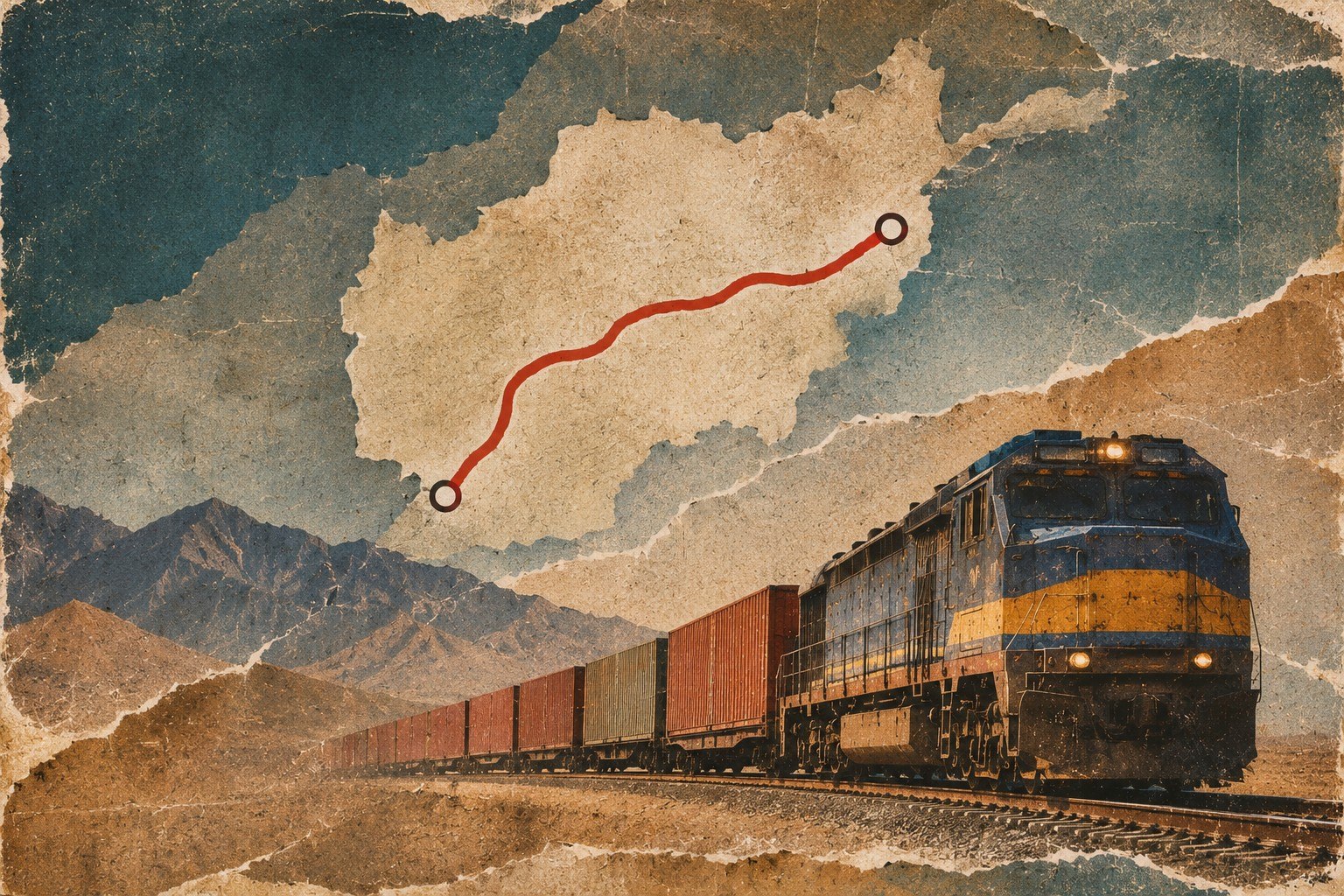
Kazakhstan is exploring several railway routes through Afghanistan to Pakistan’s seaports. One private-sector proposal is estimated to cost $4.1 billion, with operations targeted to begin in 2029. For Central Asia, the new corridor could provide an alternative to existing export routes and direct access to South Asian markets.
Preliminary details of the Central Asia–South Asia Railway (CASA) project were presented at the international New Silk Way business forum in Astana in October.
Kanat Kudaibergen, chairman of the board of GWM Capital Ltd. (GreyWolf Management), told The Times of Central Asia that the southern route would help diversify freight transportation, complementing the Trans-Caspian International Transport Route (Middle Corridor) and the International North-South Transport Corridor.
Routes and Freight Potential
One option under consideration involves using existing railway infrastructure in Kazakhstan and Turkmenistan, followed by the construction of a line through western and southern Afghanistan to the Pakistani border.
In early February 2026, Kazakhstan’s Ministry of Transport and Pakistan’s Ministry of Railways signed a memorandum on railway cooperation, including plans to develop a railway connection through Afghanistan.
Kazakhstan is also exploring a route through Uzbekistan. On September 30, 2026, Kazakhstan and Uzbekistan signed a memorandum with the United Arab Emirates on jointly assessing the technical and economic feasibility of the CASA railway corridor, which would provide access to the Pakistani ports of Karachi and Gwadar. The government’s announcement said a joint working group was under consideration.
The routes through Turkmenistan and Uzbekistan are separate infrastructure initiatives. Both share the objective of establishing a continuous railway connection between Central and South Asia.
According to Kudaibergen’s projections, freight volumes through Central Asia and Afghanistan could reach 28 million metric tons. Exports from Central Asia to and through Afghanistan are estimated at seven million metric tons, while imports from South Asia into Central Asia and Russia, including transit shipments, are estimated at 2.2 million metric tons. He estimates the corridor’s overall freight potential at 35–40 million metric tons annually.
Construction Costs and Financing
The private-sector proposal presented at the forum envisages a Mazar-i-Sharif–Herat–Kandahar–Spin Boldak railway.
Under the preliminary schedule, the feasibility study and approval of project documentation are to be completed by the end of 2026. The cost of this phase is estimated at $3.5 million. Construction is scheduled for 2027–2029, with commercial operations and investment recovery expected to begin in 2029.
To attract financing, the CASA investment fund has been established at the Astana International Financial Centre, which operates under a special legal and financial framework. According to Kudaibergen, the fund has been structured in accordance with Islamic finance principles.
The developers are still seeking investment agreements and arrangements with Pakistani ports.
Kazakhstan’s Involvement
Kazakhstan has expressed its readiness to invest up to $500 million in constructing the approximately 75-mile Torghundi–Herat railway. This section is envisaged as the first phase in developing the western branch of the Trans-Afghan Corridor.
According to Kazakhstan’s Ministry of Transport, preliminary technical work has already been completed. Once the necessary approvals have been obtained, Kazakhstan is ready to begin construction and supply building materials.
In late September 2026, a new 27-mile section of the Khaf–Herat railway linking Afghanistan and Iran was opened. Kazakhstan’s Integra Construction KZ participated in its construction.
The ministry also plans to establish a specialized railway training center in Herat. Discussions are underway with Uzbekistan on the possible construction of a transport and logistics center in Mazar-i-Sharif to receive and distribute freight from Kazakhstan, including metals, petroleum products, timber, and grain.
Until the railway infrastructure is completed, Kazakhstan is proposing expanded road freight transportation through Afghanistan. During the initial phase of railway operations, Kazakhstan estimates the corridor’s capacity at approximately ten trains in each direction per day.
Part of the freight base for the future corridor already exists. Between January and July 2026, Kazakhstan’s exports to Afghanistan reached $572.9 million, including $215.6 million in flour and $122 million in wheat. Vegetable oil accounted for another $51.1 million.
Further development of trans-Afghan freight transportation will require agreement on tariffs for the full route. Operators will also need to accommodate different track gauges, or distances between the rails, in Central Asia and Pakistan. Crucially, uninterrupted operations at the Afghan-Pakistani border will be needed. The main border crossings have been closed to regular trade for over a year, following clashes between Afghanistan and Pakistan in October 2025.