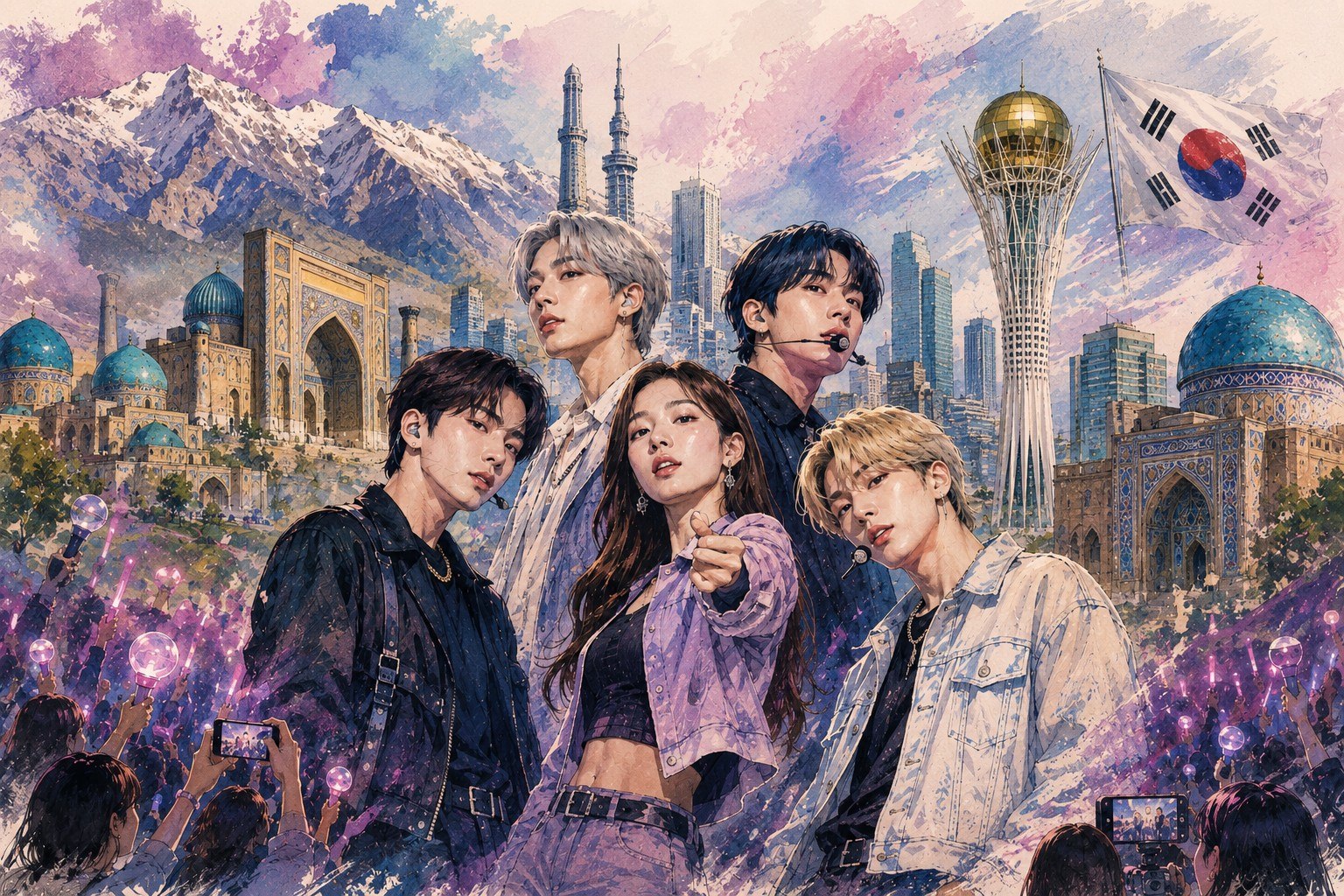
On weekend afternoons in Almaty, Tashkent, or Bishkek, groups of teenagers practice synchronized dance routines in parks, shopping centers, and university courtyards, their clothes echoing the polished style of Korean idols. BTS, BLACKPINK, Stray Kids, NewJeans, aespa, SEVENTEEN, and many other groups fill their playlists and social media feeds. Some are filming dance covers for TikTok, others are preparing for local competitions, while many simply gather with friends who share the same enthusiasm.
K-pop in Central Asia has become much more than a foreign music genre. It forms part of the broader Korean Wave, or Hallyu, encompassing television dramas, films, fashion, cosmetics, cuisine, tourism, and language learning. For many young people, Korean culture represents modernity, creativity, and participation in a global cultural space.
Korean popular culture began entering Central Asia in the late 1990s and early 2000s through serial dramas. With their emphasis on family values and interpersonal relationships, Korean dramas often felt culturally closer to local audiences than many Western productions.
The digital era dramatically accelerated this process. Psy’s “Gangnam Style” crossed linguistic barriers in 2012 and became one of the first truly global viral music videos. What initially appeared to be a novelty proved to be a turning point in the international expansion of Korean popular culture.
BTS later built an enormous international following through highly synchronized performances and songs addressing insecurity, ambition, self-acceptance, and the pressures experienced by young people. BLACKPINK connected K-pop with fashion, luxury branding, and a new image of female confidence.
Today, K-pop has become one of South Korea’s strongest cultural brands. According to the 2025 Overseas Hallyu Survey, 17.8% of respondents identified K-pop as the first thing they associate with South Korea, while 70.3% expressed a favorable view of Korean cultural content.
The global Hallyu community has also continued to expand. Organized Hallyu fan communities exceeded 225 million members worldwide by the end of 2023, spanning 119 countries.
Central Asia represents only a small share of that global audience, but enthusiasm across the region is unmistakable.
Kazakhstan has developed one of Central Asia’s largest and most organized K-pop communities. Almaty and Astana host dance-cover groups, fan meetings, cultural festivals, and Korean-language clubs. The country’s comparatively strong consumer market, widespread digital connectivity, and extensive presence of Korean businesses and institutions have helped Hallyu gain momentum.
Kazakhstan’s long-established Koryo-saram community has also reduced the cultural distance between the two countries. Although contemporary K-pop differs greatly from the traditions preserved by ethnic Koreans whose ancestors were deported to Central Asia during the Soviet period, the diaspora continues to serve as an important bridge between Korean and Central Asian societies.
Almaty is home to the State Republican Academic Korean Theatre, one of the oldest Korean-language theaters outside the Korean Peninsula. Together with cultural centers and educational institutions, it has helped sustain interest in Korean culture for decades, while younger generations have embraced contemporary Korean entertainment through digital media.
In June 2025, Almaty hosted the Central Asia K-Pop Cover Dance Champion, bringing together performers from Kazakhstan, Uzbekistan, and Kyrgyzstan. Twelve teams were selected from 28 applicants across the region, marking the first time national competitions were combined into a regional final.
These events have transformed fans from spectators into performers who produce their own online content.
Given its demographics, Uzbekistan may offer the greatest long-term growth potential for K-pop in Central Asia. Tashkent already has an active K-pop scene, while interest continues to spread to Samarkand and other cities. Several factors support this expansion, including Uzbekistan’s sizeable Koryo-saram community, growing Korean investment, labor migration, and expanding educational cooperation with South Korea.
A young listener may begin with a BTS song, then discover Korean dramas, try ramyeon or tteokbokki, and eventually enroll in a Korean-language course. Hallyu functions as an interconnected cultural ecosystem in which music often serves as the gateway to broader cultural engagement.
Uzbekistan has become one of South Korea’s closest partners in Central Asia in education and labor migration. Korean-language programs have expanded significantly over the past decade, and the popularity of Korean television dramas and music has helped sustain interest among younger audiences. Dance studios, fan clubs, and Korean cultural events are now regular features of student life in Tashkent.
Kyrgyzstan has witnessed similar developments, albeit on a smaller scale. Bishkek hosts K-pop dance competitions, Korean film screenings, and cultural festivals, many organized jointly by local enthusiasts and the Korean Cultural Center. Social media has enabled Kyrgyz fans to connect directly with global fan communities, making geography far less relevant than it was only a decade ago.
Tajikistan’s K-pop community remains relatively modest but has grown steadily. Despite more limited institutional support, Korean entertainment has become increasingly accessible to young audiences as internet access has improved.
Even Turkmenistan, despite its tightly controlled media environment, has not remained entirely outside the Korean Wave. In 2022, Ashgabat hosted a K-pop festival organized with the support of the Embassy of the Republic of Korea, demonstrating that Korean cultural diplomacy continues even under restrictive conditions.
The rapid spread of Hallyu across Central Asia would have been impossible without digital platforms. YouTube first introduced millions of viewers to Korean music videos, while Netflix, Viki, Disney+, and other streaming services dramatically expanded access to Korean dramas and films. Social media has accelerated this process further, allowing fans to share dance covers, reaction videos, translations, and original content almost instantly.
Unlike previous waves of foreign popular culture, K-pop has developed through constant interaction between artists and audiences. Fans are not passive consumers. They create subtitles, organize concerts and charity projects, produce fan art, coordinate online campaigns, and build communities that often extend well beyond music itself.
Language has become another important dimension of Hallyu’s influence. Many young Central Asians begin studying Korean after first encountering K-pop or Korean dramas. Universities throughout the region have expanded Korean studies programs, while demand for private language courses continues to increase.
The King Sejong Institute Foundation, established by the South Korean government to promote Korean language and culture abroad, has played an important role in this process. By 2025, it operated 252 institutes in 87 countries, including several across Central Asia.
For many students, learning Korean opens educational and professional opportunities. South Korea has become an increasingly attractive destination for education and employment, with cultural interest often developing into broader economic and academic engagement.
South Korean companies have also contributed to the visibility of Korean culture across the region. Samsung, Hyundai, LG, Kia, and numerous other brands have maintained a strong commercial presence for many years. Their products and marketing reinforce South Korea’s image as a technologically advanced and innovative country.
The popularity of Korean culture in Central Asia reflects broader global changes in the way cultural influence is created and transmitted. Unlike earlier eras, when governments and traditional media largely shaped international perceptions, digital platforms now allow entertainment products to reach audiences directly, crossing linguistic and geographic boundaries.
South Korea has been particularly successful in turning cultural exports into an element of soft power. These reinforce one another, creating an ecosystem in which interest in one area frequently leads to engagement with many others. K-pop often serves as the first point of contact, but rarely the last.
For Central Asian countries, this trend illustrates how younger generations increasingly participate in global cultural networks while adapting them to local realities. Dance competitions in Almaty, language clubs in Tashkent, fan communities in Bishkek, and online groups in Dushanbe all represent local expressions of a global phenomenon rather than simple imitation.
This process has also become increasingly self-sustaining. Young people who first encountered Korean music online are now introducing Korean culture to new audiences.
The Korean Wave is unlikely to displace local cultures or replace existing cultural identities. Instead, it has become part of an increasingly diverse cultural landscape in which global and local influences coexist. Central Asian audiences continue to consume domestic, Turkish, Russian, Western, Japanese, and increasingly Korean entertainment simultaneously, selecting content according to personal interests rather than national borders.
The continuing growth of Hallyu also reflects broader changes in South Korea’s international position. Once known primarily for its rapid industrialization and technological achievements, the country is now recognized as one of the world’s leading cultural exporters. The success of Korean entertainment has strengthened South Korea’s international image while creating new opportunities in tourism, education, trade, and investment.
For Central Asia, the Korean Wave represents more than changing musical tastes. It demonstrates how cultural influence increasingly flows through digital communities rather than traditional institutions, creating new forms of international engagement that are shaped as much by young audiences as by governments or businesses.
As internet access expands and educational ties between Central Asia and South Korea continue to deepen, Hallyu’s influence is likely to remain a visible feature of the region’s cultural landscape for years to come.