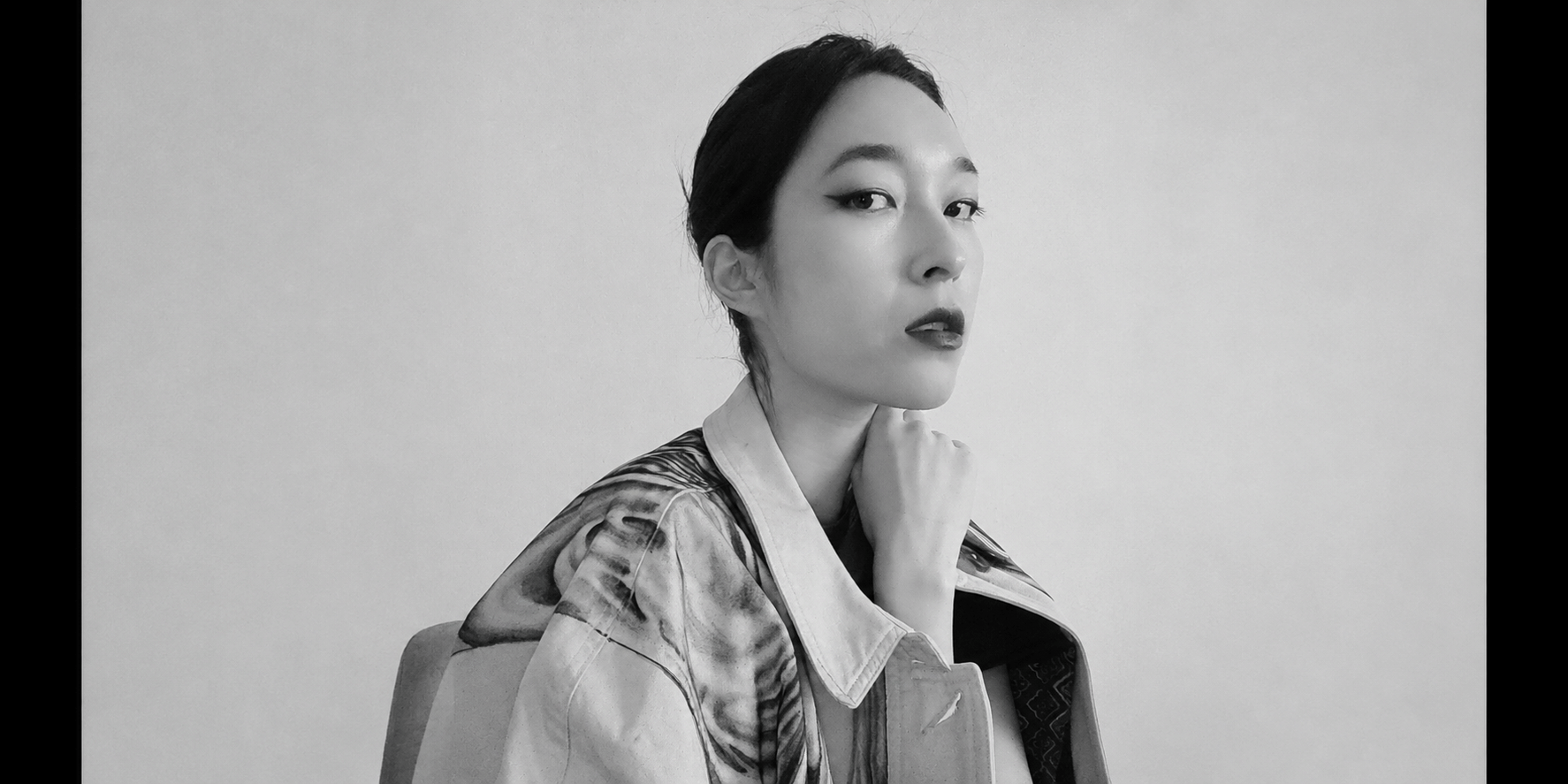
On Abdymomunov Street in Bishkek, a café serves Qurt Mocha, a drink based on coffee, hot chocolate, and qurt, the local extra-salty Kyrgyz cheese. It’s easy to get addicted to it, and the presentation is aesthetic enough to make a captivating Instagram story. Perhaps it’s still a long way before this will become the next matcha latte, coveted by ‘it girls’ around the world, but certainly not for lack of trying on my part.
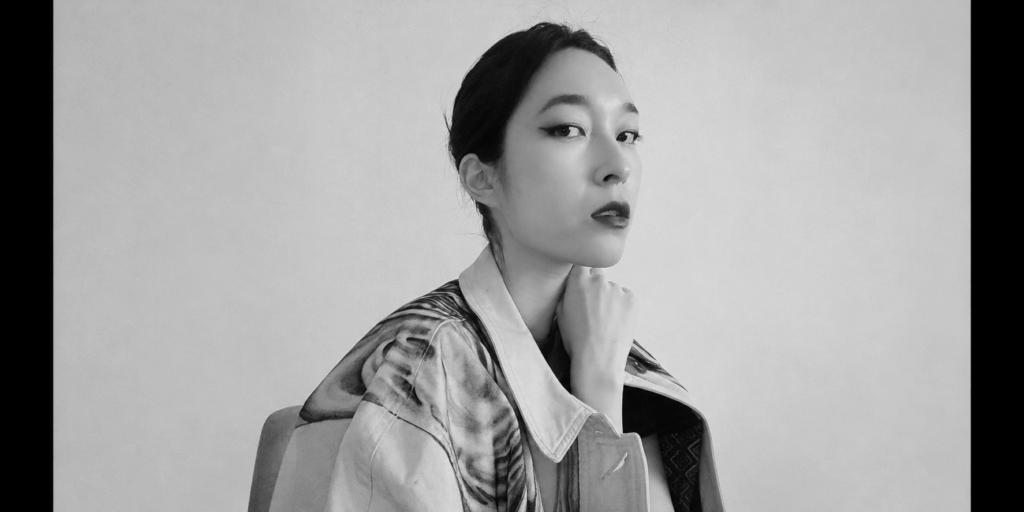
“I always wanted to try this coffee shop,” artist Sonata Raiymkulova tells me. Elegant and slightly coy, she is certainly an ‘it girl’ of the Central Asian art world herself, “… but I’ll take some green tea instead,” she concludes.
While I start feeling like an easily gulled tourist, she sits across from me in the Kölökö coffee shop, lightly tapping on her iPad and showing me her virtual portfolio. The coffee shop has a beautiful garden, with dim lights and a serene nightly atmosphere. I can’t help but notice how this contrasts with the air, which is so heavy with smog that it’s hardly breathable.
Like the livability of Kyrgyz cities, issues such as pollution are precisely what Sonata, a former architect with a passion for urbanism, tackles in her work. Her drawings, installations, and performances don’t necessarily look Kyrgyz, or at least not like what foreigners would expect Central Asian art to look like. Not so much qurt in them, so to speak.
Rather than attaching herself to some recognizable traditional elements, Sonata tackles the present of her city, Bishkek, where she was born and raised, and where, after her architectural studies, she took up contemporary art.
Her Dō – I use the Japanese term as her father steeped her and her brother in Japanese traditions – is collaborative and a little unorthodox. In 2016, she joined Estelik (also known as “monument of memory”), a Bishkek project in which artists, artisans and participants swapped brand-new stools for old, colorful ones and piled their haul into an impromptu massive monument. In 2021, she was one of more than 40 artists from the five Central Asian countries involved in Art Plov CA, a British Council-supported project run from Tashkent.
Her studies also took her to Moscow to the HSE Design School, where she graduated. In 2023, she won a Prince Claus Fund Seed Award, one of 100 awarded that year across more than 60 countries. She later told her university she had known about the prize for years but had been too scared to apply, and that winning mostly meant doubting herself less.
In February 2024, she had a solo show at DREIVIERTEL in Bern, in collaboration with the Residency.ch programme. She has also had shows in Karlsruhe, Milan, Almaty, and Moscow. This summer she was back in Almaty with Bishkek Gothic, a series made with her brother Marat Raiymkulov for Efes Art Space’s Sayran city route.
Raiymkulova’s work moves between the personal and the political, exploring the human body as well as Bishkek’s changing urban landscape. In 2025, she produced ink drawings of plots of land suspended in space, inspired by local land seizures. On April 1 that year, she walked from a city park to a museum wearing her Nomadic Museum, an embroidered coat that unfolds to display small works by other Kyrgyz artists. Her latest series turns inward, mapping the objects inside a flat and exploring how they shape the lives of its occupants.
I take a sip of Qurt Mocha and turn on the recorder to hear her story.
TCA: Your brother is an artist, your father grows bonsai, and your mother is a pathologist. How did growing up in such a household shape your interest in art?
Raiymkulova: One of the reasons is my older brother, Marat. He’s also an artist, working mostly in graphics and performance, and growing up, I watched what he did, and it inspired me in some way. My father is interested in Japanese culture and grows bonsai trees, so there was always an atmosphere where you worked a lot with culture. He showed me many artworks, Japanese and others. My mother is a doctor, a pathologist, and she worked at a university.
TCA: Your portfolio places you between Kyrgyz nomadic traditions and Japanese aesthetics. What does that mean for you?
Raiymkulova: I grew up between the two, and from that I developed an understanding of space as both transient and carefully shaped. I think my practice comes from that tension.
TCA: You studied architecture, specializing in environmental design, but no longer practice. How does that background influence your art?
Raiymkulova: I’m 100% dedicated to art, but I still use that architectural background in the work, and this comes across very clearly in my latest series, and also in terms of the awareness of the social themes I tackle, and of how the city has developed.
It started with public space: feelings about our new city, because now there are a lot of new constructions. Then I went to private land, and the last series is the interiors. It’s getting closer and closer to the individual, to how people live in the city, in the house, in the interior.
TCA: The series The Premonition Landscapes are large sanguine drawings on tracing paper. What did you want to communicate to the audience?
Raiymkulova: In the first, there is an enormous block of flats under a heavy sky, one of those repetitive housing blocks. The second depicts a barren landscape, with a pit in the foreground and a few dead trees. They are about the feel of our new city: you can see the pollution coming over; it is quite heavy. I wanted to draw a state of anticipation, even anxiety, about how fast the city is being rebuilt, where the ground itself becomes unstable. They are big pieces, 150 by 80 centimeters.
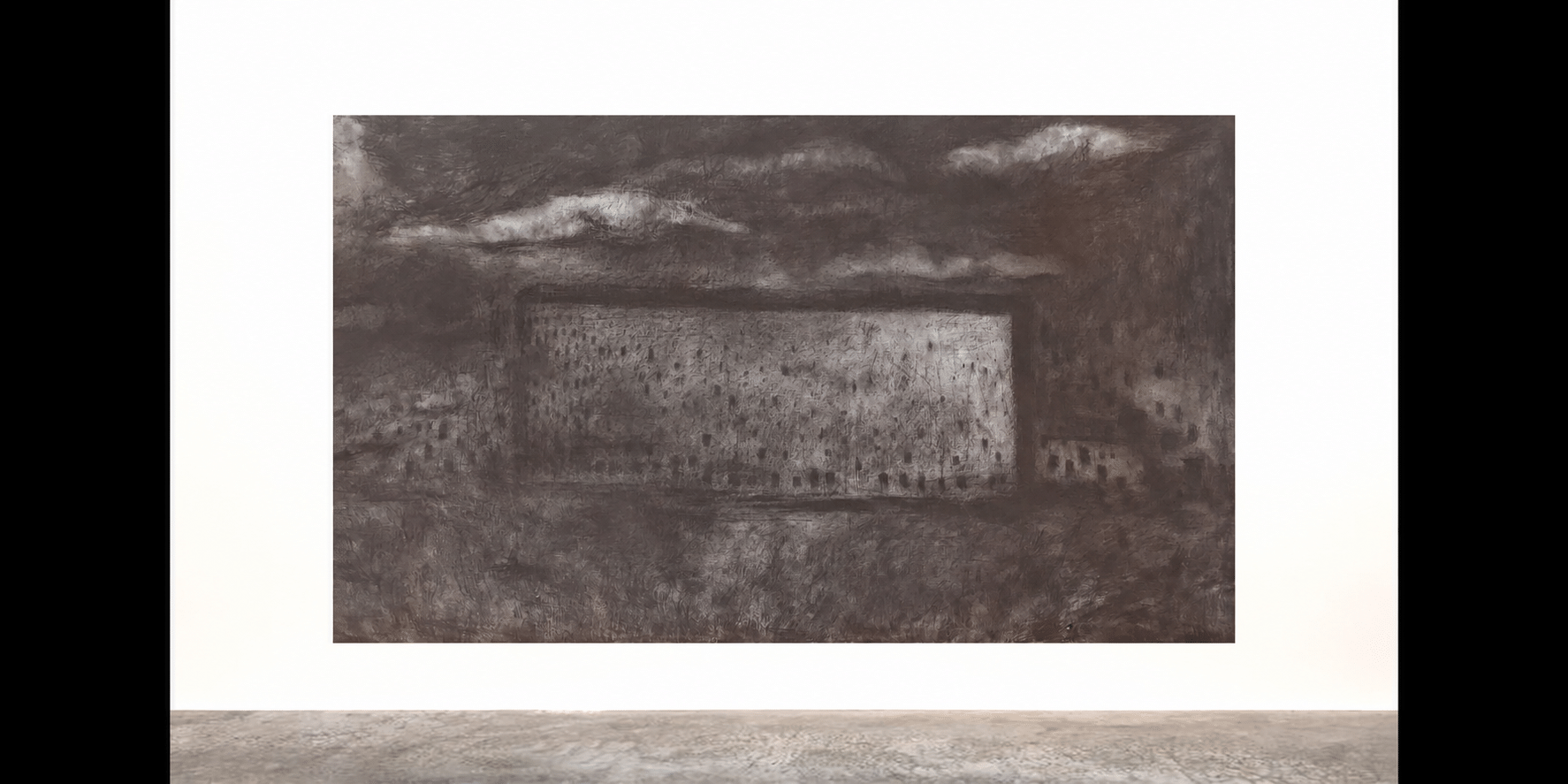
Premonition Landscapes – Drawings exploring the anxiety and uncertainty surrounding Bishkek’s rapidly changing urban landscape.
TCA: In Plots of Land, you depict plots marked out with tape and everyday objects, including an outhouse and a clothesline, suspended above a void. What inspired this series?
Raiymkulova: From the difficulties with land that began here about a year ago, when the government took people’s private land for its needs. You could have a house, and they would break half of it to make a road through your garden. People couldn’t live there; they had no roof and nowhere to go, and everyone began to feel scared because now any of us could lose our land and our home.
So, I decided to draw something that can’t be taken from people. Each plot is half imagination and half real houses, with different plants growing on it. They are small, about 25 by 25 centimeters, in gel pen on cardboard, and I usually draw the outline first and then fill the inside. By isolating a fragment of soil and measuring it, I turn it into an image, a kind of symbolic possession that can’t be confiscated.
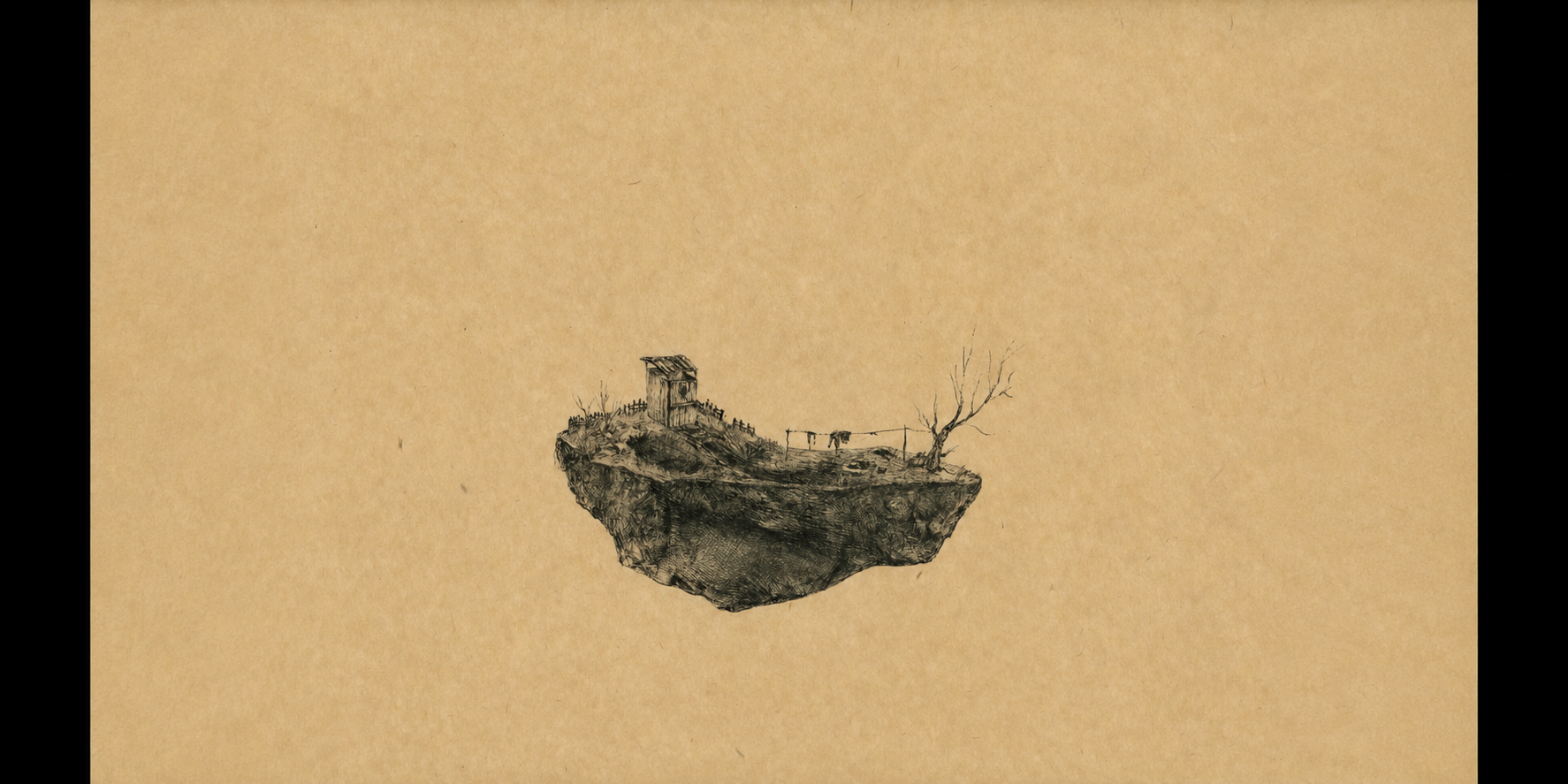
Plots of Land: Drawings reflecting the loss of private land and the impact of urban redevelopment on Bishkek’s residents.
TCA: Your new series heads indoors, to floor plans where every object is accounted for. What does a flat reveal that a city doesn’t?
Raiymkulova: I researched my own space, the place where I live, and how people control the environment in their own house: how they place things, and then how these things control how they move in these spaces. It looks like a floor plan of a house with all the objects. It is our vital space, almost an inner space. It is about how we are controlled by objects.
TCA: Before exploring objects and their relationship with people, you focused on the human body, particularly through drawings of anthropomorphic creatures. What inspired this series?
Raiymkulova: In the beginning, I was drawing many of these creatures and worked a lot with the body and with feelings: how it feels to be a person, some existential questions. It was the time when my mother’s medical sphere influenced me. I spent a lot of my childhood at her laboratory, at the university. I never saw actual corpses, but I did see body parts preserved in bottles. Those images stayed with me, although I drew from imagination rather than using references. I mostly drew whatever came to my mind… I was dedicated to this series of drawings from 2018 until maybe 2024.
I don’t work on several series at once. I focus on one, and then move to the next. My solo show at DREIVIERTEL in Bern in 2024 was about bodies, with a scientific side, and it included sculptures.
TCA: Yes, you also worked with sculpture and installations, creating cement vases. Why vases?
Raiymkulova: It’s true that in the past I’ve worked with the architecture of the city, making vases inspired by Bishkek, by its roads and buildings. I made a cardboard carcass and then worked with cement, and I mostly directed the form. Year by year, there are fewer trees here, fewer plants, so I wanted to work with this idea. In one vase, the cement holds a piece of asphalt with flowers growing out of it; another is painted white, with narrow gaps down its sides. Then there is the bone pot, a real bone with a plant in it. They are miniature gardens about compression and containment: plants growing inside restricted structures, facing limits and mortality.
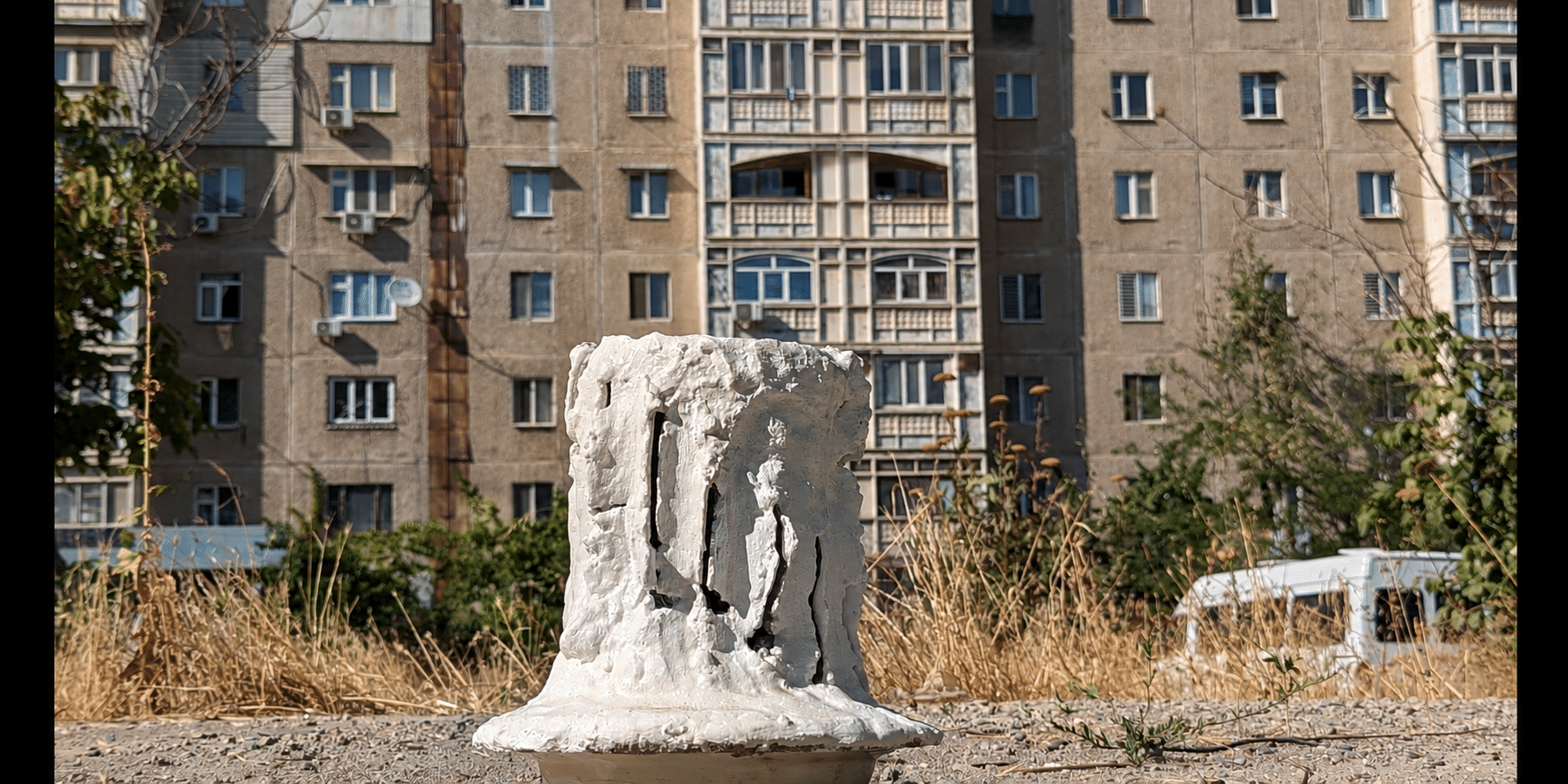
Vase: Concrete sculptures inspired by Bishkek’s architecture and the city’s changing urban environment.
TCA: Your Refuges are tents visitors can enter and lie down in. How did the series start?
Raiymkulova: It started from an exhibition in a school here and grew into a big project in 2023, with an Instagram account of its own called Refuge. It’s also architecture, and I had never worked in that sphere. I had some fears, and this structure helped me feel free to construct everything, like in childhood, when you don’t have boundaries or rules to build within. It also works as a place that protects you from the outside world.
I use what I find. In one museum, I built using window frames because there were a lot of them, and in the school, I used chairs with fabric over them. With the Refuges, I liked that people visiting an exhibition could sit or lie down and rest for a while. Kids are more open to this kind of installation, and they interact the most.
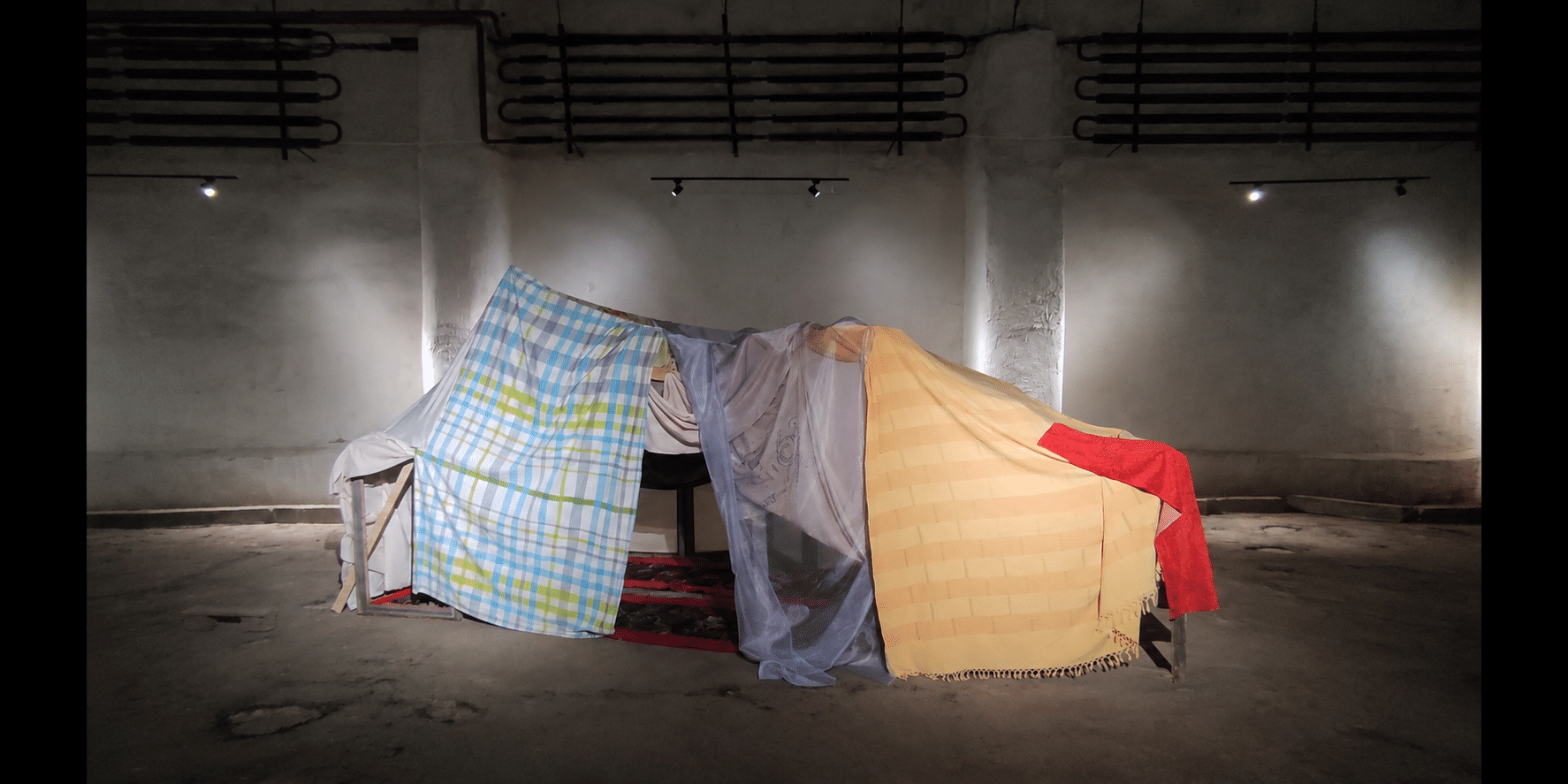
Refuge: An installation made from found window frames for an exhibition at Tolon Museum, exploring the human need for shelter and security.
TCA: After the Refuges came Nomadic Museum, an embroidered coat you wear. What was the idea behind this?
Raiymkulova: After those constructions, I decided to create constructions that can move with you. The coat is embroidered and carries works by other Kyrgyz artists, all made for this project. When I open it, you can see the whole picture of the art I’m bringing, so it becomes something like a performance. I made it in 2025 and showed it on the first of April, during the city’s art festival.
Before the opening, I walked in front of the park and then went on to the museum. There is also a smaller version, a vest with little soft figures pinned on felt shelves. I tried to continue the series, but now it is a little difficult to build things you can wear. They have to be small and light, and it was physically very hard to stay still and keep it open for hours.
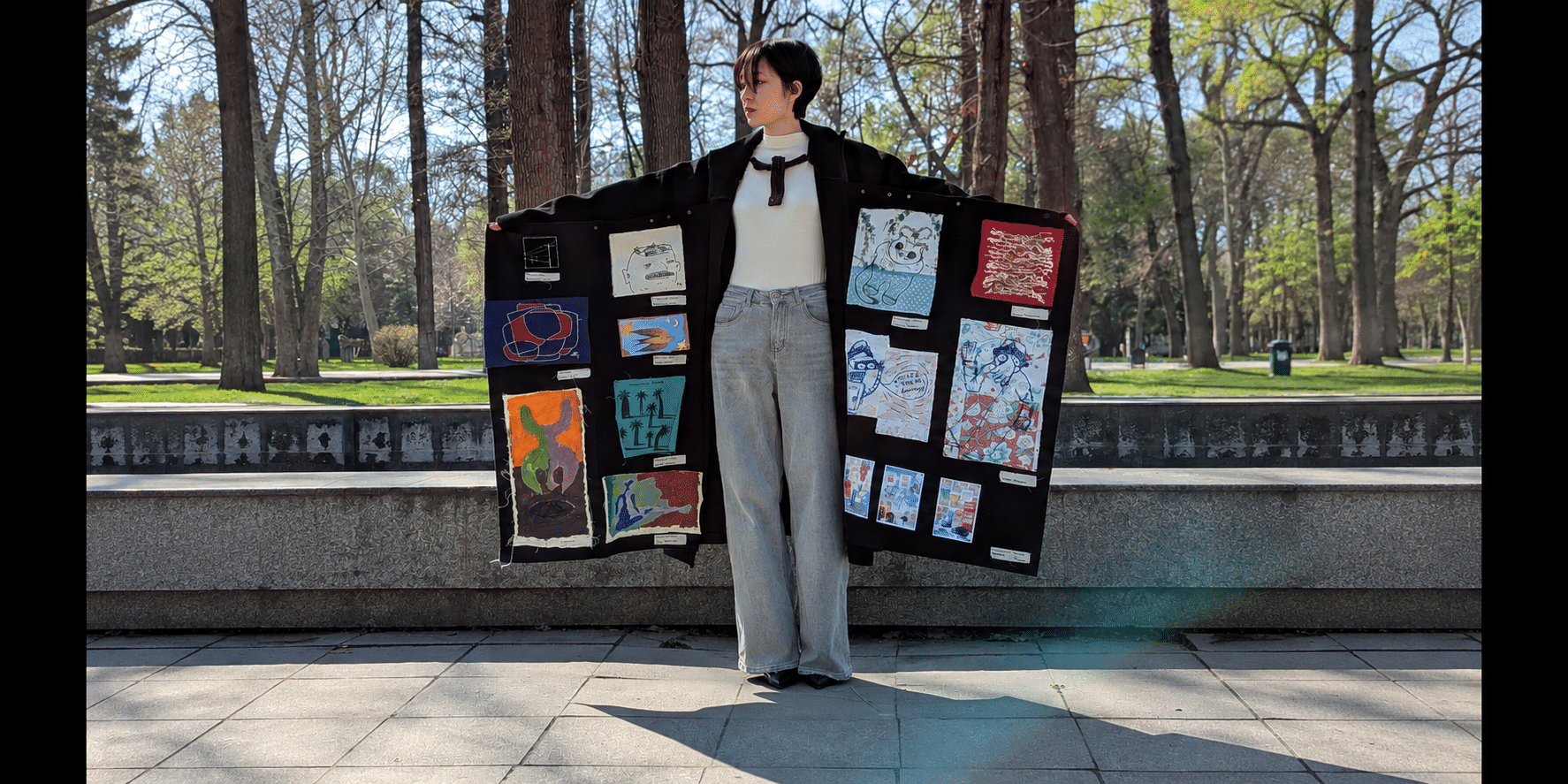
Nomadic Museum: A portable exhibition showcasing Kyrgyz artists, created in response to limited gallery space. The project won the Audience Choice Award at the April Fool’s Art Competition.
TCA: From the drawn plots to the coat, your works are often small, portable, or impossible to confiscate. What are you trying to keep?
Raiymkulova: I respond to the lack of space with small ecosystems, portable shelters, and a museum that moves with you. They are my way of keeping a little agency, some continuity and some care inside a constrained space. I decided to draw something that can’t be taken from people, and I think everything else follows from that. When the space around you keeps shrinking, you make something small enough to carry with you.