Kyrgyzstan has a new TV station. At first glance, it’s the kind of cozy, local news channel satirized in 2004’s Anchorman. The headline item on December 10th was the fact that it had snowed in Bishkek, with the on-screen reporter treading around the city asking residents whether they felt cold.
“Not really,” is the general response, given that plummeting temperatures are hardly a new phenomenon in the Kyrgyz capital.
“What kind of precautions did you take against the weather?” the reporter asks one gentleman.
“Put on a hat and gloves,” comes the droll reply.
This piece is followed by an interview with a representative of the city’s police service, advising people to tread carefully on the icy pavements.
Similar soft news items follow: an interview on the progress of Asman eco-city on Lake Issyk Kul; the modernization of a factory in Bishkek; and the announcement of a new coach for the national football team.
These are hardly stories to make waves. Indeed, most people in Bishkek are unaware of the new channel’s existence.
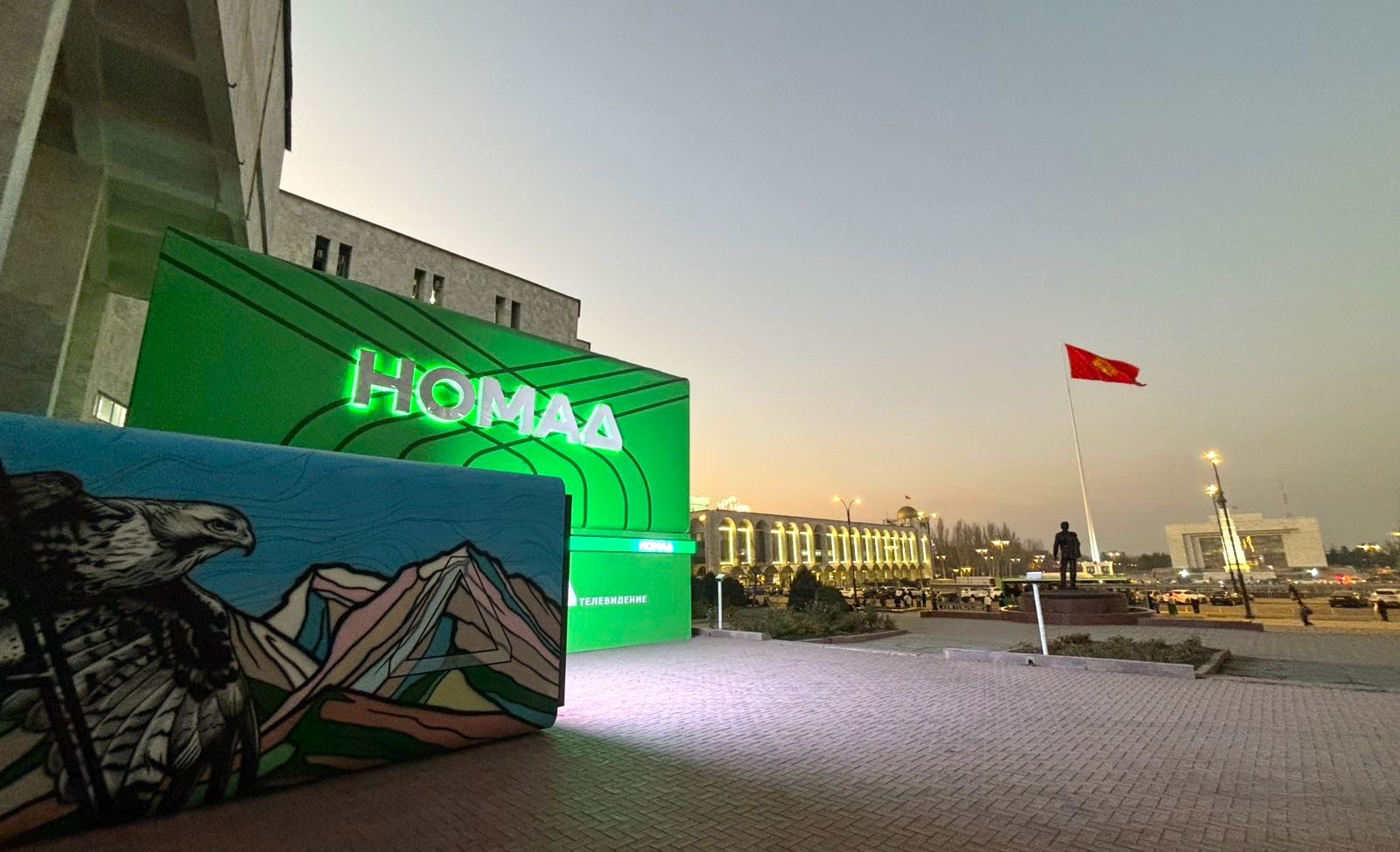
“It hasn’t been a major discussion point; the only presence that I felt is this huge, green box that has been installed on the central square,” Nurbek Bekmurzaev, the Central Asian editor of Global Voices, told The Times of Central Asia, referring to the broadcaster’s temporary studio at the heart of the city.
Yet Nomad is one of the best-funded media outfits in the country, offering salaries twice as high as those paid by rival organizations. And, in one form or another, it seems clear that the money is coming from the Russian state.
So why has the Kremlin, which is hardly underrepresented in Kyrgyzstan’s media sphere, decided to throw such sums at a local news station?
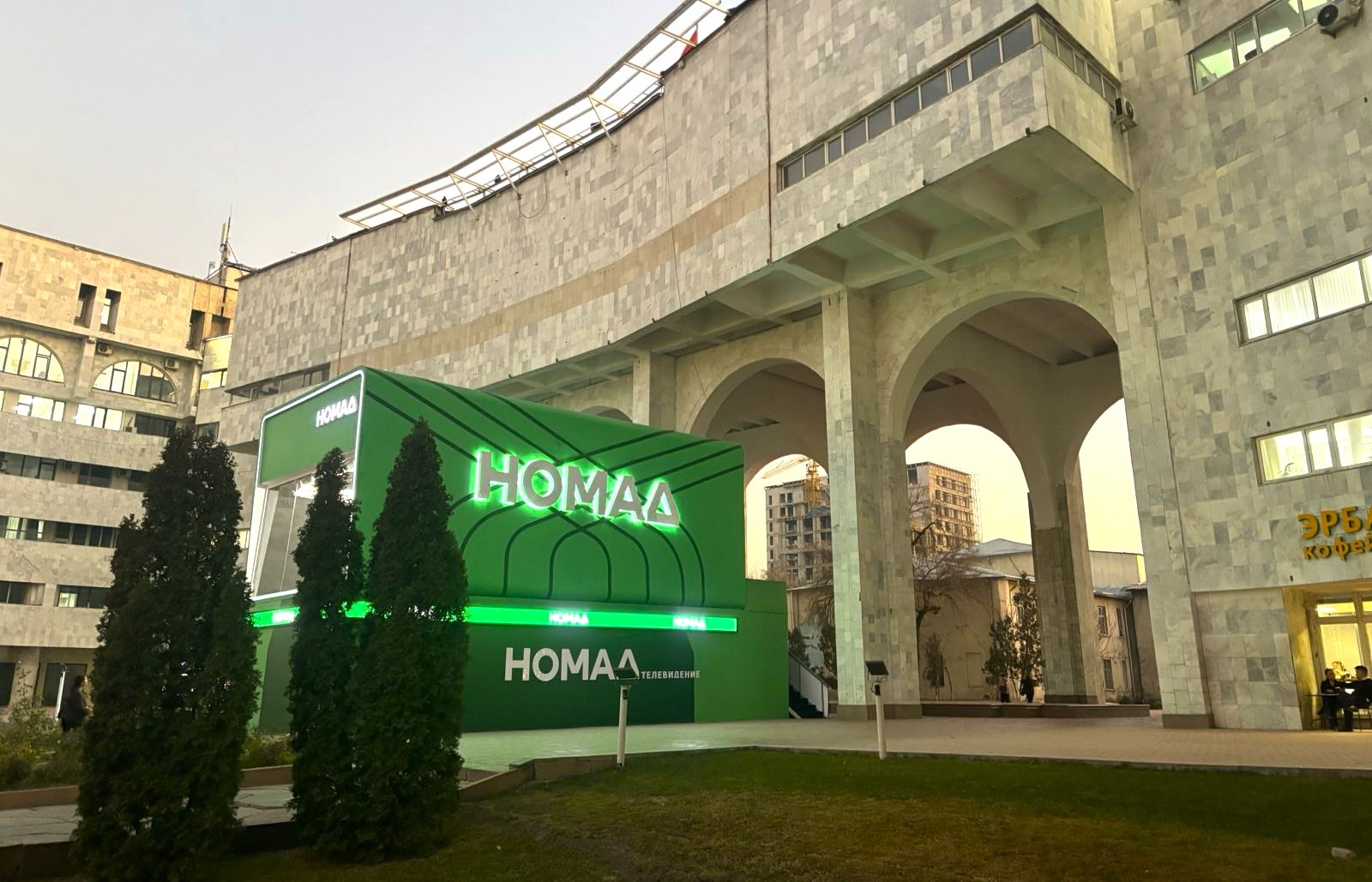
Nomad TV’s temporary studio on Ala-Too square in the heart of Bishkek; image: TCA, Joe Luc Barnes
A Bold Start
Nomad’s initial coverage was not so banal. On November 23, the channel began broadcasting with a cascade of high-profile interviews linked to Vladimir Putin’s state visit to Kyrgyzstan on November 25-27.
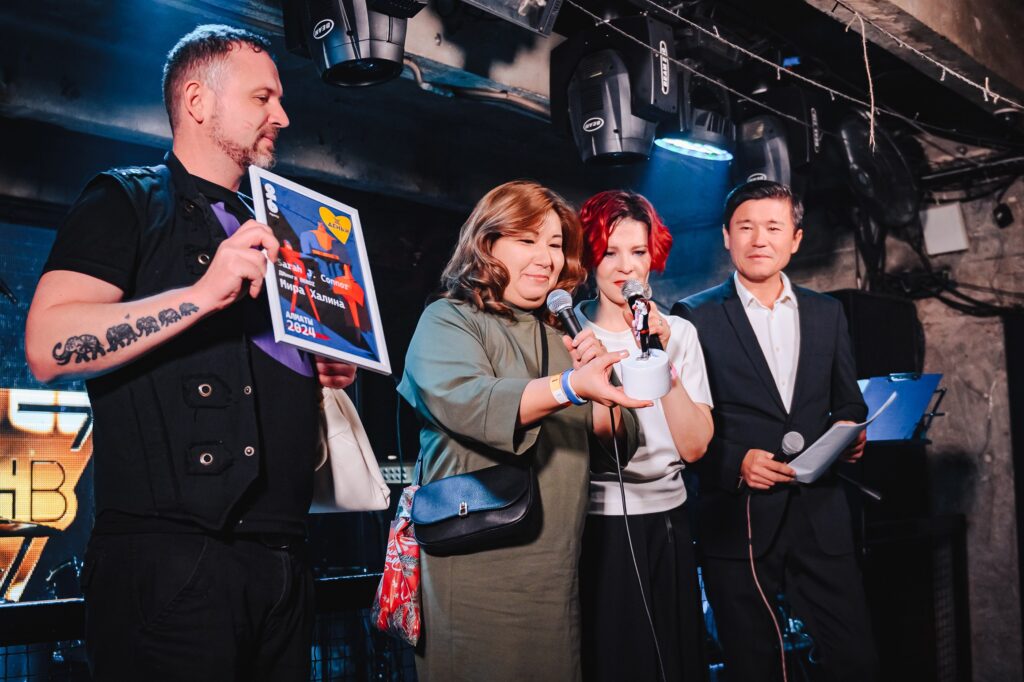
This followed a lavish launch ceremony at the city’s opera house, attended by Russian Foreign Ministry spokeswoman, Maria Zakharova, and the Kyrgyz deputy Prime Minister Edil Baisalov. Putin himself lauded the new channel in his speech on November 26, and gave its chief editor, Natalia Korolevich, an exclusive interview the following day.
This followed a feverish autumn, which the broadcaster had spent poaching talent from newsrooms around Bishkek.
This included Mirbek Moldabekov, a veteran broadcaster from the state television channel, UTRK; the head of Sputnik in Kyrgyzstan, Erkin Alimbekov; and his wife, Svetlana Akmatalieva, a journalist from the National TV and Radio Corporation. The channel’s producer is Anna Abakumova, a former RT journalist who gained fame reporting from Russian-occupied territories in Ukraine.
These aggressive recruitment tactics have split the profession in Kyrgyzstan. Journalist Adil Turdukolov asserted in an interview with Exclusive.kz that anyone who has chosen to work for Nomad “is not particularly concerned with the moral or civic aspects [of the job].”
Others in the media industry told TCA under condition of anonymity that the campaign against journalists joining the new channel “has become a little hysterical.”
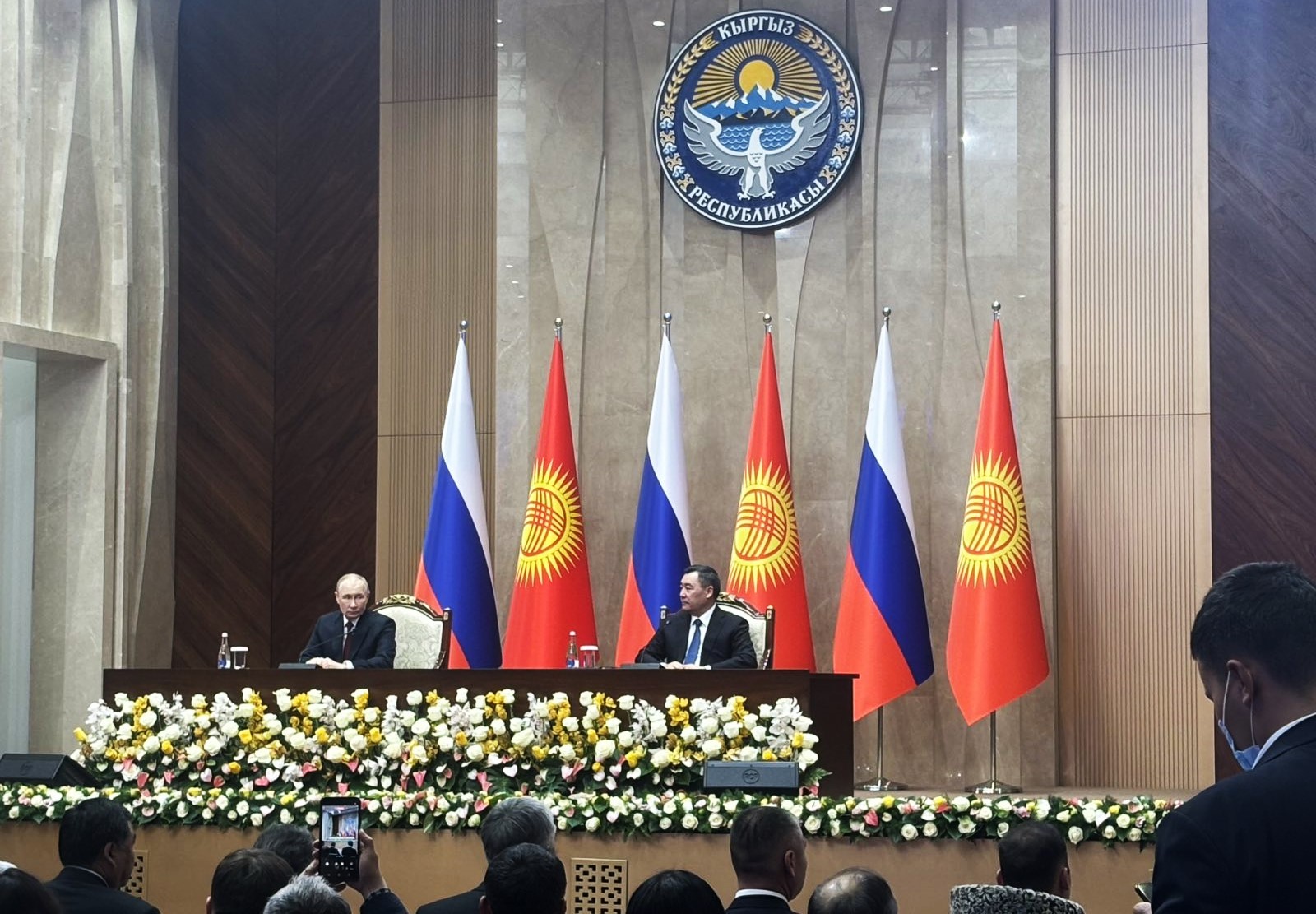
Vladimir Putin’s state visit to Kyrgyzstan on November 26, where he praised the launch of Nomad TV; image: TCA, Joe Luc Barnes
A Warm Welcome
While Russia is hardly unique in having state media in Kyrgyzstan – Britain’s publicly-funded BBC operates a Kyrgyz service, while the United States Congress currently still funds Radio Azattyk (RFE/RL) – Rashid Gabdulhakov, associate professor at the University of Groningen, notes the contrasting reception that Nomad has received when compared to other foreign media.
“The claim that Nomad TV is ‘just another media outlet’ free to operate like any other is misleading,” he told TCA.
When Azattyk was defunded by the White House in March 2025, Kyrgyzstan’s President Sadyr Japarov responded favorably: “People do not need information from Azattyk… Trump and Musk’s decision should be supported,” he said, having accused the media outlet of disinformation.
Meanwhile, independent media in Kyrgyzstan, such as Kloop and Temirov Live, have been designated extremist organizations. “Former employees were prosecuted for having worked there,” said Gabdulhakov. “Even liking or sharing Kloop’s content can now carry risks.”
He contrasts that with the fact that leading politicians are eager to appear in interviews with Russia’s new channel.
“Nomad offers something politically convenient: predictable, Kremlin-aligned messaging that also flatters the ruling regime in Bishkek, as long as it stays within the boundaries acceptable to Moscow,” he said.
Russia’s Wider Media Ambitions
Russian television channels such as Channel One, Russia 24, Kultura, and Zvezda already broadcast in Kyrgyzstan, and coffee shops such as Vanilla Sky offer a free copy of the state newspaper Rossiyskaya Gazeta. So what purpose is being served by the creation of another channel?
Temur Umarov, research fellow at the Carnegie Russia Eurasia Center in Berlin, believes that money lies at the root of it. “I don’t think anyone in Russia is thinking about it strategically, except as a means of pitching it to decision makers; it’s much more about money,” he told TCA, asserting that the channel is a means of “washing out the resources that Russia has for the purposes of particular people in the media machine.”
Others suspect that it might be a means of restoring influence on social media. Channels funded by the Russian state were removed from YouTube in 2022.
Although Nomad is evidently linked to the Russian state, given its access to the Russian president and the number of employees linked to Kremlin media, its funding sources are grey, and it is officially designated a Kyrgyz-Russian joint project.
An investigation by Azattyk revealed Nomad’s links to the shadowy non-profit organization, Evrasia, funded by Moldovan oligarch Ilan Shor and chaired by Russian Duma speaker Vyacheslav Volodin. The organization, which opened a Russian Cultural Center in Bishkek just before Putin’s visit, has already been at the heart of a disinformation campaign in the 2024 elections in Moldova, and is said to be in charge of training the new recruits for Nomad TV.
The funding appears to be grey enough, however. The channel has not yet fallen foul of YouTube, where it has over 6,000 subscribers, while on its Instagram account, this figure has risen to more than 20,000. While these figures are modest, they may represent a test case in how to spread Russian influence abroad.
The use of these U.S. platforms is rather ironic given that Instagram has been designated as extremist by Moscow and is banned within Russia. Meanwhile, YouTube’s speed has been affected by Rozkomnadzor, the country’s internet censor, making its use difficult without a VPN.
Such hypocrisy is not unique to Russia, with Chinese state media also making use of YouTube to spread their own state narrative despite banning it at home – CGTN alone has 3.6 million subscribers. In this case, “influence strategy takes precedence over ideological consistency,” said Gabdulhakov.
Nomad’s launch in Kyrgyzstan was quickly followed by a larger Russian campaign elsewhere – on December 5, RT opened a new bureau in India, based in New Delhi.
Is there an audience?
While RT’s operation in New Delhi suggests the Kremlin sees scope for pushing its narrative in the global south, Nomad’s style is quite different. Unlike RT, there is little in the way of foreign wars, hordes of migrants, or sensationalist polemics. The thunderous, frenetic music is nowhere to be heard either.
For all the fanfare of the launch, the high-level interviews, and the glitzy studio, Nomad’s offerings have focused on the local and the everyday. When there is no news, the channel rebroadcasts NTV, another Russian state channel.
And there are further doubts about the potential audience. Although there is a Kyrgyz option on the channel, the main broadcasting language is Russian, and according to Bekmurzaev, “most people don’t understand Russian well enough to listen to news and debates.”
That said, the channel’s Kyrgyz language Instagram page has seen far faster growth than its Russian equivalent, suggesting that social media may be the long-term play.
“TV is dead,” says Umarov bluntly. “Everyone is going from TV to socials.”
Umarov is also unconvinced about Moscow’s desire to influence the Kyrgyz population. “I would be surprised if it became an effective tool to spread the Kremlin’s message,” he said.
“The Kremlin thinks that the audience doesn’t really matter. As long as there is an understanding among the elites, the Kremlin is happy. It doesn’t really need the support of the population.”