• KGS/USD = 0.01144 0%
  • KZT/USD = 0.00196 -0%
  • TJS/USD = 0.10899 -0%
  • UZS/USD = 0.00008 -0%
  • TMT/USD = 0.28490 0%
  • KGS/USD = 0.01144 0%
  • KZT/USD = 0.00196 -0%
  • TJS/USD = 0.10899 -0%
  • UZS/USD = 0.00008 -0%
  • TMT/USD = 0.28490 0%
  • KGS/USD = 0.01144 0%
  • KZT/USD = 0.00196 -0%
  • TJS/USD = 0.10899 -0%
  • UZS/USD = 0.00008 -0%
  • TMT/USD = 0.28490 0%
  • KGS/USD = 0.01144 0%
  • KZT/USD = 0.00196 -0%
  • TJS/USD = 0.10899 -0%
  • UZS/USD = 0.00008 -0%
  • TMT/USD = 0.28490 0%
  • KGS/USD = 0.01144 0%
  • KZT/USD = 0.00196 -0%
  • TJS/USD = 0.10899 -0%
  • UZS/USD = 0.00008 -0%
  • TMT/USD = 0.28490 0%
  • KGS/USD = 0.01144 0%
  • KZT/USD = 0.00196 -0%
  • TJS/USD = 0.10899 -0%
  • UZS/USD = 0.00008 -0%
  • TMT/USD = 0.28490 0%
  • KGS/USD = 0.01144 0%
  • KZT/USD = 0.00196 -0%
  • TJS/USD = 0.10899 -0%
  • UZS/USD = 0.00008 -0%
  • TMT/USD = 0.28490 0%
  • KGS/USD = 0.01144 0%
  • KZT/USD = 0.00196 -0%
  • TJS/USD = 0.10899 -0%
  • UZS/USD = 0.00008 -0%
  • TMT/USD = 0.28490 0%
08 December 2025

Tajikistan Revises Export Duties to Boost Domestic Processing

The government of Tajikistan has approved revised export duties on raw materials and semi-processed goods, a move that has prompted considerable discussion within the business community. The changes, which directly affect exporters and producers, are intended to stimulate domestic processing and reduce the export of unrefined resources.

The key reform replaces fixed tariffs with duties calculated as a percentage of a product’s market value. Previously, export duties were set at:

  • €300 per ton for leather
  • 20% or €100 per ton for silk and cocoons
  • 10% for cotton fiber

Under the new rules, export duties fluctuate with global market prices, allowing for more adaptive regulation.

According to the Ministry of Economic Development and Trade, the reform is designed to promote higher-value production within Tajikistan. “The goal of this resolution is to reduce the export of raw materials and support the production of high-value goods,” said First Deputy Minister of Economic Development and Trade Ashurboy Solekhzoda.

The revised duties apply to a range of commodities including cotton fiber, leather, silk, cocoons, minerals, concentrates, plant juices, and other semi-processed goods. However, around 34 categories of raw materials remain exempt from export duties.

Tajikistan’s approach mirrors policies implemented in neighboring states. Kazakhstan imposes export duties on 44 product categories, including leather, wool, scrap metal, sunflower seeds, and oil. In Uzbekistan, export duties apply to over 86 types of goods, with some rates reaching as high as 100%.

Such measures aim to reduce reliance on raw material exports, stimulate domestic value-added industries, and enhance export competitiveness.

Economists and industry observers say the new policy could incentivize companies to expand local processing operations and reduce dependence on commodity exports. It may also enhance Tajikistan’s attractiveness to foreign investors interested in long-term, value-driven partnerships.

Over time, the revised export framework is expected to help strengthen the national economy and integrate Tajikistan more deeply into regional supply chains across Central Asia.

Experts Say Kazakhstan Must Boost Manufacturing to Tame Inflation

Inflation is steadily eroding incomes in Kazakhstan, depleting savings and undermining government efforts in the social sector. The Times of Central Asia previously noted that surging economic growth could be a contributing factor to Kazakhstan’s inflation problem. But despite rising prices, the government has no plans to apply the brakes. On the contrary, officials point to promising GDP growth driven by sectors beyond oil. Meanwhile, independent experts argue that only large-scale industrial development can provide a lasting solution to inflation.

Persistent Price Pressures

Inflation continues to outpace official projections. In August, annual inflation hit 12.2%, and by the end of 2025 it is expected to reach 14%, well above the National Bank of Kazakhstan’s target range of 5-6%. Economists say the country’s dependence on imports is a key driver. Kazakhstan imports large volumes of food, fuel, medicine, equipment, and consumer goods. Wage and pension increases are failing to keep pace with the surge in prices.

President Kassym-Jomart Tokayev has acknowledged that high inflation poses a serious challenge, warning it is “eating away at economic growth and household incomes.”

Government efforts to stabilize prices have yet to show meaningful results. On September 23, Minister of Trade and Integration Arman Shakkaliev announced that Kazakhstan will gradually phase out price controls on socially significant food products (SZPT) in favor of targeted digital support for consumers. The SZPT list currently includes 19 essential items.

At the same time, Prime Minister Olzhas Bektenov instructed agencies to crack down on unjustified price hikes for basic goods, ordering strict enforcement of available price control tools.

Growth at a Cost

Inflation, according to Deputy Prime Minister and Minister of National Economy Serik Zhumangarin, is being fueled by economic expansion. He warned that efforts to restrain inflation could hinder growth.

“Since 2023, GDP has grown by 5%, and in 2024 we grew without the contribution of oil. This year is a turning point. From 2026, oil will no longer influence GDP growth,” Zhumangarin said.

Although Kazakhstan’s economy has long relied on oil revenues, the minister believes this trend is now shifting. “Economic growth is always accompanied by high inflation,” he said. “More than $12 billion in investments have already been attracted, and the target for the year is $24 billion. The government will soon announce a new strategy for economic growth. We must follow the path of Asian countries but with modern technologies.”

Call for Industrialization

Independent analysts argue that real progress against inflation requires mass domestic production across a wide range of goods. Political analyst Gaziz Abishev stressed the urgency of moving beyond megaprojects toward practical, infrastructure-linked industry.

“Kazakhstan needs real production, not fairy-tale megaprojects. Industry tied to infrastructure, logistics, human resources, and markets solves many issues,” he wrote. “It creates well-paid jobs, stimulates small and medium-sized businesses, reduces reliance on imports, supports the tenge, and addresses budget deficits.”

Abishev also called for openness to foreign industrial investment, regardless of origin. His comments appear to push back against public concerns over the influence of Russia, China, and Western countries in Kazakhstan’s economy.

“We must not listen to populists. History grinds those who can’t keep up with technological progress into dust,” he wrote. “Science, technology, and labor are the answer to both unemployment and inflation. That should be the national idea.”

Kyrgyz Parliament Votes to Dissolve; Preparations for Early Elections Begin

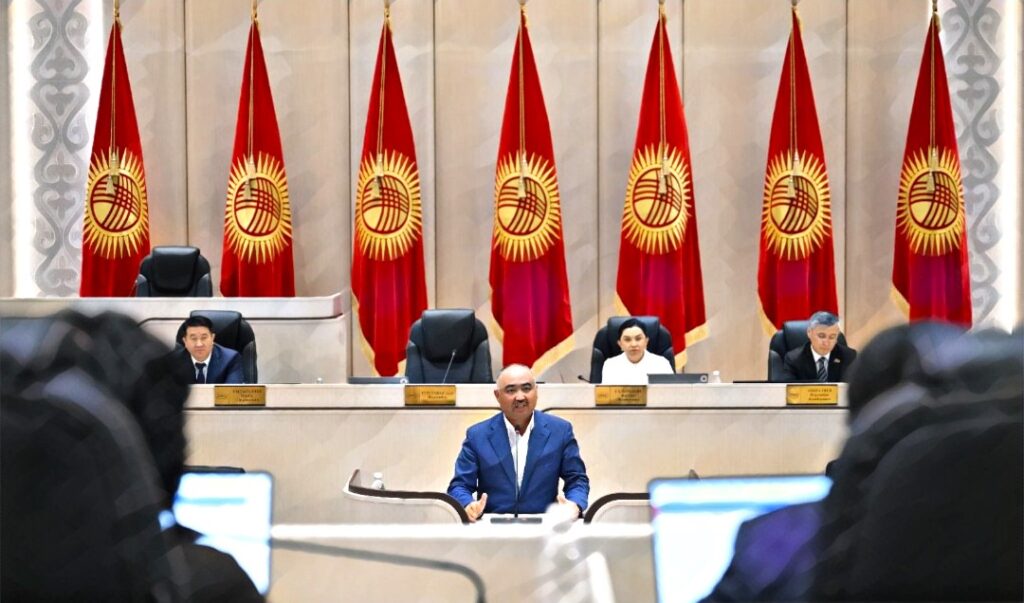
Deputies in Kyrgyzstan’s parliament voted on September 25 to dissolve parliament, paving the way for early elections that will be conducted under a revised electoral format later this year.

Deputies voted 84-0 in favor of dissolving parliament. Five other deputies abstained from voting, and one MP was absent from the session.

Kyrgyz President Sadyr Japarov now has five days to name the date for snap parliamentary elections, though speaker of parliament Nurlanbek Turgunbek uulu said he expects the date will be November 30.

The move was expected as a group of deputies started collecting signatures earlier in September to introduce a motion on dissolving parliament.

The chairman of Kyrgyzstan’s Central Election Commission (CEC), Tynchtykbek Shaynazarov, said in an interview on September 2 that the CEC is ready to conduct parliamentary elections this year, “if [parliament] takes the decision to dissolve itself.”

Shaynazarov explained the reason for advancing elections by one year. “According to the law, and plans, the elections for deputies to the Jogorku Kenesh (Kyrgyzstan’s parliament) will take place in November 2026.” 

However, Shaynazarov said, “According to the constitutional regulations, the next presidential election is set for January 2027. If we have (parliamentary) elections… in November 2026, the CEC must release an official tally (of votes) within 20 days.” Shaynazarov continued, “Then there will be those who are dissatisfied with the elections and will file a lawsuit. Thus, the campaign for the election of deputies may drag on until December.”

Shaynazarov pointed out this would overlap with campaigning for the presidential election.

Member of Parliament Janar Akayev agreed the proximity of the two elections according to the current schedule could negatively impact the work of the CEC.

Akayev also noted that Japarov signed a new law on procedures for electing parliamentary deputies in June this year. 

That law changed the mixed system of electing deputies Kyrgyzstan used in 2021, whereby 36 MPs were elected in single-mandate districts and 54 by party lists. In the next elections, all 90 deputies will be chosen in single-mandate districts. “Since current MPs support the transition to a new system, new elections should be held,” Akayev said.

Kyrgyzstan’s early parliamentary elections, in 1995, 2000, and 2005, were conducted via single-mandate districts. Election by party lists was first used in the 2007 snap elections, and continued to be used in the 2010, 2015, and 2020 elections.

The new regulations for parliamentary elections have negative and positive aspects.

The non-refundable fee to seek a seat in parliament favors the wealthy.

The fee for independent candidates to run remains at 100,000 Kyrgyz som (about $1,115), which is still a high price in a country where the average monthly salary is just a bit over 41,000 som.

Political parties can still participate in elections but must pay 9 million som (almost $103,000). Currently six parties have seats in parliament, but 21 parties fielded candidates in the 2021 elections.

The prohibitively high cost of registering will make it difficult for many people who aspire to a seat in parliament to run as candidates, leaving mainly those with access to relatively large amounts of money to run for seats.

Further favoring the affluent and powerful, all of Kyrgyzstan’s previous elections have been riddled with accusations of vote-buying and use of state funding and/or influence for select candidates. Japarov’s government has criticized both practices, and several of the deputies elected in November 2021 were subsequently removed for paying for votes.

Parliamentary Speaker Turgunbek uulu addressed these concerns when announcing the dissolution of parliament. “The current government intends to hold clean and transparent elections,” Turgunbek uulu said, “No one will be pushed through, no one will be hindered.”

The new elections rules make it obligatory for 30 of the 90 seats, at least one seat from each of the 30 voting districts, to go to women.

The new rules also dispense with by-elections should a deputy step down from his or her post. One of the authors of the amendments to the election law, Ulan Primov, pointed out that Kyrgyzstan has spent nearly 200 million som (about $2.29 million) on by-elections since the 2021 parliamentary elections.

The candidate from the district with a vacated seat who received the fourth most votes in elections will receive the empty seat. If the deputy vacating their seat is a woman, the female candidate who received the next highest number of votes in that electoral district will fill the seat.

The current parliament will continue to function until elections.

Campaigning officially starts 30 days before the elections. 

From Rare Collectibles to Mainstream Chic: The Suzani’s American Story

At the turn of the century, a suzani, the traditional embroidered textile from Central Asia, was almost impossible to find in the United States. These pieces, once given as dowries in Uzbekistan and Tajikistan, were the kind of object you might stumble upon in the back room of a rug gallery or in the private collection of a well-traveled dealer. To collectors, they were mysterious and precious, valued partly for their rarity as much as their beauty.

Today, in New York and across the U.S., suzanis are everywhere. They hang in boutique hotel lobbies, appear in glossy interior design magazines, and are sold by the dozen on Etsy and Instagram. The journey from rarity to ubiquity is both cause for celebration and reason for reflection, and reveals how cultural objects travel, are reinterpreted, and can carry heritage into new contexts.

Rooted in family life and ritual, suzanis were traditionally embroidered by brides with circular and floral motifs, each stitch carrying symbolic meaning. They were displayed at weddings, passed down through generations, and treasured as heirlooms, remaining within Central Asian households for centuries before appearing on international auction blocks or design blogs.

Shortly after the collapse of the Soviet Union, suzanis began appearing in the U.S., arriving primarily through Istanbul’s antique textile markets. These textiles – once private heirlooms – caught the eye of auction houses in London and New York as rare examples of artistry. As design editors and boutique retailers rediscovered their vibrant motifs and handmade quality, suzanis shifted from decorative obscurity to sought-after global accents.

Collectors quickly prized their vivid palettes and dense embroidery, and museums displayed them as artifacts of a little-known artistic tradition. At auction houses, the most exceptional pieces commanded astonishing prices. For instance, a Shakhrisabz (Green City) suzani from eighteenth-century Uzbekistan was recently valued at up to £50,000 ($67,000) at Sotheby’s in London. As someone who once ran a family Persian rug gallery in the Midwest, I remember the excitement when a genuine suzani appeared. It was almost mythical, a piece that drew genuine excitement from serious buyers and curiosity from casual visitors.

In New York, designers showcase suzanis as bedspreads, wall hangings, and upholstery, while fashion houses borrow their patterns for prints. The mainstream embrace is a sign that a once-overlooked textile is now celebrated as part of the city’s design vocabulary, and that Central Asian culture is being appreciated in new ways.

Hand-embroidered suzanis take months of work, with their thread tension, symbolic motifs, and slight irregularities forming part of their beauty. Machine-made copies, now sold widely online, mimic the look but erase the artistry; selling for a fraction of the price, they may look authentic but have no connection to Central Asian makers or traditions. Yet the enduring appeal of hand-stitched suzanis shows that authenticity continues to matter, and that the artistry behind these textiles cannot be replaced by machines.

As suzanis find their way into new settings, they show that traditions remain vibrant as they adapt and endure. Their symbols of prosperity and continuity still resonate, whether in a family home in Samarkand or a loft in Brooklyn. To see a suzani draped on a bed or hanging on a wall is to encounter art in its most accessible form, something born of ritual yet still able to transform modern spaces. Their presence in the U.S. is not a dilution but a widening of recognition, proof that living traditions adapt without losing their spirit.

Caspian Pipeline Consortium Workers Among Injured in Ukrainian Attack in Russia

Ukrainian drones struck Russia’s Black Sea port of Novorossiysk on Wednesday, killing at least two people and injuring others, including two employees of the Caspian Pipeline Consortium, according to Russian officials and the consortium. 

“The attack targeted the central part of the city, near the Novorossiysk hotel,” said Veniamin Kondratyev, governor of the Krasnodar Krai region in Russia. “Preliminary information reports two dead and three injured. Five residential buildings, including apartment buildings, as well as the hotel building, were damaged.”

Tass, the Russian state news agency, later reported that eight people were injured.

The Caspian Pipeline Consortium, which is critical to the export of oil from Kazakhstan, said its office was damaged in what it described as a “massive” attack.  

“Two company employees sustained injuries of varying severity and were transported to a medical facility. The administrative office’s work is temporarily suspended, and the staff has been evacuated,” said the consortium, also known as CPC.    

The drone strike also seriously injured people in the building who are not employees of the international crude oil transportation project, according to the CPC. 

Russia, Kazakhstan and major international oil and gas companies participate in the CPC project, which primarily delivers crude oil from western Kazakhstan as well as Russian producers to a marine terminal at Novorossiysk. There, it is loaded onto tankers for delivery to international markets. 

Ukraine has increasingly targeted Russia’s energy infrastructure with long-range drone attacks, raising concerns about the vulnerability of Kazakhstan’s oil industry to the long-running war.

Kazakhstan’s Rail Deal – A Long Way from Soviet-Era Locomotives

The roots of the $4.2 billion deal in which American firm Wabtec will provide 300 locomotives for Kazakhstan’s growing railway infrastructure emerged soon after the country’s 1991 independence, when the new government needed to upgrade its decaying Soviet-built locomotives. 

Pennsylvania-based GE Transportation, a major producer of railway equipment, helped with the modernization program in the mid-1990s and continued business with Kazakhstan in the following decades. In 2019, Wabtec, a transportation and technology company, bought GE Transportation. Wabtec celebrated the deal that was announced on Monday during Kazakh President Kassym-Jomart Tokayev’s visit to New York for the U.N. General Assembly. 

How big was the deal?   

The agreement has been described in different shades of magnitude. The U.S. Commerce Department said it was “the largest locomotive deal in history” – Wabtec said it was the largest in Wabtec’s history – and the Kazakh government and media have generally steered clear of historical references. 

Other big international railway deals include a 3 billion euro Siemens project in India that was announced in January 2023. Under that deal, the German company is to deliver 1,200 electric locomotives and provide 35 years of full service maintenance.

In March this year, France-based Alstom said it had delivered 500 electric locomotives to Indian Railways, part of a 3.5 billion euro contract to deliver 800 locomotives for freight service. That contract was signed in 2015. 

Who gets the credit? 

U.S. Commerce Secretary Howard Lutnick described the deal with Kazakhstan as “President Trump’s America First trade policy in action.”

Still, GE Transportation, which later became part of Wabtec, has been a key part of Kazakhstan’s railway industry for years. The company modernized hundreds of diesel freight locomotives decades ago and later transferred technology to Kazakhstan, developing engineering skills that could be used to build new trains.  

Wabtec acquired full ownership of a manufacturing facility in Astana in 2023 and says it has exported locomotives to countries including Tajikistan, Mongolia, Moldova and Ukraine.

“I mean, it’s great,” Evan A. Feigenbaum, a former U.S. State Department official, said of this week’s deal in a post on X. 

“But GE and Wabtec have been doing a locomotive business in and with Kazakhstan for 20 years. I was in the Bush Administration as the deputy assistant secretary of State overseeing Central Asia and was giving speeches and talks about locomotives and Kazakhstan back then…” Feigenbaum said. 

Kazakhstan’s decision to make a big agreement with Wabtec fits with its policy of developing ties with a wide range of diplomatic and business partners. Alstom, of Europe, and Chinese locomotive maker CRRC are also significant players in Kazakhstan’s railway industry. 

What does the deal mean for Kazakhstan?

A lot. Railways underpin the economy. Rail transport accounts for about 64% of Kazakhstan’s total freight turnover, far more than other forms of transport such as air and road, according to Kazakh railway officials. Kazakhstan is one of the biggest countries in the world, ranging from its Chinese and Russian borders in the east to the Caspian Sea in the west. 

Kazakhstan believes the deal will position it as a leader in the Eurasian transport technology market. Other countries stand to benefit as development of the so-called “Middle Corridor,” a trade route from China and Central Asia through the South Caucasus and into Europe, gains momentum. 

How about the environment? 

In a social media post about the locomotive deal, U.S. President Donald Trump said: “We need to support our U.S. Rail Industry, which has been attacked by Fake Environmentalists for years.” 

Electric trains are widely viewed as a cleaner, more efficient alternative to diesel locomotives. However, Wabtec says the diesel locomotives from its Evolution Series that are earmarked for Kazakhstan “will improve fuel efficiency and operate for longer periods between maintenance overhauls.”

Also, the rollout of all-electric models could pose additional infrastructure challenges for Kazakhstan, which is already making some electric locomotives with the help of the Alstom company.  

Kazakhstan Temir Zholy, Kazakhstan’s national railway company, said in its 2024 report that rail transport is “one of the most environmentally friendly modes of transportation,” while acknowledging that it can contribute to pollutant emissions, a negative impact on ecosystems and noise pollution. It said it was making progress, reducing emissions by 1.6% to 62,900 tons between 2023 and 2024.