• KGS/USD = 0.01144 0%
  • KZT/USD = 0.00196 -0%
  • TJS/USD = 0.10899 -0%
  • UZS/USD = 0.00008 -0%
  • TMT/USD = 0.28490 0%
  • KGS/USD = 0.01144 0%
  • KZT/USD = 0.00196 -0%
  • TJS/USD = 0.10899 -0%
  • UZS/USD = 0.00008 -0%
  • TMT/USD = 0.28490 0%
  • KGS/USD = 0.01144 0%
  • KZT/USD = 0.00196 -0%
  • TJS/USD = 0.10899 -0%
  • UZS/USD = 0.00008 -0%
  • TMT/USD = 0.28490 0%
  • KGS/USD = 0.01144 0%
  • KZT/USD = 0.00196 -0%
  • TJS/USD = 0.10899 -0%
  • UZS/USD = 0.00008 -0%
  • TMT/USD = 0.28490 0%
  • KGS/USD = 0.01144 0%
  • KZT/USD = 0.00196 -0%
  • TJS/USD = 0.10899 -0%
  • UZS/USD = 0.00008 -0%
  • TMT/USD = 0.28490 0%
  • KGS/USD = 0.01144 0%
  • KZT/USD = 0.00196 -0%
  • TJS/USD = 0.10899 -0%
  • UZS/USD = 0.00008 -0%
  • TMT/USD = 0.28490 0%
  • KGS/USD = 0.01144 0%
  • KZT/USD = 0.00196 -0%
  • TJS/USD = 0.10899 -0%
  • UZS/USD = 0.00008 -0%
  • TMT/USD = 0.28490 0%
  • KGS/USD = 0.01144 0%
  • KZT/USD = 0.00196 -0%
  • TJS/USD = 0.10899 -0%
  • UZS/USD = 0.00008 -0%
  • TMT/USD = 0.28490 0%
08 December 2025

Afghanistan Launches Toti-Maidan Gas Project with Uzbek Support

Uzbekistan has reaffirmed its support for Afghanistan’s economic recovery by backing a long-term gas development initiative in Jawzjan province. According to ToloNews, work has officially begun on the exploration and extraction of the Toti-Maidan gas fields under a 25-year contract signed by Afghanistan’s Ministry of Mines and Petroleum with KAM Group and Uzbek firm Railcom.

Speaking at the launch ceremony, Deputy Prime Minister for Economic Affairs Mullah Abdul Ghani Baradar said the project would help reduce Afghanistan’s dependence on imported gas and electricity, stem the outflow of foreign currency, and lay the groundwork for future gas exports. “This project sends a message to regional countries that Afghanistan is ready for investment,” he stated.

Afghan Minister of Mines and Petroleum Hedayatullah Badri described the initiative as a new model of cooperation with Uzbekistan, elevating bilateral ties from historical proximity to a “new phase of modern economic cooperation.” The ministry noted that the Toti-Maidan fields cover 7,500 square kilometers and already contain around 30 wells.

Uzbekistan’s Deputy Minister of Energy, Bakhtiyar Mohammad Karimov, emphasized the strategic significance of the agreement, highlighting the application of advanced technologies and adherence to environmental standards. He called the initiative the start of major bilateral energy cooperation.

The Toti-Maidan project follows a series of energy agreements signed in August between Afghanistan’s state-owned utility company, Da Afghanistan Breshna Sherkat (DABS), and Uzbekistan’s Ministry of Energy. Those $243 million contracts, signed with Nego Energy and Uz Energy, include the extension of the 500-kilovolt Surkhan-Dasht Alwan transmission line, substation expansions in Arghandeh and Nangarhar, and upgrades to the Kabul-Nangarhar power corridor.

Officials from both countries say these initiatives underscore a shared commitment to deepening energy and economic ties, even as Afghanistan continues to face serious political and humanitarian challenges.

East Kazakhstan’s Akbaur Stones: An Ancient Site Shrouded in Mystery

East Kazakhstan is home to one of Central Asia’s most enigmatic archaeological sites, the Akbaur complex. Often dubbed the “Kazakh Stonehenge,” it has been linked to ancient rituals, astronomical observations, and even cosmological legends. Despite decades of study, Akbaur continues to raise more questions than it answers.

The Mysteries of Akbaur

Archaeologists regard Akbaur as a unique cultural monument, though its true purpose remains debated. Some view it as an open-air temple, others as an ancient observatory or a major cult center for early civilizations of the region.

More than a tourist attraction, Akbaur is a symbol of East Kazakhstan’s deep and still-unrevealed history. The site is not just a scattering of stones. It is a vast historical and architectural complex covering some 70,000 hectares, long surrounded by legends.

Today, this area is protected by the state, and special permission is required to visit it, but just a few decades ago, both tourists and livestock roamed freely here.

@Yulia Chernyavskaya

For local residents, Akbaur holds sacred meaning. A tradition of leaving offerings has persisted through the centuries: small pieces of meat or fat are placed in shallow man-made depressions in stone slabs. A stone staircase, also human-made, leads to a grotto carved into the rock, and is believed to have carried symbolic as well as functional significance.

Even the name “Akbaur” is contested. Possible Kazakh translations include “white liver,” “close relative,” and “mountain slope.” Though varied, each carries symbolic resonance with the site’s layered history.

A Portal Between Worlds?

The Akbaur complex is located near the village of Besterek, about 38 kilometers from Ust-Kamenogorsk. At first glance, the arrangement of boulders and slabs might appear natural. Archaeologists, however, identify the site as a Bronze Age monument.

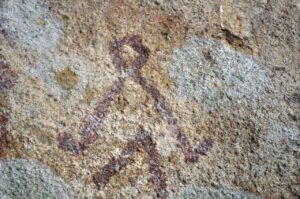
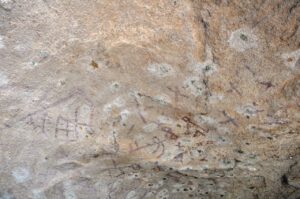
A conical grotto sits six meters above the mountain base, decorated with petroglyphs dating to the early 3rd millennium BCE. Around 80 images have been recorded, depicting humans, animals, dwellings, and tools, alongside more mysterious symbols. Interpretations range from cosmological signs to religious symbols, with fringe theories suggesting messages for descendants or even references to extraterrestrials.
@Yulia Chernyavskaya
@Yulia Chernyavskaya

What makes the petroglyphs unique is their use of red ochre, a rare pigment in the region’s rock art. Some scholars speculate blood may have been mixed into the paint, adding a ritual dimension.

The site’s natural features are equally intriguing. Above the grotto lies a massive slab with a heart-shaped hole, believed by some to have functioned as a “sky window” for astronomical observations. Elsewhere, stone “bowls” reveal remarkable precision: during the spring equinox, sunlight reflecting on water in one cavity aligns exactly with another, suggesting their use as a solar calendar.

Other theories propose more practical functions. The depressions could have been used in sacrifices or metallurgy, given the discovery of nearby ingots matching their shapes.

What Does Akbaur Hide?

Systematic study of Akbaur began in the 1970s under archaeologist Zainolla Samashev, a native of East Kazakhstan. Since 2019, excavations led by Samashev have uncovered grain grinders, whetstones, and bones of domestic animals, pointing to settled communities of the Bronze and early Iron Ages.
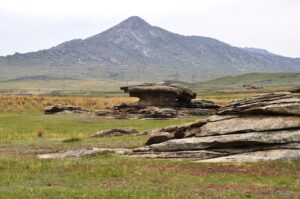
@Yulia Chernyavskaya

“These finds show that tribes such as the Saka were not only nomadic but also practiced farming, weaving, ceramics, and metallurgy. We have identified several settlements stretching over more than a kilometer and a half, a rare case for Kazakh archaeology,” Samashev explained.

The site also contains kurgans with distinctive “mustaches” and ritual platforms, strengthening its significance as one of Kazakhstan’s earliest cult centers.

Observatory, Temple, or World Center?

Theories about Akbaur are as varied as its mysteries. Some suggest it was an open-air temple oriented westward for funerary rites, with the stone staircase symbolizing a passage to the afterlife. Others argue it functioned as an observatory, with rock formations and the heart-shaped “sky window” serving astronomical purposes.

More speculative ideas describe Akbaur as a “planetary energy center” or even a generator of cosmic information. While such claims remain outside mainstream scholarship, they underscore the fascination the site continues to hold.

@Yulia Chernyavskaya

What is certain is that Akbaur remains one of Kazakhstan’s most significant archaeological treasures. Whether temple, observatory, or sacred gathering place, its petroglyphs and monuments still defy definitive explanation, inviting future generations to uncover its secrets.

Turkmenistan and Qatar Build Closer Ties at Doha Summit

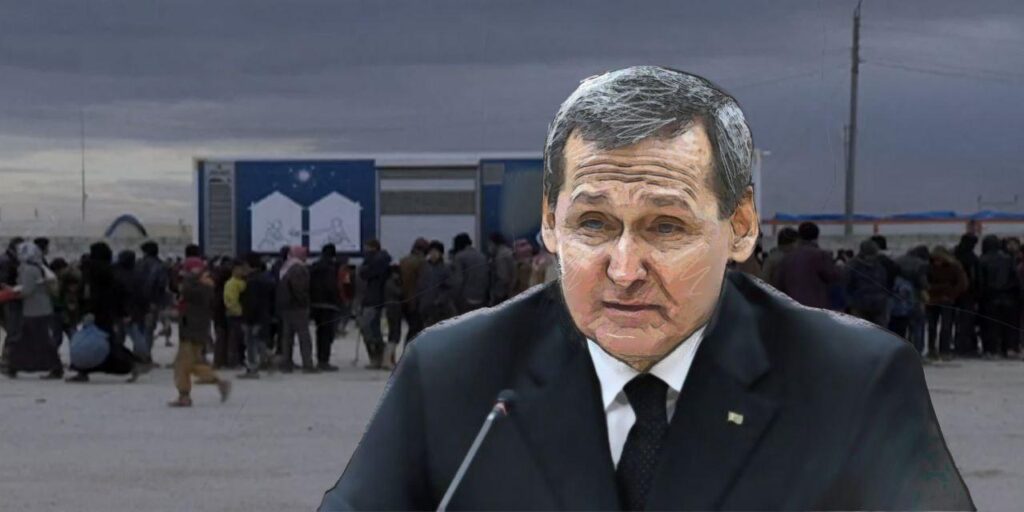
As Doha readies an emergency Arab-Islamic Summit, Turkmenistan and Qatar have moved to underscore a steadily warming relationship. On Sunday, Turkmenistan’s Deputy Prime Minister and Foreign Minister Rashid Meredov met Qatar’s Prime Minister and Foreign Minister Sheikh Mohammed bin Abdulrahman Al-Thani on the sidelines of the summit, a show of solidarity with Qatar after this month’s attack attributed to Israel.

Qatar’s Foreign Ministry also reported a separate meeting between Meredov and Minister of State for International Cooperation Maryam Al-Misnad during the ministerial preparations, where both sides discussed ways to deepen ties. Indeed, Ashgabat’s presence in Doha on the eve of the summit offers political cover for expanded cooperation, and adds a Central Asian voice to backing Qatar’s mediation role in the war in the Middle East.

The relationship is not new. Doha and Ashgabat established diplomatic ties in 1996, opened a Qatari embassy in Ashgabat in 2014, and upgraded political contact with a state visit by President Serdar Berdimuhamedov to Qatar in March 2023. Turkmenistan also inaugurated its embassy in Doha. The Qatari side later highlighted that 17 agreements and memorandums of understanding were signed across economic, cultural and sporting fields.

Momentum has built through 2025. On March 16, Meredov met Sheikh Mohammed bin Abdulrahman Al-Thani in Doha to prioritise energy, investment and transport, and to brief on the Serhetabat–Herat section of the TAPI gas pipeline inside Afghanistan. Turkmen statements said Qatar “highly appraised” cooperation on the project, while the Turkmen Foreign Ministry framed the visit as a step forward.

Qatar’s visibility in Turkmenistan also rose in August when Doha sent a delegation to the UN’s Third Conference on Landlocked Developing Countries, hosted in the Awaza coastal zone — the Turkmen government’s marquee venue for foreign investors. That forum dovetails with Turkmenistan’s pitch that logistics, energy and tourism can be built out with Gulf capital and know-how.

For Turkmenistan, cooperation with Qatar matters for three reasons. The first is energy strategy. Turkmenistan sits on the world’s fourth-largest proven gas reserves, yet remains constrained by export routes and customer concentration. The World Bank and regional energy think tanks have long flagged Ashgabat’s reliance on pipeline gas to China, and the need to diversify destinations and modalities. Pairing with Qatar — currently the world’s third-largest LNG exporter — offers access to market expertise, contract structuring and investment models that could help Turkmenistan de-risk projects like TAPI and swaps via Iran.

The second reason is capital. The Qatar Investment Authority (QIA) has been signalling a more aggressive deployment cycle, buoyed by anticipated LNG windfalls and new programmes to crowd in venture funds and international managers to Doha. While no Turkmen-specific commitments have been announced, Ashgabat’s priority sectors — transport links to Afghanistan and the Caspian, petrochemicals, and hospitality at Awaza — fit the kind of long-dated infrastructure and real-asset plays that Gulf sovereigns favor.

Third is private-sector linkage. Since 2023, business councils and chambers have stepped up exchanges, including a March 2025 Qatar Chamber event for a Turkmen trade delegation and the creation of a bilateral business council the previous year. Such platforms translate diplomatic goodwill into business, particularly in agriculture inputs, construction materials and services, which are less capital-intensive than pipelines and can move faster.

The immediate optics around the summit also serve both nations. Qatar, seeking a united Arab-Islamic front while safeguarding its mediator role, benefits from visible support by a neutral Central Asian state. Turkmenistan, true to its stated “positive neutrality,” can express solidarity without entanglement, while quietly advancing bilateral files in energy and finance.

What to watch next is whether the two sides convert their March talking points into concrete projects. Officials have repeatedly highlighted energy, investment and transport as the pillars; the TAPI segment inside Afghanistan is the most symbolically potent, but cross-border logistics, petrochemicals and services may move first. If Doha’s summit diplomacy goes to plan, it may also create a political window for Gulf–Central Asia initiatives to ride a wave of regional solidarity. For Turkmenistan, the calculus is straightforward: Qatar brings capital, commercial savvy in gas markets and a megaphone on the world stage. These are assets Ashgabat can leverage as it seeks to sell more than just pipeline gas to a single buyer.

Bukhara Craftsman Keeps Ancient Woodcarving Traditions Alive

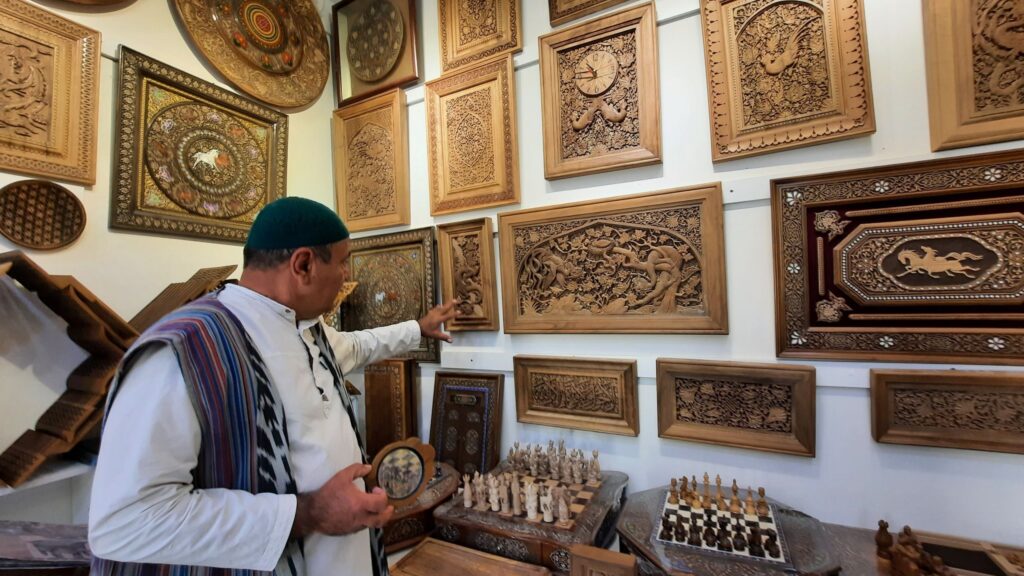
In the heart of Bukhara, one of Uzbekistan’s most historic cities, the sound of chisels meeting wood still resonates through the workshop of Shavkat Ashurov. At 57, he has dedicated more than two decades to the art of woodcarving, a tradition that has endured through centuries of upheaval and modernization in Central Asia.

Ashurov’s workshop feels like a living museum. The patterns he carves are not modern inventions but trace their lineage back to the fifth and sixth centuries, long before the spread of Islam in the region. “There is only one similar piece left in Shahrisabz,” Ashurov explains, “on the museum door connected to Amir Temur, and another in Turkistan. What we do here is to keep these traditions alive.”

Ashurov’s workshop. @Sadokat Jalolova

For Ashurov, woodcarving is more than a profession, it is a family legacy. “We are the fourth generation,” he said. “I only try to pass on what I know. I don’t add more than I can. What I learned from my forefathers, I hand over to my students.”

He began carving more than 35 years ago, but for the past two decades has devoted himself almost entirely to the craft. Over the years, he has trained nearly 100 apprentices, though today he works with just four. The reason, he admits, is the patience the art requires. “This work takes time and patience, and not everyone can manage that,” he said. “Some of my students chose other professions. But with the ones I have, I continue.”

The work itself is painstaking. A simple carved bowl may take about 40 minutes if the wood is well-prepared, but larger projects can span months. “One of our biggest works took nine months to complete,” he recalled. “It depends on inspiration too. Sometimes you work every day; sometimes you pause, waiting for the right moment to continue.”

Chess pieces from an 83-year-old apprentice working with his teacher Ashurov. @Sadokat Jalolova

Ashurov’s designs are rich with symbolism. Many incorporate chessboard-like patterns, interlocking stars, or subtle references to family and genealogy. Over centuries, foreign influences have entered Uzbek woodcarving, but artisans like Ashurov have absorbed them into a distinctly local tradition. “Miniature lacquer work came from Europe and Russia, and we placed it into our art,” he said. “The use of mother-of-pearl came through Iran and Turkey. But we reworked them into our own tradition.”

Equally important to him is honesty. “I tell customers about product defects before selling them, and I teach my students to be honest too. Honesty is as important as the design itself.”

Woodcarving is both an art and a livelihood. His workshop supports not only his own household but four other families. Income is unpredictable from modest sums to as much as 100 million soums (around $8,000) depending on commissions. “It is 50 percent local buyers, 50 percent foreigners,” he said. “Our people also value this work, but foreigners are often very interested.”

Social media has become an unexpected ally. On Instagram (@bukharawoodcarving), he shares photos of his work, attracting attention from within Uzbekistan and abroad. “People write to me on Instagram, sometimes even from overseas. I put many of my works there, and I leave my phone number so anyone can contact me directly.”

Ashurov’s workshop. @Sadokat Jalolova

Teaching remains central to his mission. His oldest student, now in his 80s, still collaborates in the workshop. While men typically handle the more complex carving, women in his family contribute a lot. “Our women do not do the difficult carving,” he said. “But they help with the lighter tasks, like lacquering and finishing.”

In a city famed for its domes, madrassas, and tiled minarets, Ashurov’s quiet workshop offers another dimension of Bukhara’s cultural heritage. Each carved panel, bowl, or bookstand is a bridge between the distant past and the present day, carrying forward the voice of generations who shaped wood with patience and devotion.

As Ashurov put it: “I only try to pass on what I know. What came to me from my fathers, I pass to my students. That is enough. That is how this craft survives.”

Taliban Again Urges Uzbekistan and Tajikistan to Return Military Helicopters

Afghanistan’s acting Foreign Minister Amir Khan Muttaqi has once again called on Uzbekistan and Tajikistan to return military helicopters flown out of the country by Afghan pilots during the collapse of the previous government in August 2021. The appeal was reported by Afghan news outlet Tolonews, following Muttaqi’s meeting with diplomats and representatives of international organizations in Kabul.

“We ask those countries that, four years ago following political developments, took part of our helicopters and transferred them to neighboring countries, to return these helicopters to the Afghan people so they can be used in humanitarian operations,” Muttaqi said.

He also criticized ongoing sanctions on Afghanistan, particularly banking restrictions that he claimed have prevented Afghans abroad from sending money to families affected by natural disasters. “Unfortunately, due to the unjust and unlawful restrictions imposed on Afghanistan, our compatriots have been unable to send aid to those affected by the earthquake,” he added.

An earthquake that struck eastern Afghanistan on August 31 killed around 2,200 people and destroyed more than 5,000 homes, according to Al Jazeera. Both Tajikistan and Uzbekistan have since sent humanitarian aid, including food, medical supplies, and tents, to assist survivors.

Muttaqi emphasized that providing sustained assistance to those affected remains a top priority for the Taliban government.

Earlier this month, The Kabul Times quoted Taliban spokesman Zabihullah Mujahid as saying that Uzbekistan had agreed to return 57 helicopters. However, Ahror Burkhanov, spokesman for Uzbekistan’s Foreign Ministry, dismissed the claim as “fake news,” stressing that Tashkent’s position on the matter has not changed.

Kazakhstan Sees Growth in Urban Cancer Cases

The incidence of cancer has risen in Kazakhstan’s cities, while rural areas have seen a decline, according to Energyprom.kz, which cited data from the Ministry of Health.

In 2024, cancer incidence in urban areas reached 239.2 cases per 100,000 people, up from 230 the previous year. The highest rates, exceeding the national average, were recorded in the Karaganda region (353.5 per 100,000), Kostanay region (352.7), East Kazakhstan region (349.4), and Abay region (302.4).

Environmental factors are believed to contribute. Karaganda, the hub of Kazakhstan’s coal and metallurgical industries, was ranked the world’s third most polluted city in 2024, according to the World Air Quality Report by IQAir.

By contrast, cancer incidence in rural areas decreased to 147.1 per 100,000 people in 2024, down from 173.8 in 2023.

Regional Data

The total number of cancer patients in Kazakhstan reached 230,900 in 2024, an increase of 12,800, or 5.8%, compared to the previous year.

  • Almaty, the country’s largest city, recorded the highest number of patients: 34,200. However, its incidence rate per 100,000 people was slightly below the national average.
  • Karaganda region ranked second with 21,400 patients.
  • Astana followed with 16,800.

In 2024, 41,300 people in Kazakhstan were diagnosed with cancer for the first time. The largest numbers of new cases were in Almaty (5,200), Karaganda region (3,800), and Astana (3,000).

Medical statistics also showed that the rate of primary diagnoses declined slightly, from 208.6 to 204.8 per 100,000 people.

Kazakhstan in Regional Contex

Within Central Asia, Kazakhstan has the highest cancer incidence, followed by:

  • Kyrgyzstan – 86 per 100,000
  • Uzbekistan and Turkmenistan – 74.1
  • Tajikistan – 32.1

The cancer mortality rate in Kazakhstan also rose in 2024, from 65.1 to 68 deaths per 100,000 people.

Measures to Combat Cancer

To expand treatment access, Kazakhstan has launched domestic production of oncological drugs. In October 2024, Swiss pharmaceutical company F. Hoffmann-La Roche Ltd., in partnership with Nobel Almaty Pharmaceutical Factory JSC, began producing three biotechnological medicines in Almaty for the treatment of HER2-positive breast cancer, an aggressive form affecting up to 20% of breast cancer patients in Kazakhstan.

Each year, around 5,000 new cases of breast cancer are registered in the country, with about 1,200 resulting in death.