• KGS/USD = 0.01143 -0%
  • KZT/USD = 0.00192 -0%
  • TJS/USD = 0.10820 0.19%
  • UZS/USD = 0.00008 0%
  • TMT/USD = 0.28575 0%
  • KGS/USD = 0.01143 -0%
  • KZT/USD = 0.00192 -0%
  • TJS/USD = 0.10820 0.19%
  • UZS/USD = 0.00008 0%
  • TMT/USD = 0.28575 0%
  • KGS/USD = 0.01143 -0%
  • KZT/USD = 0.00192 -0%
  • TJS/USD = 0.10820 0.19%
  • UZS/USD = 0.00008 0%
  • TMT/USD = 0.28575 0%
  • KGS/USD = 0.01143 -0%
  • KZT/USD = 0.00192 -0%
  • TJS/USD = 0.10820 0.19%
  • UZS/USD = 0.00008 0%
  • TMT/USD = 0.28575 0%
  • KGS/USD = 0.01143 -0%
  • KZT/USD = 0.00192 -0%
  • TJS/USD = 0.10820 0.19%
  • UZS/USD = 0.00008 0%
  • TMT/USD = 0.28575 0%
  • KGS/USD = 0.01143 -0%
  • KZT/USD = 0.00192 -0%
  • TJS/USD = 0.10820 0.19%
  • UZS/USD = 0.00008 0%
  • TMT/USD = 0.28575 0%
  • KGS/USD = 0.01143 -0%
  • KZT/USD = 0.00192 -0%
  • TJS/USD = 0.10820 0.19%
  • UZS/USD = 0.00008 0%
  • TMT/USD = 0.28575 0%
  • KGS/USD = 0.01143 -0%
  • KZT/USD = 0.00192 -0%
  • TJS/USD = 0.10820 0.19%
  • UZS/USD = 0.00008 0%
  • TMT/USD = 0.28575 0%
13 December 2025

Vietnamese Company to Build Solar Power Plant in Kyrgyzstan

Kyrgyzstan’s Cabinet of Ministers has signed an investment agreement with Vietnam’s RECA LLC, Rox Energy Global for the construction and operation of a solar power plant in the village of Kyzyl-Oruk, located in the Issyk-Kul region.

The agreement was signed by Kyrgyz Energy Minister Taalaibek Ibrayev and senior representatives of the Vietnamese firms, which are part of ROX Group, one of Vietnam’s leading conglomerates. Discussions covered key implementation stages, including land allocation by the Kyrgyz government, grid integration, and state-supported incentives for the project .

The solar plant is designed to have a capacity of 1,900 MW and is scheduled for completion in 2027. The project will be financed through foreign direct investment.

Founded in 1996, ROX Group operates across several sectors including real estate, technology, hospitality, and financial services, and is actively expanding into international markets, particularly in Europe.

In Kyrgyzstan, the company is also behind the construction of the Royal Central Park residential complex in Bishkek.

The solar power initiative is fully aligned with Kyrgyzstan’s national strategy to diversify its energy portfolio, increase electricity generation from renewable sources, and address persistent energy shortages across the country.

Kazakhstan’s Birth Rate Continues to Fall Amid Demographic Concerns

Kazakhstan is witnessing a sustained decline in its birth rate despite government efforts to stimulate demographic growth. In their latest report, analysts at Ranking.kz have explored why more Kazakhstanis are choosing to have fewer or no children, and what factors are driving this downward trend.

Sharp Decline in Newborn Numbers

According to official data, 77,300 children were born in the first quarter of 2025, a 15.8% decrease compared to the same period in 2024. This continues a multi-year decline: annual births dropped from 446,500 in 2021 to 365,900 in 2024.

Kazakhstan’s total fertility rate also reflects this trend. After peaking at 23.5 births per 1,000 people in 2021, the rate has steadily fallen to 18.2 in 2024 and further to 15.4 in early 2025.

Regionally, Mangistau and Turkestan remain the most fertile areas, with 21.3 births per 1,000 people, followed by Shymkent (19.7). The lowest rates are in North Kazakhstan (8.5), Kostanay (9.5), and East Kazakhstan (9.6).

Changing Attitudes Toward Parenthood

A 2024 national survey shows a growing reluctance among citizens to expand their families. Over half (51.3%) of respondents said they already have children and do not plan to have more. Only 13% hoped to have two children, 9.1% three, and 10.5% four or more. Meanwhile, 3.9% said they do not intend to have children at all, a sentiment more common in urban areas (4.5%) than in rural regions (3%).

Among urban parents, 52.4% said they would not have more children, compared to 49.5% in rural communities.

UN projections suggest Kazakhstan’s demographic decline will persist. The fertility rate is expected to dip to 19 in 2025, 17.6 in 2034, and continue falling to 11.4 by 2100, raising concerns about aging and the growing demographic burden.

Economic and Medical Challenges

According to the platform “Children of Kazakhstan”, economic hardship remains a central factor. Rising costs for housing, healthcare, and education have made child-rearing increasingly unaffordable, prompting many to delay or reconsider parenthood altogether.

Societal values are also shifting. More young Kazakhs are prioritizing education, careers, and personal development. Women, in particular, are pursuing higher education and professional goals before starting families.

Healthcare issues have further exacerbated the trend. The number of women diagnosed with infertility rose to 29,100 in the first half of 2024, surpassing the total for all of 2023 (28,500). This figure has climbed steadily from just 10,000 in 2019.

Male infertility is also rising, though the numbers are significantly lower. Reported cases increased from 36 in 2019 to 119 in 2021, before fluctuating slightly to 108 in 2023.

Most Uzbeks Recognize Human Trafficking Risks, Survey Shows

July 30 marks World Day against Trafficking in Persons, a United Nations-designated observance established in 2013 to raise awareness about one of the most severe human rights violations globally. In conjunction with this date, Uzbekistan’s Ijtimoiy Fikr Center for Public Opinion Research has released the findings of a nationwide survey assessing public awareness of human trafficking and its associated risks.

According to the 2025 data, 61.3% of respondents reported being well informed about human trafficking. An additional 29.5% of respondents said they were familiar with the issue but lacked detailed knowledge. Experts caution that such informational gaps can foster misinformation if not addressed through credible sources. Encouragingly, the share of respondents unaware of trafficking risks has declined, reflecting the impact of ongoing awareness initiatives.

Television remains the primary source of information for 76.8% of respondents, followed by social media at 54.1%. While digital platforms are increasingly influential, the report underscored the importance of improving media literacy to curb the spread of disinformation. Traditional print media also remains relevant, particularly among older demographics, with 24% citing newspapers or magazines as their main source.

When asked how they would respond to a trafficking incident, 78.3% of respondents said they would report it to the police. Other authorities named included the Prosecutor’s Office (47.1%) and the Ombudsman (37.2%), while more than 27% said they would contact an anti-trafficking hotline.

Respondents identified the most common forms of trafficking as labor exploitation (68.9%), sexual exploitation (42.1%), illegal organ trade (24.3%), forced begging (23.2%), and child trafficking for adoption (21.3%).

Unemployment, economic hardship, and the promise of quick financial gain were cited as the main drivers behind trafficking. Job offers abroad, often made through acquaintances or online platforms, remain the most prevalent method of recruitment.

Reassuringly, 91.9% of respondents said they knew of cases where victims had been rescued and successfully reintegrated. Experts view this as a sign that current rescue and rehabilitation programs are making an impact.

While 73.1% believe the situation has improved over the past five years, Ijtimoiy Fikr emphasized that human trafficking remains a significant threat in Uzbekistan. The report calls for enhanced legal protections, expanded public education, and deeper international collaboration to maintain momentum.

The Center concluded that raising awareness, preventing exploitation, and supporting survivors must remain the core pillars of the national anti-trafficking strategy.

Kyrgyzstan Proposes Controversial Criminal Code Changes Targeting Recidivism, Limiting Official Liability

Kyrgyzstan’s Interior Ministry has submitted a bill aimed at restoring the concept of recidivism to the Criminal Code and limiting the liability of civil servants if their actions are deemed to protect national security. The proposal has sparked heated debate in both parliament and the public.

Proposed Changes

The draft law would reintroduce harsher penalties for repeat offenders. Recidivism, abolished in 2019 to ensure fairer treatment of convicted criminals, would once again become a legal category. According to the explanatory note, the earlier reform failed to yield the desired outcomes.

“The abolition of the concept of recidivism did not have the expected effect,” the note states. “Excluding harsher liability for members of organized criminal groups, who are often repeat offenders, has enabled them to consolidate and expand their influence.”

According to the bill’s proponents, nearly 90% of inmates in Kyrgyzstan have prior convictions. They argue that current parole and probation policies treat repeat offenders too leniently.

Combating organized crime has been a major priority in recent years. Dozens of so-called ‘thieves-in-law’ have been detained or neutralized, and suspects are now publicly compelled to renounce their criminal status. President Sadyr Japarov has already signed a law criminalizing the support or financing of criminal organizations.

“Organized crime poses a serious threat to national security and affects virtually all sectors of society,” the Cabinet said.

Under the proposed legislation, penalties for recidivism would be no less than half the maximum sentence for a given crime. In cases of “particularly dangerous recidivism,” the minimum would be two-thirds. Moreover, reconciliation between victim and perpetrator would no longer be grounds for dismissal of charges.

Authorities claim the measures will deter crime and diminish the appeal of criminal subcultures, particularly among young people.

Public Criticism

The most controversial element of the bill, however, is a provision that would exempt individuals from criminal liability if their actions were taken in defense of national sovereignty, the constitutional order, or environmental, economic, informational, or other forms of security.

Former MP Felix Kulov criticized the vague language of the proposal on social media, warning it could lead to legal abuse. He cited a hypothetical case in which an environmental activist seriously injures or kills a litterer, arguing the act could be wrongly justified as “defending environmental security.”

“Such additions clearly do not belong in Article 18 of the Criminal Code,” Kulov wrote. “The code already includes provisions for exceeding the limits of necessary defense and abuse of authority, and these new clauses would contradict them.”

Current MP Dastan Bekeshev reacted more bluntly: “This is crazy. If the law is passed, what is the point of justice at all?”

The draft law is now under review in the parliament. If adopted, it would represent one of the most significant overhauls of Kyrgyzstan’s criminal legislation in recent years.

Kazakhstani Opera Talent Aigerim Altynbek Wins Contest in Italy

Kazakhstani soprano Aigerim Altynbek believes “greater heights” await after she came first in an international opera singing competition in Italy.

Altynbek was among singers from 50 countries competing in the Concorso Lirico Internazionale di Portofino (CLIP) in the scenic harbor village of Portofino. The competition, which began in 2015, aims to support young talents and many of its winners and finalists have embarked on successful careers.

“I want to share some incredibly joyful news with you!” Altynbek posted on Instagram after she was awarded first prize on Sunday. “This was a truly special experience for me – and I believe even greater heights lie ahead.”

President Kassym-Jomart Tokayev congratulated Altynbek.

“This achievement, which has made our country’s culture known to the world and has been recognized by international experts, is of great significance,” Tokayev said. “You have made our state proud and brought our native art to the forefront of the world.”

Altynbek performed a duet last month with Italian tenor Andrea Bocelli at Pompeii, days after an appearance with Spanish tenor José Carreras in Astana. She has already received a number of accolades, including first prize in the Città di Arcore – Giacomo Puccini opera singing competition in Italy last year. She has been studying in Italy after graduating from the Kazakh National University of Arts.


Opinion: Ghosts of the Gulag: Kazakhstan’s Uneasy Dance With Memory and Moscow

In May 2025, the authorities in Moscow unveiled a life-size bas‑relief sculpture of Josef Stalin in the Taganskaya metro station. The next month, a statue of Lenin was pulled down in Osh, Kyrgyzstan. Between these two symbolic acts lies Kazakhstan, caught in a tug-of-war over the memory of Soviet-era repression.

Between 1920 and 1960, millions of prisoners were deported to more than fifty labor camps across what was later to become the Republic of Kazakhstan. Those who weren’t executed on the spot — political opponents, intellectuals, artists — were forced to work in mines, construction sites, or collective farms feeding Soviet industrial expansion. The death toll remains unknown but is believed to be in the millions.

Today, this dark past draws in history buffs and thrill-seekers. But darktourism.com, the go-to website on the topic, warns them: forgotten cemeteries, ghost villages, crumbling camps — this gulag archipelago is well hidden in the steppes. No sign points the way to the Museum of Political Repression in Dolinka, housed in the former headquarters of Karlag, one of the largest camps of the Soviet Gulag system.

The only other gulag transformed into a museum is ALZHIR, built on the ruins of the Akmola camp near Astana. It commemorates the 18,000 women imprisoned between 1939 and 1953 for being the wives of “traitors to the motherland.” These two museums now stand as official symbols of Soviet repression in Kazakhstan, and, more subtly, as frontline sites in a broader memory war across the former Soviet Union.

Selective Memory

When the museums were nationalized in the 2000s, their message became tightly controlled. Portraits and quotes from former president Nursultan Nazarbayev began to cover the walls. Guillaume Tiberghien, a specialist in dark tourism at the University of Glasgow, calls it a “selective interpretation of history.” The goal? To unify the country’s 160 ethnic groups under a shared narrative of collective suffering. At both Karlag and ALZHIR, guides emphasize acts of solidarity between Kazakh villagers and deportees — hospitality, compassion, bits of cheese tossed over barbed wire fences to feed the starving.

Execution scene recreated at the Karlag museum; image: Manon Madec.

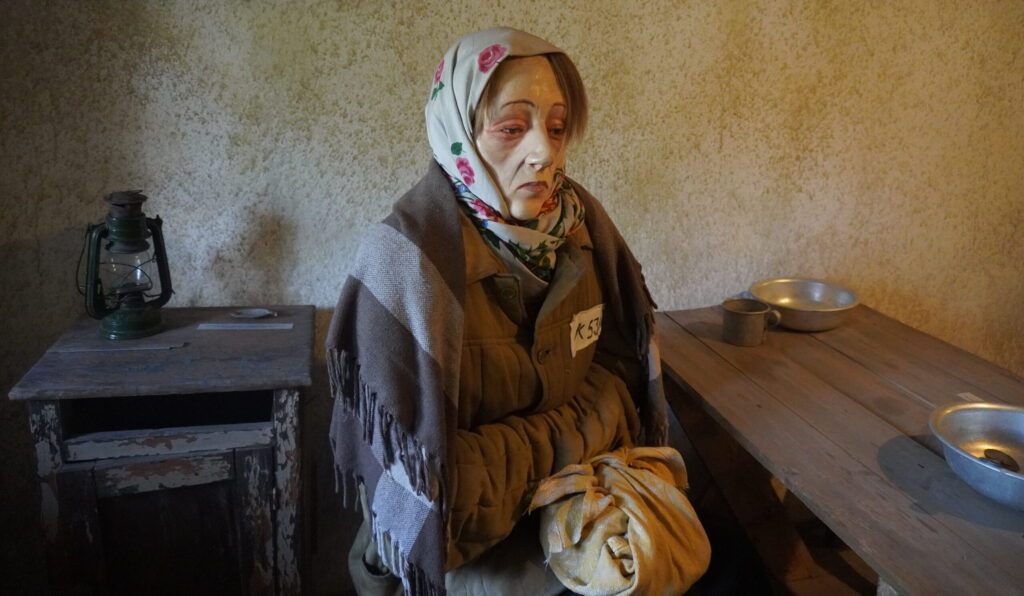
The past is staged. Between wax statues with sunken faces, sound effects mimicking heartbeats, and torture room reconstructions, the visitor is drawn into a visceral experience, sometimes at the cost of accuracy. “You wonder if the museum overdoes it to trigger emotion,” Tiberghien remarks. Margaret Comer, a memory studies expert at the University of Warsaw, explains: “It’s sometimes easier to mourn victims than to identify perpetrators.”

Execution scene and fake blood, reconstructed in the Dolinka museum; image: Manon Madec.

The complicity of local Kazakhs is never addressed. Russian responsibility is blurred behind vague terms like “NKVD” or “Stalinist repression.” At ALZHIR, visitors learn only about Sergey Barinov — a Russian commandant described as cultured, discreet, and caring toward the women detained. The other two camp directors are never mentioned.

In other former Soviet republics — Ukraine, the Baltics, Georgia — such neutrality would be unthinkable. “There, any figure linked to the Soviet regime is fiercely contested,” Comer notes.

Memory Wars

Tensions have sharpened since the war in Ukraine. In the background, Putin has accelerated the rehabilitation of Stalin, architect of the gulag archipelago. His busts are reappearing across Russia. Volgograd’s airport has been renamed “Stalingrad.” In occupied Melitopol, a new statue of the dictator was erected. “We’re witnessing a broad return of repressive memory politics in Russia,” says Tiberghien.

Former Soviet republics have taken note. “In Eastern Europe, especially the Baltics, every commemoration now includes a warning about today’s Russian threat,” Comer explains. Even in Central Asia — typically cautious — the decolonial narrative is gaining ground. In Kazakhstan, “some people now fear that Russia might one day cross the border,” she adds.

“The country is walking a tightrope,” Tiberghien explains. “It wants to keep things calm, to avoid upsetting Russia.” This balancing act was evident in President Tokayev’s speech on May 31, the official Day of Remembrance for Victims of Political Repression. While calling for the rehabilitation of victims and better access to archives, he also condemned the “instrumentalization” of history and urged the nation to look forward.

Museums mirror this caution. At ALZHIR, the May 31 commemorations are now held indoors, away from public view. A guide quietly admits she’s not allowed to comment on the closure of Russian memorial museums: “It might offend Russian tourists.” At Karlag, between two torture exhibits, visitors learn about inmate-led innovations: giant sunflowers, new cattle breeds, the Chizhevsky chandelier. “There’s an emphasis on what the prison system ‘contributed’ to the nation,” Comer notes. In this anniversary year of the Great Patriotic War, “the focus is more on Karlag’s role in victory than on mourning the victims,” adds Tiberghien.

Collective Amnesia

Why this insistence on what the gulag ‘contributed’? “There are conflicts of interest and truths people would rather not face. What tourists see is a compromise — one that works for the state and local communities,” Tiberghien emphasizes.

As a result, much of the Soviet legacy remains buried. Literally. “Around ALZHIR and in the Karaganda region, there are mass graves everywhere,” Tiberghien notes. The Mamochkino cemetery, near Karlag, is one of the few memorial sites dedicated to women and children who perished in the camps. It, too, lies neglected. Tiberghien speaks of a “collective amnesia” that obstructs historical reckoning.

The Mamochkino cemetery, left abandoned near the Karlag museum; image: Manon Madec

In Karaganda, Dimitry Kalmykov, director of the local Ecological Museum, sees an unspoken deal: “The state doesn’t want to reopen the file, and the Kazakhs aren’t demanding it.” The fear of speaking out, he says, has been passed down across generations. Kalmikov himself learned little about the USSR at school. What he knows, he read on his own.

But resources are fading. The archives are sealed by Russia. “The question isn’t when we’ll get access, but whether we ever will,” says one museum historian.

Gulags are not the only legacy at risk of being forgotten. The Soviet nuclear past is quietly vanishing too. “The Kurchatov museum has been closed to the public since 2023,” says Tiberghien. There, deformed animals preserved in jars bore witness to radiation damage. In Semipalatinsk, visits are increasingly rare, bogged down in bureaucracy. “Even the website listing radiation data has disappeared,” confirms Kalmykov.

In Karaganda, Lenin’s statue, stripped of its name, still stands; image: Manon Madec

What path will Kazakhstan choose? The future of its memory may lie in the hands of researchers, citizens, and akimats — those determined not to repeat the past. For now, the statue of Lenin still stands watch over Karaganda. But for how much longer?