• KGS/USD = 0.01144 0%
  • KZT/USD = 0.00193 -0%
  • TJS/USD = 0.10811 -0.28%
  • UZS/USD = 0.00008 0%
  • TMT/USD = 0.28490 0%
  • KGS/USD = 0.01144 0%
  • KZT/USD = 0.00193 -0%
  • TJS/USD = 0.10811 -0.28%
  • UZS/USD = 0.00008 0%
  • TMT/USD = 0.28490 0%
  • KGS/USD = 0.01144 0%
  • KZT/USD = 0.00193 -0%
  • TJS/USD = 0.10811 -0.28%
  • UZS/USD = 0.00008 0%
  • TMT/USD = 0.28490 0%
  • KGS/USD = 0.01144 0%
  • KZT/USD = 0.00193 -0%
  • TJS/USD = 0.10811 -0.28%
  • UZS/USD = 0.00008 0%
  • TMT/USD = 0.28490 0%
  • KGS/USD = 0.01144 0%
  • KZT/USD = 0.00193 -0%
  • TJS/USD = 0.10811 -0.28%
  • UZS/USD = 0.00008 0%
  • TMT/USD = 0.28490 0%
  • KGS/USD = 0.01144 0%
  • KZT/USD = 0.00193 -0%
  • TJS/USD = 0.10811 -0.28%
  • UZS/USD = 0.00008 0%
  • TMT/USD = 0.28490 0%
  • KGS/USD = 0.01144 0%
  • KZT/USD = 0.00193 -0%
  • TJS/USD = 0.10811 -0.28%
  • UZS/USD = 0.00008 0%
  • TMT/USD = 0.28490 0%
  • KGS/USD = 0.01144 0%
  • KZT/USD = 0.00193 -0%
  • TJS/USD = 0.10811 -0.28%
  • UZS/USD = 0.00008 0%
  • TMT/USD = 0.28490 0%
10 December 2025

EDB Analysts Predict Record Economic Growth for Tajikistan

Tajikistan’s economy is projected to grow at its fastest pace in two decades, reaching 8.4% in 2025. This forecast comes from the Eurasian Development Bank’s (EDB) latest macroeconomic report, presented to member states of the Eurasian Economic Union (EAEU) and other participating countries.

Migrant Remittances and Economic Drivers

EDB analysts attribute this strong growth to several key factors: sustained domestic consumption, a favorable external economic environment, and high global prices for gold, one of Tajikistan’s primary exports.

Remittances from Tajik migrant workers remain a critical source of financial inflows, accounting for roughly 45% of the country’s GDP. This long-standing trend has consistently supported domestic consumption and overall economic stability.

The EDB projects continued strong growth in the medium term, with GDP expected to expand by 8% in 2026 and 7.1% in 2027. While the pace is forecast to slow slightly, Tajikistan’s growth will remain high relative to regional and global averages.

Despite these positive indicators, EDB economists caution that several risks could undermine the forecast. These include potential fluctuations in commodity prices, geopolitical instability, international trade disputes, and a possible decline in migrant remittances, especially from oil-exporting countries where many Tajik workers are employed.

Regional and Global Outlook

For the broader Eurasian Economic Union which includes Armenia, Belarus, Kazakhstan, Kyrgyzstan, and Russia, the EDB projects GDP growth of 2.7% in 2025. This marks a slowdown from 4.5% growth in 2024, driven largely by weakening business activity in the United States and European Union.

Globally, economic growth is expected to decelerate to 3% in 2025, down from 3.3% the previous year. The United States is forecast to slow to 1.4%, while the eurozone is projected to grow by just 0.6%. In contrast, China is expected to maintain a 5% growth rate, bolstered by policies aimed at stimulating domestic consumption and expanding industrial clusters.

Despite global headwinds, the Eurasian Economic Union, established in 2015, continues to exhibit economic resilience. By the end of 2024, the combined GDP of member states reached $2.6 trillion. Intra-union trade is nearing the $100 billion mark, and the bloc accounts for 4.2% of global economic output.

Fatherless Tajik Children: The Social Consequences of Labor Migration

Labor migration has become a daily reality in Tajikistan, and a vital means of survival for many families. It is estimated that between 800,000 and 1 million citizens (up to 20% of the labor force) work abroad. Remittances make up a significant share of GDP, estimated between 27 % and nearly 50 %, with one measure at 45 % in 2024, helping families cover essential expenses such as food, education, and healthcare. However, this economic stability comes at a high social cost, which is often paid by the children left behind, many of whom grow up without adequate parental care.

Shifting Roles: Mothers and Children Left Behind

The prolonged absence of a father figure significantly alters family dynamics. Women, mothers, grandmothers, and often older children assume all household and caregiving responsibilities. Tasks traditionally viewed as “men’s work,” such as repairing windows, chopping wood, and cultivating land, are now undertaken by those remaining at home.

Children are frequently forced to grow up early. Older siblings help raise younger ones, cook meals, and manage household chores while their mothers work. In some cases, these duties interfere with education. In rural areas, it is not uncommon for girls to leave school after the ninth grade to help sustain the household. Experts note that parental absence accelerates emotional and social maturity by placing an undue burden on children.

Studies confirm this trend: around 15% of children aged 10 to 14 in migrant households are engaged in informal labor, working in markets or fields instead of attending school. As a result, many children are deprived of a full childhood and are compelled to act as “little adults,” shouldering family responsibilities.

The issue is widespread. In Tajikistan, where labor migration is especially intense, up to 30% of school-age children are raised by grandparents or extended family members. Thousands grow up under the care of older siblings while both parents or, more commonly, fathers, are abroad.

The Emotional Toll: Loneliness and Psychological Strain

The long-term absence of fathers also takes a psychological toll. While phone and video calls offer some form of connection, they are no substitute for physical presence. Communication is often irregular: surveys show that 70% of children speak with their migrant parent less than once a week, and 15% only once a month. Feelings of abandonment and emotional detachment are widespread.

One in three children of labor migrants reportedly exhibits signs of depression, including apathy, sadness, and a declining interest in school. Approximately 40% feel lonely and emotionally neglected. Teachers note lower academic performance and reduced motivation among these children. Moreover, the absence of paternal supervision can contribute to behavioral issues: up to 10% of adolescents from migrant families in Tajikistan display signs of deviant behavior, such as aggression and minor offenses, significantly higher than among their peers in two-parent households.

Family relationships often suffer as well. Women left behind effectively become single parents, managing both emotional and material responsibilities. Years of separation, financial strain, and infrequent visits can lead to emotional distance between spouses. Observers note that one in four migrant families in rural Tajikistan has experienced divorce or permanent separation. Conversely, some men form new families abroad. A growing number of Tajik migrants in Russia, for example, choose not to return home, abandoning their families in Tajikistan.

For women, the choice becomes stark: wait indefinitely or attempt to rebuild their lives alone.

Voices from the Field: Personal Stories

Nigora, 17, Penjikent: “My parents left for Russia when I was about ten. At first, I kept waiting, every year they promised, ‘We’ll be back for good soon.’ But in reality, they visited once a year at most, and briefly. Now, I’ve stopped counting the days. My younger brother and I have gotten used to this life.

“Our grandparents raised us. They do their best, but it’s not the same. When my friends have celebrations and their parents show up, I feel a void. But most of my peers share the same story: parents gone, rare video calls, gifts in the mail, and promises to return. I guess we’re already a generation raised by grandmothers.”

Mavjigul, 28, Khorog, primary school teacher: “My father left to earn money when I was about five, first to Russia, then to Kazakhstan. He rarely came home. My younger siblings barely remember him. For them, he’s just the face in a framed photo. My sister and I once argued about what his voice sounded like. His image became abstract, like a fictional figure.

“Now I work with children, and I see how vital a father’s presence is, not just on the phone, but physically, emotionally. Sometimes I feel sad we didn’t have that. But I know he left for us, for our education, our future.”

Nasim, 18, Bokhtar, medical student: “My father left for Russia when I was seven. I didn’t understand why at the time, I only heard the adults say it was necessary so we wouldn’t starve. He’s only been back a few times since then, mostly for short holidays.

“My mom handled everything: the house, the garden, and raising us.

“When things get tough, I wonder what it would be like if my father were around. Sometimes I just need his advice or another point of view. We talk on the phone, but it’s not the same. It’s like he’s both there and not there. I don’t blame him. He left for our sake. I just hope that one day we’ll be a family again, not on a screen, but sitting at the same table.”

Toward Solutions: Supporting the Children of Migration

In recent years, the plight of “children of migration” has gained more attention from both the government and civil society. Recognizing the scale of the problem, the Tajik government, together with international partners, has started taking steps.

UNICEF and other organizations have launched social support programs across Central Asia. In Tajikistan and Kyrgyzstan, around 3,000 migrant families have gained access to microloans and agricultural training, enabling many mothers to earn an income locally. After-school programs and children’s centers have also been established, offering safe spaces for unsupervised youth.

Psychological support services are gradually expanding. Since 2018, a program in Uzbekistan supported by the EU and UNICEF has provided psychological and material aid to migrant families and trained social workers. Similar initiatives in Tajikistan have reached nearly 10,000 children, offering psychosocial care, educational support, and household monitoring.

The authorities are also developing national roadmaps to address the needs of migrant families and prevent child neglect. However, these programs still reach only a small proportion of affected children.

In rural areas, where most migrant workers originate, the support infrastructure remains limited. Many caregivers do not seek psychological assistance. In Tajikistan, 60% of grandparents raising migrant children believe they can manage alone.

Experts emphasize that more comprehensive measures are needed. Improving children’s access to education and healthcare, expanding school-based psychological services, and, most critically, creating sustainable economic opportunities at home are essential to addressing the root causes of labor migration.

Halyk Bank Buys 49% Stake in Uzbekistan’s Click in Landmark Fintech Deal

Almaty – Kazakhstan’s Halyk Bank has announced it will acquire a 49% stake in Uzbek digital payments company Click for $176.4 million, marking one of the largest cross-border banking investments in Central Asia to date.

The deal values Click at approximately $360 million, highlighting the growing importance of digital finance in the region’s rapidly evolving financial landscape. With over 20 million customers, Click is one of Uzbekistan’s most widely used payment providers.

As part of the agreement, Click will also take a 49% stake in Tenge Bank, Halyk’s Uzbek subsidiary, for $60.76 million. The reciprocal structure of the deal is designed to foster tighter operational integration and shared technological infrastructure between the two institutions – a significant step toward regional financial harmonization.

“This is a historic moment for Click. Partnering with Halyk Bank and expanding our capabilities through Tenge Bank represents a major step forward in delivering world-class digital financial services to millions of users,” said Ulugbek Rustamov, CEO of Click. “At the same time, the structure of the deal ensures Click retains its independence, continues to shape its strategic vision, and remains a proud national brand.”

Strategic Push Toward Integration

The announcement comes as both Kazakhstan and Uzbekistan continue efforts to modernize their financial systems and ease cross-border payments. Regional trade between the two nations has grown steadily in recent years, with bilateral trade turnover reaching $4.22 billion in 2024, up from $2.9 billion in 2020.

Halyk Bank, already Kazakhstan’s dominant financial institution with a 29% market share and more than 10.9 million active retail clients, views the investment as a strategic step towards capturing Uzbekistan’s booming digital economy. Click, meanwhile, gains regulatory grounding via Tenge Bank and access to Halyk’s technology and ability to raise capital from its public listing on the London Stock Exchange.

Uzbekistan, whose GDP grew by 7.2% in the first half of 2025, continues to open its financial sector to foreign capital – a key pillar of President Shavkat Mirziyoyev’s economic reform program.

Competing Power Structures?

This fintech alliance also throws an intriguing light on Central Asia’s most influential business families. Halyk Bank is majority-owned by Timur Kulibayev and his wife Dinara, the daughter of former Kazakh president Nursultan Nazarbayev, widely viewed as Kazakhstan’s most powerful couple.

Their expanding presence in Uzbekistan via Click and Tenge Bank may once have had the potential to ruffle feathers amongst Uzbekistan’s elite. The fact that the deal has been allowed to proceed this far is in itself an acknowledgement of the shared interests of regional powerbrokers.

A Shift in Regional Strategy

The deal represents a strategic reversal for Halyk Bank. In recent years, the bank has divested from its Kyrgyz and Tajik operations, selling 100% of its Kyrgyz subsidiary to oligarch Aidan Karibzhanov in 2024 and liquidating its Tajik entity in 2022. The Click acquisition signals a renewed focus on Uzbekistan, with the potential to make the country Halyk’s primary external growth market.

This renewed push comes as Halyk cements its dominance in Kazakhstan, where it controls nearly one-third of all banking assets and processes 90% of its retail loans through digital channels, including via its popular Halyk Super-App.

The Future of Banking in Central Asia

Click’s prominence in Uzbekistan’s digital economy, now backed by Halyk’s financial infrastructure, positions the partnership to pioneer a regional payments ecosystem, long hindered by incompatible systems and protectionist government policy.

It represents further evidence of Central Asian integration, which has gathered pace since Mirziyoyev came to power in 2016, and has accelerated since the Russian invasion of Ukraine. The deal comes on the back of Kyrgyzstan, Tajikistan, and Uzbekistan signing a joint border agreement earlier in 2025, the establishment of a regional civil aviation authority, and regular summits in the C5+1 format, through which post-Soviet Central Asian states regularly engage with the outside world.

The deal is pending approval by regulators in both countries and is expected to close by the end of 2025. Joint product launches and integrated financial platforms are already under discussion.

This is a developing story…

Bridging Empires: A Japanese Historian on Kazakh-Qing Relations

Last year, I came across Professor Jin Noda’s research from the Tokyo University of Foreign Studies: The Kazakh Khanates Between the Russian and Qing Empires: Central Eurasia International Relations during the 18th–19th Centuries. As it explores Kazakh history, particularly letters written by Khan Ablai and other sultans to the Qing emperor, I reached out to Professor Noda to ask a few questions.

TCA: What inspired you to write this book?

Noda: I thought there was a great divide between studies of Central Asia from the Russian side and those from the Qing Chinese side. To bridge this gap, I decided to research Kazakh history using both Russian and Chinese sources.

TCA: You published letters from 1779 related to Ablai Khan. What is their social significance?

Jin Noda: While the “social significance” isn’t entirely clear to me, the letters are important for Kazakhs as evidence of relations with the Qing Dynasty. They also reflect Ablai’s authority — sending letters to the Qing emperor signified his direct contact with the imperial court.

TCA: Were these letters originals? What challenges did you face studying them?

Jin Noda: I accessed microfilmed versions at the First Historical Archive in Beijing. The poor image quality made them difficult to read, and some texts were unreadable.

TCA: How much did you rely on Chinese sources, and how reliable are they?

Jin Noda: For my PhD and the book, I used many Manchu documents. While they have their biases, they also offer valuable new information on the Kazakhs. I cross-referenced them with Russian sources from the same era.

TCA: Are there many historical records about Kazakhs in Japan? How should they be studied?

Jin Noda: Some records exist, particularly from the Japanese military’s interest in Xinjiang after the Russo-Japanese War. For Kazakhs under Russian rule, one rare case is the Kazakh politician Marsekov contacting the Japanese government during the revolution. His letter’s translation is preserved in a Japanese archive and was recently studied by Prof. Uyama and Mr. Ono.

TCA: Apart from Sultan Gubaidolla’s well-known letter, did you find other sources related to him?

Jin Noda: I collected Russian archival documents on his activity around 1824 in Almay and Omsk. He is known for his role in protesting Russian colonisation.

TCA: As a foreign researcher, how do you assess Kazakh-Qing political relations?

Jin Noda: Traditionally, Chinese discourse portrayed the Kazakhs as distant vassals. However, Qing sources place them closer to the empire, like the Mongols or the Torghuts. I believe the Kazakh khans understood the strategic advantage in their relations with the Qing. These ties held unique importance for both sides.

TCA: You’ve also used Manchu archives. What did they reveal?

Jin Noda: Manchu documents are rich sources — essentially direct reports from Xinjiang officials to the emperor. While they reflect the officials’ own motivations, they offer a vivid picture of the Kazakhs’ contact with the Qing.

TCA: Have you received proposals to translate your book into Kazakh?

Jin Noda: I’ve recently received a proposal to translate it into Russian. If it resonates with readers in Kazakhstan, I hope it might eventually be translated into Kazakh as well.


Timur’s Birthplace Languishes on UNESCO List of Endangered Sites

Bukhara, Samarkand, Khiva. Uzbekistan’s cultural heritage draws visitors from around the world, but the troubled modern history of another ancient site, Shakhrisabz, is a reminder that development and mass tourism sometimes overshadow preservation.

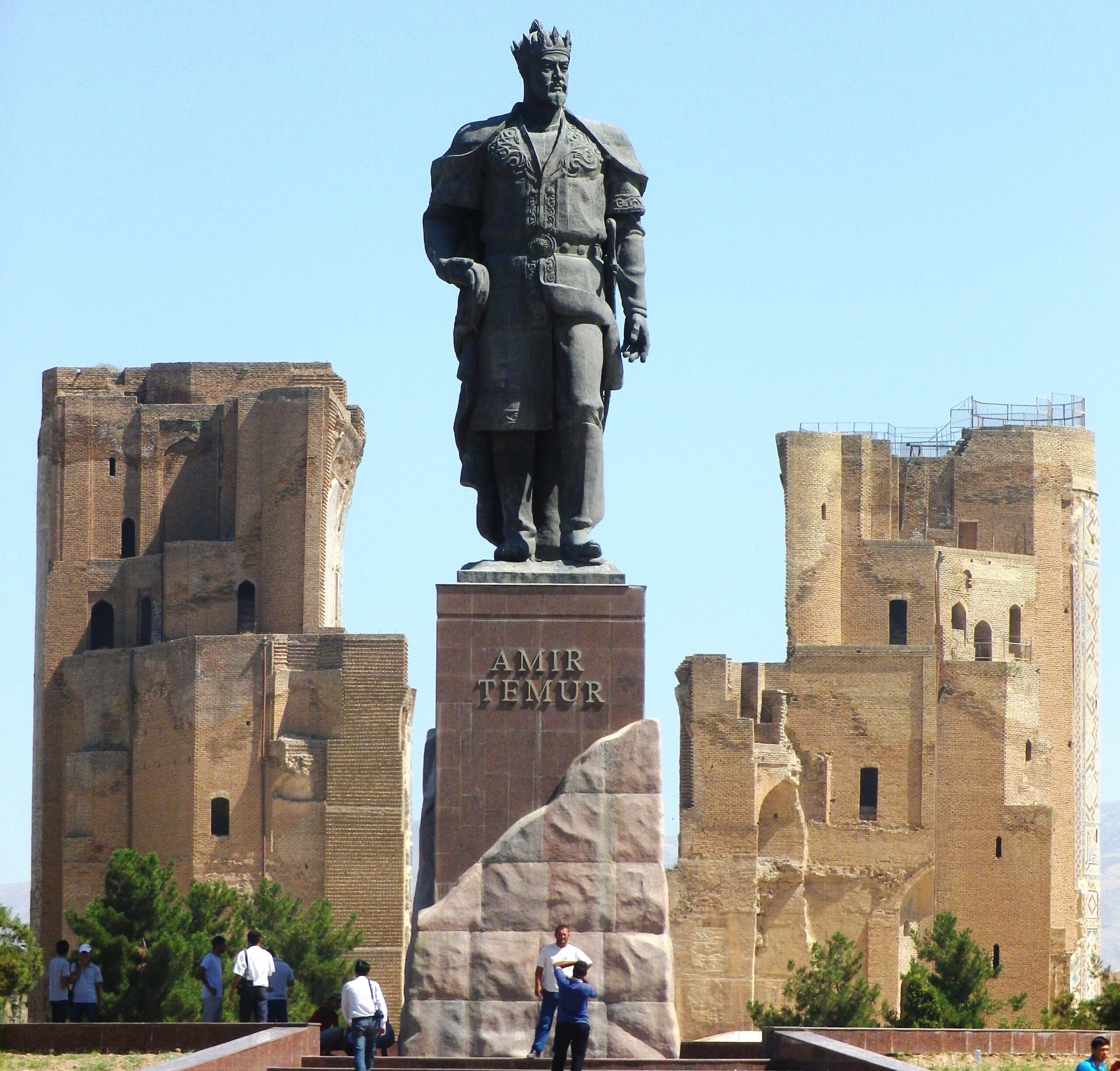
Shakhrisabz, or Green City, is less known than some other tourist destinations in Uzbekistan that were part of the Silk Road network linking cultures across Asia, Europe, and Africa many centuries ago. Yet the old urban core is more than 2,000 years old and contains spectacular monuments and other structures, some dating from the heyday of the city during the rule of the Turco-Mongol conqueror Timur, also known as Tamerlane, and the Timurids in medieval times.

Timur Statue; image: TCA, Stephen M. Bland

UNESCO declared it a world heritage site in 2000. But the historical center of Shakhrisabz, previously called Kesh, was placed on the U.N. cultural agency´s list of world heritage sites in danger in 2016 after large sections were razed to make way for a park and tourist facilities. It has stayed on the danger list ever since as officials in Uzbekistan, assisted by international advisers, try to figure out a way to prevent it from losing its United Nations status altogether. A total of 53 locations around the world are on UNESCO’s danger list.

The Fayzullah Ravnakhi Museum B&B, one of many buildings demolished to make way for tourist facilities; image: TCA, Stephen M. Bland

A solution in Uzbekistan’s case appears to be in the works. At a meeting in Paris this month, the UNESCO World Heritage Committee tentatively approved an Uzbek proposal that would restore Shakhrisabz in southern Uzbekistan to the regular heritage list but in reduced form – only four key Timurid monuments would be included, while the rest of the historical center would be labeled as a buffer zone.

“The main focus is expected to shift from the concept of a ´complete historic city´ to the conservation of the ensemble of monuments, including the Ak-Saray Palace, while preserving their urban context,” reported Gazeta.uz, a media organization in Uzbekistan.

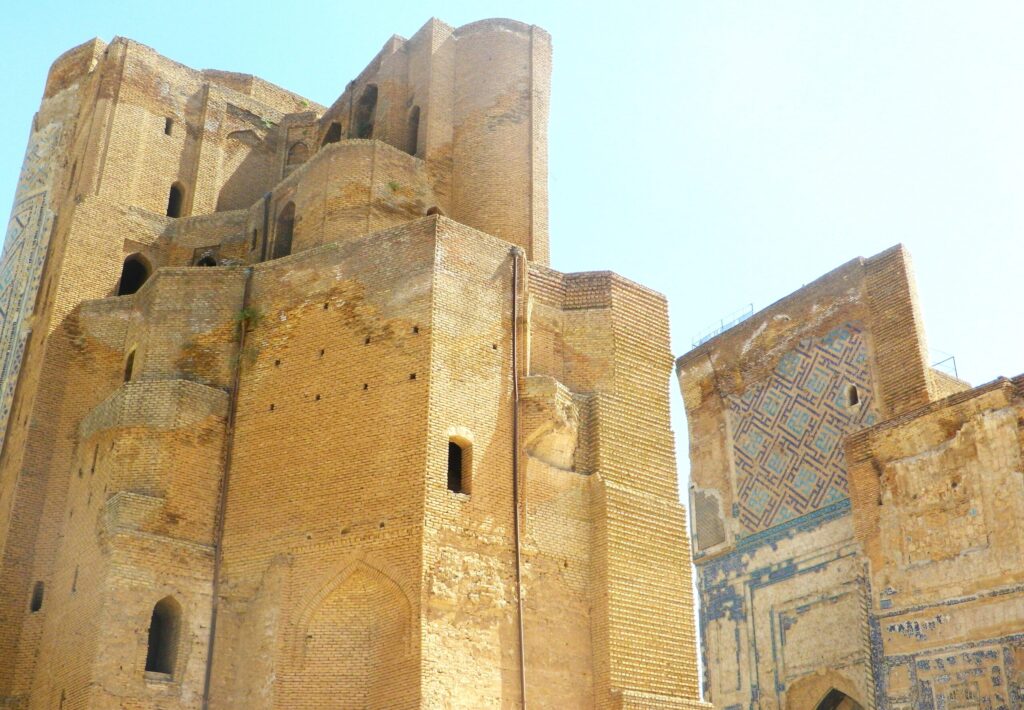
Ak-Saray Palace; image: TCA, Stephen M. Bland

Uzbekistan must conduct archaeological studies, prepare a restoration plan, and take other measures in order for the proposal to succeed, according to Gazeta.uz. Uzbekistan must update UNESCO on its progress in February 2026, and the process could still take several years.

Construction of the Ak-Saray Palace began in 1380 after a military victory by Timur, who was born in the city, according to UNESCO. The agency said that not one of the many Timurid monuments in Samarkand, north of Shakhrisabz, can rival the Ak-Saray Palace.

“The foundations of its immense gate have been preserved: this architectural masterpiece is outstanding in its dimensions and bold design,” UNESCO said.

While Shakhrisabz has less tourist infrastructure than nearby Samarkand, there are efforts to raise its profile. Last year, the Economic Cooperation Organization, whose ten members include Central Asian countries, declared it the tourism capital for 2024.

Uzbekistan’s other cultural sites have also faced development pressures as tourism booms in the country, alarming conservationists who warn that some of the most striking remnants of Central Asia’s ancient heritage are at risk.

Kazakhstan to Launch “School for Philanthropists” to Support Endowment Sector

Kazakhstan is set to establish a “school for philanthropists” at one of its universities, a specialized training center for professionals working in endowment funds. The initiative was announced by Gulzat Kobenova, Deputy Minister of Science and Higher Education.

Currently, 22 endowment funds operate in Kazakhstan. These targeted financial structures support the long-term development of education, healthcare, and cultural institutions through private donations. Unlike traditional charitable organizations, endowments invest the principal and use only the investment income to fund their programs, ensuring financial sustainability over time.

A significant step toward institutionalizing the sector came in June 2025 with the enactment of the Law on Endowment Funds. The legislation established a regulatory framework requiring independent audits, the publication of financial statements, and strict accounting standards. Endowments must also form a governance structure, including a board of trustees, an executive body, and an internal audit service.

For endowments with assets exceeding USD 75,000, management must be transferred to a licensed professional asset management company. The law also caps administrative and operational costs at 15% of investment income, or 0.5% of average asset value if there is no income.

Kobenova stressed that the development of this sector demands a new class of skilled professionals both fund managers and financial investors. To address this need, the ministry is launching a “school of philanthropy” based on international best practices, with input from Indiana University (USA).

“The school will train endowment fund employees, prospective investors and donors, and professional fund managers. There are also plans to create a professional community, including an endowment fund association,” Kobenova stated.

The creation of the school is part of the Ministry of Science and Higher Education’s roadmap through 2029. As part of this plan, five pilot university-based endowment funds will be launched by the end of 2029, with a total targeted capitalization of approximately USD 94 million.

According to Kobenova, these efforts aim to reduce universities’ dependence on the state budget and tuition fees, helping to ensure long-term financial independence.

As previously reported by The Times of Central Asia, Kazakhstan’s investment in research and development (R&D) nearly tripled over the past five years, reaching USD 430 million in 2024. However, science continues to contribute only 0.16% to the national GDP.