• KGS/USD = 0.01144 0%
  • KZT/USD = 0.00193 -0%
  • TJS/USD = 0.10811 -0.28%
  • UZS/USD = 0.00008 0%
  • TMT/USD = 0.28490 0%
  • KGS/USD = 0.01144 0%
  • KZT/USD = 0.00193 -0%
  • TJS/USD = 0.10811 -0.28%
  • UZS/USD = 0.00008 0%
  • TMT/USD = 0.28490 0%
  • KGS/USD = 0.01144 0%
  • KZT/USD = 0.00193 -0%
  • TJS/USD = 0.10811 -0.28%
  • UZS/USD = 0.00008 0%
  • TMT/USD = 0.28490 0%
  • KGS/USD = 0.01144 0%
  • KZT/USD = 0.00193 -0%
  • TJS/USD = 0.10811 -0.28%
  • UZS/USD = 0.00008 0%
  • TMT/USD = 0.28490 0%
  • KGS/USD = 0.01144 0%
  • KZT/USD = 0.00193 -0%
  • TJS/USD = 0.10811 -0.28%
  • UZS/USD = 0.00008 0%
  • TMT/USD = 0.28490 0%
  • KGS/USD = 0.01144 0%
  • KZT/USD = 0.00193 -0%
  • TJS/USD = 0.10811 -0.28%
  • UZS/USD = 0.00008 0%
  • TMT/USD = 0.28490 0%
  • KGS/USD = 0.01144 0%
  • KZT/USD = 0.00193 -0%
  • TJS/USD = 0.10811 -0.28%
  • UZS/USD = 0.00008 0%
  • TMT/USD = 0.28490 0%
  • KGS/USD = 0.01144 0%
  • KZT/USD = 0.00193 -0%
  • TJS/USD = 0.10811 -0.28%
  • UZS/USD = 0.00008 0%
  • TMT/USD = 0.28490 0%
10 December 2025

Uzbekistan and China Deepen Ties Across Strategic, Economic, and Soft-Power Fronts

Uzbekistan and China have significantly expanded their bilateral relationship in the last month. The meeting between Presidents Shavkat Mirziyoyev and Xi Jinping on June 17, 2025, in Astana, during the second China–Central Asia Summit, formally endorsed what both states termed a “multi-dimensional strategic partnership.”  The occasion marked the conclusion of bilateral negotiations on Uzbekistan’s accession to the World Trade Organization. This membership is both procedural and symbolic, as it signals Uzbekistan’s intensifying participation in global economic architecture. In particular, it serves to legitimize the country’s market-opening reforms in the eyes of international partners.

Strategic Dialogue and the Evolution of Political Ties

The June 2025 summit meeting built upon groundwork laid during Mirziyoyev’s January 2024 state visit to China, when a suite of agreements were reached that catalyzed the creation of a Strategic Dialogue between the two countries’ foreign ministries. A year later, in January 2025, this was formally upgraded to an “all-weather comprehensive strategic partnership”.

This phrase signifies that the dialogue was acquiring operational substance in the form of diversified sectoral initiatives spanning infrastructure, innovation, security, and energy. For Uzbekistan, this initiative marks a sustained effort to define itself not only as a recipient of foreign capital but as a co-architect of regionally significant configurations.

Trade and investment data point to a structurally intensifying relationship. Bilateral trade stood at $14 billion in 2024, up from $13 billion the previous year, with both sides aiming for $20 billion in the near term. As of February 2025, 3,467 Chinese firms were active in Uzbekistan, an increase of over 1,000 from the prior year. However, the $9.8 billion trade deficit in China’s favor remains politically sensitive, highlighting asymmetries even as cooperation deepens.

Sectoral Investment and Institutional Coordination

A joint investment portfolio exceeding $60 billion undergirds this integration. Key projects include special economic zones, technoparks, and localized production of BYD electric vehicles. The sectoral spread extends to renewable energy, mining, logistics, metallurgy, pharmaceuticals, and smart agriculture. Financial institutions such as the Silk Road Fund and China Eximbank are underwriting emblematic initiatives, including the Olympic Village in Tashkent. On June 28, 2025, Uzbekistan’s Deputy Minister of Investments, Industry and Trade met with Chinese leather industry representatives to coordinate manufacturing projects in Andijan and Ohangaron.

These dynamics were further institutionalized at the Uzbekistan–China Interregional Forum held June 1–2, 2025, in Samarkand, where Uzbekistan’s Deputy Prime Minister Jamshid Khodjaev emphasized that Chinese investment has increased fivefold since 2017. Although this was technically a regional event, it reinforced — as a public-facing moment of alignment between central planning and international economic engagement — a national-level policy architecture receptive to external capital, particularly from China.

Infrastructure and Energy

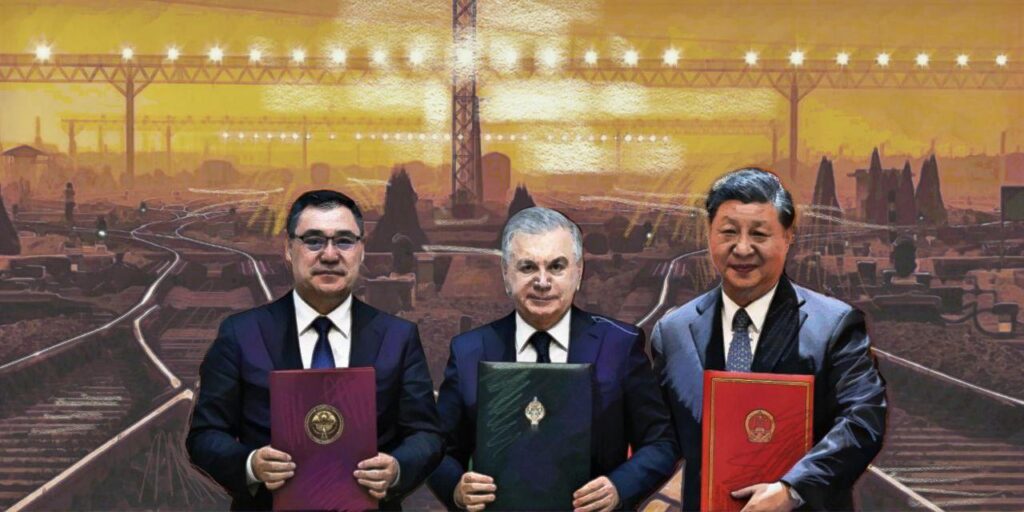
At the infrastructural core of bilateral cooperation stands the China–Kyrgyzstan–Uzbekistan (CKU) railway. Both presidents re-emphasized the project’s strategic relevance, identifying it as essential to transcontinental logistical continuity from East Asia to Europe. The project has not only economic but also geopolitical significance, situating Uzbekistan as a connective node rather than a peripheral conduit. If completed on time, it may also reduce Uzbekistan’s dependency on northern or western transit corridors.

Uzbekistan’s natural gas exports to China saw a substantial increase of over 60% year-on-year in the first five months of 2025. According to official data from Uzbekistan’s National Statistics Committee, gas exports to China reached $288 million between January and May 2025. Interestingly, physical volumes have not been officially reported or unofficially hinted at. Based on typical regional prices, however, a reasonable estimate of quantities would be 1.0–1.5 billion cubic meters (bcm), or an annual rate of 2.4–3.6 bcm. This development reinforces the dual commercial and energy linkages that increasingly characterize the bilateral channel.

China’s expanding role in Uzbekistan’s energy sector now also includes a strategic shift toward green infrastructure and technological modernization. Since 2023, Chinese state and private enterprises have committed to over 5,000 megawatts (MW) of new solar and wind capacity in Uzbekistan, including flagship facilities in Andijan, Karakalpakstan, and Jizzakh. Uzbekistan’s Atomic Energy Agency is also in exploratory talks with China National Nuclear Corporation to deploy small modular reactors and expand uranium production, signaling a long-term alignment on low-carbon energy strategies.

Human Mobility and Soft-Power Engagement

Effective June 1, 2025, a mutual 30-day visa-free regime was implemented for citizens of both countries. Announced by Foreign Ministers Wang Yi and Bakhtiyor Saidov, the policy aims to facilitate not just tourism and business but also people-to-people connectivity. The agreement is expected to normalize short-term mobility for professionals, students, and cultural figures. In this connection, Beijing has established a branch of Northwest Agricultural and Forestry University and the International Mathematics Center with Peking University in Uzbekistan.

Public sentiment within Uzbekistan remains, nevertheless, cautious. A mid-June 2025 incident in which a local official appeared to suggest farmland transfers to Chinese investors ignited controversy. The Ministry of Agriculture swiftly denied any such transactions, but the viral video triggered a broader reaction over land sovereignty and, by extension, economic dependency. These concerns are not new but have gained visibility as China’s economic footprint expands. Tashkent has sought to manage public discourse with narratives emphasizing national benefit and regulatory oversight, all while denying the reports. While elite consensus remains favorable toward Chinese investment, societal perception introduces an enduring constraint, shaping how far and how fast integration can proceed without risking political backlash.

Beyond trade and infrastructure, the relationship is being expanded to issue areas of human and social development. The two governments have pledged cooperation on poverty reduction initiatives, aligning with Uzbekistan’s domestic policy agenda. Coordination in smart agriculture, logistics, and green energy development has also been framed as a long-term platform for mutual benefit. Whether such diversification will insulate the relationship from any geopolitical shocks remains uncertain, but the effort to institutionalize its breadth is evident.

Balancing Growth and Sensitivities

Uzbekistan and China have consolidated a high-density bilateral relationship, combining formal diplomatic upgrades with tangible projects and policy coordination. The July 2025 milestone of mutual visa liberalization and expanding logistical access serves as both a signal and substance of this convergence. However, structural asymmetries and public sensitivities temper the otherwise smooth trajectory.

The Uzbek government must now navigate between the material benefits of Chinese capital and the symbolic costs perceived domestically. Going forward, the pace of implementation, particularly of the China–Kyrgyzstan–Uzbekistan railway, and the durability of public consent will serve as bellwethers for the sustainability of this accelerated bilateralism. Much will hinge on whether economic gains are sufficiently distributed to justify the strategic momentum.

Azerbaijani Crew Films in Kazakhstan for Plane Crash Documentary

A film crew from Azerbaijan has visited Kazakhstan to make a documentary about the deadly crash of an Azerbaijan Airlines plane that Azerbaijan says was hit by Russian ground fire.

Lada.kz, a media organization based in the city of Aktau in western Kazakhstan, talked to the three-member team from the CBC Azerbaijan TV channel about the project. The filmmakers went to Aktau because the plane crashed on the approach to the city’s airport on December 25 last year after diverting across the Caspian Sea from its planned landing in Grozny, Chechnya.

“Several films have already been made in Azerbaijan on this topic, but in our project we want to reconstruct the chronology of events in detail, literally minute by minute,” senior editor Gulzar Mustafayeva told Lada.

“It is very important to show how the people of Kazakhstan reacted, how the residents of Aktau united and came to the rescue,” she said, referring to emergency response teams that rushed to help survivors as well as the donation of blood from people in Kazakhstan.

The crash killed 38 of the 67 people on board and soured relations between Russia and Azerbaijan, which accused Russian officials of failing to take responsibility. Russian President Vladimir Putin apologized to Azerbaijani leader Ilham Aliyev, but did not acknowledge that Russian fire damaged the plane. Russia has said the area was under attack by Ukrainian drones at the time.

Kazakhstan issued a preliminary report on the crash in February. It said the plane had been hit by metal objects, an assertion that appeared to confirm that the aircraft was shot at from the ground. But the report didn’t say Russia was to blame.

Mustafayeva and her colleagues visited the crash site, where a simple memorial has been installed.

“Despite the fact that everything was cleaned, tidied up, and the main fragments were taken away long ago, small details still remain on the site – scraps of clothing, remnants of shoes, a wheel from a suitcase in which someone was carrying their things,” she told Lada. “This makes a very strong impression. You stand and understand: human lives were cut short here.”

She said CBC Azerbaijan TV plans to show the documentary later this year.


#SaveChorvoq: Experts and Bloggers Demand Answers on Sea Breeze Uzbekistan Project

The Times of Central Asia earlier reported that Azerbaijani businessman Emin Agalarov plans to build “Sea Breeze Uzbekistan,” a huge tourist complex on the shores of the Charvak (Chorvoq) reservoir.

The center will cover 500–700 hectares and include hotels, cottages, pools, sports areas, shops, restaurants, and a bridge connecting both sides of the reservoir. It will also host festivals, concerts, and cultural events.

News of this project has sparked a strong public reaction. Many people wonder why such a big plan was made without any open discussion. The project is discussed under the hashtag #SaveChorvoq, which many use to call for action.

The idea first appeared in December when Agalarov presented it to President Shavkat Mirziyoyev. In April, the president reviewed the master plan. Since then, social media has been full of debates about the environmental risks and possible water shortages.

An Instagram video by environmental blogger Urikguli (Mutabar Khushvaqtova) gathered opinions from experts and influencers about how Sea Breeze Uzbekistan might affect Charvak’s water balance.

Temur Ahmedov, a sustainable construction specialist, said: “Tashkent has 3.5 million people, and New Tashkent is being built too. Where will all that water come from? If Charvak’s balance is broken, we have a big problem.”

Dr Yulduzkhon Abdullaeva, a doctor of natural sciences, warned: “First, biodiversity will suffer. Charvak reservoir and its surroundings house rare plants and animals. A lot of materials must be brought in that way. Because we don’t have waterways, transport will use roads, which can pollute the air.

Pools and fountains will need water from Charvak, which may disturb its hydrological balance. An environmental impact assessment is necessary. The results must be made public.

If the assessment is negative, the project should be cancelled. That’s why public involvement is very important.” Abdullaeva also noted: “Rare plants grow near the reservoir, and animals live there. Pools and fountains will use Charvak water, which could upset its balance. A project evaluation must be done, and if bad, construction should be stopped.”

Urban planner Iskandar Soliyev expressed doubts about the developer’s promises. “I think building such a large project around the reservoir is a mistake. Even Agalarov says in his videos that first we will install water-cleaning devices, then start construction. But we know those promises are often broken. That is the main worry.”

Urikguli stressed: “If errors happen or water is polluted at Charvak, we could lose our only source of drinking water. That is why a thorough environmental check and transparency are essential.”

Alisher Khudoyberdiev, a hydrometeorology researcher, pointed out that motorboats could pollute the water and harm both drinking supplies and farmland.

Blogger Samandar Nizomov questioned the idea of a VIP zone. “Why let the rich go in and make the poor watch from afar? Charvak is not a sea or an ocean. I don’t want to drink water with impurities.”

His view echoed that of Umida Odilova: “Our reservoir is our drinking water source—for us and our children. There’s already too much building in the city. Only the mountains have clean air.”

The Times of Central Asia asked Urikguli whether the Ministry of Ecology or other officials had responded to the study of these concerns. She informed that Rasul Kusherbayev, advisor to the Minister of Ecology, expressed his opinion on this matter. “I am against any construction near Charvak reservoir. Not only Sea Breeze but also hotels or recreation areas, even boat rides—I reject them fully. The more we protect Charvak, the more we will thrive. If we pollute it, we force future generations to abandon this place. The Ministry of Ecology is now reviewing this matter. We don’t have full documents yet. The Ministry has publicly opposed motorboats on the reservoir since last year. Our response will reflect this position,” said Kusherbayev.

The Times of Central Asia also emailed Agalarov Development to request details about the environmental side of the Sea Breeze Uzbekistan project. In our message, we asked:

Did you carry out any environmental assessments or consult local ecological experts before proposing the project?

How do you respond to concerns from environmental activists and bloggers about risks and the lack of public discussion?

So far, Agalarov Development has not replied to our request.

With so many voices calling for caution, it is clear that people want to protect Charvak’s unique ecosystem. The debate shows the need for careful planning, open dialogue, and strong environmental safeguards before building such a large project near this vital water source.

Opinion: Uzbekistan Shows the World How Distance Education Can Work in a Crisis

A new study from Uzbekistan offers a powerful counter-narrative to the global trend of learning losses during the COVID-19 pandemic. While many countries struggled to maintain academic progress amid widespread school closures, Uzbekistan managed to not only sustain but improve learning outcomes — a feat made possible through swift and innovative education responses.
In our latest paper, we draw on unique longitudinal data to evaluate the impact of pandemic-induced school closures. The findings are striking.

Key Findings

• Grade 5 mathematics scores improved by 0.29 standard deviations during the pandemic.
• Students tested in both 2019 and 2021 gained 0.72 standard deviations, indicating continued learning.
• Uzbekistan maintained learning continuity despite massive disruptions to traditional schooling.
It was with some trepidation that I looked towards distance education done right to alleviate the situation. I am glad I was proven right, but, of course, this is all due to the students, families, teachers, administrators, and the Ministry of Education of Uzbekistan.

The Uzbekistan Model: Distance Learning via TV

What made this success possible? We credit Uzbekistan’s rapid deployment of daily televised lessons, taught by the country’s best teachers, ensuring nationwide coverage even where internet access was limited.
Despite limited internet access in rural areas, 100% digital TV penetration made broadcasting the most viable mass learning platform. By April 2020, over 350 video lessons were airing nationally and uploaded online for supplementary access.

Implications for Global Education Policy

Uzbekistan’s experience illustrates that learning loss is not inevitable. With well-designed, inclusive, and adaptive policies, countries can maintain — and even accelerate — learning during crises.
The study contributes to the growing body of evidence on educational resilience and can inform crisis responses worldwide.

Jessica Lynn’s Concerts in Ashgabat: A New Chapter in Turkmenistan’s Cultural Landscape

Ashgabat, Turkmenistan, July 2025 – American country-rock artist Jessica Lynn will perform in Turkmenistan’s capital, Ashgabat, on July 5 and July 6, marking a rare cultural exchange between the country and the West. This event offers a glimpse into Turkmenistan’s gradual shift towards engaging with global culture, even as the country remains cautious in its diplomatic and cultural openness. For the residents of Ashgabat, Jessica Lynn’s performance presents an opportunity to experience live music from a genre not often seen in this part of the world—a blend of American country, rock, and pop influences that are popular across the United States but less familiar in Turkmenistan. As noted by the U.S. Embassy in Turkmenistan, these concerts symbolize a key moment in strengthening cultural diplomacy.

A Milestone for Turkmenistan’s Cultural Diplomacy

Jessica Lynn’s two concerts will take place at two significant venues in Ashgabat: the Turkmenistan Cinema Concert Hall and the Arkaç Shopping and Entertainment Center, both emblematic of the country’s urban modernization. The concerts, open to the public on a first-come, first-served basis, come at a time when Turkmenistan is slowly embracing a more open stance towards foreign cultural influence. While the country has long been known for its cultural isolation, recent leadership under President Serdar Berdimuhamedov has shown a willingness to engage selectively with the outside world, particularly in the fields of art and entertainment. These concerts serve as a cultural milestone, not just because of Jessica Lynn’s genre-defying music, but also as part of Turkmenistan’s broader strategy to position itself as a more modern and internationally engaged country. By inviting a Western artist like Jessica Lynn, the government is signaling its intent to introduce international music into a society where such influences were once heavily restricted. According to the Turkmenistan State News Agency, the government’s outreach is part of its gradual integration into global culture.

Why Country-Rock? The Shared Themes Between Turkmen and American Music

The choice of country-rock for this cultural exchange might seem unexpected, but there are surprising similarities between Turkmen folk music and American country music. Both musical traditions place a strong emphasis on storytelling, with lyrics often centered around love, hardship, national pride, and life in rural communities. Turkmen folk music, which has been passed down through generations, is known for its rich oral traditions and its focus on personal and communal narratives. The dutar, a two-stringed instrument, plays a key role in many of these traditional songs, but the central theme—narrating stories of daily life and personal experiences—echoes the storytelling style that defines much of American country music. This connection between storytelling traditions is explored in a Nomads Life article about the influence of Western music on Turkmen artists, highlighting how both cultures value narrative as a central element of their music.

Much like the country ballads of artists like Johnny Cash and Dolly Parton, Turkmen folk songs depict struggles, resilience, and deep connections to the land. For example, Turkmen songs often tell tales of life on the steppe, which resonates with country music’s focus on the rural American experience. These shared emotional themes of longing for home, connection to nature, and personal resilience create a natural bridge between the two musical cultures. As explored in an analysis by Oriented Opinion, these common themes provide fertile ground for cross-cultural understanding.

A New Generation’s Engagement with Global Music

For many in Turkmenistan, especially the younger generation, Jessica Lynn’s concert will offer a rare opportunity to experience live Western music in a country where foreign cultural influences have only recently begun to take hold. While Turkmenistan remains a highly controlled society, there has been a marked shift in how the country engages with international culture. Events like Lynn’s concerts, though still exceptional, are becoming more common, reflecting a gradual loosening of cultural restrictions. The performances will likely appeal to a young, cosmopolitan audience that is increasingly exposed to global pop culture through the internet, social media, and state-sponsored events. This shift towards greater cultural openness is in line with recent developments noted in reports by the Turkmenistan State News Agency that discuss the country’s increased cultural exchange and participation in international festivals.

This engagement with Western music is not just about the novelty of a foreign artist performing in Ashgabat; it also reflects a growing cultural exchange where Turkmen audiences can appreciate global art forms while still maintaining a strong sense of national identity. As Turkmenistan opens its cultural borders, such performances represent an intersection of tradition and modernity, where global influences are carefully blended with local customs.

Cultural Diplomacy Through Music: A Steady Approach

The significance of Jessica Lynn’s concerts goes beyond entertainment. They represent cultural diplomacy in action, with music serving as a soft power tool that helps to build connections and foster mutual understanding. The U.S. Embassy in Turkmenistan has highlighted the concerts as part of its broader efforts to strengthen people-to-people ties between the two nations. Music, as a universal language, has long been recognized for its ability to transcend political and cultural boundaries. For Turkmenistan, hosting an American artist is a way to project a more modern, outward-facing image, while also maintaining control over the kinds of foreign influences that enter the country. This cultural diplomacy approach is reflected in previous reports from the U.S. Embassy in Turkmenistan and its ongoing commitment to fostering these types of exchanges.

While the concerts are small in scope, they fit within a larger trend of cautious internationalization. Turkmenistan has hosted various Western musical acts in recent years, and these events serve as stepping stones towards greater cultural engagement. Hosting Jessica Lynn is another carefully managed step that shows the country’s willingness to engage with international culture, but always on its own terms.

Looking Ahead: What Do These Concerts Mean for Turkmenistan’s Future?

Jessica Lynn’s performances are part of a broader movement within Turkmenistan to gradually modernize while still adhering to its cultural and political values. As the country slowly embraces more international influences, it will be interesting to see whether these cultural exchanges will expand beyond music into other areas such as film, literature, or visual arts. As Turkmenistan continues to open up, the influence of international music will play an important role in shaping its future cultural direction.

For now, the concerts represent a rare opportunity for cultural interaction, and for Jessica Lynn, it’s an uncommon chance to perform in a country that remains relatively closed off from the global stage. Her music, rooted in the storytelling tradition that resonates deeply with Turkmen folk music, will undoubtedly strike a chord with audiences in Ashgabat, while offering a fresh perspective on American country-rock.

In the long term, events like these may play a role in shaping Turkmenistan’s cultural future—a future where controlled openness and international collaboration continue to define the nation’s approach to cultural engagement. For now, as Jessica Lynn takes the stage in Ashgabat, she’ll be part of a quiet revolution in Turkmenistan’s cultural landscape, one that celebrates both tradition and global connection.

AIIB and Tajikistan Sign First Grant Agreement for Obigarm–Nurobod Road Project

The Asian Infrastructure Investment Bank (AIIB) and Tajikistan have signed a $2.04 million Project-Specific Window (PSW) Grant Agreement to support the Obigarm–Nurobod Road Project – Long Bridge and Approaches. This marks AIIB’s first PSW grant, a significant milestone in its efforts to mobilize blended finance for development impact.

The Obigarm–Nurobod Road Project aims to restore critical connectivity along a 75-kilometer section of the M41 Highway in central Tajikistan. This section, located in the mountain range north of the Vahdat River Valley, was disrupted by the reservoir impoundment of the Rogun Hydropower Plant. The project is expected to enhance regional connectivity and improve access for communities in the affected areas.

The agreement was signed at AIIB Headquarters in Beijing by Fayziddin Qahhorzoda, Tajikistan’s Minister of Finance, and Konstantin Limitovskiy, AIIB’s Chief Investment Officer. Representatives from the China International Development Cooperation Agency (CIDCA), which funds the grant, also attended the ceremony.

“This first PSW grant is an important step in AIIB’s journey to scale impact through blended finance,” said Limitovskiy. “By combining infrastructure investment with local skills development and inclusive programming, we aim to deliver long-term benefits for communities, especially women and youth in project-affected areas.

The PSW grant, funded by CIDCA, will focus on strengthening local capacity and promoting inclusive development. Key initiatives include:

  • Technical and Vocational Training: Programs for infrastructure professionals and construction workers.
  • Community Training Centers: Facilities aimed at empowering women through skills development.
  • Entrepreneurship Support: Initiatives to improve livelihoods and promote economic empowerment in affected areas.