• KGS/USD = 0.01144 0%
  • KZT/USD = 0.00212 0%
  • TJS/USD = 0.10456 0.19%
  • UZS/USD = 0.00008 0%
  • TMT/USD = 0.28490 0%
  • KGS/USD = 0.01144 0%
  • KZT/USD = 0.00212 0%
  • TJS/USD = 0.10456 0.19%
  • UZS/USD = 0.00008 0%
  • TMT/USD = 0.28490 0%
  • KGS/USD = 0.01144 0%
  • KZT/USD = 0.00212 0%
  • TJS/USD = 0.10456 0.19%
  • UZS/USD = 0.00008 0%
  • TMT/USD = 0.28490 0%
  • KGS/USD = 0.01144 0%
  • KZT/USD = 0.00212 0%
  • TJS/USD = 0.10456 0.19%
  • UZS/USD = 0.00008 0%
  • TMT/USD = 0.28490 0%
  • KGS/USD = 0.01144 0%
  • KZT/USD = 0.00212 0%
  • TJS/USD = 0.10456 0.19%
  • UZS/USD = 0.00008 0%
  • TMT/USD = 0.28490 0%
  • KGS/USD = 0.01144 0%
  • KZT/USD = 0.00212 0%
  • TJS/USD = 0.10456 0.19%
  • UZS/USD = 0.00008 0%
  • TMT/USD = 0.28490 0%
  • KGS/USD = 0.01144 0%
  • KZT/USD = 0.00212 0%
  • TJS/USD = 0.10456 0.19%
  • UZS/USD = 0.00008 0%
  • TMT/USD = 0.28490 0%
  • KGS/USD = 0.01144 0%
  • KZT/USD = 0.00212 0%
  • TJS/USD = 0.10456 0.19%
  • UZS/USD = 0.00008 0%
  • TMT/USD = 0.28490 0%

Explosion of Unknown Drone Reported in Western Kazakhstan

Debris believed to be from an unmanned aerial vehicle (UAV) has been discovered in the Burlin district of West Kazakhstan region. Preliminary information indicates that the explosion occurred early in the morning near the village of Kyzyltal.

According to Uralskaya Nedelya, representatives from the district akimat (local government), emergency services, and local police are currently investigating the scene. The military prosecutor’s office has also been dispatched and has opened a criminal case.

“This morning, a drone of unknown origin exploded near Kyzyltal village in the Burlin district. The roofs of houses in the village were nearly blown off,” eyewitnesses told local media.

The incident coincides with an air threat alert declared in Russia’s neighboring Orenburg region, where authorities reported a potential UAV incursion. The “Kover” plan, a protocol enacted during airspace threats, was implemented at the airports in Orenburg and Orsk.

Police in West Kazakhstan confirmed the incident and stated that a full investigation is underway.

“The police department, in cooperation with authorized agencies, is conducting an investigation into the discovery of what appears to be UAV debris in the Burlin district. All circumstances are being reviewed,” the department’s press service said.

Kazakhstan’s Ministry of Defense also responded, noting that no casualties or material damage had been reported.

“In cooperation with relevant state bodies, verification efforts are underway to determine the circumstances and origin of the object. The Ministry of Defense of the Republic of Kazakhstan has implemented additional measures to enhance airspace control and prevent unauthorized aerial border crossings. Consultations are ongoing with foreign partners who may potentially be linked to the UAV,” the ministry said in a statement.

This incident follows a similar discovery on June 19, when suspected UAV fragments were found in the Karakiyan district of the Mangistau region, near the Bolashak border station. As The Times of Central Asia previously reported, in March 2025 there were three drone-related events in West Kazakhstan in one month, raising concerns about airspace security near the country’s border with Russia.

Kyrgyzstan Expands Mineral Reserves Amid New Exploration Drive

Kyrgyzstan now boasts over 1,000 deposits of 51 different types of minerals, including precious, base, and rare earth metals, as well as coal and hydrocarbons, according to the Ministry of Natural Resources, Ecology, and Technical Supervision.

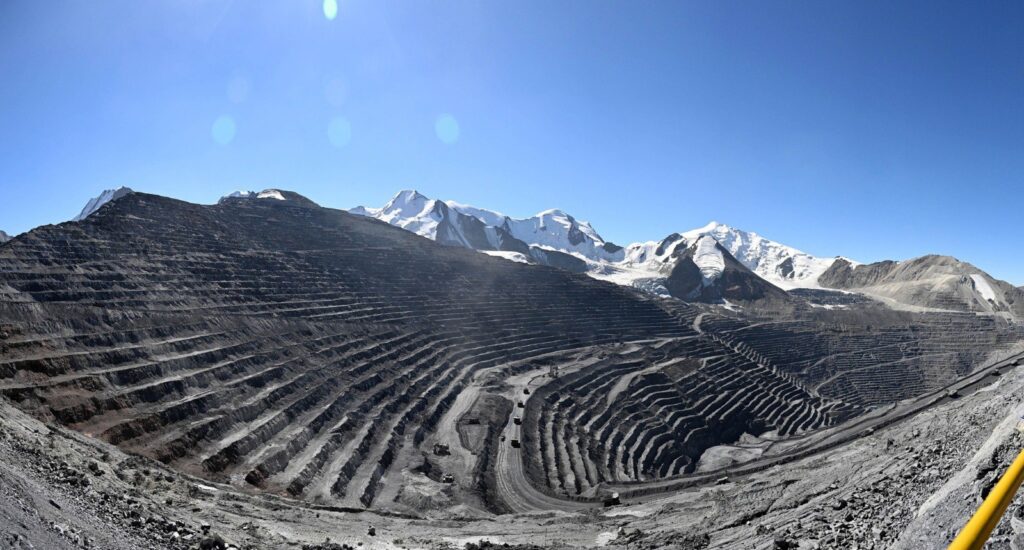
Among the most prominent is the Kumtor gold mine, situated at an altitude of 4,000 meters in the Issyk-Kul region. Kumtor ranks among the world’s ten largest gold deposits and remains a cornerstone of the national mining sector.

Approximately 400 deposits across the country are currently under development or active exploration, while operations at around 600 sites have been suspended pending reserve reassessments and upgrades to mining technologies.

The mining sector is considered a strategic priority for Kyrgyzstan’s economy. After years of limited geological activity, the government allocated 1 billion soms in 2024 to Kyrgyzgeology for equipment modernization and intensified exploration of polymetals and rare earth elements.

Between January and September 2025, the industry recorded stable growth in both output and reserves. As of January 1, 2025, Kyrgyzstan’s confirmed reserves included 973 tons of gold, 1,100 tons of silver, and 960,400 tons of copper, along with significant quantities of other minerals.

Recent exploration efforts yielded an additional 5.8 tons of gold, 3.7 tons of silver, and substantial volumes of non-ferrous metals, coal, and construction materials.

In the first nine months of 2025, Kyrgyzstan produced 17 tons of gold, 198,000 tons of oil, 18.9 million cubic meters of gas, and 2.3 million tons of coal.

To support industry growth, the government conducted 26 auctions for subsoil use rights, generating $1.6 million in revenue. As of September 2025, a total of 2,005 mining licenses had been issued, including 103 granted to state-owned enterprises.

Uzbekistan Expands Nuclear Energy Cooperation with Italy’s Ansaldo Energia

Uzbekistan and Italy are deepening their cooperation in the field of nuclear energy, according to a statement from the press service of the Uzatom Agency. A delegation led by Uzatom Director Azim Akhmedkhadjaev has just returned from a working visit to Genoa, Italy, where talks focused on advancing Uzbekistan’s first nuclear power plant project.

The visit included meetings with representatives of the regional government, the Genoa Chamber of Commerce, leading universities, and major Italian energy firms. A key session was held with Ansaldo Energia and its nuclear subsidiary, Ansaldo Nucleare, one of Europe’s leading providers of power generation technologies.

Discussions focused on integrating Italian technical solutions into Uzbekistan’s planned nuclear facility, with particular emphasis on adapting auxiliary systems to local climatic and geological conditions. The Italian side shared its experience in safety system design, nuclear software development, and fuel management, expertise gained through projects in China, Belgium, Slovenia, Hungary, and Ukraine.

Both sides explored the potential role of Italian companies as technical consultants during construction, ensuring the project aligns with international safety standards. Cooperation in radioactive waste management and deployment of advanced Italian fuel-handling technologies was also discussed.

Italy also expressed readiness to support Uzbekistan in developing a national regulatory framework for nuclear energy and licensing procedures. Further, the two parties considered launching joint research and engineering initiatives to train Uzbek nuclear specialists, part of a broader effort to build local capacity and ensure the safe, long-term operation of the country’s future nuclear infrastructure.

The talks come as Uzbekistan diversifies its energy portfolio. Energy Minister Jurabek Mirzamahmudov recently announced that Saudi-based Pemco will begin constructing a 200-megawatt gas-piston power plant in Samarkand. Meanwhile, Uzbekistan continues to expand its solar and wind capacity through ongoing projects with ACWA Power.

East Kazakhstan Falconry Festival Brings Together Guardians of Steppe Traditions

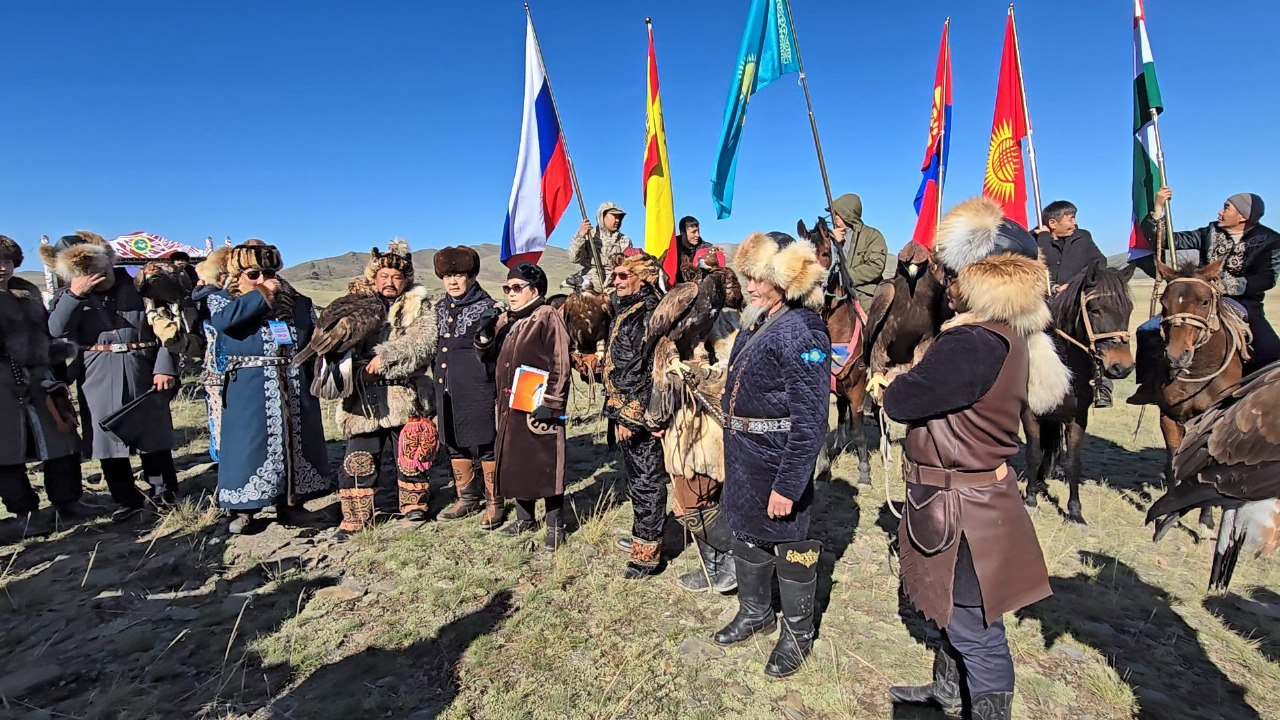
The fifth International Falconry Festival was held this month in East Kazakhstan, bringing together falconry masters and custodians of ancient culture from seven countries.

A Festival That Brings the Steppe to Life

Traditionally held in Ulan district near the village of Bozanbay, the event, also known as Shygys Salburyny, drew more than 100 participants, including falconers and cultural figures from Kazakhstan, as well as guests from Spain, Hungary, Russia, Mongolia, China, and Kyrgyzstan.
@TCA

Shygys Salburyny is a celebration of nomadic civilization, where customs and crafts are revived, ancestral songs are sung, ancient rituals performed, and golden eagles once again soar over the steppe.

Every gesture of the participants reflects respect for the past, for the harmony between humans and nature, and for the spirit that nurtures strength and nobility.

‘Berkutchi’ and Golden Eagles: Guardians of the Sky and Steppe

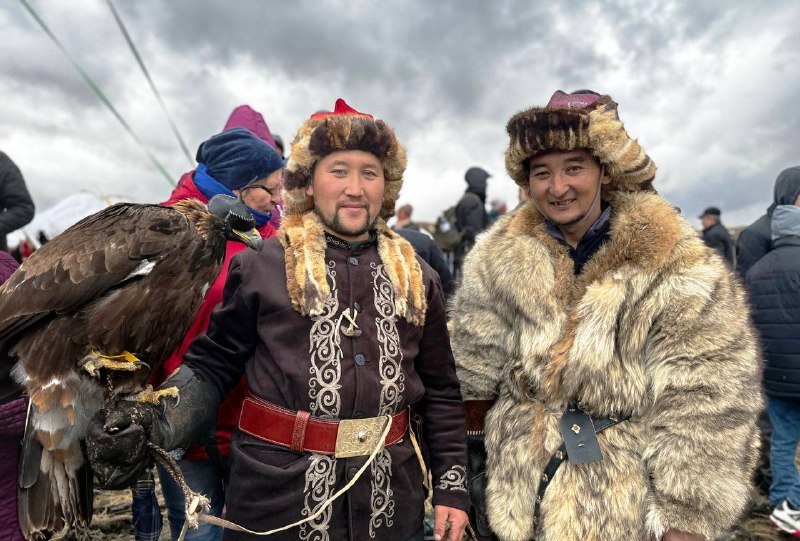
For as long as the Kazakh steppe has existed, golden eagles have ruled its skies. Revered for their strength and freedom, their cries louder than the wind, their flight graceful over mountains and rivers, the birds inspired the development of sayat, the art of hunting with birds of prey. From this tradition emerged the berkutchi, a unique brotherhood of falconers.

A berkutchi is more than a hunter. He understands nature’s rhythm, reads the wind’s breath, and senses his bird’s mood. The bond between falconer and eagle cannot be imposed; it must be earned.

Historically, hunting with golden eagles was a matter of survival, especially in the harsh winter months when eagles provided both meat and feathers for warmth. Over time, sayat evolved into a symbol of spiritual strength, courage, and reverence for nature. A true berkutchi was revered like a batyr, a warrior, respected for his calm, fairness, and poise.

@TCA

Training a young eagle is an intricate art, requiring patience and reverence. Eaglets are taken from the nest and slowly trained to accept the falconer’s hand and voice. Trust is built gradually, as the bird learns to recognize and respond to its handler.

Every detail is vital from hand movements to shadows on the ground. Before a hunt, the falconer dons an iyanga (sturdy glove) and fits a tomaga (leather hood) on the bird’s head to block light until the moment of release. A whispered prayer to the spirits of the steppe precedes the flight, reminding all that hunting is not conquest, but a respectful exchange with nature.

Sayat Today

The sayat tradition endures in many parts of Kazakhstan, but East Kazakhstan remains its heartland.

“Not every bird flies in immediately,” said Daniyar Nurbek, chief judge of the festival, speaking to The Times of Central Asia. “What matters isn’t force, but mutual understanding. There must be a deep, almost spiritual bond between hunter and eagle, it cannot be commanded, only nurtured.”

@TCA

Youngsters and Masters

The festival welcomed both seasoned falconers and novices. Among them, seven-year-old Abdurashid Mamyrkhan drew particular attention. His father, Mamyrkhan Manayuly, explained that his son has been learning about birds since the age of five.

“This isn’t just hunting, it’s in our blood and memory,” he said. “By teaching my son, I pass on our respect for nature and our ancestors.”

Foreign guests also shared their impressions. Hungarian falconer Gergely László Bodis noted that in the steppes of East Kazakhstan, he felt “the breath of antiquity” for the first time.

“In Hungary, we also practice falconry, but here it feels like a living ritual, part of the soul,” he said.

Russian participant Alexander Malakhov, attending for the second time, described the event not as a competition, but a philosophy.

“The essence lies not in technique, but in respect. Kazakhstan inspires: its people, its culture, and its nature call for reflection,” Malakhov said.

@TCA

Luis Guijarro Panadero from Spain came to study Asian falconry traditions.

“We also have bird hunting in Spain, but the methods are quite different. Here, it’s not just sport, it’s a cultural code,” he noted.

Ethno-Site and Traditions

Beyond the competitions, guests enjoyed a vibrant cultural program. On the Burkit Tobe site, a traditional village of 40 yurts was assembled, each serving as a miniature museum of Kazakh life and ritual.

Regional delegations from East Kazakhstan staged scenes from ancient Kazakh life: weddings, rituals for newborn children, and the symbolic “adding oil to the fire.”
@TCA

The Spirit of Competition

In addition to falconry events, participants competed in shooting and traditional equestrian games. Serikbol Oktyabr won the shooting competition, citing the importance of spiritual strength.

“This tests not only physical power but inner resolve. Through such events, we revive ancestral traditions and set an example for our youth,” he said.

Aqzhan Merke triumphed in the horse-riding competition. “Equestrian sport is a vital tradition, and we must preserve and develop it,” Merke said.

@TCA

Spectators were captivated by the birds soaring, then plunging in response to their handler’s call.

Baitbay Omirkhan from Almaty won the eagle and hawk competitions, while Kenzhetaev Erlan from Akmola region claimed victory in the falcon category.

“The falcon is a noble bird, and working with it carries great responsibility,” Omirkhan said. “This year, I felt the spirit of the festival more deeply than ever. It’s not just a competition, it’s unity.”

Kenzhetaev added: “This is my third Shygys Salburyny. The level of competition keeps rising, and the organization is exceptional. Festivals like this are vital to preserving our heritage.”

As one participant aptly summarized: “As long as the golden eagle soars over the steppe, as long as fathers pass down the tomaga and iyanga, as long as Kazakh songs are sung, our culture will endure.”

Iran to Retain Control of Sangtuda-2 Hydropower Plant in Tajikistan Until 2032

Tajikistan and Iran have agreed to extend the repayment period for Iran’s investment in the Sangtuda-2 hydroelectric power plant by six years and four months. The extension will allow the Iranian side to recover its investment, after which full ownership of the facility will transfer to the Tajik government.

The amendments to the electricity purchase agreement between Tajikistan’s state-owned power utility Barki Tochik and Iran’s Sangtuda Sangob company were ratified by the lower house of Tajikistan’s parliament in early October. The revised agreement was originally signed on May 29, 2025, in Dushanbe, following high-level negotiations between the two countries.

Under the initial agreement, Iran was to recover its investment by August 2026, after which the hydropower plant would become Tajik state property. However, under the new terms, Iranian management of the plant will continue until the end of 2032.

The total construction cost of the Sangtuda-2 hydroelectric plant was $256 million. Of this, the Iranian government contributed $180 million, Sangob invested $36 million, and the Tajik government provided $40 million.

According to Tajikistan’s Ministry of Energy and Water Resources, between the plant’s launch in 2012 and the end of 2023, Barki Tochik purchased 8.9 billion kilowatt-hours of electricity worth $451.5 million. However, the power plant itself received only $122.5 million, roughly 27% of the total value.

As a result, Tajikistan’s outstanding debt to Sangtuda-2 reached $329 million. Under the new agreement, this debt will be fully written off. In return, Dushanbe has committed to a new payment schedule over the next six years and four months. After this period, control of the plant will transfer to Barki Tochik.

Sangtuda-2 is among the largest joint energy projects between Tajikistan and Iran. Construction began in 2006, with the first hydroelectric unit launched in September 2011 and the second in 2014.

The plant is located in the Danghara district of the Khatlon region, on the Vakhsh River. It is the fifth stage of the Vakhsh cascade of hydroelectric stations.

The Taliban’s Border Rhetoric: Pashtun Frontiers, Not Central Asian Borders

Two incidents in mid-October reignited debate over Afghanistan’s borders, particularly its long-disputed frontier with Pakistan. On October 18, Mohammad Nabi Omari, Afghanistan’s first deputy minister for interior affairs, suggested that Afghanistan’s “historical lands” now in Pakistan could one day return to Afghan control. The next day, Qatar’s Ministry of Foreign Affairs referred to “ending tensions on the Afghanistan–Pakistan border” in a ceasefire statement, prompting Taliban objections and a quick retraction.

These remarks revived a longstanding Afghan grievance: the Durand Line, a frontier drawn in 1893 by the British between Afghanistan and British India. No Afghan government has ever recognized it as an international border, and the Taliban refers to it as an “imaginary line.”

The Taliban’s language may alarm some observers who wonder whether such rhetoric could extend beyond Pakistan to Afghanistan’s northern borders with Central Asia. Those frontiers were defined in the 19th century by treaties between the Russian and British empires, with little Afghan involvement.

Yet despite the heated language and recent armed clashes with Pakistan, the Taliban’s stance appears more ideological than expansionist.

The Durand Agreement of 1893 established the boundary between Afghanistan and British India as a line separating their respective spheres of influence. When Pakistan gained independence in 1947, that line became an international border, recognized by all states except Afghanistan. The 2,600-kilometer frontier divided Pashtun and Baloch communities between two countries, leaving deep resentment that continues to shape tensions in the region. Pashtuns still move relatively freely across this rugged border, which has served as a haven for militants for decades.

Afghanistan’s northern borders tell a slightly different story. They were drawn not by Afghan rulers but under the Anglo-Russian Agreement of 1873, which set the Amu Darya River as the boundary between the Russian and British spheres of influence. This arrangement confirmed Afghanistan’s authority over the lands south of the river, including Balkh, Kunduz, and Badakhshan, reinforcing both its territorial control and its legitimacy.

In essence, the demarcation of Afghanistan’s northern boundary was a political gain. While the Durand Line came to represent partition and loss, the 1873 agreement brought Afghanistan new territory and legitimacy as a buffer state between the Russian and British empires. The north is largely inhabited by Uzbeks, Tajiks, and Turkmen, with few Pashtuns. This distinction helps explain why the Taliban’s references to “historic lands” focus on the Durand Line rather than Afghanistan’s borders with Central Asian states.

Afghanistan’s acting defense minister, Mawlawi Mohammad Yaqoob Mujahid, the son of the Taliban’s late founder Mullah Mohammad Omar, recently reiterated that “[the Durand Line] has never been recognized as an official border, and no agreement has been made on this issue.… This is not a decision any government can make; it is a matter for the people.” Deputy Interior Minister Mohammad Nabi Omari’s call for the “return” of historic lands reflects the same ideological stance: a vision of Pashtun unity shaped by popular will rather than a call for military action or unilateral political moves.

The Taliban, a Pashtun-led movement, uses this rhetoric to appeal to supporters on both sides of the Durand Line. It is best understood as a symbolic appeal to Pashtun identity rather than a call for territorial expansion. At its core, it reflects a grievance shared by Pashtuns divided by a colonial-era border, an assertion of identity and dignity rather than a demand for land.

Afghanistan’s relations with its Central Asian neighbors are built on cooperation rather than historical disputes. The Anglo-Russian Agreement ultimately benefited Afghanistan by consolidating control over mineral-rich regions that the Taliban now hopes to develop.

Economically, Afghanistan’s future prosperity depends on stronger integration with its northern neighbors as it seeks to become a regional transit hub through projects such as the TAPI natural gas pipeline, the Trans-Afghan Railway, and the Wakhan Road linking it to China.

For the Taliban, maintaining stability and peaceful relations with Turkmenistan, Uzbekistan, and Tajikistan is a strategic priority. The group has shown no interest in claiming Central Asian territory, recognizing that any such move would threaten Afghanistan’s development and weaken its pursuit of international recognition.

The Taliban’s references to “historical lands” reflect a long-standing national grievance rather than a new geopolitical threat. Its leaders appear to understand that Afghanistan’s future depends on regional stability and economic integration, including progress on the Durand Line dispute and respect for the dignity of the Pashtun people.

Resolving the border dispute with Pakistan will remain difficult given Islamabad’s allegations of Taliban links to the Tehrik-e-Taliban Pakistan (TTP), the TTP’s public pledge of allegiance to the Afghan Taliban, and Pakistan’s concern over growing ties between Kabul and New Delhi. Earlier this month, Pakistan’s defense minister accused the Taliban of allowing India’s influence to reach “both sides” of Pakistan’s borders, a claim reflecting deep mistrust rather than verified policy.

Central Asian states are likely to view the Taliban’s rhetoric as an internal assertion of Afghan identity rather than a signal of aggression. Afghanistan’s priorities remain pragmatic: trade, energy, and diplomacy. In the end, regional security will depend on Afghanistan’s ability and its neighbors’ willingness to turn common borders into opportunities for cooperation.