• KGS/USD = 0.01144 0%
  • KZT/USD = 0.00212 0%
  • TJS/USD = 0.10456 0.19%
  • UZS/USD = 0.00008 0%
  • TMT/USD = 0.28490 0%
  • KGS/USD = 0.01144 0%
  • KZT/USD = 0.00212 0%
  • TJS/USD = 0.10456 0.19%
  • UZS/USD = 0.00008 0%
  • TMT/USD = 0.28490 0%
  • KGS/USD = 0.01144 0%
  • KZT/USD = 0.00212 0%
  • TJS/USD = 0.10456 0.19%
  • UZS/USD = 0.00008 0%
  • TMT/USD = 0.28490 0%
  • KGS/USD = 0.01144 0%
  • KZT/USD = 0.00212 0%
  • TJS/USD = 0.10456 0.19%
  • UZS/USD = 0.00008 0%
  • TMT/USD = 0.28490 0%
  • KGS/USD = 0.01144 0%
  • KZT/USD = 0.00212 0%
  • TJS/USD = 0.10456 0.19%
  • UZS/USD = 0.00008 0%
  • TMT/USD = 0.28490 0%
  • KGS/USD = 0.01144 0%
  • KZT/USD = 0.00212 0%
  • TJS/USD = 0.10456 0.19%
  • UZS/USD = 0.00008 0%
  • TMT/USD = 0.28490 0%
  • KGS/USD = 0.01144 0%
  • KZT/USD = 0.00212 0%
  • TJS/USD = 0.10456 0.19%
  • UZS/USD = 0.00008 0%
  • TMT/USD = 0.28490 0%
  • KGS/USD = 0.01144 0%
  • KZT/USD = 0.00212 0%
  • TJS/USD = 0.10456 0.19%
  • UZS/USD = 0.00008 0%
  • TMT/USD = 0.28490 0%

Uzbekistan-Turkey Trade Reaches $2.6 Billion as Customs Cooperation Deepens

Uzbekistan and Turkey have significantly expanded their trade partnership, with bilateral trade turnover reaching $2.6 billion, according to the State Customs Committee of Uzbekistan. The milestone was announced during the fifth meeting of the Uzbekistan-Turkey Joint Customs Council, held in the historic city of Khiva.

Friendly ties between the leaders of the two countries have laid the foundation for enhanced cooperation across a broad range of sectors, including politics, trade, investment, culture, and humanitarian initiatives.

Since the inaugural Joint Customs Council meeting in 2018, trade turnover between the two countries has grown by 35%, rising from $1.9 billion to $2.6 billion by the end of 2024. Officials called this an impressive achievement in the context of ongoing global economic challenges and noted that there is still considerable room for further growth through deeper customs collaboration.

One of the most impactful developments has been the 2022 agreement on the exchange of advance information on goods and vehicles. The agreement is currently undergoing preparations for full-scale implementation. Additionally, the two countries have improved mechanisms for foreign trade data exchange and made progress in addressing statistical discrepancies during a bilateral meeting in Samarkand in September. The next round of talks on this issue is scheduled to take place in Turkey.

Another key topic at the Khiva meeting was the mutual recognition of authorized economic operators (AEOs), a proposal first introduced at the 11th meeting of customs authorities from Turkic states, held in Kazakhstan. A draft agreement on mutual recognition is currently under review by the Turkish side.

Over the past five years, Uzbekistan’s trade volume managed by AEOs has more than doubled, increasing from $1.3 billion in 2020 to $2.7 billion in 2024. Council members also reviewed a joint cooperation plan for 2025-2026, which aims to further strengthen economic relations and streamline customs procedures.


Stanford University Names Two Tajik Scientists Among World’s Top Researchers

Professors Mahsud Saimdinov and Farukh Sharopov are the only scientists from Tajikistan included in Stanford University’s prestigious “World’s Top 2% Scientists – 2025” list.

The ranking, compiled under the guidance of renowned Stanford epidemiologist Professor John Ioannidis, assesses the scientific productivity and impact of researchers worldwide. Conducted annually since 2019, it analyzes data from more than 100,000 scientists across disciplines using the Scopus (Elsevier) database.

In 2025, just two researchers from Tajikistan, Farukh Sharopov and Mahsud Saimdinov, were included in the top 2% of global scientists based on their citation impact and publication record.

Researchers in the 98th percentile or above in their field qualify for inclusion.

Farukh Sharopov: Pioneer in Pharmaceutical Chemistry

Born in 1976, Farukh Safolbekovich Sharopov is among Tajikistan’s leading chemists. A graduate of the Chemistry Department at the Tajik State University (1998), he defended his doctoral dissertation at the V. I. Nikitin Institute of Chemistry of the Academy of Sciences of Tajikistan in 2002.

Sharopov has held positions as a senior and leading researcher at the Institute of Chemistry and has taught at the Abu Ali ibn Sina Medical University. Since 2019, he has served as a senior researcher at the China-Tajikistan Innovation Center for Natural Products.

In October 2025, he successfully defended a doctoral dissertation titled “Chemical Study of Secondary Metabolites of Essential Oil Plants Using Gas Chromatography and Mass Spectrometry.”

According to Scopus data as of October 14, 2025, Sharopov has authored 105 publications, which have been cited 6,881 times. He holds an h-index of 40 and ranks 692nd globally in the pharmaceutical and biomolecular chemistry field.

Mahsud Saimdinov: Global Leader in Nanotechnology

Mahsud Ismatboevich Saimdinov, born in 1988 in Isfara, is recognized internationally for his contributions to nanotechnology. A graduate and postgraduate of Lomonosov Moscow State University, he completed a postdoctoral fellowship at the King Abdullah University of Science and Technology (KAUST) in Saudi Arabia, served as a visiting researcher at MIT, and taught at the University of Toronto.

Currently, he holds a Tier II Canada Research Chair in Advanced Functional Materials and is a faculty member in the Department of Chemistry at the University of Victoria in Canada.

According to Scopus, Saimdinov has published 170 scientific papers, which have received 24,886 citations. His h-index stands at 69. In the category of nano and nanotechnologies, he ranks 630th globally, placing him among the field’s top-tier scientists.

Kyrgyz Authorities Open Public Debate on Death Penalty Bill

Following a series of high-profile murders and sexual assaults targeting young women, Kyrgyz authorities have initiated a public discussion on the possible reinstatement of the death penalty for convicted murderers and rapists. President Sadyr Japarov proposed the nationwide debate in response to growing public outrage.

The president’s office has prepared a draft bill that would allow for the introduction of capital punishment for particularly grave crimes committed against women and children.

“Currently, Kyrgyzstan is witnessing an increase in particularly serious crimes against children and women, including rape and murder involving rape, which are causing deep concern to both society and the state,” reads the explanatory note to the document.

According to the bill, its primary aim is to protect the lives and health of women and children from violent crimes. The Constitution of Kyrgyzstan identifies life and health as the highest values of the state, while guaranteeing special protection of citizens’ sexual integrity.

The authors of the bill also reference the UN Declaration on the Elimination of Violence against Women, adopted by General Assembly Resolution 48/104 on December 20, 1993, which calls on member states to develop legal measures, including criminal and administrative sanctions, to combat physical and sexual violence against women.

Statistics from the Prosecutor General’s Office indicate a steady rise in violent crimes in recent years. In 2021, there were 39 murders; 36 of the victims were women and three were children. By 2024, the number had increased to 43 (34 women and nine children). In the first eight months of 2025 alone, 28 people were killed.

Official data also show that more than 80 women, most of them minors, are raped each year. A large proportion of such crimes remain unreported or unresolved, as families often avoid publicizing the cases due to stigma and fear of reprisal.

The draft legislation proposes reinstating the death penalty only for two categories of crimes: the rape of minors and murders committed in conjunction with rape.

“The facts of violence against children and the murder of women accompanied by rape no longer shock society, it is becoming commonplace, and that is alarming,” the bill’s authors stated.

Public consultation on the proposal will continue until October 28, with parliamentary consideration scheduled until November 4.

Kyrgyzstan formally abolished the death penalty in 2007; the last execution was carried out in 1998. In December 2010, the country ratified the Second Optional Protocol to the International Covenant on Civil and Political Rights, committing to the eventual and permanent abolition of capital punishment.

Legal Imports of Chinese Smartphones Surge in Kazakhstan

Mandatory verification of mobile phones imported into Kazakhstan has led to a significant reduction in the shadow market, according to Deputy Minister of Finance Yerzhan Birzhanov. He stated that official imports of many popular Chinese smartphone models have increased 1.5 times and for some models, up to four times.

As previously reported by The Times of Central Asia, Kazakh authorities introduced a policy in March 2025 requiring telecom operators to check the IMEI codes of smartphones and disable illegally imported devices. This measure applied to all phones brought into the country after March 24.

Parliamentary deputy Ekaterina Smyshlyaeva supported the move, citing that 64% of mobile devices in Kazakhstan were previously brought in through illegal or “gray” channels. In 2024 alone, this led to an estimated loss of nearly 100 billion tenge (approximately $196 million) in unpaid value-added tax (VAT).

The Ministry of Digital Development, Innovation, and Aerospace Industry, later reorganized as the Ministry of Artificial Intelligence and Digital Development, reported even higher levels of illicit trade. According to its data, around 5 million smartphones were sold in Kazakhstan in 2024, with up to 75% believed to have been imported illegally.

However, there has been no immediate impact in the premium segment. “This was expected, as consumers were awaiting the release of new models from brands like Apple and Samsung. We anticipate growth in legal volumes from these brands as soon as sales data from October becomes available,” Birzhanov added.

Under the new system, all smartphones imported into Kazakhstan after March 2025 are categorized based on their IMEI codes into three lists: white, gray, and black.

The white list includes legally purchased and customs-cleared devices. The gray list comprises phones with suspicious or duplicate IMEI codes; owners of these devices have 30 days to verify their legitimacy. The black list includes stolen or counterfeit devices, which are barred from network access.

In a further step to combat illegal imports, Kazakhstan also introduced personal import limits. As of this year, individuals are permitted to bring in no more than two smartphones and two tablets per year without customs clearance.

Kyrgyzstan Highlights Water Crisis at FAO’s Rome Water Dialogue

Kyrgyzstan requires $1.2 billion in investment to resolve drinking water supply issues in 960 villages nationwide, Minister of Water Resources, Agriculture, and Processing Industry Bakyt Torobayev announced during the Rome Water Dialogue 2025. The event took place at the headquarters of the Food and Agriculture Organization of the United Nations (FAO) in Rome.

According to the ministry, Kyrgyzstan has 2,014 villages, but only 796 currently have access to clean drinking water. While pipeline construction is underway in 258 villages, 960 remain without a reliable supply.

“If we don’t invest the necessary funds today, restoring the lost potential tomorrow will cost three times as much. It’s time to give water the same level of attention as oil and gas,” Torobayev told the international forum.

The minister emphasized that the conservation and rational use of water resources is one of the most urgent challenges in Central Asia. Accelerated climate change and population growth are intensifying water shortages and threatening food security across the region.

Torobayev noted that approximately 10 million people in Central Asia still lack access to clean drinking water. He also cited figures showing that 80% of the region’s water infrastructure is outdated, with water losses reaching up to 55%.

He underscored the importance of protecting Kyrgyzstan’s mountain glaciers, which serve as critical water sources for major regional rivers that supply neighboring countries, including Kazakhstan, Tajikistan, and Uzbekistan.

Another urgent issue, according to the minister, is the declining water level in Lake Issyk-Kul, a body of water with regional environmental and climatic significance. “The tragic example of the Aral Sea shows that the loss of natural resources can lead to irreversible consequences. Water security is not only an environmental issue but also a matter of national and global sustainable development,” Torobayev warned.

New Kazakh Fish Processing Plant Exports Aral Fish to Europe

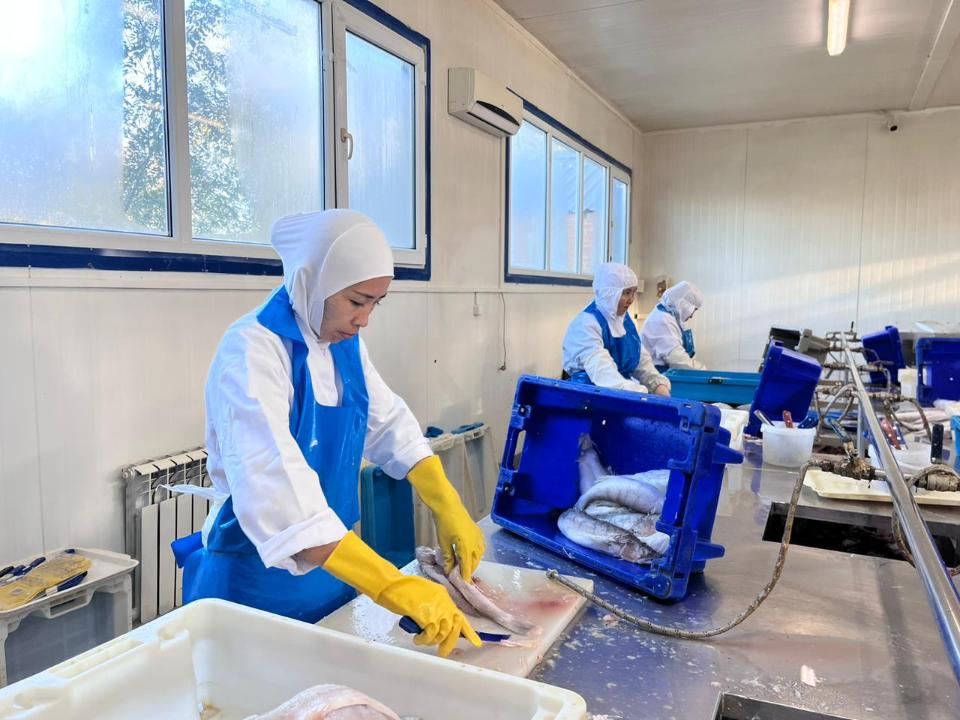
A new fish processing plant has opened in Kazakhstan’s Kyzylorda region, signaling continued progress in efforts to revive the fishing industry in the Aral Sea basin, once the site of one of the world’s most devastating environmental disasters.

According to the Ministry of Agriculture, the facility, located in the Aral district, has the capacity to process up to 6,000 tons of fish annually. Outfitted with modern equipment, the plant focuses on producing environmentally sustainable fish products that comply with international quality and safety standards. Its primary export, pike perch fillets, is shipped to markets in Germany, Denmark, and Norway.

Kazakhstan currently operates 72 fish processing plants, 20 of which are licensed to export to the European Union.

The country’s fishing sector has been buoyed by ongoing efforts to restore the Northern Aral Sea. Formed in 1987 during the large-scale desiccation of the original Aral Sea, the northern section has been preserved and partially replenished following the construction of the Kokaral Dam. Earlier this year, The Times of Central Asia reported a record increase in the sea’s water volume.

Rising water levels have expanded the surface area, reduced salinity, and facilitated the return of 22 fish species to the ecosystem. The annual catch in the Northern Aral now reaches approximately 8,000 tons, creating new economic opportunities for local communities.

Kazakhstan’s fishing industry continues to show steady growth. In 2024, the country produced 94,600 tons of fish products, a 7% increase compared to 2023. Of this total, 45,200 tons came from natural water bodies, while 18,200 tons were farmed.

In the same year, Kazakhstan exported 23,400 tons of fish products worth $74.7 million to 21 countries, reflecting rising global demand for sustainable fish from the Aral region.