TCA Interview: Kazakh Director Venera Kairzhanova on the Bravery of Children with Special Needs

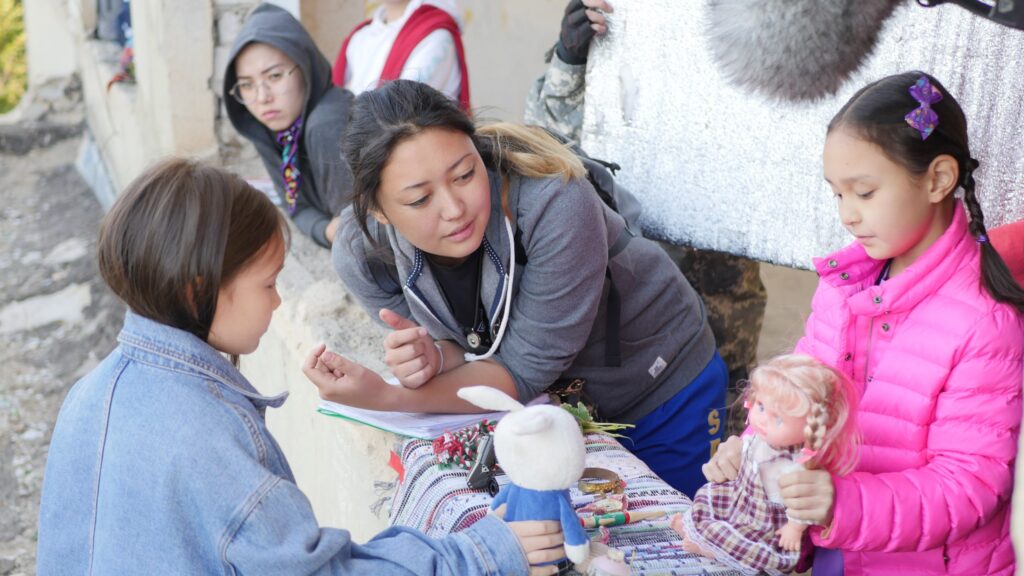
November saw the premiere of Venera Kairzhanova’s debut feature film, Second Mother. The documentary centers on the Meyirim rehabilitation center for children with developmental disabilities. But the film is more than a social chronicle; it’s a warm and luminous portrait of people who help children explore the world every day. Step by step, movement by movement.
Kairzhanova spoke with The Times of Central Asia about the making of the film.
TCA: Venera, congratulations on the premiere. How did you feel seeing your work on the big screen?
Kairzhanova: It was very exciting, but everything went smoothly in a warm, friendly atmosphere. The film was well received, and the theater was full. The audience included employees of the Meyirim center, parents, media representatives, and industry colleagues. The first private screening was back in September, but it was in a small theater with limited guests. This time, it was a huge hall with lots of people, a completely different experience.
What’s interesting is that when the project is finished and you watch it with the audience, you see it not just as a director, but also as a viewer.
TCA: The audience cried. Did you?
Kairzhanova: Yes. At the first screening, very much so. At the second, the emotions were a bit less intense, but the material still moves me: stories about the children, their teachers, their victories. After the screening, people came up to me to share their impressions and that was incredibly valuable. It’s important when a film is not just watched but really touches people’s hearts.

@Galiya Baizhanova
TCA: Working with children is always a special process. How did you prepare?
Kairzhanova: Honestly, I didn’t prepare specifically. I arrived early, observed the classes and that was it. I was nervous, of course, because I didn’t know how the children would react to the cameras, lights, and equipment. But everything went surprisingly well.
The children turned out to be incredibly open and sociable. They weren’t shy about the cameras; on the contrary, they played around and looked straight into the lens. Everything was so natural that we hardly interfered. We didn’t ask them to repeat anything or stage any shots. We just captured moments: in the dining room, during classes, and in their interactions.
This project made me fall even more in love with documentary filmmaking, even though this is already my fifth documentary.
TCA: Which episode was the most emotional for you?
Kairzhanova: The film mainly focuses on the rehabilitation center’s educators. We filmed their daily routines: classes, meetings, celebrations. By the third day, everyone had gotten used to each other, and the atmosphere became very warm.
One day, we filmed an individual session between instructor Anna Kosenko and a girl named Aisha. She was learning to walk with the help of an exoskeleton. Aisha, fragile, small, beautiful, was taking steps, and Anna was helping her. At one point, Anna asked, “Are you okay?” Aisha smiled and said, “Yes, I’m fine.”
TCA: And you couldn’t hold back…
Kairzhanova: I just started crying. I looked at the monitor and cried.
I’d been working for three days, just recording what was happening. And then suddenly, something clicked. I realized this wasn’t just a shot. This was real life, the children’s efforts, their inner strength. I turned away so no one would see me and sat behind the monitor, crying.
Our cameraman, the wonderful Azamat Zhanabekov, came over and said he’d also barely held it together. It was a very moving moment.
@Galiya Baizhanova
TCA: What touched you so deeply, her joy at taking her first steps?
Kairzhanova: It was her inner strength and the joy with which she accepts life. We often get upset over nonsense. But these children work every day to learn to walk, talk, hold a spoon, things that come naturally to us. And they smile while doing it.
They look at you with such warmth, such gratitude for life, that it turns everything inside you upside down. Even now, talking about it, my voice trembles. That moment will stay with me forever.
TCA: You were the screenwriter for the film Paralympian. Did you choose inclusive cinema consciously, or was it a coincidence?
Kairzhanova: It started back when I was a student. Aldiyar and I have been working together for a long time. One of our first inclusive projects was the short film Hop-Top. It was successful, got a lot of feedback, and then we were invited to make a social video about a girl with Down syndrome. Then Aldiyar came up with the idea for Paralympian.
That film probably led to Second Mother. The author of the idea, Bakhyt Saparov, suggested making a film about teachers at rehabilitation centers, to show their work and the atmosphere from the inside.
You could say this topic found us. We weren’t looking for it.
TCA: “Khlop-Top” is the one where Santa Claus visits a rehabilitation center?
Kairzhanova: Exactly. An actor is sent without being told the details. He walks in and sees most of the children in wheelchairs. He panics and leaves. The teacher runs after him and says, “Please don’t leave. The children were waiting for you.”
He returns, and the children experience a real miracle.
That’s how we got drawn into the topic of inclusion. We didn’t have any personal experience with it; it just found us.
TCA: In Paralympian, you don’t push for pity but use humor. Why?
Kairzhanova: Because we listened and observed a lot. We realized that people overcome difficulties through humor.
The characters joked about their situations but in a kind, good-natured way. And it’s not just about people with disabilities. Everyone lives like that. Life is hard, and humor helps you get through it without staying stuck in pain.
@Galiya Baizhanova
TCA: Is your new film also uplifting?
Kairzhanova: Yes. Many expected a heavy film, but they smiled throughout. And I loved that.
We didn’t focus on how hard things are for the children. We showed how they live, how they’re supported, how they grow.
The centers create an atmosphere of complete safety and acceptance. No one is judged. There, children are just children.
TCA: Second Mother is your feature film debut. What were your earlier works about?
Kairzhanova: My first documentary was about our friend Sofia Tormysheva, who passed away. It was a very personal story.
Then in 2021 came a turning point. After the pandemic, I had two offers: to work as an assistant on a TV series, a feature film, my comfort zone or to direct a documentary project. It was scary, but I chose documentary. I have no regrets – it was a turning point.
After that came projects: a film about cattle breeding for the Meat Union of Kazakhstan, one about Turkestan, and a project for the 30th anniversary of a mineral water plant.
And Second Mother is already a social film and a special one.
TCA: Will the film be released?
Kairzhanova: The producers are considering it, but it’ll most likely go to festivals and streaming platforms.
Theatrical release is harder. As far as I know, the only documentary to make it to theaters was Kanat Beysekeev’s Winter in Rehab. He’s a media personality with his own audience. It’s much more difficult for other filmmakers.
TCA: Social films are increasingly being made in Kazakhstan now. Can such films become part of theatrical distribution?
Kairzhanova: I think so. When major players like Tiger Films focus on social issues, it’s important. Inclusive stories need to be seen they shouldn’t stay hidden in festival niches.
The potential for such films is huge. Look at the global success of 1+1, that’s a social film too. Our film Paralympian was also very well received.
Audiences are changing, opening up to new topics, and that’s wonderful. I’m glad there are directors and producers taking on such bold stories.