• KGS/USD = 0.01144 0%
  • KZT/USD = 0.00193 -0%
  • TJS/USD = 0.10876 0.55%
  • UZS/USD = 0.00008 0%
  • TMT/USD = 0.28490 0%
  • KGS/USD = 0.01144 0%
  • KZT/USD = 0.00193 -0%
  • TJS/USD = 0.10876 0.55%
  • UZS/USD = 0.00008 0%
  • TMT/USD = 0.28490 0%
  • KGS/USD = 0.01144 0%
  • KZT/USD = 0.00193 -0%
  • TJS/USD = 0.10876 0.55%
  • UZS/USD = 0.00008 0%
  • TMT/USD = 0.28490 0%
  • KGS/USD = 0.01144 0%
  • KZT/USD = 0.00193 -0%
  • TJS/USD = 0.10876 0.55%
  • UZS/USD = 0.00008 0%
  • TMT/USD = 0.28490 0%
  • KGS/USD = 0.01144 0%
  • KZT/USD = 0.00193 -0%
  • TJS/USD = 0.10876 0.55%
  • UZS/USD = 0.00008 0%
  • TMT/USD = 0.28490 0%
  • KGS/USD = 0.01144 0%
  • KZT/USD = 0.00193 -0%
  • TJS/USD = 0.10876 0.55%
  • UZS/USD = 0.00008 0%
  • TMT/USD = 0.28490 0%
  • KGS/USD = 0.01144 0%
  • KZT/USD = 0.00193 -0%
  • TJS/USD = 0.10876 0.55%
  • UZS/USD = 0.00008 0%
  • TMT/USD = 0.28490 0%
  • KGS/USD = 0.01144 0%
  • KZT/USD = 0.00193 -0%
  • TJS/USD = 0.10876 0.55%
  • UZS/USD = 0.00008 0%
  • TMT/USD = 0.28490 0%
11 December 2025

Uzbekistan and SOCAR Advance $2 Billion Ustyurt Energy Project

Uzbekistan’s Minister of Energy, Jorabek Mirzamahmudov, has outlined the country’s deepening energy cooperation with Azerbaijan’s state oil company SOCAR, highlighting progress on a recently signed Production Sharing Agreement (PSA) for the Ustyurt region and broader plans in petrochemicals and electricity trade.

In an interview with Azerbaijani media outlet Report, Mirzamahmudov confirmed that Uzbekistan, SOCAR, and Uzbekneftegaz have already established a joint operating company to oversee the Ustyurt project. Fieldwork is expected to accelerate soon, with seismic surveys covering over 3,000 linear kilometers set to begin before year-end, followed by the drilling of the first exploration well.

The PSA structure splits ownership equally between the state and investors, with SOCAR and Uzbekneftegaz as the primary partners. British energy major BP has shown interest and is in preliminary discussions to join the consortium.

Azerbaijani President Ilham Aliyev stated in August that SOCAR had commenced work at an Uzbek oil field following the contract signing. He expressed optimism about potential discoveries within the next one to two years.

Mirzamahmudov acknowledged that earlier data on Ustyurt had not suggested large hydrocarbon reserves but said that modern interpretation techniques have revealed greater potential. While refraining from early reserve estimates, he said SOCAR specialists are optimistic about promising oil indicators. If confirmed, Uzbekistan plans to build a new refinery. Total investment in the Ustyurt project is projected at around $2 billion.

The minister said SOCAR and Uzbekneftegaz would finance the project’s initial stages, with BP possibly joining later. He did not rule out future collaboration with Azerbaijan on major fields like Shah Deniz or Absheron but emphasized that Uzbekistan’s current priority is increasing domestic production. In the long term, joint ventures in third countries are also being considered.

Trans-Caspian Energy and Renewables Push

Mirzamahmudov also discussed the proposed trans-Caspian high-voltage direct current (HVDC) cable project aimed at exporting renewable energy to Europe. A joint venture involving Azerbaijan, Kazakhstan, and Uzbekistan has already been formed. The Asian Development Bank is assisting in selecting a consultant for the project’s feasibility study. Several countries, including Saudi Arabia, have expressed interest.

Uzbekistan currently generates more than 20% of its electricity from renewables and aims to increase that share to 54% by 2030. In the Ustyurt region alone, wind projects totaling over 2.5 GW are under development, with the first 100 MW already operational. The government also plans to deploy hybrid wind-solar-storage systems with a minimum capacity of 5 GW.

Localization and Petrochemical Cooperation

Mirzamahmudov noted that future oil and gas processing facilities could be localized in special economic zones in Bukhara, Karakalpakstan, and Khorezm, which are currently being evaluated for infrastructure and logistics readiness.

A joint venture with SOCAR Trading is already exporting polymer products, and ongoing discussions aim to expand cooperation in fuel production and fertilizer manufacturing.

Uzbek Consulate Assists Citizen Misled into Russian Army Contract

Uzbekistan’s Consulate General in St. Petersburg has intervened to assist an Uzbek citizen who was allegedly misled into signing a contract to serve in the Russian Armed Forces, the Consulate announced on November 12.

According to the Consulate, a citizen identified as K.M. appealed for help after their child, K.R., reportedly signed the contract while held in pre-trial detention in Kolpino, Leningrad Region. K.R. had been taken into custody on charges of intentionally inflicting minor bodily harm on another Uzbek national.

K.M. told consular officials that K.R. suffers from serious mental health issues and had been deceived into agreeing to military service while in detention. The parent requested that the Consulate assist in nullifying the agreement.

The Consulate stated that it had promptly contacted the relevant Russian authorities, including the Human Rights Commissioner for Leningrad Region, urging a review of the case and protection of the detainee’s legal rights.

As a result of these efforts, Russian officials acknowledged K.R.’s objections to military service. The Consulate confirmed that no military contract was finalized and that the detainee was returned to the Kolpino detention center, where the investigation remains ongoing.

The Consulate emphasized that it is closely monitoring the case and will continue to safeguard the legal rights and interests of the Uzbek citizen.

The Times of Central Asia has previously reported on several instances in which Central Asian migrants have faced pressure to join Russia’s military amid recruitment campaigns targeting foreign nationals, particularly migrant workers.

Kazakhstan to Seek Extradition of Boxer Dmitry Bivol’s Ex-Wife

Kazakhstan’s Ministry of Internal Affairs plans to pursue the extradition of Ekaterina Bivol, the ex-wife of world boxing champion Dmitry Bivol, according to Deputy Minister of Internal Affairs Sanzhar Adilov.

Dmitry Bivol, who was born in Kyrgyzstan and moved to Russia at age 11, married Ekaterina Burdinskaya before rising to prominence in professional boxing. The couple divorced while Bivol held the WBA light heavyweight world title. Following the split, Ekaterina repeatedly posted derogatory comments about Bivol and his relatives on social media. Despite the controversies, Bivol became the undisputed world champion in his weight class in February 2025.

In the fall of 2025, a video circulated on social media in which Ekaterina Bivol made offensive remarks about Kyrgyz and Kazakh people. In response, Kyrgyzstan’s Ministry of Internal Affairs launched a preliminary investigation into the distribution of the video material.

On October 25, the Pervomaisky District Court in Bishkek issued a preventive detention order and an arrest warrant for Ekaterina Bivol under Article 330 of Kyrgyzstan’s Criminal Code: “Inciting racial, ethnic, national, or interregional discord.”

Soon after, Kazakhstan’s Ministry of Internal Affairs opened a similar criminal case.

The matter is complicated by the fact that Ekaterina Bivol is a citizen of the Russian Federation. However, Adilov stated that Kazakhstan intends to seek her extradition if she is located within Russian territory.

“A criminal case has been opened against her, and she has been placed on an international wanted list. The investigation is ongoing. We are in contact with the Russian police through special channels. If she is detained, we will raise the issue of extradition through the Prosecutor General’s Office,” Adilov said in response to journalists’ questions.

Earlier this year, The Times of Central Asia reported that in May, Kazakhstan secured the deportation of Talgat Ardan, the former head of the Astana Light Rail Transit (LRT) project, who was wanted internationally for large-scale embezzlement. He was extradited from Turkey, a process made easier by the fact that he held Kazakh citizenship.

Ashgabat Police Reportedly Crack Down on Non-Resident Workers

In Turkmenistan, police raids targeting non-resident laborers seeking short-term work in the capital are intensifying, according to Turkmen.News, placing additional pressure on citizens from regions that face chronic unemployment at home.

Day Laborers Targeted

Police in Ashgabat have reportedly been extorting money from non-resident day laborers, threatening them with detention and forced removal from the city. These raids are concentrated near the newly opened transport hub in the Gurtly district, which recently replaced the former central interchange near the Tekin Bazaar, a long-established site for informal employment.

For many from Turkmenistan’s regions, Ashgabat offers the only opportunity to earn a daily wage of $2.50 to $3.50. But this marginal lifeline is vanishing as police expel day laborers from Gurtly and threaten to drive non-residents out of the capital entirely.

The area has developed its own informal employment system. Several women operate as unofficial coordinators, posing as passengers at the bus stop. They maintain notebooks filled with phone numbers, service prices, and available workers. Locals approach them with tasks, such as moving furniture or doing basic repairs, and are promptly matched with laborers who remain discreetly nearby.

Raids and Intimidation

Authorities appear intent on dismantling this system. Eyewitnesses say police conduct daily patrols in Gurtly, stopping young men, checking residency documents, and confiscating their earnings. The money is allegedly pocketed by officers, with no official record kept.

Victims report being insulted, intimidated, and threatened with deportation to their home provinces before being released following brief “educational conversations.”

Such operations are not new. In late October, Ashgabat police issued mass fines to non-resident taxi drivers. During the summer’s UN forum in Avaza, day laborers in Turkmenbashi were reportedly detained en masse, held in temporary facilities, and then forcibly returned to their home region. These actions are part of what appears to be an ongoing, unofficial campaign of pressure against internal migrants.

Erasing Poverty from the Capital’s Image

Some Ashgabat residents believe the relocation of the main bus hub to the outskirts is part of a broader strategy to conceal poverty behind the capital’s polished facade. “This is an attempt to cleanse the capital of any hints of the real, unsightly side of life,” one resident remarked.

Income levels outside the capital remain significantly lower. For many families, irregular work in Ashgabat is their only source of supplemental income. Yet instead of addressing inequality, observers argue that authorities are reinforcing regional discrimination, further marginalizing non-resident workers.

Kazakhstan and Kyrgyzstan Aim to Boost Trade to $3 Billion by 2030

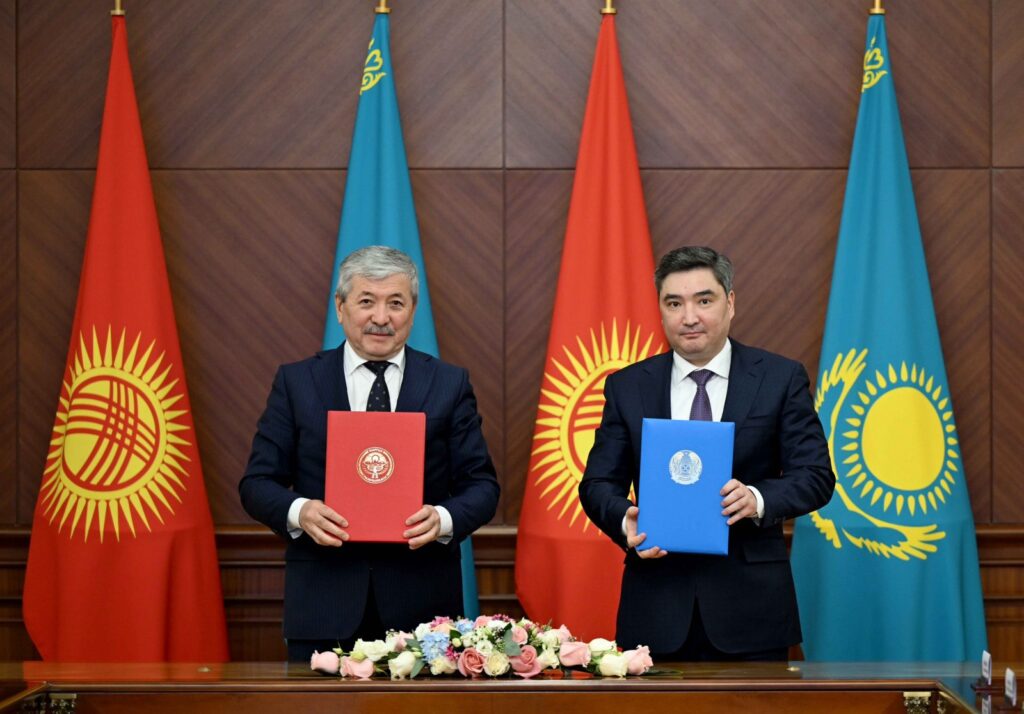
Kazakhstan and Kyrgyzstan have reaffirmed their commitment to increasing bilateral trade to $3 billion annually by 2030. This objective was emphasized during the 13th meeting of the Kazakh-Kyrgyz Intergovernmental Council, held on November 13 in Astana and co-chaired by Kazakhstan’s Prime Minister Olzhas Bektenov and Adylbek Kasymaliev, Chairman of the Cabinet of Ministers of Kyrgyzstan.

The meeting covered a broad spectrum of cooperation, including trade, investment, water and energy management, as well as cultural and humanitarian initiatives.

Kasymaliev highlighted recent progress, noting that bilateral trade reached $1.7 billion in the first nine months of 2025, a 15% increase compared to the same period in 2024.

Direct investment from Kazakhstan to Kyrgyzstan totaled nearly $64 million in the first half of 2025. “This demonstrates the Kazakh business community’s trust in Kyrgyzstan and the broad opportunities for new projects,” said Kasymaliev.

Key Infrastructure Projects and Trade Hubs

The Council identified priority areas to strengthen cooperation. Chief among them is the construction of an industrial, trade, and logistics complex near the Karasu and Ak-Tilek road checkpoints at the border. This facility is expected to become a major regional hub for cargo consolidation, processing, and distribution, advancing industrial integration between the two economies.

Another key project is the establishment of a wholesale storage and distribution center for fruits and vegetables in Kazakhstan’s Almaty region. This facility aims to secure uninterrupted agricultural trade between the two countries.

Bilateral trade in agricultural products surged by 42% in the first eight months of 2025, reaching $326 million. Over 80% of that trade volume comprised exports from Kazakhstan.

Energy Cooperation and Border Infrastructure

The sides also discussed potential supplies of Kazakh oil and motor fuel to Kyrgyzstan. The latter consumes about 1.6 million tons of motor fuel annually, with 93% imported from Russia. Fuel prices in Kyrgyzstan have climbed since mid-2025, driven by higher wholesale costs in Russia, linked to reduced refining capacity, damage from Ukrainian drone attacks, and sanctions-related difficulties in acquiring technological equipment.

Kazakhstan and Kyrgyzstan stressed the need to complete the ongoing reconstruction of three key border checkpoints, Kichi-Kapka-Besagash, Ak-Tilek-Karasuu and Karkyra-Kegen-which are expected to significantly facilitate cross-border trade.

Tourism and Cultural Cooperation

The two countries are also prioritizing mountain tourism. Plans include reviving tourist routes to Khan Tengri Peak, a destination located on the border and shared by both states, offering mutual opportunities to boost tourism-related revenues.

American Companies Explore Investment Prospects in Tajikistan

President Emomali Rahmon’s recent visit to the U.S. has sparked renewed interest in the Tajik economy. In New York, a major investment forum showcased large-scale development projects to American companies from hydropower initiatives to green data centers.

U.S.-Central Asia Engagement via C5+1

An event titled Presentation on Tajikistan’s Investment Opportunities was held at the Vista LIC Hotel in New York. It was organized by the state-owned Tajinvest enterprise with support from the State Committee for Investment of Tajikistan and the U.S., Tajikistan Business Council. The gathering marked the tenth anniversary of the C5+1 platform, a regional framework for economic cooperation between the U.S. and Central Asia.

Timed to coincide with Rahmon’s official visit to Washington, the event was designed to promote Tajikistan’s economic potential to U.S. businesses.

Jonibek Ismoil Hikmat, Tajikistan’s permanent representative to the United Nations, opened the event with a speech emphasizing the country’s strategic aspirations.

“Today, we are creating a new Silk Road, not of caravans and goods, but of ideas, innovations, and investments,” he stated.

Elena Son, Executive Director of the U.S.-Tajikistan Business Council, encouraged American firms to more actively explore the Tajik market. She shared her experience accompanying major U.S. companies to Dushanbe, affirming that Tajikistan is increasingly ready for serious investment.

“They sometimes take a long time to get started, but once they do, no one can catch up with them,” she noted, describing the pace of Tajik partners once projects are underway.

Investment Mechanisms and Key Projects

Tajinvest CEO Dilshod Jurazoda delivered a presentation titled How to Invest in Tajikistan? He outlined legislative guarantees, investor support mechanisms, and the implementation of a One-Stop-Shop model within Tajinvest to streamline business entry.

Jurazoda highlighted a portfolio of strategic projects open to foreign investment, including:

  • Dushanbe Mall
  • Dushanbe Arena Hall
  • Expo Center Dushanbe
  • Sugdbarktaminot energy complex
  • Mehrgon agro-cultural complex in Sughd
  • Green data centers leveraging Tajikistan’s hydropower capacity
  • Tourism infrastructure development projects

U.S. Businesses Signal Interest

The event featured interactive sessions, with participants pitching projects, engaging in open discussions, and networking in an informal setting.

Representatives of major U.S. investment and tech firms were in attendance, including Edward Mermelstein (Atlantic Bridge Capital), Val Kogan (Mid-Atlantic-Eurasia Business Council), Burke McCormack (Ardmore Capital), Mack Kerker and David Halpert (Penataran), Leon Nektalov (Leon Diamond), Sam Bousfield (Samson Sky), and Erkin Mustafokulov (United Bros LC).

The U.S. delegation stressed that direct dialogue with Tajik officials offered valuable insights into the local market and practical opportunities for cooperation.

The New York presentation underscored growing American interest in Tajikistan. With major projects on offer, abundant energy resources, and demonstrated government support, prospects for deepening bilateral economic ties appear increasingly favorable.