At the invitation of President Trump, on November 5-6, the Presidents of the five Central Asia Republics arrived in Washington, D.C. to celebrate and sign deals on the 10th anniversary of C5+1. They were accompanied by cabinet ministers and business leaders.
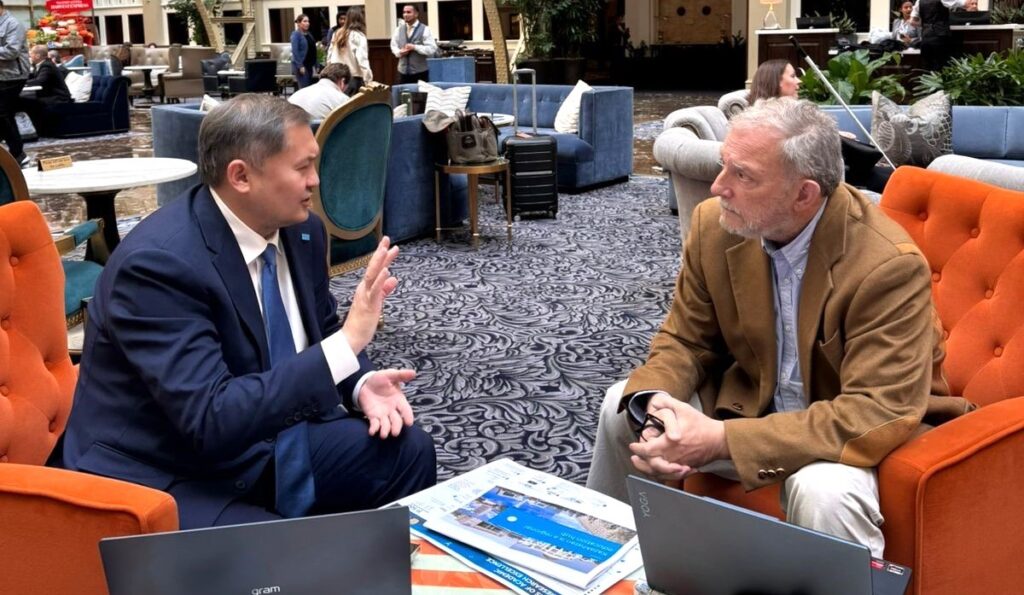
The Times of Central Asia presents a wide-ranging interview with Kazakhstan’s Minister of Education, Sayasat Nurbek. Minister Nurbek sat down with our Washington Correspondent, Javier M. Piedra, to discuss Kazakhstan’s education strategy.
The interview offers U.S. academic and technical institutions a glimpse into Minister Nurbek’s educational philosophy and his plans to advance Kazakhstan’s higher education through new partnerships with U.S. universities, AI platforms, and private sector innovators—positioning Kazakhstan as a regional educational hub.
Nurbek shared his insights on his understanding of traditional values, the human person, AI’s potential and risks, critical thinking, and building mutually beneficial partnerships in the context of education. (His responses have been edited for length and flow.)
TCA: The tenth anniversary of C5+1 was a landmark event, bringing together the Presidents of all five Central Asian nations at the White House. Kazakhstan President Tokayev has tasked you with transforming Kazakhstan into a fully digital nation within three years. In the last two days, you secured six key partnerships with U.S. universities and tech firms across education, testing, mining, and engineering. Minister, with that in mind, how is Central Asia important to the United States?
Nurbek: My message to American academic institutions is straightforward. Kazakhstan has a lot to offer, and we are keen on deeper engagement with the outside world. Also, the timing to deepen U.S.-Kazakhstan relations is perfect given that the world is changing. Avenues are open for new relationships and business opportunities. America and Kazakhstan can have a great future as long as we work together to achieve that future. America should not miss this moment in history; the importance of Eurasia and of Central Asia in particular.
Besides the education aspects – most important to me – academic and technical partnerships can serve as platforms to maintain U.S. influence, share values, and promote ideas, benefiting both the United States and Kazakhstan as friends in a non-geopolitical sense.
TCA: In our earlier conversation, you referenced Sir Halford Mackinder, the early 20th-century British academic who emphasized geography’s role in geopolitics. Can you comment on the sensitivity of mixing education and geopolitics?
Nurbek: In The Geographical Pivot of History in 1904, Halford Mackinder argued that control of Eurasia’s central “Heartland,” particularly Eastern Europe and Central Asia, could secure global influence. Mackinder’s theory stressed land power’s dominance over naval power in an increasingly rail-connected world in the early 20th century. Central Asia mattered then and still does today—but why do I mention Mackinder in the context of education?
President Tokayev has been clear, especially in the sphere of education, that Kazakhstan seeks great gain, not a “Great Game” – the rivalry between Great Powers for influence and control in Central Asia. In other words, the main way to produce great gains in Kazakhstan and across the region is through the development of education and training, both academic and skilled labor, with a focus on science, engineering, and AI, without politicizing education. In this sense, we want to focus on partnerships that yield benefits without the need to take sides in the geopolitical ambitions of others. That’s why I brought up Mackinder.
TCA: How do you envision integrating computer processing and machine learning into the educational system without destroying critical thinking?
Nurbek: That is a very challenging question. Let me first define what I mean by critical thinking. Critical thinking is the essential human aptitude for questioning, contextualizing, and conscientiously applying data or conclusions that AI provides, preventing us from becoming dumb passive consumers or regurgitators of automated conclusions. We want partners who understand that.
My focus is to connect education to the digital ecosystem while maintaining independent thinking in our students. Towards this end, we want to work with the United States – not on an exclusive basis, incidentally – to achieve our win-win objectives and respective national goals.
TCA: Is there not a “brain drain” underway in Kazakhstan? How do you hope to keep young people in Kazakhstan?
Nurbek: We are aware of this issue. It was certainly a problem in the 1990s, but since then, the situation has changed. We must keep working to ensure that students and graduates remain in Kazakhstan. It’s the same story across Central Asia.
One of my key initiatives as minister has been to roll out a strategy to attract foreign university branch campuses to Kazakhstan, including over fourteen top-tier research institutions. By building a first-rate educational system, we’ll stop the brain drain. I am committed to expanding this effort by inviting more U.S. universities and trade schools.
TCA: Please provide American educators with some examples of the agreements you signed on this trip. What do you expect down the road?
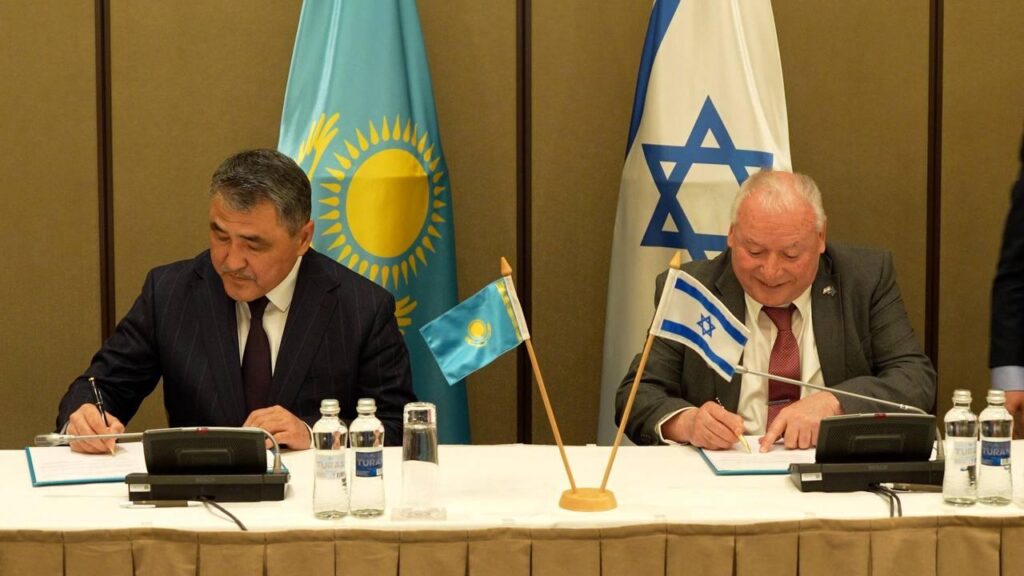
Nurbek: We have so much going on that I’d point those interested to our website. But to get a sense, Kazakhstan’s Ulytau Technical University, for example, partnered with Colorado School of Mines and Kazakhmys, a Kazakhstan mining company. They will forge a mining/metallurgy innovation hub. It offers dual degrees, industry R&D, and tech transfer, boosting Kazakhstan’s academic leadership and U.S. economic ties. Arizona State University will be opening two big branch campuses in Kazakhstan. That is only the tip of the iceberg.
Kazakhstan is poised to become a draw for students across the region. This is already happening. I expect Kazakhstan’s educational system to continue to improve and meet the needs of our growing population in a highly competitive world where young families need to find stability and predictability. What’s more, we need to teach ethics and traditional values – a focus of President Tokayev.
TCA: What drives buy-in for your strategy, and how do you define ethics?
Nurbek: Education – technical and intellectual – is deeply valued in our culture. Households devote one of the region’s highest shares of income to it. To support families, Kazakhstan provides direct financial aid and other incentives when needed. But hope in the future is paramount. And for our overseas partners, we offer great incentives, like free land, tax breaks, and streamlined customs. Scholarships further ensure education remains financially sustainable.
You should know that, in Kazakhstan, we are adopting the Digital Code, a comprehensive regulatory framework addressing AI use and ethics. Our understanding of value ethics provides a context for navigating difficult moral challenges about modern technology in light of human dignity. What’s more, our strategy takes into account a growing population.
TCA: Yes, Central Asia’s population is expanding rapidly compared to the demographic collapse across much of East Asia and Europe. Pessimists see population growth as bad; optimists see it as good. Which camp do you fall into?
Nurbek: For starters, we believe in a “culture of life” – by which I mean that the human person possesses an inherent dignity – as is written in the preamble to the United States Declaration of Independence: “We hold these truths to be self-evident, that all men are created equal, that they are endowed by their Creator with certain unalienable Rights, that among these are Life, Liberty and the pursuit of Happiness.” Kazakhstan agrees with that worldview.
This region is undergoing one of the fastest population booms in the world, which requires strategic planning. While East Asia and Europe age, and North America relies on immigration for growth, Central and South Asia are surging demographically. Kazakhstan adds about half a million newborns each year, Uzbekistan nearly a million. By 2050, Central Asia is projected to be one of the world’s youngest and fastest-growing regions, with a population nearing 500 million. We see this increase as a strategic opportunity, one that demands responsible stewardship as we carry on building our nation.
TCA: It seems that you approach the population question with confidence and a sense of responsibility. Having said that, education and AI are tools, not ends in themselves – what is your goal?
Nurbek: Ultimately, Kazakhstan views people – the multiplicity of races and cultures within our borders – not as resources to exploit, but as the foundation of our nation’s future. Education is central to our strategy, ensuring prosperity is shared rather than concentrated in the hands of a few, whether that wealth is here or overseas. As President Tokayev emphasizes, the private sector must help build the nation—especially through advancing education and preparing our people for the era of AI, digital communications, and data processing. We want to help people to be creative, to be inspired to contribute to society. Educators should know that I do not believe in Thomas Hobbes’ description of human nature as “solitary, poor, nasty, brutish and short.” There are many good people who are not fundamentally self-centered and inclined toward aggression. It is the task of educators to form responsible and entrepreneurial people with a sense that there are limits to human behavior. So, I’m not just interested in technical training, but in the formation of the person in a holistic sense.
TCA: What do you see as the role of the private sector in developing the education system in Kazakhstan?
Nurbek: Benjamin Franklin had it right when he said, “An investment in knowledge pays the best interest” or “Tell me and I forget, teach me and I may remember, involve me and I learn.”
Our message to the private sector is that investing in education pays. To facilitate this partnership, we have drafted a law creating tax and other incentives for contributors to endowment funds. In this sense, the U.S. has much to show us.
Kazakhstan is leading Central Asia in computing, with two national supercomputers and others at top universities—Al Farabi, Eurasian National, and Nazarbayev. While we have critical computing power, my goal is to develop first-rate human capital with the help of AI – that must be clear.
TCA: In this sense, what are you asking U.S. universities to keep in mind as they roll out their expertise in Kazakhstan?
Nurbek: AI and science expertise should augment not just value (in a material sense) but meaning (in a philosophical sense) to everyday existence. Youth ask: “How does AI improve life?” True progress goes beyond material gain—it must enrich people and the nation, fostering unity, creativity, and entrepreneurship, giving them a sense of identity, dignity, and optimism in the future. Otherwise, AI risks serving only efficiency, divorced from human and societal needs. My job is to balance these factors. Our partners – foreign and domestic – must understand our strategic objectives.
TCA: Do you have a message to the U.S. State Department and to U.S. Universities, research institutions, and trade schools?
Nurbek: To illustrate my message, I’ll tell you an anecdote. Our two-year journey to secure U.S. approvals for a supercomputer was challenging. While we understand the need for caution, a two-year process highlights a critical issue. When procedures become too complex and time-consuming, they force us to consider more efficient partners, despite our strong preference to work with the U.S. We believe streamlining protocols on security and IP would benefit both sides and strengthen our collaboration.



 Sergey Kwan