• KGS/USD = 0.01144 0%
  • KZT/USD = 0.00210 0%
  • TJS/USD = 0.10528 0.19%
  • UZS/USD = 0.00008 0%
  • TMT/USD = 0.28571 0.28%
  • KGS/USD = 0.01144 0%
  • KZT/USD = 0.00210 0%
  • TJS/USD = 0.10528 0.19%
  • UZS/USD = 0.00008 0%
  • TMT/USD = 0.28571 0.28%
  • KGS/USD = 0.01144 0%
  • KZT/USD = 0.00210 0%
  • TJS/USD = 0.10528 0.19%
  • UZS/USD = 0.00008 0%
  • TMT/USD = 0.28571 0.28%
  • KGS/USD = 0.01144 0%
  • KZT/USD = 0.00210 0%
  • TJS/USD = 0.10528 0.19%
  • UZS/USD = 0.00008 0%
  • TMT/USD = 0.28571 0.28%
  • KGS/USD = 0.01144 0%
  • KZT/USD = 0.00210 0%
  • TJS/USD = 0.10528 0.19%
  • UZS/USD = 0.00008 0%
  • TMT/USD = 0.28571 0.28%
  • KGS/USD = 0.01144 0%
  • KZT/USD = 0.00210 0%
  • TJS/USD = 0.10528 0.19%
  • UZS/USD = 0.00008 0%
  • TMT/USD = 0.28571 0.28%
  • KGS/USD = 0.01144 0%
  • KZT/USD = 0.00210 0%
  • TJS/USD = 0.10528 0.19%
  • UZS/USD = 0.00008 0%
  • TMT/USD = 0.28571 0.28%
  • KGS/USD = 0.01144 0%
  • KZT/USD = 0.00210 0%
  • TJS/USD = 0.10528 0.19%
  • UZS/USD = 0.00008 0%
  • TMT/USD = 0.28571 0.28%

Are Innovative Industries One of the Kyrgyz Republic’s Opportunities to Prosper?

The emergence of AI is considered by many to be a major tectonic shift, much like the emergence of the internet in its time. It is hard to overestimate the role innovation plays in our lives, with founders all over the world trying to pioneer our way out of the next problem. At first glance, the Kyrgyz Republic’s tech sector does not represent anything particularly meaningful. The chances of the small landlocked country – the farthest from any ocean in the world, which is the most affordable mode of shipping mode – integrating into innovative global ecosystems on its own seem wholly unrealistic. However, if we look at the dynamics of development in its tech sector, the potential is there. Is there a chance that the Kyrgyz Republic can become a part of the global tech scene?

Image: The World in Maps

According to Ashley Vance at Bloomberg, “It’s about a landlocked nation, one with very few natural resources, hoping to gen up a tech industry on the fly.” The Kyrgyz startup ecosystem is clearly in its nascent stages, meaning that you haven’t heard about the Kyrgyz Skype. Yet. The country’s position in the Global Innovation Index in 2024 is 99th, up from 106th in 2023. The Global Startup Ecosystem Index, meanwhile, has the Kyrgyz Republic lower than 100th place in its 2024 ranking, down from 99th in 2023. “The country has maintained second position in Central Asia and seventh in the Central Asia Regional Economic Cooperation Program (CAREC) business region,” according to this index.

The Kyrgyz Republic’s VC ranking of 103rd in the Venture Capital & Private Equity Country Attractiveness has barely changed over the last couple of years. When compared to peer group economies, it is obvious that the Kyrgyz Republic needs significant improvements in the depth of the capital market, social environment, entrepreneurial opportunities, and economic activity.
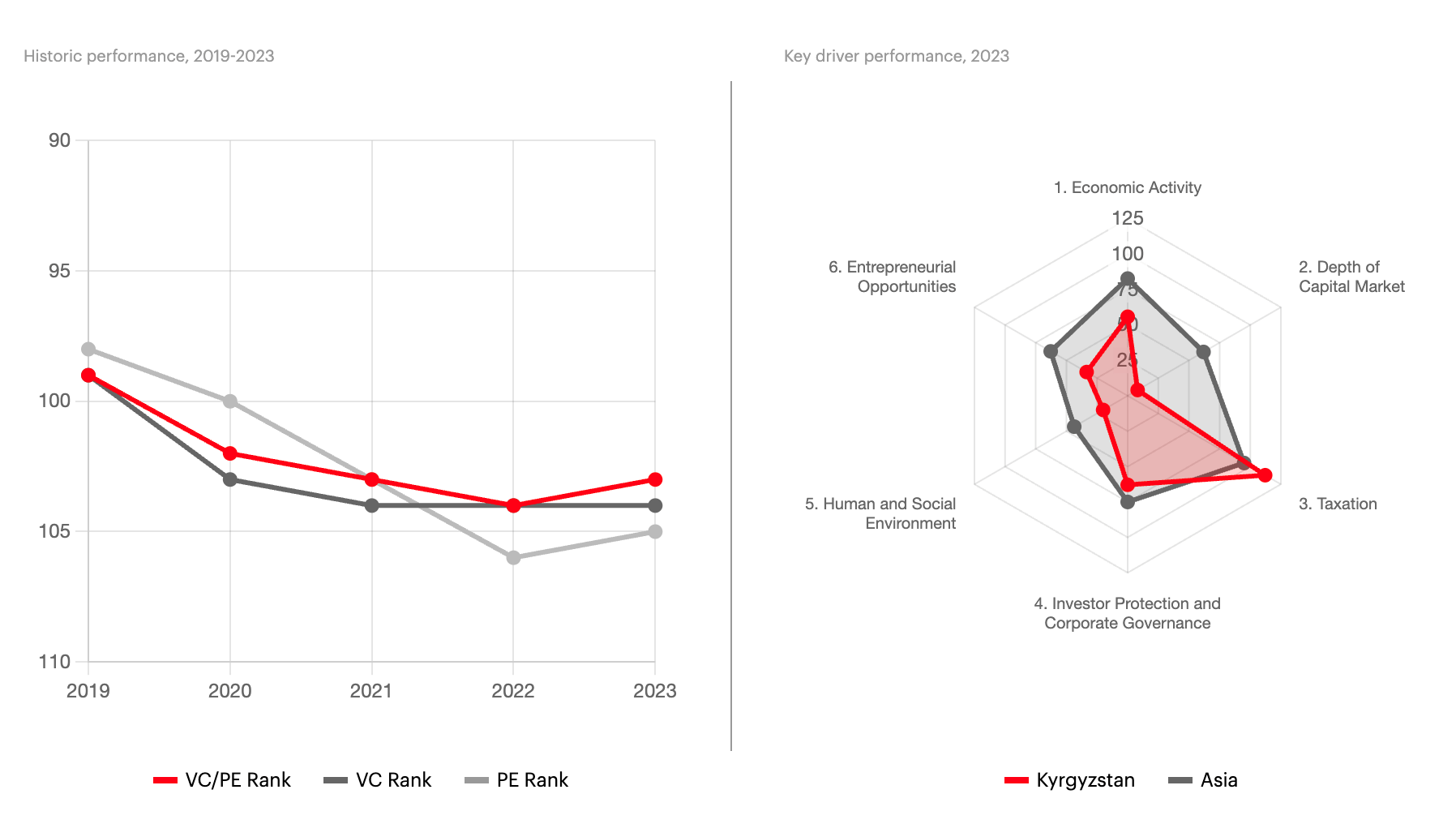
Image: Venture Capital & Private Equity Country Attractiveness Index 2023

In terms of the number of venture capital deals, the Kyrgyz Republic is still lagging behind its neighbors. Out of $110+ million of venture capital funding in the region in 2023, the Kyrgyz contribution was only a fraction at $1.1 million. In 2024, this increased to $1.7 million, however, with the country’s first venture capital law soon to be adopted.

Image Venture Capital in Central Asia 2024

The High Technology Park of the Kyrgyz Republic, which is a special tax regime for IT companies targeting exports, is demonstrating a steady growth, with its revenue expanding from under a million in 2013, to a more impressive $130 Million in 2024. The park’s residents are mostly companies providing IT outsourcing for developed markets, but the signs of a turn towards launching their own IT products are there. A separate world-first Creative Industries Park has also been set up to support the country’s creative industries, including startups.

When it comes to the largest Kyrgyz startups, they are founded by Kyrgyz nationals, who have built their startups in more sophisticated ecosystems. Erkin Adylov’s Behavox is an illustrative example of such a story. The company, which is the largest provider of AI-compliance solutions for financial institutions, raised $100 million from SoftBank’s Vision II Fund in 2020. In late 2024, Behavox secured an additional $70 million credit facility from Hercules Capital (NYSE: HTGC) for strategic expansion. A brilliant example of a soonicorn (a startup that is expected to reach the $1 billion unicorn valuation in the near future) can hardly be called a Kyrgyz startup in its full meaning, however, as it is not integrated into the local tech ecosystem.

Another so-called hybrid group is represented by those founders with expertise in more developed ecosystems who have now taken a more active role in the domestic sphere. One such person is Tilek Mamutov, both the first Kyrgyz national to become a software developer at Google and the first admitted to Y Combinator, the leading global startup accelerator based in Silicon Valley. Mamutov’s startup, Outtalent, is helping tech professionals around the world land jobs in the largest global tech companies, such as Meta, Amazon, Apple, Netflix, and Google. Not only is Mamutov helping his customers from different parts of the globe, but he is also contributing to the local startup scene by sharing his expertise. He has even moved his company’s HQ from Silicon Valley to Bishkek.

Finally, the local ecosystem has seen an explosion of locally born stories. If a decade ago the local tech scene was reminiscent of tumbleweeds in the desert, this year alone seven Kyrgyz startups were admitted to top global accelerators: Yessa — Antler Vietnam, Admitted — Antler Malaysia, Chef Vision AI — Antler Vietnam, Core Pod — Launch, MyStory — StartX, BabyGuide — Antler Malaysia, and Neobis — Google for Startups.

Another challenge is that no country in the region can integrate into the global ecosystem alone. Even larger countries in the region, such as Kazakhstan and Uzbekistan, are still too small when it comes to the global scale. The optimal opportunity, therefore, is to be found in integrating as a region, and the trend is heading in that direction.

Last year Silicon Valley saw the very first Central Eurasia @ Silicon Valley conference, which took place in the legendary Yerba Buena Arts Center in San Francisco right before TechCrunch Disrupt. The event became the largest representing the region in Silicon Valley to date. It is now clear that regional cooperation represents the best chance of ultimately becoming a part of the global tech scene.

But even with regional integration there is one more challenge to address. Without access to more mature ecosystems, there will be neither the expertise nor the capital. This is why we are seeing innovation hubs opening in different parts of the world that provide a soft-landing for founders from our region, connecting local ecosystems with established ones like Silicon Valley. One such hub is the Silkroad Innovation Hub, which organized the Central Eurasia @ Silicon Valley conference last October. The Eurasian Startup Hub is building a similar bridge in the UK, while the Al-Farabi Innovation Hub is doing the same in Saudi Arabia, and now in Dubai. There are even attempts afoot to build a hub in China.

Whether the Kyrgyz Republic can become a part of the global innovative ecosystem will depend on its ability to foster regional cooperation and to build relationships with more evolved ones as it continues to facilitate a favorable environment for Kyrgyz founders. But the seeds have certainly been planted — and while still in their early stages, their promising trajectory is becoming more and more obvious.


Kazakhstan and Kyrgyzstan Plan Faster Routes from Almaty to Issyk-Kul

Kazakhstan and Kyrgyzstan have taken another step toward implementing a long-discussed infrastructure project: the construction of an alternative highway linking Almaty, Kazakhstan’s largest city, to Lake Issyk-Kul, Kyrgyzstan’s top tourist destination.

On March 28, Almaty hosted the sixth meeting of the Kyrgyz-Kazakh Working Group on Transport and Infrastructure Development, held under the framework of the Almaty-Bishkek Economic Corridor Project, with support from the Asian Development Bank.

Participants agreed on the key parameters for a feasibility study and committed to accelerating the implementation of the new road.

@AKIPress/The existing road from Almaty to Issyk-Kul and three possible alternative routes

Lake Issyk-Kul remains a major draw for tourists from across the region and is especially popular with residents of Almaty seeking weekend or summer getaways. Although the two locations are only 80 kilometers apart in a straight line, they are separated by mountain ranges. The existing route detours through Bishkek, extending the distance to more than 460 kilometers and turning what could be a short trip into an 8-hour drive to Cholpon-Ata, the largest resort town on the lake’s northern shore.

Kazakhstan and Kyrgyzstan first signed a memorandum of understanding on the construction of an alternative route in 2007, but progress has since stalled.

The proposed new highway would bypass Bishkek, passing through the town of Uzynagash, west of Almaty, and the town of Kemin, located approximately 100 kilometers east of Bishkek, before continuing to Cholpon-Ata. This revised route would reduce the total distance to around 260 kilometers, significantly shortening travel time.

Uzbekistan’s Foreign Debt Climbs to $64.1 Billion in 2024

Uzbekistan’s total external debt rose to $64.1 billion in 2024, accounting for 55.7% of the country’s gross domestic product (GDP), according to a new report from the Central Bank on the balance of payments, international investment position, and external debt. This marks an increase from 51.9% at the end of 2023.

The country’s external debt includes both public and private liabilities, though many private-sector entities, particularly in banking and industry, are partially or wholly state-owned. The government controls approximately 65% of the banking sector and holds stakes in major enterprises such as UzAuto Motors and Uzbekneftegaz. These companies, along with state-owned banks like the National Bank of Uzbekistan (NBU) and Uzpromstroybank, have collectively issued billions in debt over recent years.

Corporate (or private sector) external debt rose by $6.6 billion to $30.2 billion, equivalent to 26.2% of GDP. Government debt increased by $4.2 billion, reaching $33.9 billion, or 29.5% of GDP.

Since 2016, Uzbekistan’s external debt has expanded 4.4 times, from $14.7 billion to $64.1 billion. Corporate debt has nearly quadrupled during that period, while government debt has grown by a factor of 5.2.

Although the growth rate of public external debt has decelerated in recent years, corporate debt, primarily borrowed by state-owned banks and companies, continues to rise sharply.

According to projections from the Ministry of Economy and Finance, Uzbekistan’s public debt is expected to reach $45.1 billion by the end of 2025, representing 36.7% of projected GDP. By the end of 2024, public debt is estimated to total $39.7 billion.

New Report Urges Local Irrigation Equipment Production to Tackle Water Scarcity in Central Asia

The Eurasian Development Bank (EDB) and the United Nations Industrial Development Organization (UNIDO) have jointly released a report titled Irrigation Equipment Production in Central Asia: Industrialising the Water Sector, highlighting the urgent need to localize irrigation equipment manufacturing in the region.

The publication argues that establishing a domestic irrigation equipment manufacturing sector could serve as a strategic response to mounting water challenges in Central Asia. It calls for coordinated action by regional governments, international organizations, and private sector actors to implement investment and policy frameworks aimed at reducing reliance on imports and fostering a self-sufficient production ecosystem.

Heavy Dependence on Imports

The report identifies irrigation equipment as a key strategic area for bolstering food security and managing water resources more efficiently. Currently, the regional market for such equipment is valued between $130 million and $200 million, with over 90% of this demand met through imports.

Despite this dependency, governments across Central Asia are taking proactive steps to modernize agriculture. Substantial financial and non-financial support is being extended to farmers, and plans are underway to expand irrigated farmland and adopt advanced irrigation technologies.

According to the study, the irrigated area in Central Asia is projected to grow to 10.6 million hectares by 2040. This expansion is expected to drive demand for up to two million units of irrigation equipment, with the potential to generate $426 million annually in local production. The report further estimates the annual market for new sprinklers at $114 million and for drip irrigation systems at $220 million.

Cluster-Based Development

To address these needs, the publication proposes a cluster-based approach to developing local irrigation equipment production hubs.

Nikolai Podguzov, Chairman of the EDB Management Board, emphasized the economic potential of localization: “The region’s demand for irrigation equipment could more than double by 2030. Localizing production will not only help retain investments within the local economy but also stimulate the development of precision irrigation technologies, digital water management tools, engineering labs, and knowledge-sharing centers focused on best practices in irrigation and water use.”

Kazakhstan to Develop Rare Earth Metals Deposit in Karaganda Region

Kazakhstan’s national mining company, Tau-Ken Samruk, is preparing to develop the Kuirektykol rare earth metals deposit in the Karkaraly district of the Karaganda region, located in central Kazakhstan.

Initial exploration of the Kuirektykol site began in 2022 and concluded in November 2024. Surveyors discovered commercially viable concentrations of rare earth elements, including cerium and lanthanides, across a 64.2 square kilometer area. Four promising zones were identified, with total resources estimated at 935,400 tons and confirmed reserves of 795,800 tons. Preliminary data suggests that reserves could potentially double with further exploration​.

On Monday, it was announced that Tau-Ken Samruk will lead the next phase of development, which includes pre-investment preparations such as additional geological studies, technology selection, and feasibility assessments. The company may proceed either independently or in partnership with private investors.

“This approach has already been applied to pilot projects at the Karatas (copper), Zhosabai (gold), North Katpar, and Upper Kayrakty (tungsten) deposits,” the Cabinet of Ministers noted. “The Kuirektykol site, with its significant rare-earth reserves used in semiconductors and high-powered magnets, is the next in line for development”​.

Prime Minister Olzhas Bektenov highlighted the growth of private investment in the sector. Over the past six years, private capital in solid mineral exploration has tripled, reaching 100 billion tenge (approximately $198.6 million) in 2024. However, Bektenov also emphasized that state funding for geological exploration remains insufficient. In total, 38 promising areas with solid mineral deposits were identified across Kazakhstan in 2024.

Earlier this year, Azat Peruashev, head of the Ak Zhol parliamentary faction, called on authorities to investigate subsoil users amid concerns over the alleged uncontrolled export of rare earth metals​.

Three Uzbeks Sentenced to Death in UAE for Murder of Israeli-Moldovan Rabbi

A court in the United Arab Emirates (UAE) has sentenced three Uzbek nationals to death for the murder of Rabbi Zvi Kogan, a dual citizen of Israel and Moldova. The verdict, issued on March 30, has not yet been publicly confirmed by UAE authorities, according to The Times of Israel.

Reports of the sentencing began circulating on social media, including an audio recording purportedly featuring one of the convicted men informing his family of the court’s decision. In the recording, the man urges his mother and sister to trust in Allah, ask for forgiveness on their behalf, and remain patient. The recording’s authenticity has not been independently verified.

Israeli diplomatic sources, however, have confirmed that the UAE has indeed imposed the death penalty. The three convicts, Olympi Tohirovich, 28; Makhmodjon Abdulraheem, 28; and Azizbek Kamilovich, 33, were arrested in Turkey shortly after the crime and later extradited to the UAE.

Uzbekistan’s Ministry of Foreign Affairs has acknowledged the sentencing but noted that the legal process is still underway. “This is not yet the final verdict. In the UAE, the death penalty is automatically appealed and sent to the Criminal Chamber of the Federal Supreme Court,” ministry spokesperson Ahror Burhonov told Kun.uz. The government of Uzbekistan has not publicly commented on the case’s merits or the broader diplomatic implications.

Rabbi Kogan, 28, was a member of the Chabad-Lubavitch movement and had been living in the UAE for several years. He was reported missing in Dubai in November 2024, and his body was later found in Al Ain, near the Omani border.

According to The Wall Street Journal, the suspects attempted to kidnap Kogan and transport him to Oman. Some of the perpetrators reportedly fled to Turkey following the incident. The Israeli government has denounced the killing as an “anti-Semitic terrorist attack.”

Rabbi Kogan had played a key role in fostering Jewish life in the UAE following the 2020 Abraham Accords, which normalized relations between Israel and several Arab states. He was instrumental in establishing kosher food services and founding the country’s first Jewish education center.