• KGS/USD = 0.01144 0%
  • KZT/USD = 0.00211 0%
  • TJS/USD = 0.10454 -0.1%
  • UZS/USD = 0.00008 0%
  • TMT/USD = 0.28571 0.28%
  • KGS/USD = 0.01144 0%
  • KZT/USD = 0.00211 0%
  • TJS/USD = 0.10454 -0.1%
  • UZS/USD = 0.00008 0%
  • TMT/USD = 0.28571 0.28%
  • KGS/USD = 0.01144 0%
  • KZT/USD = 0.00211 0%
  • TJS/USD = 0.10454 -0.1%
  • UZS/USD = 0.00008 0%
  • TMT/USD = 0.28571 0.28%
  • KGS/USD = 0.01144 0%
  • KZT/USD = 0.00211 0%
  • TJS/USD = 0.10454 -0.1%
  • UZS/USD = 0.00008 0%
  • TMT/USD = 0.28571 0.28%
  • KGS/USD = 0.01144 0%
  • KZT/USD = 0.00211 0%
  • TJS/USD = 0.10454 -0.1%
  • UZS/USD = 0.00008 0%
  • TMT/USD = 0.28571 0.28%
  • KGS/USD = 0.01144 0%
  • KZT/USD = 0.00211 0%
  • TJS/USD = 0.10454 -0.1%
  • UZS/USD = 0.00008 0%
  • TMT/USD = 0.28571 0.28%
  • KGS/USD = 0.01144 0%
  • KZT/USD = 0.00211 0%
  • TJS/USD = 0.10454 -0.1%
  • UZS/USD = 0.00008 0%
  • TMT/USD = 0.28571 0.28%
  • KGS/USD = 0.01144 0%
  • KZT/USD = 0.00211 0%
  • TJS/USD = 0.10454 -0.1%
  • UZS/USD = 0.00008 0%
  • TMT/USD = 0.28571 0.28%

Will E-Commerce Become the New Oil for Kazakhstan?

On February 26, Almaty will host Ranking Business Day, a professional Open Talk discussion titled “Will E-Commerce Become the New Oil for Kazakhstan?”

Amid ongoing structural economic transformation and the search for new growth drivers, e-commerce has emerged as one of the country’s most dynamic sectors. Online commerce is already exerting a significant impact on retail, logistics, banking, and the development of small and medium-sized enterprises. However, a central question remains: can e-commerce evolve into a strategic pillar of the economy, comparable in importance to the raw materials sector?

As part of the event, Ranking.kz will present a comprehensive industry study examining the current state and future prospects of Kazakhstan’s marketplace sector. The analysis covers market structure and dynamics, the positioning of domestic and foreign players, the economic and social impact of e-commerce, and the role of state regulation.

Participants will address the following issues:

  • the current state of e-commerce in 2025-2026;
  • the impact of cross-border trade and intensifying competition with international platforms;
  • the implications of new consumer protection legislation for the market;
  • risks and potential scenarios for the sector’s sustainable development in 2026.

Special attention will be given to balancing the interests of the state, businesses, and consumers, as well as fostering a competitive environment that supports the growth of domestic companies.

Ranking Business Day will bring together representatives of government agencies, the financial sector, industry associations, marketplaces, and logistics companies for an open professional dialogue.

The event will take place at the Mercure Almaty City Center and will begin at 9:00 a.m.

Information partners of the event include The Times of Central Asia, Kapital.kz, Kursiv.Media, Tengrinews, National Business, Bluescreen.kz, and Profit.kz.

Uzbek Janitor Saves 7-Year-Old Boy from Apartment Fall in St. Petersburg

A janitor from Uzbekistan saved a seven-year-old boy who fell from a seventh-floor window in St. Petersburg, according to the news outlet ExpressAsia.

The incident occurred on Petrozavodskaya Street, where the child was seen standing on the ledge outside an open window. Neighbors shouted, urging him to return indoors, but he did not respond. Moments later, the boy lost his balance, slipped from the partition, and fell.

At the time, a janitor identified as Khayrullo, a native of Uzbekistan, was working near the building. He was the first to notice the open window and the child playing near it. The man called out to the boy and, realizing that the child was climbing further outside and risked falling, moved closer to the building.

As the boy fell headfirst, Khayrullo managed to catch him midair. Holding the child tightly against his body, he absorbed much of the impact.

He then carried the boy into the building entrance and attempted to provide assistance while neighbors called an ambulance. The child survived and is currently in intensive care. Doctors have described his condition as stable.

Khayrullo sustained bruises but did not suffer serious injuries. The building’s management company stated that he has been employed there for only a few months.

ExpressAsia highlighted that the incident could have ended in tragedy without the janitor’s quick reaction.

The outlet has previously reported similar incidents involving Central Asian migrants in Russia. In one recent case in Moscow, a taxi driver originally from Kyrgyzstan noticed a car speeding toward a pedestrian crossing where children were present. With little time to react, he opened his car door to draw the driver’s attention and prompt him to slow down. The maneuver helped prevent a possible collision, and no injuries were reported.

Uzbekistan Joins a U.S. Critical Minerals Implementation Track

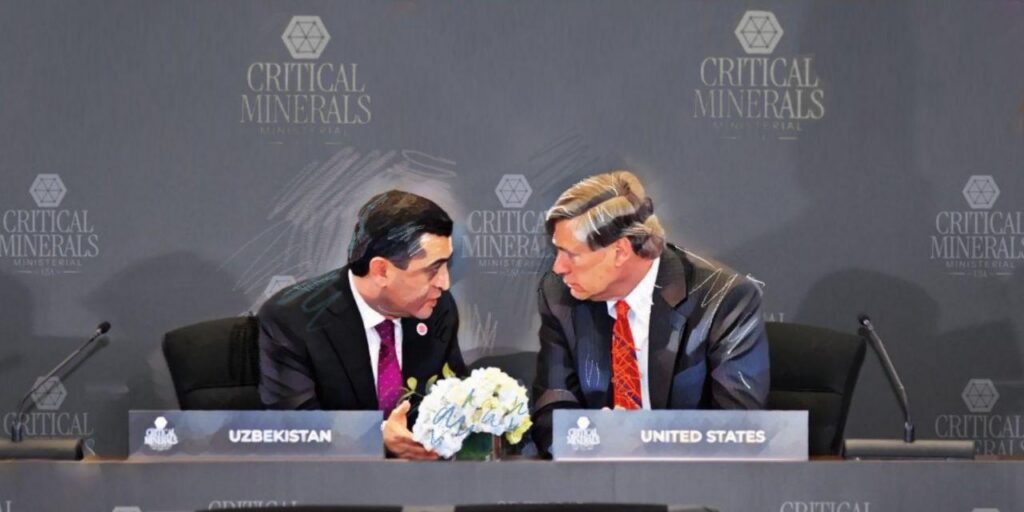
On February 4, 2026, in Washington, D.C., Uzbekistan’s Foreign Minister Bakhtiyor Saidov and U.S. Deputy Secretary of State Christopher Landau signed an intergovernmental Memorandum of Understanding (MoU) on securing supply chains for critical minerals and rare earth elements, spanning both mining and processing. A further agreement signed on February 19 brought implementation and financing to the foreground. The U.S. International Development Finance Corporation (DFC) signed “heads of terms” (i.e., commercial principles and essential terms of a proposed future agreement) for a Joint Investment Framework and outlined a proposed joint holding company. An agreement to establish an “investment platform” was exchanged in the presence of Uzbekistan’s President Shavkat Mirziyoyev.

These agreements are not a single mining deal. They combine a political instrument with a financing-and-structuring track that is intended to yield a small set of projects that can be financed and built, and they treat processing capacity and supporting infrastructure not as optional add-ons but as core deliverables. They also provide a path for early projects to full review and financing while connecting them to longer-term offtake structures that match Washington’s newer supply-shock tools, including “Project Vault.”

What the MoU Changes

The MoU’s immediate purpose is to align government priorities for critical minerals across the value chain while setting expectations that will later shape which financing and partners are feasible. The press agency of Uzbekistan’s foreign ministry emphasized “responsible partnership” and “long-term development” as part of the public framing, placing governance and reputational risk on the same plane as the geological givens. The MoU also leaves several items deliberately unresolved in public form. These include project annexes, deposit designations, and operational timelines. That document design-choice pushes the next phase of bilateral cooperation into working-level scoping and sequencing, where only a small number of candidate projects can be advanced into full review.

At the ministerial-level meeting, Washington clarified why it was framed as supply-chain security rather than commodity trade. Secretary of State Marco Rubio noted that critical minerals are inputs for infrastructure, industry, and defense, while Vice President J.D. Vance stressed the expansion of production across partner networks. As previously reported by The Times of Central Asia, this framing is part of a broader repositioning of U.S. engagement in Central Asia, where diplomatic formats are increasingly paired with mechanisms intended to generate trackable transactions and private-sector follow-through.

For Uzbekistan, what is attractive about this cooperation is the potential to convert resource endowment into a lever for industrial development, rather than treating extraction as the endpoint. President Shavkat Mirziyoyev has publicly valued the country’s underground wealth at roughly $3 trillion. He has linked rising global demand for technological minerals to the case for higher value-added activity around strategic reserves, including lithium and tungsten. The same logic supports a commercially open posture. For Tashkent’s other investors, buyers, and processing partners, Uzbekistan’s diversification toward U.S.-linked capital signals non-exclusivity.

Turning the MoU Into Projects

The next phase is practical. A candidate project will advance only if investors and public lenders can transparently evaluate its licensing and fiscal terms, audit its environmental and social baseline, and have confidence in enforceable contracts that provide a dispute-resolution pathway that counterparties treat as real. For processing facilities to be constructed and operated on time, reliable power, water supply, transport links, and disciplined procurement are decisive. Such an emphasis reflects Washington’s shift “from diplomacy to deals”.

Implementation is a division of labor. The DFC can facilitate private capital’s participation by structuring transactions and absorbing specific risks. The Export-Import Bank of the United States (EXIM) can complement those efforts through procurement-linked and exporter-linked support where the deal design fits its mandate. The bilateral investment platform is the channel that will turn candidate projects into transactions with defined terms. The proposed joint holding company is a possible co-ownership vehicle; however, capitalization, governance, and project-selection rules are not yet public.

The first tranche needs a simple selection logic. Projects with credible resource definition and studies that can be updated will be closest to feasibility. Next comes the identification of a plausible path from mined output to refined products that meet buyer specifications under auditable operating standards. Infrastructure constraints, especially power, water, and logistics, come next. Finally, projects still require long-term purchase contracts with terms that can be enforced, so locking in buyers is the last step.

A small number of clusters illustrates those criteria. They are only examples, not a project list. The Koytash–Ugat tungsten belt, including deposits such as Yakhton, Sautbay, and Ingichka, is a plausible early category and aligns with U.S. Geological Survey modeling of Uzbekistan’s tungsten export potential. Lithium is a second-wave target, conditional on delineation and a workable processing route. Rare-earth and rare-metal recovery as by-products from existing uranium and copper-molybdenum flows offers yet another pathway. In these cases, earlier volumes can be unlocked through improved separation, cleaner processing, and standards upgrades, without waiting for greenfield mine timelines.

Diversification Without Dependency

Uzbekistan is not negotiating in a vacuum. Multiple capital pools across Central Asia now compete, with different priorities in shaping where extraction ends and where processing begins. In Washington in mid-February, a new set of signed documents confirmed definitive agreements for a major tungsten development plan in Kazakhstan. This project is tied to deep processing and led by Cove Kaz Capital Group with Tau-Ken Samruk. Europe is also building its own channel through critical raw materials cooperation and financing commitments. China remains the dominant processing power and an aggressive bidder when strategic deposits come to market. Japan and South Korea are also pursuing targeted supply security through corporate offtake and project-level partnerships, as illustrated by a Mitsubishi-linked offtake arrangement tied to Kazakhstan’s rare-metals output.

In that wider context, the U.S.–Uzbekistan track is an attempt to place Uzbekistan on a non-Chinese path not just for mining but also for the midstream stages that determine where value is captured and who bears reputational risk. It is in Tashkent’s interest to use competitive pressure from other investors to raise standards and accelerate domestic capability. However, if deals become proxies for external rivalry rather than instruments of Uzbekistan’s own industrial policy, then its autonomy can be eroded. The strategic question for the Central Asian states is whether they can maintain balanced diversification while turning the new attention into durable processing capacity and the transparent, credible rules that Western capital requires for committing.

Kazakhstan to Digitalize Seaports to Boost Trans-Caspian Transport Route

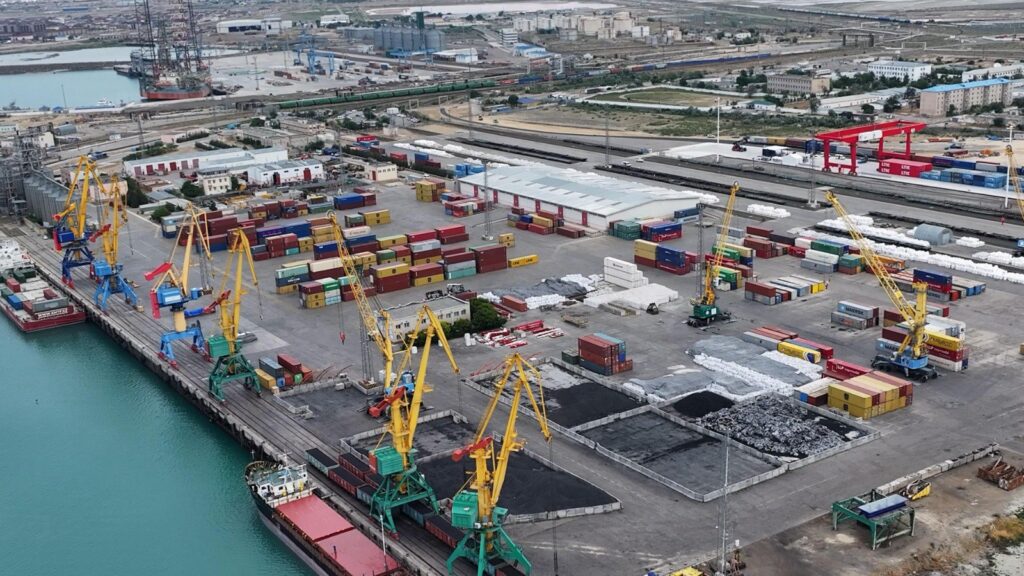
Kazakhstan is advancing the digital transformation of its maritime infrastructure as part of broader efforts to strengthen the Trans-Caspian International Transport Route (TITR), also known as the Middle Corridor.

The Ministry of Transport is developing an electronic Maritime Single Window system designed to replace paper-based documentation with digital data exchange for vessel entry and exit procedures at the country’s seaports. The initiative is included in the Roadmap for the Digitalization of Kazakhstan’s Transport Industry for 2025-2027.

According to the ministry, the project is being implemented with support from the German Society for International Cooperation (GIZ). An international tender has already been held to select experts responsible for preparing the system’s technical specifications.

In February, working meetings were held with stakeholders in Aktau and Kuryk, Kazakhstan’s two largest ports on the Caspian Sea. Discussions focused on port digitalization, simplifying administrative procedures, and reducing vessel processing times through the introduction of the Maritime Single Window.

The project is viewed as a key component in the further development of the TITR, which connects China with Europe via Central Asia and the South Caucasus. By streamlining port operations and reducing bureaucratic delays, Kazakhstan aims to enhance the route’s competitiveness and reliability.

Kazakhstan’s maritime transport sector has recorded steady growth in recent years. In 2025, maritime cargo volumes reached 8 million tons, a 7% increase compared to 2024. Container traffic through Kazakh seaports rose by 29% to 90,637 TEUs, while cargo volumes transported along the TITR increased by 36%.

Infrastructure development has accompanied this growth. In 2025, construction of a container hub at the port of Aktau was completed, a dry cargo vessel was launched on the Kuryk-Baku route, and two new ferries were acquired. Overall transit cargo traffic through Kazakhstan reached 36.9 million tons in 2025, up 6.6% year on year, driven by the integrated development of road, rail, air, and maritime transport.

Under the country’s comprehensive maritime infrastructure development plan for 2024-2028, Kazakhstan intends to establish a major transport and logistics cluster based on the ports of Aktau and Kuryk. The plan includes the expansion of container handling capacity, development of cargo terminals and international shipping logistics, and a reduction in administrative barriers. By 2028, total cargo throughput at the ports is expected to increase by 50%, while container handling volumes are projected to triple.

To ensure year-round navigation and maintain competitiveness amid changing environmental and logistical conditions in the Caspian region, Kazakhstan has also prioritized dredging works, including the deepening of the ports of Aktau and Kuryk.

Uzbekistan Pledges Support for Gaza Reconstruction

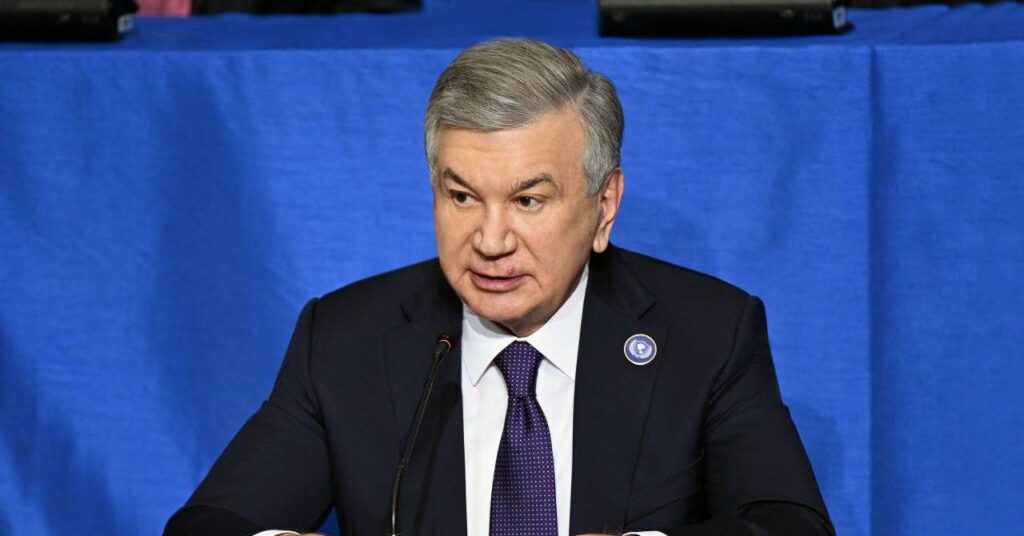
United States President Donald Trump introduced Uzbekistan’s President Shavkat Mirziyoyev as “a friend” during the inaugural meeting of the Board of Peace in Washington, setting a cordial tone for a summit focused on post-conflict recovery in Gaza.

In brief remarks while welcoming Mirziyoyev, Trump said Uzbekistan was “doing great” and had “no problems.”

The summit, held on February 19 at the United States Institute of Peace, brought together heads of delegations from Azerbaijan, Kazakhstan, Bahrain, Indonesia, Argentina, Paraguay, Romania, Egypt, Qatar, Pakistan, Hungary, Albania, Armenia, Vietnam, Cambodia, the United Arab Emirates, Turkey, Kuwait, Saudi Arabia, Israel, and Morocco, among others. Discussions focused on reconstruction and humanitarian assistance for the Gaza Strip, as well as broader efforts to promote stability in the Middle East.

In his address, Mirziyoyev thanked Trump for convening the inaugural meeting of the Board, describing the summit as the result of his “political will and pragmatism.”

Uzbekistan supported the initiative to establish the Board of Peace and declared its readiness to participate in its practical implementation. “I am confident that the Board’s work will create favorable conditions for the economic and social restoration of Gaza,” Mirziyoyev said.

He stressed that any mechanism for external governance in Gaza must be based on the support of its population. Coordinated efforts by all stakeholders, he added, would help ensure that the post-conflict process remains sustainable and that reconstruction advances efficiently.

Mirziyoyev also announced that Uzbekistan is prepared to contribute to the construction of residential buildings, kindergartens, schools, and hospitals in Gaza. He described the meeting as a symbol of international solidarity and urged participants to seize what he called a historic opportunity to help build a renewed Gaza with a functioning economy and improved living conditions.

87 Industrial Enterprises Closed in Tajikistan in 2025

In 2025, 87 industrial enterprises ceased operations in Tajikistan, according to Minister of Industry and New Technologies Sherali Kabir, who outlined the reasons for the closures and presented key industry indicators at a press conference.

Kabir described the suspension of activity at certain production facilities as “one of the ongoing issues.” The ministry is working with each enterprise individually, noting that “every job is important for the state management system.” Nevertheless, some companies were shut down, including at the initiative of the ministry.

Among the main reasons cited were zero production indicators and changes in organizational and legal status. The minister also pointed to discrepancies between statistical and tax reporting.

“This enterprise is registered as three enterprises in tax accounting and as one enterprise in statistics. This should not be the case,” Kabir said.

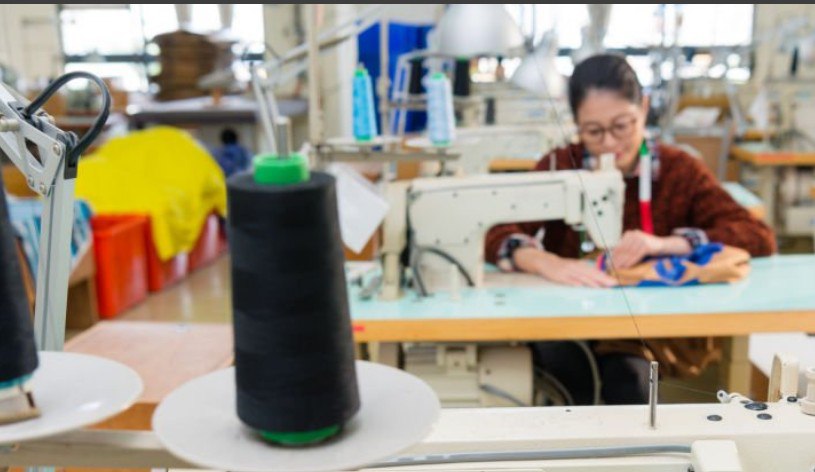
He paid particular attention to cotton-processing enterprises. According to the minister, a number of small factories relied on outdated technologies and “had a negative impact” on the sector.

“The fiber length at foreign enterprises processing our cotton is different. However, about 120 cotton ginning enterprises located in the Khatlon region, unfortunately, had a negative impact,” Kabir said.

The ministry, together with other agencies, established a special commission and proposed that these enterprises cease operations.

At the same time, the total production capacity of Tajikistan’s cotton ginning enterprises is estimated at 2.4 million tons, while actual processing volumes amount to around 500,000 tons. According to the minister, most enterprises have not properly established efficient operations.

As an alternative, authorities are considering the creation of technology parks on the sites of former enterprises. The proposal is currently under government review. Kabir stressed that closures or changes in legal status should not be viewed exclusively in negative terms.

As of January 1, 2026, Tajikistan had 3,972 registered industrial enterprises employing 92,927 people.