Kazakhstan’s Ministry of Water Resources and Irrigation has reported record water accumulation in the country’s reservoirs and lakes in 2024.
This year, Kazakhstan’s reservoirs collected over 75 billion cubic meters of water, including more than 12 billion cubic meters of floodwater from unprecedented spring floods in the western and northern regions. These floods were triggered by rapid snowmelt, leading to significant increases in water availability.
According to the Ministry, efficient floodwater distribution helped replenish reservoirs and direct excess water to rivers and lakes that have faced drying trends in recent years.
Notable allocations include:
Lake Balkhash: Received 15.4 billion cubic meters of water in 2024, a 4-billion-cubic-meter increase from 2023. Of this, 3.3 billion cubic meters came from floodwater. Located 175 miles northwest of Almaty, Balkhash is the largest lake in Kazakhstan and the fifteenth-largest in the world.
Caspian Sea: Gained 17 billion cubic meters of water, addressing concerns over its declining water level. The Times of Central Asia previously reported concerns that the Caspian could lose up to 18 meters of water by the end of the century.
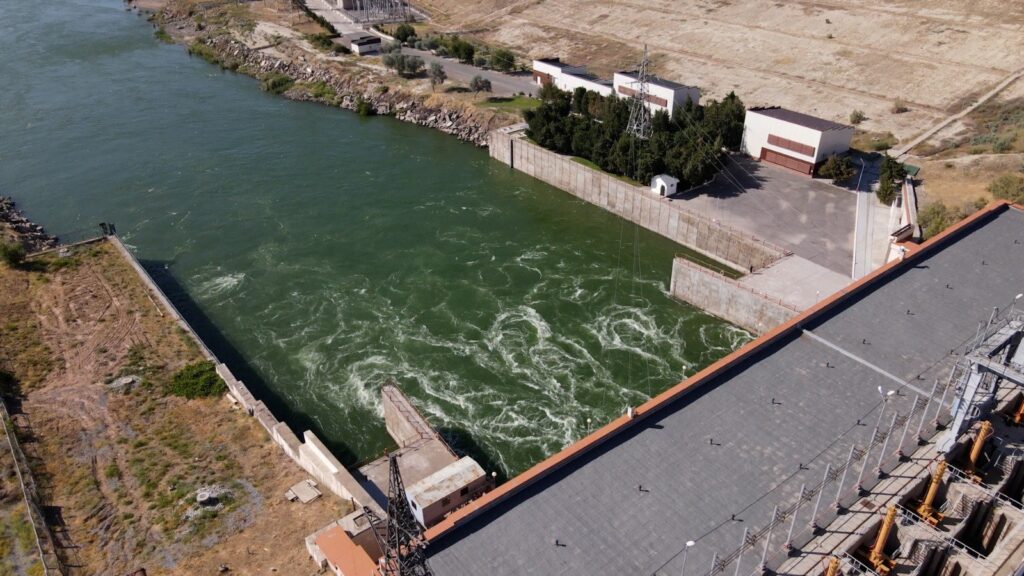
Kapchagay Reservoir: For the first time in a decade, this reservoir in the Almaty region filled to 100% of its capacity, collecting over 18 billion cubic meters of water. The reservoir regulates the flow of the Ili River, which originates in China and flows into Lake Balkhash.
North Aral Sea: Received approximately 2.5 billion cubic meters of water, 400 million cubic meters more than in 2023. This portion of the former Aral Sea is fed by the Syr Darya River and separated from the South Aral Sea in the late 1980s due to water diversion for agriculture.
Kamysh-Samar Lakes: Located in the West Kazakhstan region, these lakes were replenished with 80 million cubic meters of floodwater.
Minister of Water Resources and Irrigation Nurzhan Nurzhigitov emphasized the Ministry’s efforts to preserve and restore large and small water bodies across Kazakhstan. During the 2024 irrigation season, approximately 11 billion cubic meters of water were supplied to the country’s farms to support agricultural activities.
The record water accumulation and successful flood management efforts underscore Kazakhstan’s commitment to sustainable water resource management.
Dutch companies are expanding their presence in Turkmenistan’s agricultural sector, exploring new business opportunities to modernize and enhance local farming practices. A delegation led by former Dutch Ambassador to Kyrgyzstan Peter van Leeuwen visited Ashgabat in early December to assess potential collaborations.
The delegation included representatives from prominent Dutch firms such as Agrotech Didam, Dalsem, Geerlofs, HZPC, and Kubo. Discussions focused on key areas for joint efforts, including the construction of modern greenhouses, the implementation of drip irrigation systems, and advancements in seed production. Turkmen officials expressed a keen interest in adopting Dutch technologies to boost agricultural yields and efficiency.
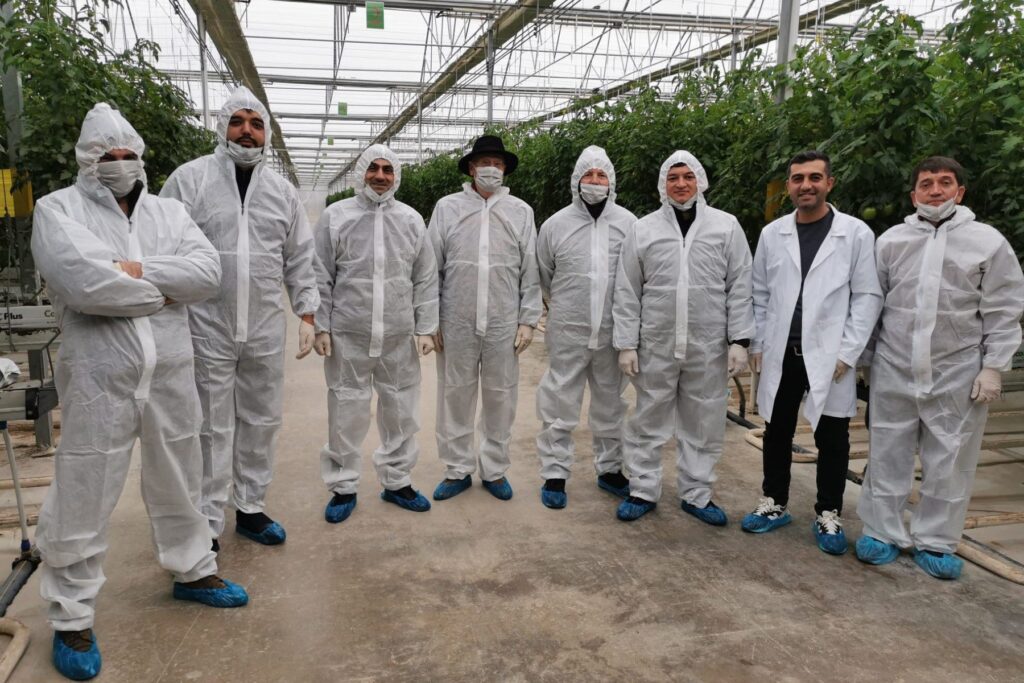
As part of their visit, the Dutch representatives toured greenhouse complexes near Ashgabat, where crops like tomatoes, strawberries, and bananas are cultivated. They also inspected potato farms and storage systems. The delegation highlighted the significant potential of Turkmenistan’s agriculture and affirmed their willingness to tailor Dutch innovations to suit the country’s specific conditions.
This visit followed a Turkmen delegation’s trip to the Netherlands in the summer of 2024. During that visit, representatives from Turkmenistan’s private sector and the Ministry of Agriculture participated in the international Green Tech Amsterdam exhibition. The event allowed Turkmen officials to explore cutting-edge agricultural technologies and establish connections with global industry leaders.
The exchange of delegations underscores growing cooperation between the two nations, with Dutch expertise poised to play a pivotal role in the modernization of Turkmenistan’s agricultural industry.
The “Work in the EAEU” mobile app, developed by the Eurasian Development Bank’s (EDB) Fund for Digital Initiatives, has officially launched services for migrant workers in Uzbekistan, the EDB has announced. With this launch, the app now operates in Uzbekistan, a country that is neither a member of the Eurasian Economic Union (EAEU) – which includes Armenia, Belarus, Kazakhstan, Kyrgyzstan, and Russia – nor an EDB member state. The expansion highlights the app’s broader regional ambitions.
Initially launched in June 2022, the “Work in the EAEU” app was designed to support the free movement of labor within EAEU member states. The service has since expanded to include Tajikistan in September 2024, and now Uzbekistan.
Services for Migrant Workers
The app provides a wide range of services tailored for individuals seeking employment in Uzbekistan. Key features include:
Job search tools and the ability to apply for vacancies.
Assistance in applying to government authorities for personal identification numbers or registration cards.
Access to tax services, information on work permits, and visa requirements, including types of visas and IT visas.
Support in finding accommodation and purchasing air or railway tickets.
Comprehensive legal and regulatory information on employment in Uzbekistan.
The app is intended to simplify employment processes for migrant workers and enhance their access to essential services through a single platform.
Migration Trends in the Region
For decades, hundreds of thousands of citizens from former Soviet republics have migrated within the region in search of better job opportunities. Central Asian countries, including Uzbekistan, have historically supplied significant numbers of labor migrants to Russia.
However, recent geopolitical shifts have altered migration patterns. Following Russia’s invasion of Ukraine and the partial mobilization in September 2022, thousands of Russian citizens fled their country, with many relocating to Central Asia. This reverse migration underscores the increasing importance of tools like the “Work in the EAEU” app, which facilitates mobility and employment across borders.
The launch of the “Work in the EAEU” app in Uzbekistan represents a step forward in easing cross-border employment processes in the region. As migration patterns continue to evolve, such digital initiatives will play a crucial role in supporting both labor migrants and host countries.
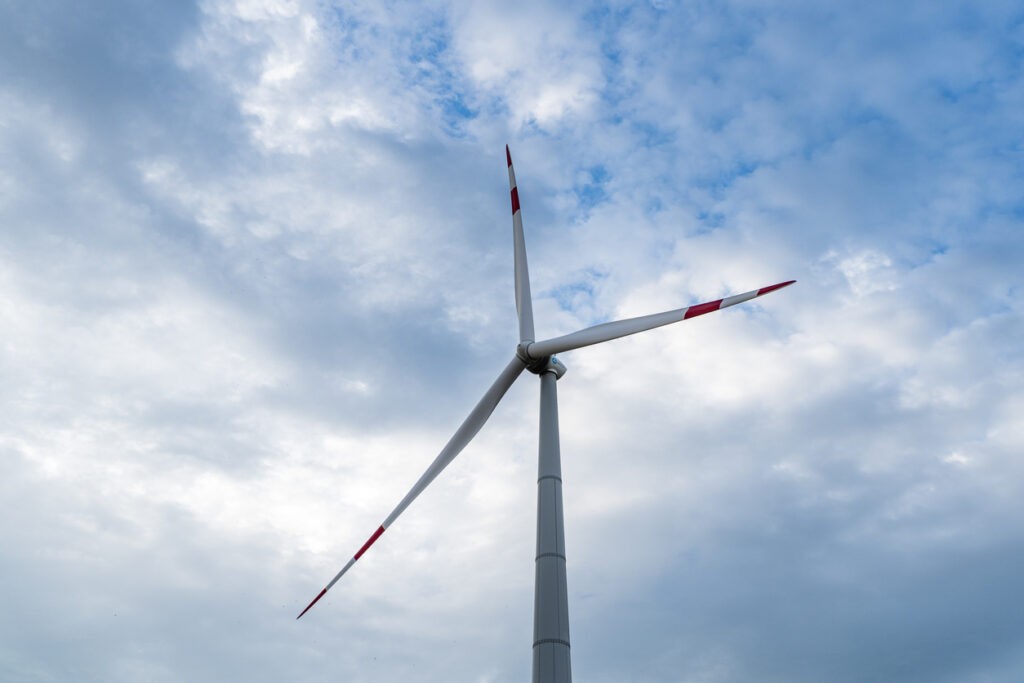
Rosatom Renewable Energy, the wind power division of Russia’s State Atomic Energy Corporation Rosatom, has signed an investment agreement with Kyrgyzstan’s Cabinet of Ministers to construct and operate a 100 MW wind farm in Kok-Moinok village, located in the Issyk-Kul region The agreement was formalized by Taalaibek Ibraev, Kyrgyzstan’s Minister of Energy; Grigory Nazarov, Director General of Rosatom Renewable Energy; and Dmitry Andreyev, Director General of NovaWind Kyrgyzstan, LLC. The project represents Rosatom’s first export initiative in wind power generation.
A ceremonial milestone was reached in September 2024 with the laying of a time capsule at the site of the future wind farm. Design and survey work, along with equipment procurement, is slated to begin in 2025.
Rosatom’s Broader Role in Kyrgyzstan
Rosatom has been actively advancing strategic energy projects in Kyrgyzstan. In January 2022, the company and Kyrgyzstan’s Ministry of Energy signed a memorandum of cooperation to construct low-power nuclear power plants based on the RITM-200N reactor.
Additionally, Rosatom is contributing to the development of Kyrgyzstan’s hydroelectric capacity, including the construction of the Leilek HPP (5.9 MW), Jerooy HPP (28 MW), and Chandalash HPP (30 MW). These efforts reflect the company’s diversified approach to strengthening the country’s energy sector.
Kyrgyzstan continues to face electricity shortages, particularly during the harsh winter months. To tackle this issue, the country is investing in a mix of renewable energy projects, including solar and wind farms, as well as large hydroelectric power plants.
Rosatom’s 100 MW wind farm in Kok-Moinok is expected to play a significant role in diversifying Kyrgyzstan’s energy sources and enhancing energy security.
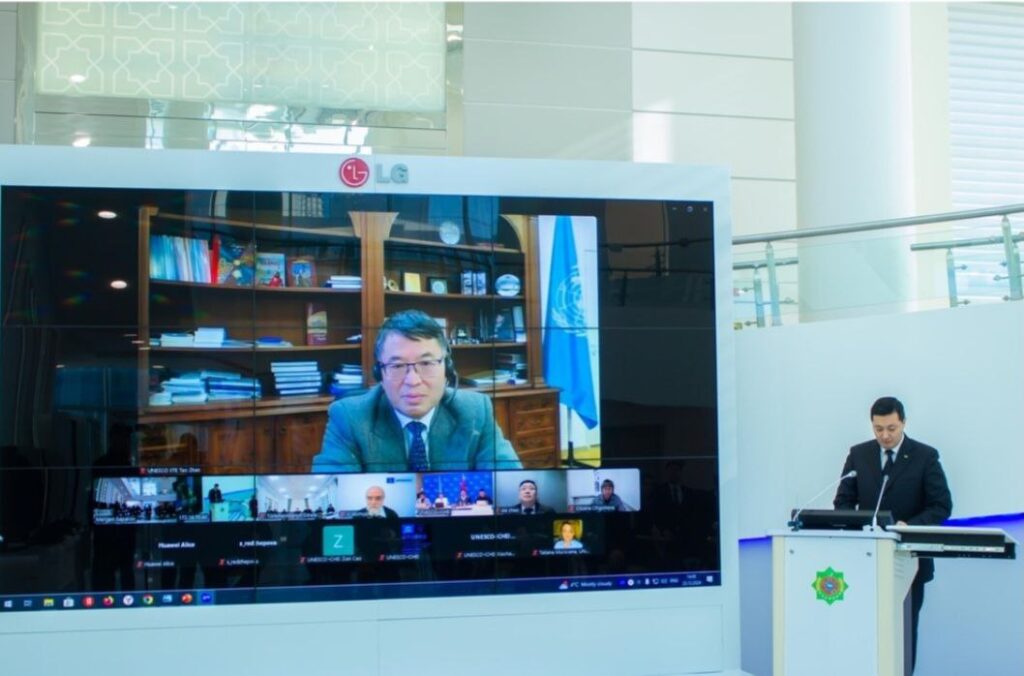
Turkmenistan has taken a significant step toward integrating artificial intelligence (AI) into its education system by hosting a scientific and practical conference. Organized by the Ministry of Education in collaboration with the UNESCO Institute for Information Technologies in Education, the event marked progress in implementing the goals outlined in the “Roadmap of Cooperation for 2024-2025.”
Key Discussions
The conference explored critical aspects of applying AI in education. Topics included the development of education management information systems, improving teachers’ digital literacy, and adapting cutting-edge technologies to Turkmenistan’s specific conditions. Participants also presented a draft strategy for the development of AI in education and highlighted international platforms already in use in this field.
Special emphasis was placed on the competencies required for both teachers and students to effectively work with AI. Experts noted that fostering such skills is essential in an increasingly digitalized society and workplace. They stressed that equipping young people with AI-related knowledge could significantly enhance their future professional prospects.
Practical Implementation and Examples
Turkmenistan is already incorporating AI into educational initiatives. A notable example was presented on October 4 in Ashgabat, where Selin Ataeva, a 12th-grade student at the Swiss School of Dubai and leader of a startup development team, showcased an AI-driven math learning platform.
This innovative software adopts a personalized approach to education, catering particularly to students in rural and remote regions. By optimizing the learning process and improving access to quality education, the platform exemplifies the transformative potential of AI in bridging educational gaps.
As Turkmenistan advances toward integrating AI into its education system, the conference highlighted the importance of aligning technology with local needs and preparing students and teachers for a digitally driven future. With initiatives like Ataeva’s math learning platform, the country demonstrates a commitment to using AI to enhance education accessibility and efficiency.
Earlier this month, the Library for the Performing Arts at Manhattan’s Lincoln Center resonated with the vibrant sounds of From Near and Far, a new musical project by the New York-based ensemble Trio Fadolín. The performance, part of the New York Public Library’s cultural programming, captivated audiences with its rich exploration of Uzbek musical traditions and beyond. Suspense, melancholy, and drama were interwoven with personal stories shared by Ljova (Lev Zhurbin), a member of the ensemble and virtuoso of the fadolín — a one-of-a-kind string instrument custom-made for him — blending the tonal depth of the violin, viola, and cello.
The program featured compositions by Ljova, Uzbek composer Dmitry Yanov-Yanovsky, and Ljova’s father, the renowned Soviet-era composer Alexander Zhurbin. Adding a poignant layer to the evening, Alexander Zhurbin attended the concert in person, providing a tangible connection to the ensemble’s exploration of cultural and familial roots.
Alexander Zhurbin, 1985
Much of Ljova’s career has been dedicated to uncovering and performing music from underrepresented regions, introducing audiences to sounds often unfamiliar in the West. Born in Moscow, he immigrated to New York in 1990 with his parents, quickly immersing himself in the city’s multicultural and musical landscape. As a composer, arranger, and bandleader for his ensemble, Ljova and the Kontraband, he has collaborated with globally acclaimed groups including the Yo-Yo Ma-founded Silkroad Ensemble (now called Silkroad). Ljova’s work defies boundaries, blending Eastern and Western influences to honor and innovate musical traditions.
The trio’s members — Ljova, violinist Sabina Torosjan (born in Estonia), and cellist Valeriya Sholokhova (born in Ukraine) — found a shared connection to Uzbekistan through their personal histories, which became the foundation for From Near and Far.
TCA spoke with the trio about their musical and familial ties to Uzbekistan.
TCA: Can you share how your personal histories connect you to Uzbekistan?
Ljova: My father, Alexander Zhurbin, wrote the Soviet Union’s first rock opera, Orpheus and Eurydice, in 1975. It played in stadiums and was in the Guinness Book of Records as the longest-running musical in Russia. He was born in Tashkent and lived there until his mid-20s when he moved to Leningrad — now St. Petersburg — to study, and then to Moscow to work as a composer in film, TV, musicals, and the concert stage.
Sabina: Just like many people from the former Soviet Union, I have a mixed background. I grew up in Estonia. My mother’s side of the family was Ukrainian Jews and my father’s side was Armenian. The interesting connection to Uzbekistan is that it is where my father was born. His father was sent to work there as a veterinarian at the time, in Biruni, Uzbekistan. But shortly after my father was born, his family returned to Yerevan.
Valeriya: My grandfather’s family sought refuge there during World War II and survived those difficult years in Uzbekistan. However, they returned to Ukraine as soon as they were able. There are pictures of my grandfather as a child wearing an Uzbek tyubeteyka, and I am deeply grateful for the safe haven that Uzbekistan provided for my family during that time. I find this photograph particularly moving because it symbolizes how Central Asia offered my grandfather a place where he could wear a head covering — albeit with a Central Asian twist — in safety. Remarkably and unironically, I haven’t seen another picture of him wearing a head covering until he moved to the United States, over 70 years later.
TCA: What was the inspiration behind From Near and Far and how do you connect with Uzbekistan’s rich musical and cultural traditions?
Ljova: We had commissioned my dad to write a piece for our trio, his Three Muses, and performed it several times on our programs, including at The Kennedy Center and Lincoln Center, but this time out, we thought to contextualize it within a program of other music from Uzbekistan. We discovered a trio by Uzbekistan-born composer Dmitry Yanov-Yanovsky — who lives in Tashkent to this day — that was previously commissioned by the Metropolitan Museum of Art. Both the work of Dmitry Yanov-Yanovsky and my father came from a classical music tradition. I wanted to bring a strain of folk music into the concert as well, to complement the program, hence, my suite of Central Asian Dances was born. At this moment, my connection is musical and culinary, the two best ways to travel without leaving home. I know a few Uzbek-born musicians here in New York, and of course, I’ve been to the restaurants. I hope to visit and travel to Uzbekistan one day, to visit and experience the land where my dad and grandparents spent their younger years, and where so many of the Jewish community found refuge in difficult times. I want to see Tashkent, Samarkand, Bukhara, and Ferghana, to get a sense of the sweep… to see the Silk Road.
Sabina: In the past few years, I’ve met more and more incredible people and artists from Uzbekistan and, as a result, have been more exposed to the incredibly rich culture. From what I’ve been exposed to, it’s very beautiful, soulful, and easy to connect to.
Valeriya: I believe we share an appreciation for Uzbekistan and a fascination with its rich cultural tapestry. What initially began as a lighthearted joke during our first recording project together — a set of waltzes by a New Jersey-based composer of Uzbek origin — about how all the artists in the studio had roots in Uzbekistan, eventually grew into the program we’ve built for the NYPL. In the wake of the full-scale Russian invasion, we’ve also been focusing on music from former Soviet republics, intentionally moving away from a “Russian”-centered repertoire. This has allowed us to delve into and celebrate the musical heritage of Uzbekistan, for which we are deeply grateful.
TCA: During the From Near and Far concert, you mentioned discovering Uzbek music through some unique and unexpected sources. Can you share how your search shaped your repertoire?
Ljova: I drew inspiration from the Hungarian composer Bela Bartók, who was among the first ethnomusicologists to preserve in recorded and notated form the folk music of the Magyar people, as well as Romani, Slovaks, Rusyns, Serbs, and others. His electrifying suite of Romanian Folk Dances, from 1915, is a staple at concerts worldwide. I wanted to write something similar, but using themes from Uzbekistan, particularly from the Bukharian Jewish Community. I was aware of the group Shashmaqom, whom I was lucky to hear perform in New York several times as part of presentations by the Center for Traditional Music and Dance, but I also wanted to hear other sources.
Alexander Khafizov is a highly in-demand clarinetist on the concert and social circuit in New York, a YouTube star with millions of views, but, in his spare time from performing, he is also an excellent barber. I thought he might be a good starting point for research on where to find Bukharian Jewish music, but he just said, “Go to YouTube.” When pressed further, he suggested Yulduz Turdiyeva. Thus began my journey, and the seeding of my YouTube algorithm.
In parallel, I started googling and came across a trove of Bukharian melodies collected by ethnomusicologist Elena Reikher from the Bukharian diaspora community in Israel. As I started trying to find recordings of the pieces she collected, I found other music that was recommended by the algorithm. I kept all the pieces I liked in a hidden YouTube playlist.
TCA: What are the unique challenges or distinct aspects of playing your instruments when interpreting traditional and contemporary music from Uzbekistan and the broader Central Asian region?
Ljova: One of the great things about the fadolín is that it’s new. We are building the repertoire afresh.
Sabina: In the program that we presented, some of it still fell into the category of “classical music” and as a result was more familiar to my ear, and didn’t require a different approach, but the suite written by Ljova based on different Central Asian songs required me to get more familiar with the songs themselves and the style of performance. The different meters, very beautiful flowing melodies, and driving rhythms made the piece really fun to play.
Valeriya: Playing Central Asian melodies on a string instrument like the cello is a truly enjoyable experience. While the cello evolved in Western Europe, it shares a connection with its distant bowed cousins in Central Asia. One unique challenge is performing microtonal music, quarter-tones that are unfamiliar to the Western ear. Exploring these pitches on the cello was both rewarding and great fun, allowing me to portray the music and culture I deeply admire.
TCA: How have Western audiences responded to your interpretations of Central Asian-influenced music and do you plan to present music from this region in upcoming projects?
Ljova: This was our very first concert focusing on music from Central Asia in such an expanded way. I’m hopeful that we will get to perform these pieces many more times, and I’m hoping to find time to work on more Central Asian folkloric sources for a future project. It’s such a trove of beautiful music, sentiment, and flavor.
Sabina: I thought our program was very well received by the audience, and I’m really looking forward to repeating it and adding to it.
Valeriya: We have performed Lev’s Central Asian Suite to great public acclaim. Audiences from all walks of life have shared how fun and relatable they found the music. After all, folk music has a unique way of resonating and speaking directly to its listeners. We are thrilled to have these pieces as a vibrant addition to our repertoire.



 Sergey Kwan