Uzbekistan and Turkey Set $5 Billion Trade Target at Strategic Council Meeting in Ankara

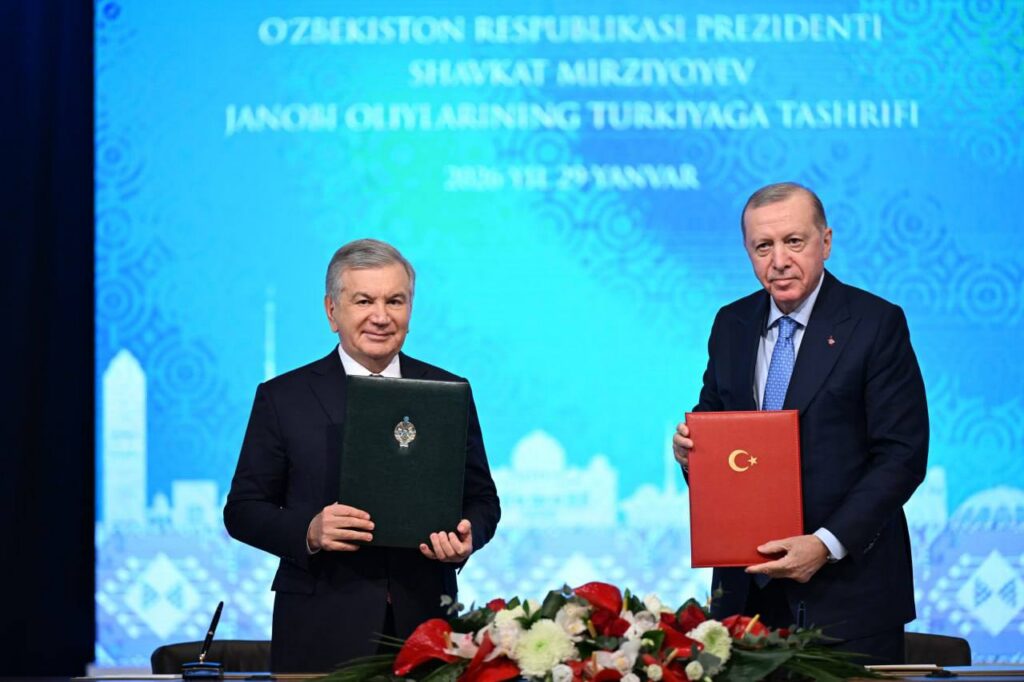
At the invitation of Turkish President Recep Tayyip Erdoğan, President of Uzbekistan Shavkat Mirziyoyev paid an official visit to Turkey on January 29, marking a new phase in the deepening partnership between the two nations. The visit was centered around the fourth meeting of the High-Level Strategic Cooperation Council, co-chaired by the two leaders in Ankara.
Discussions focused on strengthening the comprehensive strategic partnership between Uzbekistan and Turkey, with an emphasis on political dialogue, trade and economic cooperation, transport connectivity, and cultural and humanitarian exchanges. The two presidents also exchanged views on regional and global developments, underscoring the growing coordination between Tashkent and Ankara on international platforms.
Both sides highlighted the steady growth in bilateral trade, the rising number of joint ventures, and increased direct flights between the two countries. Regular cultural exchanges and growing people-to-people contacts were cited as further evidence of the strengthening relationship.
Key areas for future cooperation include joint projects in industry, agriculture, and social protection, as well as enhanced collaboration in defense, security, and combating cybercrime.
The timing of the Strategic Council meeting was described as symbolic, taking place on the eve of Ramadan and ahead of the 30th anniversary of the Treaty on Eternal Friendship and Cooperation between Uzbekistan and Turkey. The two sides expressed satisfaction with the growing political dialogue and the convergence of their positions on many international issues.
The presidents reaffirmed their commitment to mutual support in international and regional organizations, including the United Nations, the Organization of Turkic States, the Organization of Islamic Cooperation, and the Economic Cooperation Organization. Inter-parliamentary cooperation has also intensified, particularly through parliamentary friendship groups.
The leaders set an ambitious goal to increase bilateral trade turnover to $5 billion in the coming years. Expanding the list of goods covered under the Preferential Trade Agreement will be a key step toward achieving that target. Ahead of the visit, new priority areas for industrial cooperation were identified and will be implemented under a separate program.
Significant potential was noted for interregional cooperation, with delegations from all regions of Uzbekistan expected to visit Türkiye by the end of the year to develop joint projects. Cooperation will also be deepened in agriculture, horticulture, healthcare, and medical tourism.
The two countries agreed to intensify cultural and tourism ties through joint initiatives such as theater festivals, cultural weeks, historical film productions, and heritage restoration projects. In the education sector, the fourth Rectors’ Forum will be held in Bukhara this spring.
Following the Strategic Council meeting, Mirziyoyev and Erdoğan signed a Joint Statement and adopted a framework for cooperation within the comprehensive strategic partnership. A wide-ranging package of bilateral agreements was also signed, covering healthcare, education, military medicine, economic and financial cooperation, mining, transport corridors, special economic zones, nuclear safety, migration, religious affairs, foreign ministry cooperation for 2026-2027, light industry, and cultural collaboration.
At the conclusion of the visit, Mirziyoyev extended an official invitation to Erdoğan to visit Uzbekistan, reflecting the continued momentum and growing trust in bilateral relations.