• KGS/USD = 0.01144 0%
  • KZT/USD = 0.00193 -0%
  • TJS/USD = 0.10866 0.55%
  • UZS/USD = 0.00008 0%
  • TMT/USD = 0.28490 0%
  • KGS/USD = 0.01144 0%
  • KZT/USD = 0.00193 -0%
  • TJS/USD = 0.10866 0.55%
  • UZS/USD = 0.00008 0%
  • TMT/USD = 0.28490 0%
  • KGS/USD = 0.01144 0%
  • KZT/USD = 0.00193 -0%
  • TJS/USD = 0.10866 0.55%
  • UZS/USD = 0.00008 0%
  • TMT/USD = 0.28490 0%
  • KGS/USD = 0.01144 0%
  • KZT/USD = 0.00193 -0%
  • TJS/USD = 0.10866 0.55%
  • UZS/USD = 0.00008 0%
  • TMT/USD = 0.28490 0%
  • KGS/USD = 0.01144 0%
  • KZT/USD = 0.00193 -0%
  • TJS/USD = 0.10866 0.55%
  • UZS/USD = 0.00008 0%
  • TMT/USD = 0.28490 0%
  • KGS/USD = 0.01144 0%
  • KZT/USD = 0.00193 -0%
  • TJS/USD = 0.10866 0.55%
  • UZS/USD = 0.00008 0%
  • TMT/USD = 0.28490 0%
  • KGS/USD = 0.01144 0%
  • KZT/USD = 0.00193 -0%
  • TJS/USD = 0.10866 0.55%
  • UZS/USD = 0.00008 0%
  • TMT/USD = 0.28490 0%
  • KGS/USD = 0.01144 0%
  • KZT/USD = 0.00193 -0%
  • TJS/USD = 0.10866 0.55%
  • UZS/USD = 0.00008 0%
  • TMT/USD = 0.28490 0%
11 December 2025

Washington and Tashkent Push for More Trade and Investment

Speaking at the United Nations in New York on September 23, President Mirziyoyev of Uzbekistan made it clear that he no longer adheres to his predecessors’ post-Soviet policies of isolation and ‘go-it-alone’ economic development strategy – those days are over.

Uzbekistan today – or so the evidence suggests – is more open for business than at any time in its history, with the caveat that deals must be win-win, strategic, fair, and reciprocal. Though it’s unclear what that precisely entails, both Washington and Tashkent are clearly working to accelerate capital and trade flows.

“[Our] top-priority goal”, Mirziyoyev said at the United Nations, “is to fundamentally transform the lives of each and every family and citizen in our country, to enhance human dignity and wellbeing.” These are not mere words, but stand at the core of Uzbekistan’s efforts to build a new nation on the back of its – until recently – entirely archaic Soviet era socio-economic institutional structures and often ossified old ways of thinking.

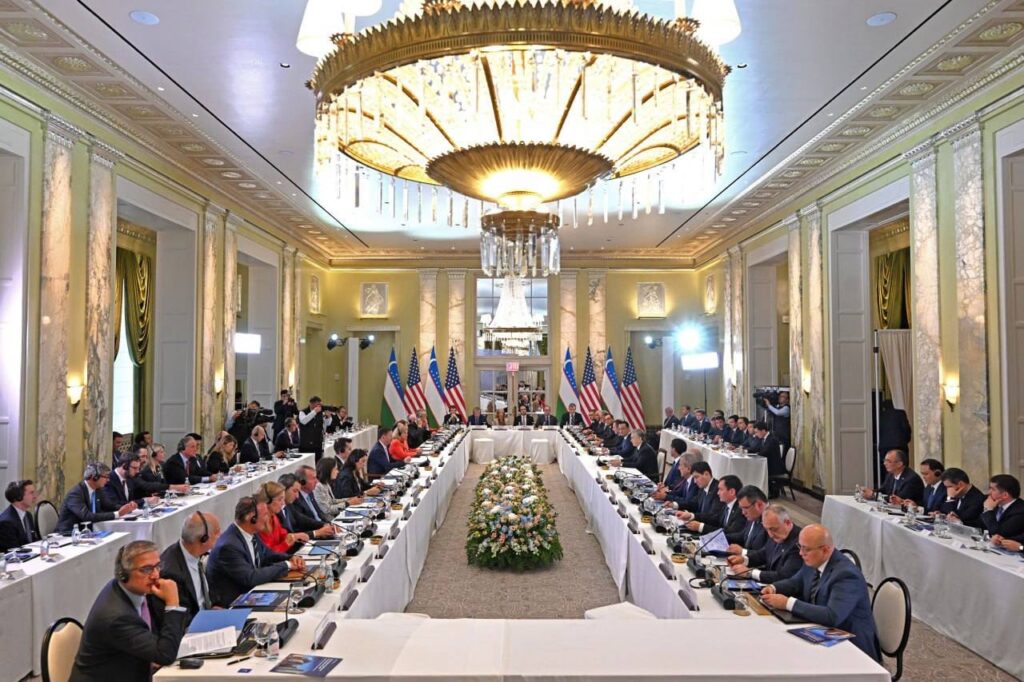
With this in mind, the main event of Mirziyoyev’s recent New York visit – besides his meeting with President Trump – was the high-level US-Uzbekistan investment roundtable with senior executives of major U.S. corporations and financial institutions.

The roundtable was more than just symbolic. Its strong turnout underscored both the U.S. and Uzbek commitment to advancing joint initiatives in key sectors, including strategic minerals, transport infrastructure, energy, and smart agriculture.  Top executives from Boeing, Citigroup, BNY Mellon, NASDAQ, Nvidia, Mastercard, Visa, General Motors, Jefferies, Oppenheimer, Cleveland Clinic, Cargill, and other U.S. corporations descended on the meetings in force, clearly eager to court the president and his team.
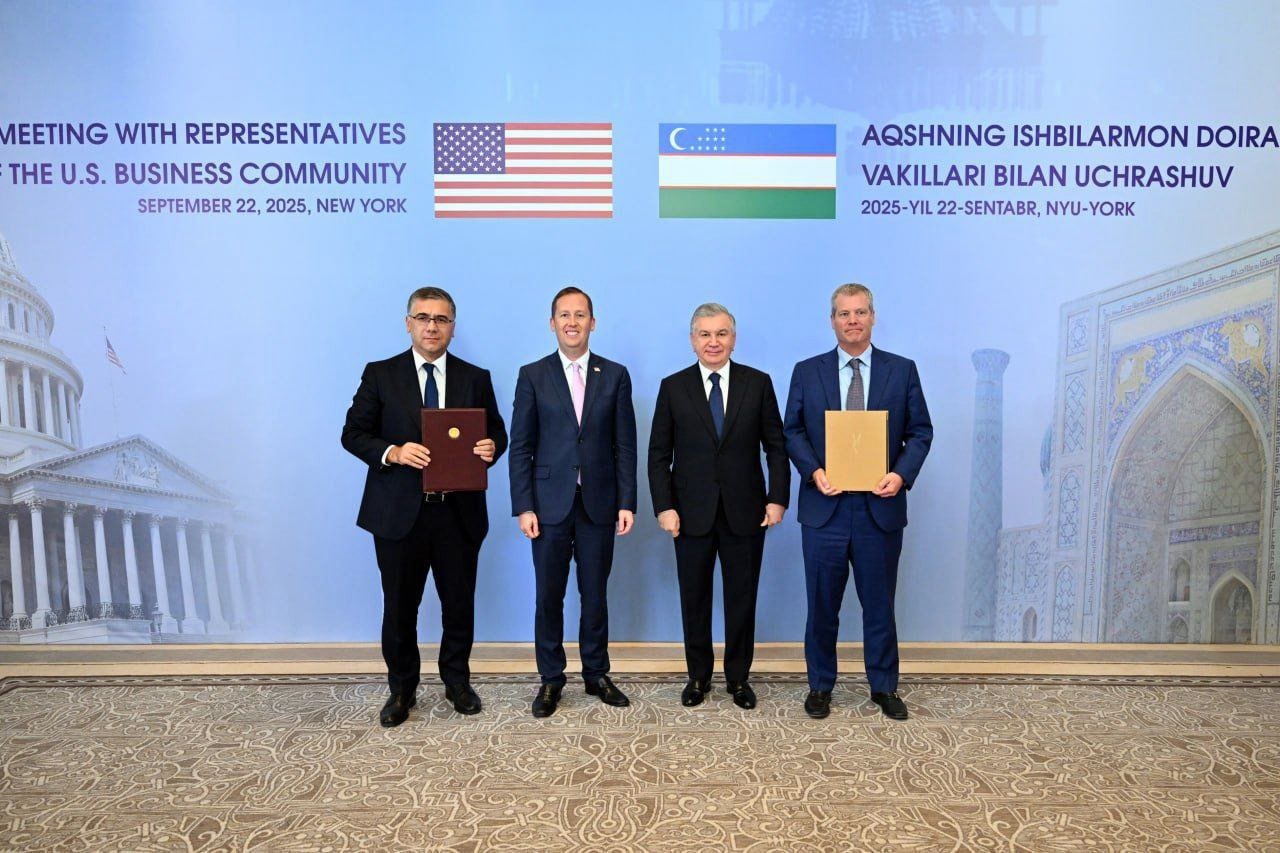
Image: president.uz

At their face-to-face meeting, President Trump personally congratulated Mirziyoyev on the landmark $8 billion Boeing-Uzbekistan Airways deal, projected to generate over 35,000 U.S. jobs – that in itself is not news. Rather, the NY business roundtable appears to have signaled that the American business community is more than just sniffing around for deals. Undoubtedly, a key force behind this growing interest is Washington’s expanding engagement with Uzbekistan.

Highlighting Washington’s strategic swing towards Uzbekistan, Mirziyoyev, Sergio Gor, U.S. Special Envoy for South and Central Asian Affairs, and William Kimmitt, Under Secretary of Commerce for International Trade, attended the signing ceremony of bilateral agreements, which ranged from transport, logistics and AI to mining, healthcare, and financial services. Their presence helped move discussions from initial interest to serious dealmaking.

To dispel investor uncertainty related to sovereign risk and other hidden booby traps often embedded in cross-border investment agreements, Mirziyoyev declared: “I assure you, I personally guarantee the success of U.S. companies operating in Uzbekistan. At the Ministry of Investments, a dedicated Deputy Minister for U.S. Affairs has been appointed. He will accompany you 24/7.”

While this makes plain Uzbekistan’s shift from aid recipient to active economic player, it’s also an attempt to shore up “investor butterflies” who are wary of corruption and shaky legal remedies in the event of contract disputes.

Moreover, recognizing that companies are often cautious about entering new markets, Washington has taken additional steps to encourage American companies to invest in Uzbekistan – at least so it would seem from the literature. For example, the U.S. Department of State’s newly released September 2025 Uzbekistan Investment Climate Statement strikes an overall positive note, avoiding the overly cautious or even negative framing often seen in such reports in the past.

With pragmatism in hand and a more engaged Washington, the long-awaited U.S. pivot to Central Asia appears to be taking shape. Strong, realism-based diplomatic efforts, if sustained and smart, should encourage deeper ties between the two countries and, over time, generate job opportunities in both the U.S. and Uzbekistan, a matter of concern for China and Russia.


Uzbek Companies Begin Gas Exploration at Afghanistan’s Toti-Maidan Field

Uzbek companies have received official licenses from Afghanistan to explore and produce hydrocarbons, Uzbek Energy Minister Jurabek Mirzamakhmudov announced in a documentary titled The Path of a New Uzbekistan – A Truth Recognized by the World, broadcast on Uzbekistan 24.

According to Mirzamakhmudov, Afghan authorities have granted Uzbek firms the right to conduct geological exploration and develop hydrocarbon deposits on Afghan territory. Work began in mid-September at the Toti-Maidan gas field in Jowzjan province under a 25-year contract signed with the Uzbek company Eriell KAM.

“This will be the first stage,” Mirzamakhmudov said, as quoted by Uzbek media. “Depending on the results, we plan to expand cooperation to new sites. The project is being implemented as an initiative that will benefit both the Uzbek and Afghan economies.”

The Toti-Maidan field spans approximately 7,500 square kilometers and includes around 30 wells, according to Afghanistan’s Ministry of Mines and Petroleum. Uzbekistan is expected to invest about $100 million annually over the next decade, with plans to process the extracted gas domestically.

Mirzamakhmudov emphasized that the initiative reflects Uzbekistan’s growing role in regional energy cooperation and aligns with its policy of fostering mutually beneficial ties with neighboring countries. He noted that the project aims to support local industry development and job creation in both nations.

In August 2025, Uzbek and Afghan energy companies signed a series of agreements in Kabul to implement four major infrastructure projects. These include the construction of a 500-kilovolt Surkhan-Dasht-e Alwan transmission line, substation expansions in Arghandeh and Nangarhar, and upgrades to the Kabul-Nangarhar power corridor.

Former Afghan Deputy Speaker “Abbas Dollar” Arrested in Tashkent

Abbas Ibrahimzada, a former deputy speaker of Afghanistan’s parliament, was arrested in Tashkent on September 24, according to sources cited by Amu. Despite reportedly posting bail of more than $350,000, he has remained in custody for over a week. His arrest follows multiple complaints filed by business rivals.

Local sources indicate that Ibrahimzada has invested more than $50 million in Uzbekistan over the past four years, with ventures spanning commercial transport and flour production. His detention has raised concerns about potential disruptions to his extensive business interests. Ibrahimzada has not publicly commented on the case.

A prominent representative from Balkh province during the 16th term of Afghanistan’s parliament, Ibrahimzada is widely known by the nickname “Abbas Dollar”, a nod to his reputation as one of Afghanistan’s wealthiest private investors.

In addition to his political career, Ibrahimzada has long been active in business. According to Afghan-Bios, he heads the Ibrahimzada Group, which operates across multiple sectors, including energy, infrastructure, and education.

His arrest in Uzbekistan adds a new layer of complexity to his cross-border business profile, drawing attention to the intersection of political and commercial interests in Central Asia. The case also highlights the legal uncertainties foreign investors may encounter in the region. Authorities have not released an official statement regarding the specific charges or the status of his business operations in Uzbekistan.

TCA Interview: Asia’s First New York Film Academy Campus Opens in Almaty

On 27 September, the New York Film Academy Kazakhstan (NYFA) opened the first branch of the world-renowned American film school in Central Asia. For young Kazakhstani and foreign students, this presents a unique opportunity to gain top-tier knowledge for future careers in the industry.

The new campus was established through a partnership between Almaty University of Energy and Communications (Energo University) and the Dala Edge Creative Technology Park, with the opening ceremony attended by Michael Young, President and CEO of the New York Film Academy, and Sayasat Nurbek, Minister of Science and Higher Education of Kazakhstan.

Gani Nygymetov, Rector of Energo University, spoke to The Times of Central Asia about the opportunities and prospects of NYFA Kazakhstan.

TCA: How did the idea to establish the New York Film Academy Kazakhstan campus in Kazakhstan come about?

GN: Energo University has been in existence for over 50 years and is one of the leading technical universities in Central Asia, specializing in engineering and energy.

In February this year, we presented a new development strategy that includes a mission to remain a leader in energy education, while also expanding into telecommunications, IT, and techno-creative programmes.

To achieve these goals, the 16-hectare Dala Edge Creative Technology Park was created near Almaty. Now, a branch of NYFA has opened there, its first campus in Asia. Previously, NYFA campuses were only located in Florence, New York, and Los Angeles.

I am confident that the opening of the campus in Kazakhstan will give an additional impetus to the development of creative industries in the region and enable us to train specialists of international calibre.

The Creative Technology Park will become a hub for professional training and innovative projects and will support the integration of students and professionals into the film, animation, and game design industries.

TCA: Who teaches at NYFA Kazakhstan, exclusively American specialists, or are local experts also involved in the programme? What subjects are taught?

GN: American specialists teach students in film directing, screenwriting, acting, 3D animation, visual effects, and game design. All programmes meet international standards, instruction is in English, and modern tools and methods used in the United States are employed.

Inviting NYFA to Kazakhstan is part of a strategy to develop the country’s academic potential. The Ministry of Science and Higher Education, led by Minister Sayasat Nurbek, is actively attracting leading international universities.

Today, more than 40 renowned foreign universities have opened branches in Kazakhstan. This allows talented students to receive high-quality education at home and also attracts students from other countries in the region.

Partnerships with international universities, including Anhalt University (Germany), which has also opened a branch at our university, and NYFA, help set high standards of education and expand opportunities for students. In the coming years, we plan to launch our own digital media faculty.

Gani Nygymetov, Rector of Energo University; image: Energo University

TCA: How many students are currently studying at NYFA Kazakhstan? Are there plans to expand the number of disciplines? 

GN: NYFA Kazakhstan issues diplomas and certificates identical to those issued at the Academy’s campuses in New York. The programmes, teaching quality, standards, and instructors fully comply with American standards.

At the same time, the cost of education in Kazakhstan is nearly three times lower than in the United States. While in the US it costs $50,000-60,000 per year, in Kazakhstan it is just $18,000. Currently, 60 students are studying here, including students from Russia, Uzbekistan, and Uganda. The majority are Kazakhstani.

In the coming years, the student body is expected to grow to 200. Five certified programmes are currently offered, and a bachelor’s programme is planned for next year. Students coming from other cities are provided with accommodation near the campus.

The campus also includes a swimming pool and other amenities for comfortable living and study. The Creative Technology Park is also open to professionals in film, 3D animation, and game design, including start-ups and projects by local entrepreneurs.

TCA: Experts note that the film industry in Kazakhstan, including animation, is developing at a rapid pace. It is clear that the opening of the campus will make a significant contribution to this process. How do you assess the prospects?

GN: Indeed, the film industry in Kazakhstan is growing very rapidly. Kazakhstani films account for about 70% of the domestic box office, which is an impressive figure. People actively go to cinemas, and Kazakhstani films are popular not only within the country but also across Central Asia, including Uzbekistan and Kyrgyzstan.

During my trips to neighbouring countries, I’ve witnessed how well Kazakh films are received. Some films have become real hits in the region. The opening of the Kazakh campus will create unprecedented opportunities for training professionals in the film industry, as well as in emerging areas like animation and game development.

These sectors are in demand and profitable worldwide. Central Asia has many unique stories that can be visualised, animated, and shared with international audiences. This will elevate the region’s global profile and promote local culture on a global stage.

TCA: How do you assess the role of NYFA Kazakhstan in the development of creative industries in Central Asia?

GN: The NYFA branch in Kazakhstan will undoubtedly provide a powerful stimulus for the development of creative industries in the region.

The academy sets international quality standards, and students here have unique opportunities for professional growth. Future directors, actors, game developers, designers, and 3D animators of global calibre are being trained right now.

We are open to students from other Central Asian countries. Several students from Uzbekistan are already studying here on full grants provided by Kazakhstan.

Artificial Intelligence Joins Board of Directors at Samruk-Kazyna

For the first time in Central Asia, a neural network has been appointed to the board of directors of a major state fund. The SKAI system (Samruk-Kazyna Artificial Intelligence), developed around a domestic language model, now holds voting rights on the board of the Samruk-Kazyna National Wealth Fund.

A Digital Voice in Governance

SKAI was officially introduced in Astana at the Digital Bridge 2025 international forum. The system is described by the fund as the first AI-powered and independent board member in the region with decision-making powers.

According to Samruk-Kazyna, SKAI analyzes internal and external regulations, board decisions dating back to 2008, and other corporate documentation. Its deployment is expected to improve “transparency and the quality of corporate governance” by enabling more data-driven decisions.

Nurlan Zhakupov, Chairman of the Management Board of Samruk-Kazyna, hailed the development as a “quantum leap.”

“Technology and people are beginning to make decisions together. Digitalization is moving beyond processes; it’s becoming part of leadership philosophy,” he said.

Security and Supercomputing

Cybersecurity was a top priority in SKAI’s development. It operates within a closed network on the Al Farabium supercomputer, owned by Kazakhtelecom, a portfolio company of the fund.

Kazakhstan’s most powerful supercomputing resources, built with NVIDIA hardware, are being used to support the system. SKAI runs on Alem LLM, a large language model trained on Kazakh data, allowing it to process sensitive documents domestically without information being transmitted abroad.

SKAI is expected to participate in upcoming board meetings as part of Samruk-Kazyna’s broader digital transformation agenda.

AI at the Heart of National Strategy

The initiative aligns with Kazakhstan’s national digital transformation strategy. Speaking at the Digital Bridge 2025 forum, President Kassym-Jomart Tokayev reiterated the goal of becoming a fully digital nation within three years.

“We have set a clear objective: Kazakhstan must become a truly digital nation within three years. This is an ambitious task,” Tokayev said.

He also reaffirmed Kazakhstan’s intent to engage in global AI governance efforts under the United Nations and welcomed China’s initiative to establish an international organization for AI cooperation.

Institutions and Infrastructure

In 2025, Kazakhstan launched the Ministry of Artificial Intelligence and Digital Development, as well as the region’s first AI Council. The government is also preparing legislation, including a dedicated Artificial Intelligence Law and a Digital Code, which will form the foundation for AI governance in education, healthcare, and the economy.

Tokayev announced the establishment of Kazakhstan’s first AI-focused university and the Alem.ai International Center for Artificial Intelligence. He described the center as a “historic step” intended to become a platform for ethical AI development and a core institution within Central Asia’s emerging tech ecosystem.

“Alem.ai will be a place where artificial intelligence technologies are implemented efficiently and ethically,” the president said.

Established in 2008, Samruk-Kazyna manages national assets and spearheads economic modernization. The Government of Kazakhstan remains its sole shareholder. The fund’s Chairman of the Board of Directors is Prime Minister Olzhas Bektenov, and the Chairman of the Management Board is Nurlan Zhakupov. Samruk-Kazyna’s total assets are valued at approximately $81 billion.

Government Securities Drive Growth on Kyrgyz Stock Exchange

The trading volume of government securities on the Kyrgyz Stock Exchange (KSE) has nearly doubled in 2025. From January to August, turnover from treasury bonds and treasury bills reached $64.3 million, almost twice the figure for the same period in 2024. Despite this increase, government securities still account for a relatively small share of total market activity.

According to local brokers, the market for government securities in Kyrgyzstan remains in its formative stages but is showing steady progress. Analysts attribute the growth to increased government focus on capital markets and active public outreach aimed at building trust in both sovereign and corporate instruments.

“The fact that the state is entering the stock market and that the president publicly encourages investment, while legislative changes are being made to improve market regulation, all this has a positive impact on the development of the financial sector,” said Meerim Askarbekova, director of the financial company Senti, in an interview with The Times of Central Asia. “It builds confidence in the Kyrgyz stock market. The effect is not yet visible in numbers, but the authorities have set a strong direction for growth. Even foreign brokers and financiers have started to talk about the Kyrgyz market.”

Askarbekova added that a decade ago, Kyrgyz financial professionals had limited visibility abroad and the stock exchange was undervalued domestically. Today, with greater government engagement, the KSE is attracting international attention and rising interest from local investors.

Between January and August 2025, the KSE recorded 1,711 transactions totaling $1.8 billion, compared to 1,200 transactions worth $1.07 billion over the same period in 2024. The share of government securities in total trading volume rose from 2.7% to 3.4% year-on-year.

KSE data shows that the primary buyers of treasury securities are large corporations and financial institutions. Notably, commercial banks now hold one-third of Kyrgyzstan’s domestic public debt.

A major catalyst for market growth was the 2023 law mandating all state-owned enterprises to list their securities on the KSE. The Ministry of Finance led the way, setting a precedent for other public entities.

Reform momentum continued in June 2025, when the government introduced new measures to boost stock market participation. Companies can now submit listing documents electronically, a green bond issuance framework has been established, and foreign issuers have been granted access to the exchange. These steps are expected to enhance cross-border investment and improve overall market liquidity.