As the temperatures in Astana dipped below zero this week, the capital played host to two international gatherings that offered sharply contrasting visions of Kazakhstan’s future. On one bank of the Ishim River, industry veterans and government officials gathered for Kazakhstan Energy Week in the cavernous halls of the Independence Palace. Just across town, the Astana Digital Bridge forum drew swarms of young entrepreneurs and tech enthusiasts to the gleaming Expo Center.
The Old Guard Assembles
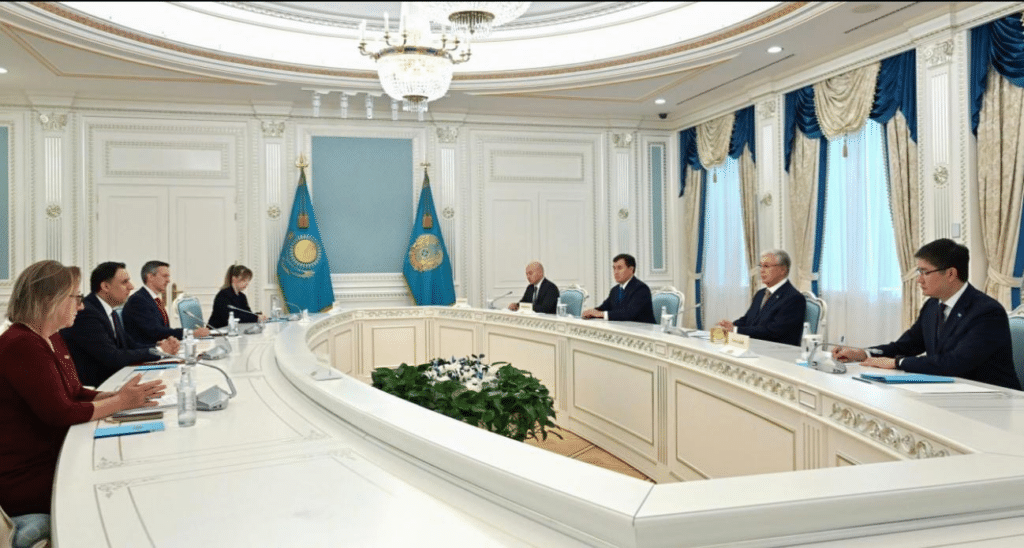
Energy Week opened at 10 a.m. sharp on Thursday, October 2nd. Beneath gold-and-jade ceilings, chandeliers clinging to them like stalactites, padded white leather chairs were lined up neatly on stage. They were filled by some of the oil industries leading lights; dark suits were de rigueur. Over lunch, a string quartet performed Gardel’s Por Una Cabeza, while the final evening saw delegates invited to see Verdi’s Rigoletto at Astana’s ostentatious opera house.
The format was carefully stage managed. Executives delivered their speeches like lecturers at a school assembly, with the audience listening politely. Questions from the floor were not invited.
There was a certain quiet bullishness amongst those present – the air of an industry that had been written off, but far from ready to concede relevance. Oil and gas continue to provide 35% of GDP and 75% of exports, despite talk of an energy transition.
“We expected a tailing off in demand on a global level, and this has not happened,” said Richard Howe, Executive Vice President of Shell’s Exploration and Production division during a panel of energy executives.
Beside him, Askhat Khassenov, Chairman of the Board at KazMunayGas, was a little more smug – “It looks like oil and gas are going to be around for a lot longer than some had anticipated,” he said.
Nevertheless, regular attendees at Kazakhstan’s annual energy shindig noted that the event was notably quieter than in previous years. Russians were absent, and Europeans few and far between. Delegations from neighboring Central Asian and Middle Eastern states padded out the numbers, perhaps reflecting countries in a similar situation.
The audience skewed heavily male and middle-aged. While a side event titled “Women in Oil” took place in a nearby hall, the real worry was generational. Both Howe of Shell and Bakhodirjon Sidikov of Uzbekneftegas admitted that talent – or the lack of it – was their biggest challenge.
Concerns about the lack of top scientists have also been taken up at the highest level. “Today, 90% of university graduates have bachelor’s degrees. Meanwhile, the proportion of PhD holders is less than 1%,” President Kassym-Jomart Tokayev said earlier this week. “Therefore, it is necessary to increase the number of grants for doctoral studies, with preference given to technical specialties.”
If the message of Energy Week was that Kazakhstan’s present still runs on oil and gas, it was also clear the sector is worried about who will run it tomorrow.
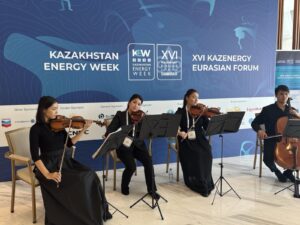
Image: Joe Luc Barnes, TCA
New Kazakhstan
For the future talent, you only had to drive a few minutes to the Expo Center, where Astana Digital Bridge was in full swing. If Energy Week was polished but staid, here the halls were packed with enthusiastic youth. Long queues snaked outside, the kind more often seen at rock concerts.
The language was different too. At Energy Week, everyone addressed one another as “colleagues” and “partners”. At Digital Bridge, it was simply “friends”.
The crowd responded accordingly, breaking into spontaneous applause during keynote speeches with local tech titans. They were motivational pitches to a generation that sees technology as the only real ladder of social mobility in Kazakhstan. At every panel the unspoken, aspirational message was “you can do this too”.
“The main thing is that being IT gives you a road to becoming independent,” said Tolkyn, an IT worker attending the event, told The Times of Central Asia. “It offers great opportunities for Kazakhs to work abroad, to earn good money and build an international career, and to support your parents. And all of this through honest work: in IT, your success is more or less a function of your hard work. Even if you have connections, if you’re not bright, you’re not going to get a job.”
Thousands of young Kazakhs crammed into sessions on fintech, artificial intelligence, cryptocurrency and venture capital.
On the exhibition floor, Sairan, a young salesperson for Crocus, a company developing a hotel management platform called ChekInn, explained his choice of career. “I work in tech marketing,” Sairan says enthusiastically, “I went into it because it’s well paid, plus I’m very sociable so it gives me the chance to meet people.”
Nearby, Aigerim, a medical student volunteering at the stand for Remind.ai, a start-up focused on detecting early signs of Alzheimer’s, took a broader view. “I believe in the power of tech to do good,” she said. “As a medical practitioner, I can help one person at a time, whereas technology helps me to scale up that ability.”
The government is keen to blow wind into these sails. “We have set ourselves a clear goal: Kazakhstan must become a truly digital country within three years,” Tokayev declared while opening Digital Bridge.
While developing its own digital infrastructure, including building its first supercomputer and announcing plans for one more, Astana has also positioned itself as a haven for Russian and other post-Soviet tech entrepreneurs seeking a new base since 2022. One blockbuster panel featured Timur Turlov and Arsen Tomsky, two Russian founders of Kazakhstani SuperApps Freedom Holding and InDrive appearing alongside local hero Mikhail Lomtadze, founder of Kaspi.kz, Kazakhstan’s biggest tech success story.
Even Pavel Durov, also of Russia and the founder of Telegram, met with Tokayev at the Akorda before taking part in one of the panels. Telegram has officially joined Astana Hub, opened an office in Kazakhstan, and launched the Alem.AI AI laboratory.

Image: Joe Luc Barnes, TCA
An Ambitious Tech Agenda
The big question is whether Kazakhstan can make the leap from hydrocarbons to high tech. Other petro-states have tried. Dubai, often invoked as the city that Astana would like to emulate, has recast itself as a global logistics and fintech hub. Kazakhstan appears to be trying to follow suit.
Some evidence suggests it could. Kaspi.kz has already expanded into Turkey through its purchase of a controlling share in e-commerce firm Hepsiburada, which now has 17 million users. Lomtadze also floated an ambition to rival Yandex, the ubiquitous taxi and delivery provider across the post-Soviet space. Turlov has spoken of pushing into the Tajik market and has openly asked the government to champion Kazakh digital firms abroad, particularly against Chinese competition.
But for all its elegance and finesse, the newest generation of technology, particularly AI, is also energy-hungry. And it is here that the two fora agendas may dovetail.
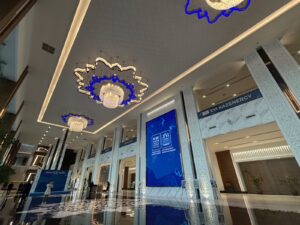
Image: Joe Luc Barnes, TCA
Two Astanas, One Future
Tokayev’s recent address to the National Council on Science and Technology, delivered days before both events, struck a stark tone. “The future of our country, its place among the world’s leading nations, depends on its implementation,” he said of the national drive toward digitalisation and AI. “Clearly, as digitalization and artificial intelligence develop, the country’s energy demand will grow rapidly,” he said. “Therefore, it is necessary to use energy sources efficiently.”
Tokayev evidently believes that the country cannot be underutilizing its massive energy capacities if it is to compete in the technologies of the future.
Last week he notably echoed Donald Trump in dismissing climate change as a “fraud” and praised Kazakhstan’s coal sector. “The U.S. president rightly said, ‘I don’t like wind, I like coal,’” he said. “Kazakhstan produces 113 million tons of coal annually … this is our asset.”
For a country already on the frontlines of desertification and water stress, it was an uncomfortable message to square with international expectations, but it appears that the president sees the AI race as equally existential.
“We have no right to lag behind global progress in our development,” Tokayev said. “Ultimately, this is a question of Kazakhstan’s survival as an independent country.”
But the question is whether it can persuade its young people to persevere with the energy industry when the attractions are elsewhere.
“I never thought about working in the oil and gas industry,” said Tolkyn. “The money is great there – and I’m aware that people in Western Kazakhstan feel like they foot the bill for the lifestyles of people in Almaty and Astana, but I’d be uncomfortable living in a place with a lot of emissions and pollution. IT gives you flexibility, you can be part of any industry – in finance, in medicine, even in oil and gas!”