The proposed Power of Siberia 2 (PoS-2) pipeline from Russia to China has re-entered the headlines on the strength of a new memorandum between Gazprom and CNPC. Russia calls the memorandum “legally binding,” but China has avoided the phrase, because the only thing that is legally binding is an agreement to negotiate.
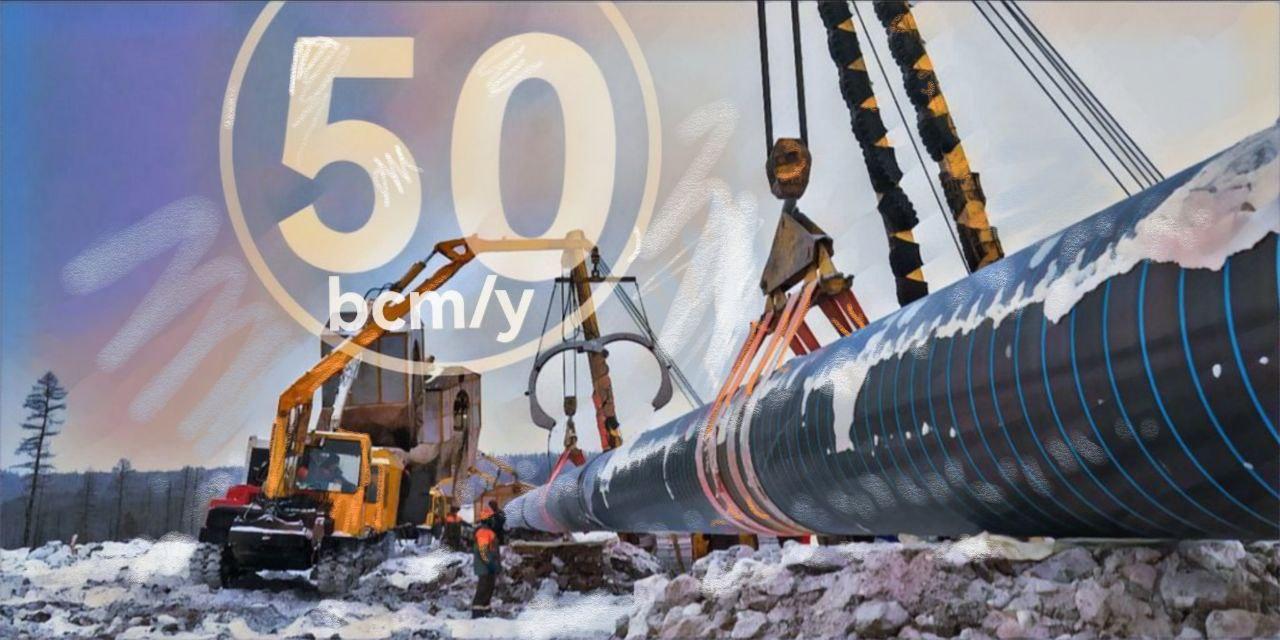
The memorandum affirms a design capacity up to 50 billion cubic meters per year (bcm/y), a route via Mongolia, and a total trunk length of roughly 2,600 kilometers (km) on the Russian side before crossing Mongolian territory. Feasibility work has highlighted a 1,420-millimeter (56-inch) pipe diameter, and an indicative cost cited in some trade reporting near $13–14 billion.
The political signaling is strong, but pricing terms remain unresolved. For Central Asia, the significance is immediate: even without a final sales contract, the expectation of future Russian volumes tightens China’s negotiating posture with Turkmenistan, Kazakhstan, and Uzbekistan, the three states already connected to China by the Central Asia–China Gas Pipeline (CAGP).
Central Asia’s Gas Supplies to China
China’s westbound import corridor from Central Asia consists today of three parallel pipelines that together provide a nominal capacity of 55 bcm/y (Lines “A” and “B” at 15 bcm/y each, and Line “C” at 25 bcm/y). Construction of the first two lines began in 2008, with operations starting in 2009–2010; Line C entered service in 2014. Line D, planned at 30 bcm/y through Uzbekistan–Tajikistan–Kyrgyzstan to China, has been delayed for years; if completed, it would raise corridor capacity toward 85 bcm/y.
Turkmenistan is the anchor supplier. The Oxford Institute for Energy Studies (OIES) estimates its deliveries to China at 32.9 bcm in 2022 (roughly 81% of the country’s gas exports that year), with long-term sales structured on formulas linked to the price of oil. Interfax reports that in the second quarter of 2025, the price for Turkmenistan’s gas fell below $290 per thousand cubic meters (mcm). This figure is consistent with oil-price linkage rather than hub-indexed European benchmarks. Recent industry and regional reporting puts Turkmenistan’s deliveries averaging approximately 35 bcm/y in the mid-2020s.
Kazakhstan had committed to supply up to 10 bcm/y, but domestic constraints have kept actual flows lower. S&P Global cites 4.4 bcm in 2022 and 5.86 bcm in 2023, with winter interruptions to protect domestic consumers; of the 29.8 bcm of commercial gas produced in 2023, 19.4 bcm was consumed at home.
Uzbekistan’s volumes have been more variable as Tashkent balances domestic demand, imports, and swap operations. Jamestown noted a fall in Uzbek gas export value to China from $1.07 billion in 2022 to $563.5 million in 2023, before a rebound in 2024 and 2025 according to Chinese customs-based press summaries.
PoS-2’s Route, Mongolian Gatekeeping, and Central Asian Implications
The geography of the route matters for Central Asia. On the Russian side, public summaries describe a corridor from Yamal via Urengoy through Krasnoyarsk and Irkutsk, then across Buryatia toward Kyakhta near the Mongolian border. In Mongolia, official communications stress underground installation across the steppes and local economic benefits, but final investment and ownership arrangements remain pending, and the project’s schedule still depends on a binding Russia–China gas sales agreement that has eluded negotiators for more than a decade.
A critical near-term reality is policy prioritization in Ulaanbaatar. In August 2024, multiple outlets reported that Mongolia omitted PoS-2/Soyuz Vostok from its National Development Plan through 2028, signaling caution. In 2025, Russian and Mongolian officials have emphasized progress on the environmental assessment and intergovernmental cooperation, but the earlier omission underscores the project’s non-inevitability.
Prospects for PoS-2 affect Central Asia in three ways. First, it provides a reference for competition: even without physical deliveries, a credible future Russian option of 50 bcm/y gives Beijing bargaining leeway in price talks with Turkmenistan, Kazakhstan, and Uzbekistan. Second, it enables Chinese portfolio hedging by providing a stabilizer against spot volatility in LNG procurement cycles. Third, the Mongolian gating window gives other suppliers leverage, as physical gas remains years away.
Geography and System Interaction
There would be significant system-level changes if PoS-2 were to proceed. First, the entry-point would shift, as would China’s reliance on the single Xinjiang entry for Central Asian gas. Second, a new corridor would increase China’s flexibility to arbitrage among LNG, PoS-1, PoS-2, and CAGP inflows. Third, Mongolian transit would decrease the relative strategic premium of Central Asian transit.
The hardest commercial issue for PoS-2 has always been price. Europe historically provided Russia with high profitability metrics on pipeline gas. China has resisted paying European-like prices for Siberian volumes, preferring oil-linked formulas. The latest memorandum trumpets route and capacity while avoiding a published price formula. Pricing remains unsettled: a core reason why PoS-2 has slipped repeatedly.
Yet China’s westbound pipeline system already gives Beijing physical optionality across three Central Asian suppliers, with Turkmenistan dominant by volume. The existing 55 bcm/y corridor, and the possibility of even a delayed Line D, would expand China’s portfolio negotiating space even before any Russian gas arrives via PoS-2.
Lessons for Central Asia
Central Asian gas diplomacy has usually been bilateral. A shift toward “managed oligopoly” involving coordinated production, synchronized maintenance, and aligned transit rules would change the arithmetic for Beijing. Even rudimentary steps could have an effect. The distant prospect of PoS-2 increases the penalty for disunity, because even the shadow of 50 bcm/y of Russian gas magnifies China’s walk-away option.
For Central Asia, this matters in two ways. First, every month without a Russia–China price is a month when Turkmenistan can stress proven delivery, Kazakhstan can sell seasonal firmness, and Uzbekistan can market reliability. Turkmenistan’s own contracts, linked to oil price, and the recent realized price under $290/mcm illustrate that Central Asian sellers already work within a pricing regime that fits Beijing’s preferences.
The bottom line for Central Asia is that their leverage resides not in hypothetical flows from Russia that lack a public price formula, but rather in what already flows and what Mongolia has not yet approved. The Central Asian governments can convert this reality into improved terms by emphasizing dependability, modest coordination, and credible optionality. Together, these tactics aggregate into a strategy that will determine whether PoS-2 functions as a long-term constraint on Central Asian gas diplomacy or as a short-term bargaining chip that Central Asia turns to its own advantage.