Over the past decade, global geopolitics has witnessed a clear return to Great Power competition, reviving elements of Cold War-style rivalry and a pronounced East-West divide.
Yet, contrary to the belief that international relations are defined exclusively by great powers, the countries of Central Asia, historically perceived as chess pieces between Moscow, Washington, and Beijing, have been exercising their own autonomy and asserting independent foreign policy paths. Kazakhstan, the region’s largest and most resilient economy, has arguably emerged as a leading example of this movement.
Through a careful balancing strategy, Kazakhstan has worked to avoid firmly aligning itself with any one geopolitical camp. Rather than choosing sides, it has chosen options. However, when pressure from one power arises, Astana’s response has rarely been resistance for its own sake, but rather negotiation and taking advantage of the opportunities that power can offer it. Essentially, if alignment is expected, it comes at a price. In this sense, great-power competition is treated less as an existential threat and more as a marketplace – one in which influence is traded. However, the question is, is there space for both Beijing and Washington?
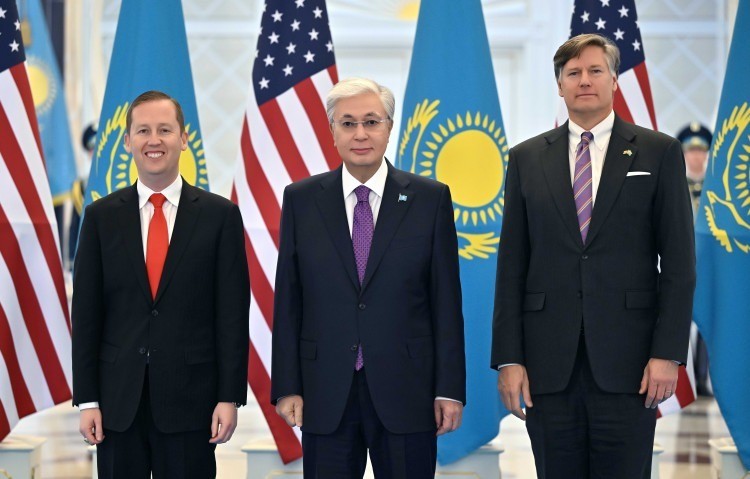
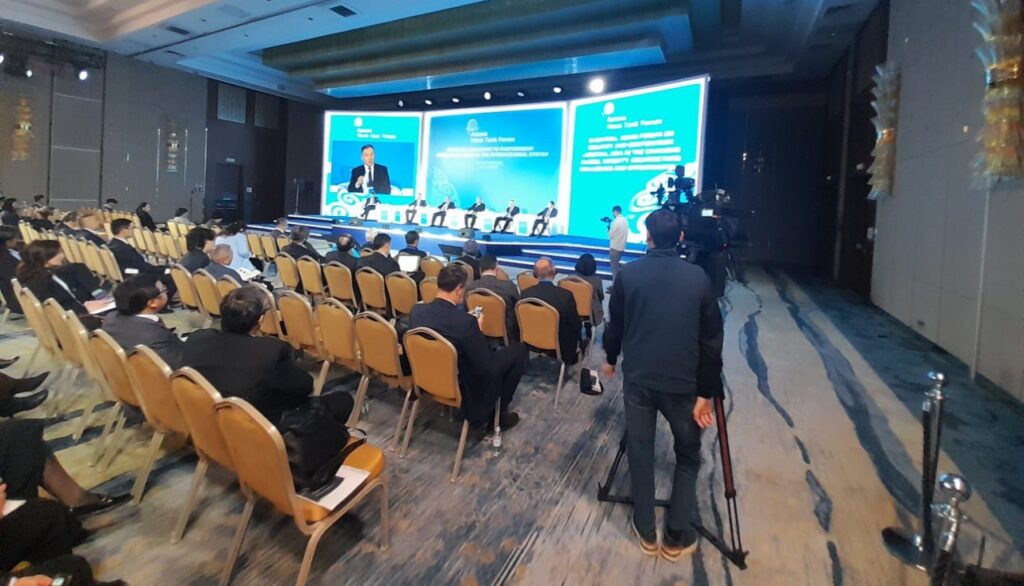
In this context, there is much to examine regarding last week’s B5+1 forum in Bishkek. Bringing together government officials and private sector representatives from Kazakhstan, Kyrgyzstan, Tajikistan, Turkmenistan, Uzbekistan, and the United States, the forum aimed to deepen economic ties and explore investment opportunities. Among the attendees was Sergio Gor, the U.S. Special Envoy for South and Central Asia. Perhaps the B5+1 forum is not just a routine investment event; it’s a signal from the U.S. to China.
A cornerstone of the cooperation between the U.S. and Kazakhstan was illustrated by the creation of a partnership in rare metals. The Ulba Metallurgical Plant (UMP) is located in north-eastern Kazakhstan. UMP is one of the very few facilities worldwide capable of carrying out the full processing cycle for rare metals. What elevates this cooperation beyond conventional trade is UMP’s production of materials such as beryllium and tantalum. These materials are critical inputs for the defense industry supplied to major aerospace and defense contractors, including Boeing and Lockheed Martin, both of which conduct business with the U.S. Department of Defense. Thus, Kazakhstan’s contribution to the U.S. defense supply chains signals a broader shift in regional geopolitics. By enabling access to strategically important resources that underpin advanced military technologies, Astana is strengthening its economic alignment with Washington, while subtly influencing the broader balance of defense capabilities between Western and Eastern powers.
Furthermore, another one of the headline-making deals at the B5+1 forum was the announcement of a joint venture between U.S.-based Cove Capital LLC and Kazakhstan’s National Mining Company to develop the world’s largest known undeveloped tungsten resource. This deal is significant against the backdrop of the ongoing tug-of-war between Beijing and Washington over strategic natural resources, and analysts note that the U.S. and China are already competing for Kazakhstan’s tungsten – another material crucial in the defence and microelectronics industries. China presently controls nearly 80% of the worldwide tungsten market, and a Chinese company has reportedly made an aggressive bid for the development rights to these deposits. Ultimately, U.S.-based Cove Kaz Capital’s successful bid hinged on two factors. Firstly, funding support from the U.S. Development Finance Corporation (DFC), which enabled them to equal the Chinese offer; and secondly, arguably more importantly, the American firm’s pledge to enhance tungsten processing capacity within Kazakhstan.
This deal underscores a dynamic often overlooked: while global powers may appear to dictate the trajectory of Central Asian development and geopolitics, the reality is that the competition between them creates leverage for countries like Kazakhstan. By strategically engaging with multiple powers, Kazakhstan can advance its own economic and strategic agenda, effectively turning great-power rivalry into a tool rather than a constraint. In this case, the country is not merely a passive actor in the greater East-West chess game; rather, it is spoilt for choice and thus has much more autonomy in deciding its economic future.
While the agenda covered a range of issues, transport infrastructure emerged as the most consequential and arguably the most sensitive topic. Connectivity lies at the core of Central Asia’s economic future, but it is also an area where geopolitical competition is visible. For example, the attendance of representatives from the American Rail Group and discussions regarding rail infrastructure projects in Kyrgyzstan signals American interest in regional transport development alongside existing and planned Chinese-led railway initiatives.
This raises a key question: is there room for a U.S.-backed alternative corridor alongside China’s Belt and Road? Perhaps there is – and perhaps this is precisely the point. As Beijing and Washington compete for influence through infrastructure and investment rivalry, Central Asian states find themselves in an advantageous position. By welcoming parallel initiatives, they are able to advance economically by diversifying partnerships and enhancing their strategic autonomy without having to overtly align with either side.
But what can be said about China’s reaction to more U.S. involvement in the region? It’s important to define and differentiate their approaches. For China, Central Asia is primarily a conduit for transport routes, access to critical materials, and strategic depth. On the other hand, the U.S. takes a different approach, viewing the region largely through a geopolitical lens and increasing influence.
However, the U.S. overtaking China will be difficult in the near future as China solidified its position in 2025 as Central Asia’s top trade partner, with overall turnover topping $106.3 billion, a 12 percent increase over the previous year’s total. Moreover, China doesn’t seem concerned, for now, as it is comfortable in its position in Central Asia; however, might there be a threat down the road? Only time and the aggression of U.S. involvement in Central Asia will tell. Beijing and Washington will continue advancing their geoeconomic and geopolitical strategies.