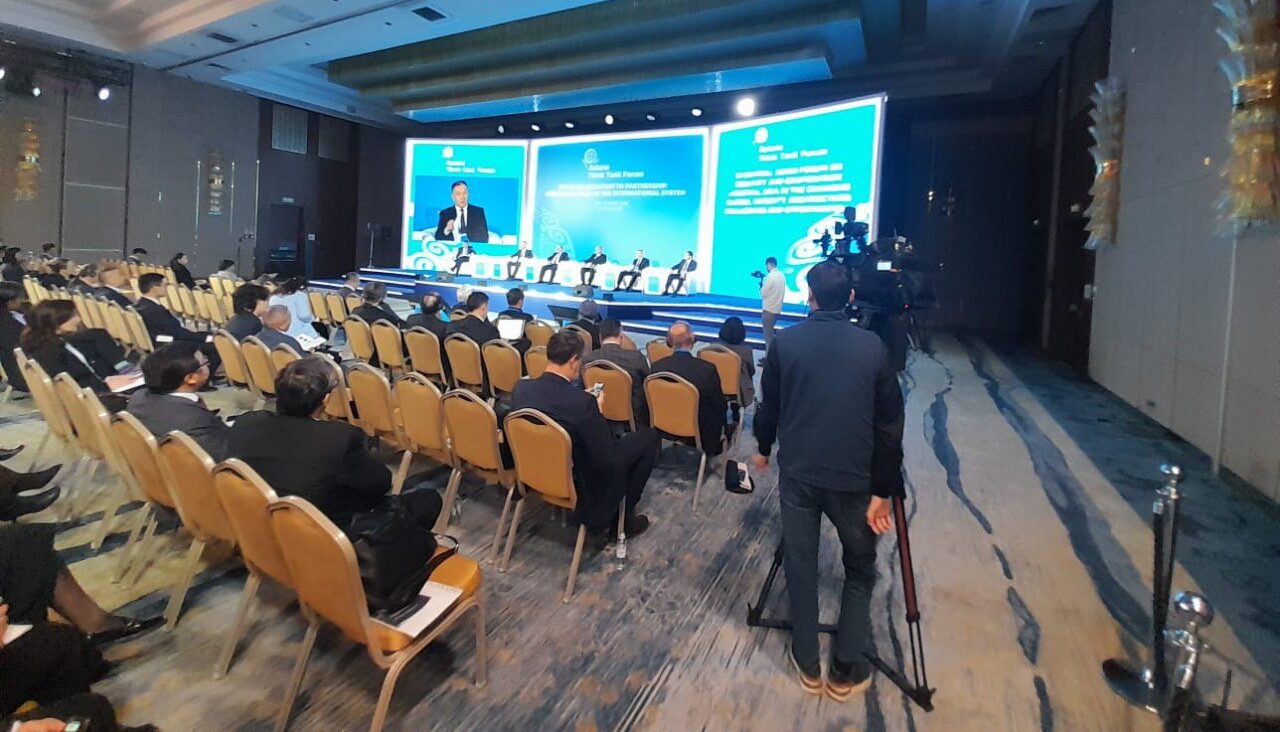
Zhandos Shaimardanov, director of the Kazakhstan Institute for Strategic Studies (KazISS) under the President of the Republic of Kazakhstan, has called for the formation of an international network of think tanks to act as an intellectual capacity for reforming the global governance architecture. He said the proposal stems from lessons learned in regional cooperation efforts across Central Asia.
Speaking at the session “Central Asia in the Changing Architecture of Global Security: Challenges and Opportunities” during the Astana Think Tank Forum 2025, Shaimardanov said the world is experiencing a period of geopolitical flux. The old global rules no longer function effectively, while new norms have yet to take shape.
“History is giving our region a chance to show leadership,” he said. “Central Asia is realizing its agency and unity, ready to formulate collective responses to global challenges and offer a positive agenda. Trust and mutual respect have made us resilient, and now this political capital must be transformed into institutional resources.”
Shaimardanov stressed that the existing global security architecture is in crisis, with mechanisms such as the UN Security Council and arms control frameworks losing effectiveness.
“In September, at the UN General Assembly, the President of Kazakhstan rightly observed that serious violations of international law have become the new norm. This is a sign that global institutions need intellectual renewal. When multilateral mechanisms fail, it is the regions that retain the potential for agreement,” he said.
From Regional Unity to Global Contribution
Shaimardanov recalled that at the sixth Consultative Meeting of the Heads of State of Central Asia, held in Astana last August, regional leaders adopted the “Central Asia 2040” concept, which sets out a long-term vision for cooperation across the region.
“Now is the time not just to implement this document without slogans,” he said, “but to present this regional experience to the broader world.”
He said that Central Asia’s cooperative model could help redefine the principles of global governance. As a bloc of “middle powers,” the region can offer a constructive and non-hegemonic voice.
“In this context, Kazakhstan proposes creating an expert alliance of middle powers, a global network of think tanks and institutions that could help rethink international systems,” Shaimardanov said.
He suggested that such a body could cooperate with international organizations, including the United Nations, to develop joint strategies on security, sustainable development, and institutional accountability.
“Central Asia can not only adapt to new realities but also offer new ideas that security can be built not on fear but on trust,” he said.
Focus Areas: Digital Trust, Water Security, Human Capital
Shaimardanov noted that an expert network would help Central Asian countries coordinate on key development challenges, including digitalization, water management, and innovation.
He highlighted the example of Kazakh startup Higgsfield AI, which recently achieved unicorn status with a valuation exceeding $1 billion. The company developed a generative AI tool that creates videos from text prompts.
“This is a major milestone not only for Kazakhstan but for the entire region,” he said. “It reflects Central Asia’s growing maturity in the global venture market and signals our capacity to produce competitive solutions.”
He said Kazakhstan aims to become a fully digital nation within three years, and a regional analytical network could support collaboration in this transition.
“Our region can pioneer new standards in digital trust and AI ethics. We must begin fostering a culture of digital trust where technology serves humanity,” Shaimardanov emphasized.
Noting that nearly half the region’s population is under 30, he added that youth are both consumers and creators of new technologies and will drive the knowledge economy.
“Our region is entering a new phase of maturity. We are united not only by common challenges but by shared solutions. If we integrate our efforts in science and digital technologies, Central Asia can become a model of how security is built through mutual development,” he said.
Shaimardanov also addressed water resource management, calling it a barometer of regional trust.
“Coordinated regulation of transboundary rivers strengthens regional stability. We propose building a network of research centers to model water management and forecast demand. This is critical for both policy and infrastructure planning, especially when proposals come from international institutions,” he said.
Expanding the Scope: Energy, Transport, Social Resilience
Forum participants echoed the proposal and suggested broadening the scope of the envisioned expert alliance.
Bakhtiyor Mustafayev, Deputy Director of the Institute for Strategic and Interregional Studies (ISRS) under the President of the Republic of Uzbekistan, stressed the importance of incorporating Afghanistan into regional stability strategies through education and investment.
“We need barrier-free trade and regional specialization. Each country has unique strengths. Solving these issues will foster stability across the region,” he said.
Khayriddin Usmonzoda, Director of the Center for Strategic Research (CSR) under the President of Tajikistan said the Kazakh initiative could support energy security, infrastructure development, natural resource management, and countering transnational threats like drug trafficking and extremism.
“There are already successful ecological initiatives, like the Aral Sea Rescue Fund. But we must seek new approaches rooted in peaceful coexistence. Central Asia has a strong basis for complementarity, not competition,” he said.
Batyr Rejepov, Turkmenistan’s Ambassador to Kazakhstan, reiterated his country’s support for international dialogue and proposed establishing an Institute of Neutrality and Security in Ashgabat. This center could serve as a platform for research on neutrality and preventive diplomacy.
“Turkmenistan supports consolidating international efforts to address global challenges through dialogue, to prevent conflict escalation,” he said.
Shumkarbek Adilbek uulu, Deputy Director of the National Institute for Strategic Initiatives (NISI) under the President of Kyrgyzstan, suggested conducting joint studies on social attitudes and readiness for innovation.
“Regional growth is currently driven by shifts in logistics and financial flows, a temporary phenomenon. We need sustainable development strategies. In 10-15 years, countries may face the middle-income trap and rising social demands. We must assess how prepared our societies are for the future,” he said.
KazISS Senior Research Fellow Sanat Kushkumbayev supported the initiative, noting the importance of aligning economic, foreign policy, and social agendas.