Discussions about Central Asia’s long-term strategic future are increasingly shifting from a focus on external attention to one of growing regional agency.
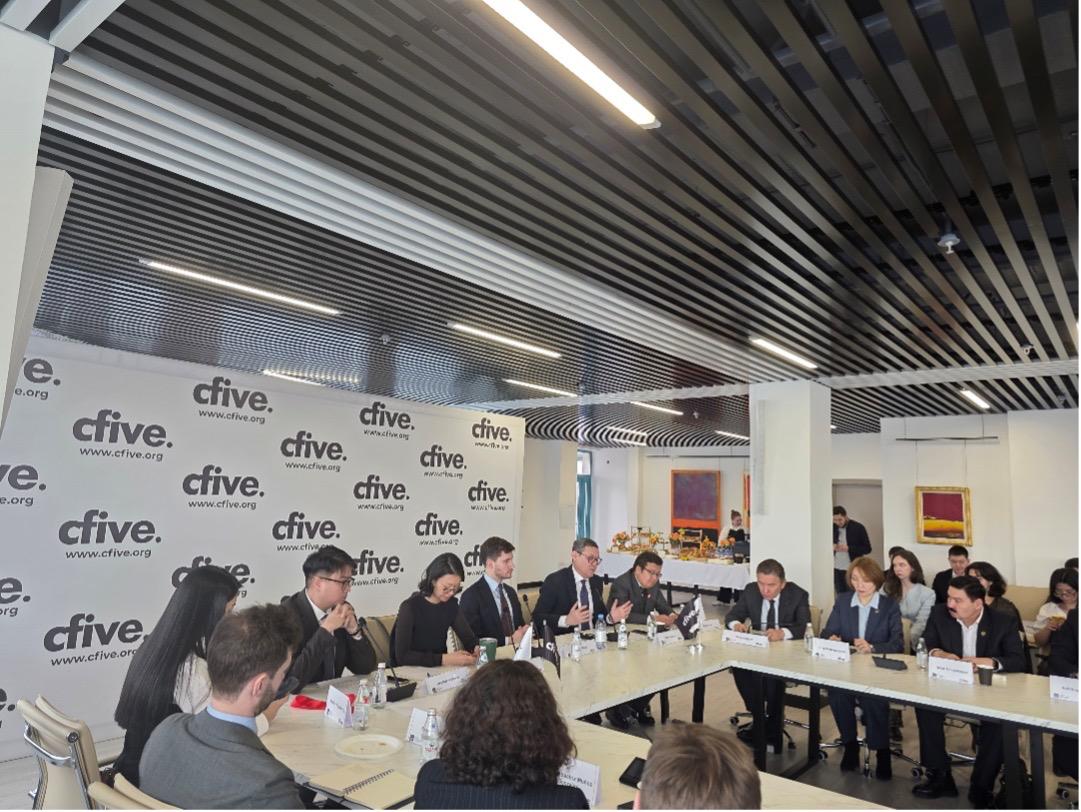
On Monday, Astana International University hosted the first roundtable in the series Central Asia 2030: Strategic Horizons and Regional Choices. Speakers included Andrew D’Anieri, Deputy Director of the Atlantic Council’s Eurasia Center; Yerkin Tukumov, Special Representative of the President of Kazakhstan; Ambassador-at-Large Zulfiya Suleimenova; and Dauren Aben, Deputy Director of the Kazakhstan Institute for Strategic Studies under the President of Kazakhstan.
Pragmatism, Regional Choice, and the Logic of the “Grand Bargain”
In his remarks, Andrew D’Anieri emphasized that Central Asia is increasingly viewed in the U.S. not as a peripheral zone but as an independent strategic partner.
He noted that “environmental, water, and climate issues considered within a regional framework are fully supported by the U.S.” However, he added that “long-term commercial and investment projects are impossible without long-term stability, which in turn requires coordination between neighbors, engagement on sensitive issues, and pragmatic regional cooperation.”
D’Anieri also pointed to Afghanistan as “an integral part of regional logic,” and described formats such as C5+1 as evidence of Central Asia’s growing subjectivity. He highlighted the first-ever C5+1 summit at the presidential level in Washington as a landmark event, especially under the administration of Donald Trump, known for its preference for bilateral over multilateral formats.
Trump and the Possibility of a Visit: Only with a “Big Deal”
When asked whether a visit by President Trump to Central Asia is realistic, D’Anieri offered a candid assessment: “Such a visit is only possible if there is a large, symbolically and economically significant deal.” Whether in aviation, technology, or infrastructure, these high-visibility projects are typically what draw Trump’s engagement.
He added that “the region has work to do in developing a package of initiatives that could interest the U.S. president and justify a high-level visit.” Potential areas include mining, transport, and logistics.
Reframing Afghanistan’s Role in the Region
Special Representative Yerkin Tukumov focused on the importance of reframing the region’s relationship with Afghanistan. For too long, he said, Afghanistan has been viewed primarily “through the prism of security threats,” resulting in a narrow and often misleading approach.
Tukumov argued for a broader, more pragmatic view that considers economic, humanitarian, and cross-border dimensions. He described the C5+1 format not as a replacement for bilateral diplomacy, but as “an additional level of coordination where Central Asia can speak with a more consolidated voice without losing national autonomy in foreign policy.”
He stressed the need to move beyond “ideological and declarative approaches,” toward practical, interest-based mechanisms of cooperation.
Ecology, Water, and the Case for a Global Water Agency
Ambassador-at-Large Zulfiya Suleimenova addressed the strategic urgency of regional coordination on water and climate. She emphasized that “water issues are transboundary in nature,” and that efforts to resolve them solely within national frameworks are bound to fall short.
“Regional coordination in Central Asia is not a political slogan, but a functional necessity,” she said. Suleimenova argued that jointly promoting initiatives in international forums “strengthens the region’s negotiating position, reduces mistrust, and increases legitimacy.” She described water as “not a factor of division, but a platform for cooperation.”
She also criticized the inefficiency of current global water governance mechanisms. “International formats are overloaded, poorly managed, and often fail to yield results, particularly in the water sector,” she said. In this context, she expressed support for President Kassym-Jomart Tokayev’s proposal to establish a dedicated UN water agency.
Regional Choice as Strategic Imperative
Throughout the roundtable, the theme of Regional Choices emerged as central. As Dauren Aben noted, “Central Asia remains a region of natural competition and differences in national interests.” Attempts to reduce it to integrationist or geopolitical binaries, he warned, oversimplify a far more complex reality.
Aben posed what he sees as the defining question: “To what extent are Central Asian states ready to define who they want to be by 2030 and what projects should shape their future?” Conscious coordination, he argued, is essential to resisting imposed external frameworks and maintaining control over internal agendas.
A Strategic Message from the Caspian Policy Center
A written message from Efgan Nifti, Director General of the Caspian Policy Center, was also presented. Though unable to attend, Nifti offered his perspective on the regional moment.
He described 2025 as “a year of alignment and strategic rapprochement in the Trans-Caspian region,” highlighting Kazakhstan, Azerbaijan, and Georgia as key pillars of the emerging Middle Corridor. These states, he argued, “possess unique tools to strengthen economic and logistical connectivity between Europe and Asia.”
Nifti also noted that the European Union stands to benefit significantly from the development of trans-Caspian routes, gaining more secure and diversified supply channels.
Toward 2030: From Reaction to Institution-Building
The roundtable demonstrated that Central Asia is increasingly moving beyond reactive politics. The region is beginning to see itself not as a subject of external agendas, but as a planner of its own future, one in which security, ecology, water, the economy, and diplomacy are part of a shared strategic framework.
The challenge now is to transform that agency into durable institutions and implementable projects by 2030.