Uzbekistan’s agricultural sector is once again in the spotlight following a recent report by Human Rights Watch and the Uzbek Forum for Human Rights, which raised concerns about the treatment of cotton and wheat farmers under what it describes as a coercive state production system. At the same time, local agricultural representatives argue that the situation is more complex and that recent legal and institutional changes have improved farmers’ ability to defend their rights.
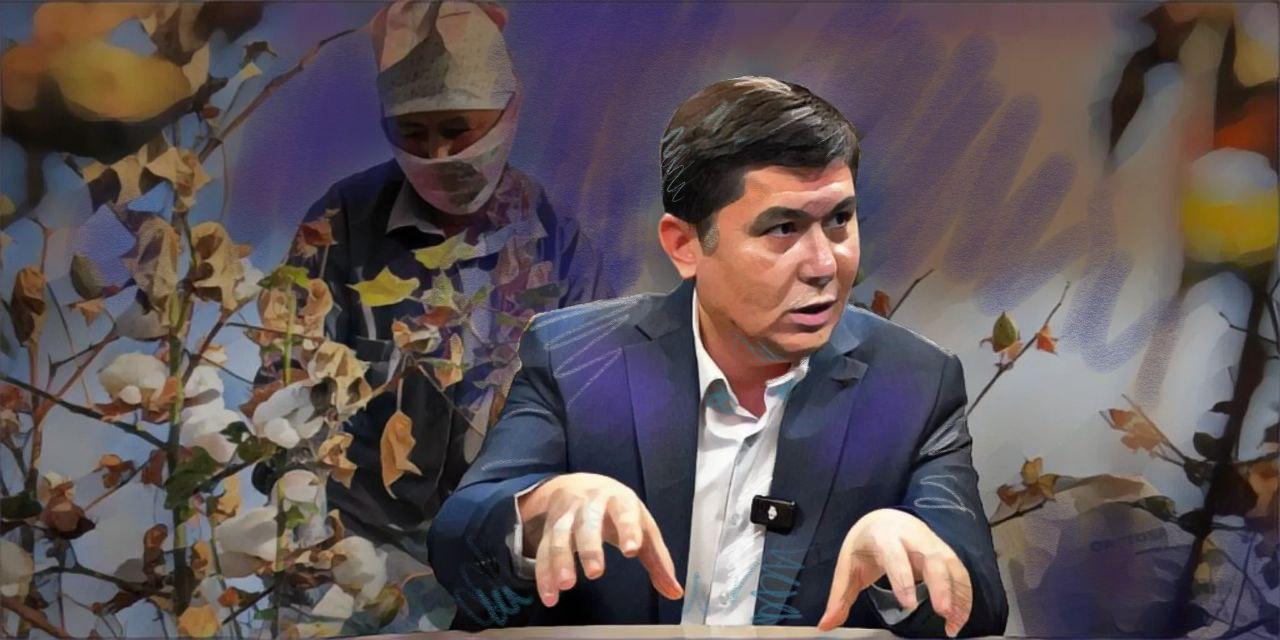
The debate intensified earlier this year after complaints from farmers in parts of the Syrdarya region, particularly in the Xovos district, regarding land seizures linked to failure to meet so-called “normative yield” requirements. Komoliddin Ikromov, head of the Agrobiznes Association, has been among the most vocal local figures commenting on these developments.
State Plan Abolished, but Normative Yields Remain
According to Ikromov, it is important to distinguish between the former state production plan and the current regulatory framework.
“There is no state plan now,” he said. “The state order was abolished in 2020. What exists today is the concept of rational land use. If a farm’s yield falls below the normative level for three consecutive years, then the land may be withdrawn, but only through a court decision.”
While cotton state procurement was abolished beginning with the 2020 harvest, reforms affecting wheat and grain procurement were phased in and linked to the 2021 harvest.
Ikromov referred to Article 36 of the Land Code, which sets out the procedure for termination of land-use rights where land is used irrationally or in violation of law. Detailed criteria — such as persistent underperformance relative to normative yield levels — are established in related regulatory acts rather than in the Land Code text itself.
“Under current legislation, the khokim (local governor) cannot independently seize land,” Ikromov said. “The case must be submitted to the court. Only a court can decide.”
Ikromov cited reforms adopted beginning in 2022 and subsequently strengthened by presidential measures in 2024, which expanded electronic auction procedures and curtailed direct administrative land allocation.
Complaints from Farmers
Beginning in January, the Agrobiznes Association started receiving complaints from farmers, mainly in Syrdarya.
“I personally received about 50 to 60 appeals,” Ikromov said. “In total, there were more than 100 messages, mostly through Telegram.”
According to him, many complaints concerned pressure to voluntarily surrender land leases through notarized statements. Farmers alleged that they were being encouraged or pressured to go to a notary and sign documents relinquishing their land.
“These were not isolated cases,” he said. “In some districts, it was widespread. But after the issue was raised publicly, the process shifted. Now cases are going through courts.”
Ikromov noted that unusual weather conditions contributed to the problem. Heatwaves and water shortages in 2024 made it difficult for some farmers to meet normative yield levels. In areas like Xovos, where soil fertility is relatively low, he said, agricultural production is already more challenging.
Legal Process and Court Outcomes
Following public attention, including Ikromov’s interview with the Uzbek outlet Kun.uz, land disputes increasingly moved into the judicial system. “Now everything is going through the courts,” he said. “Farmers have the opportunity to defend themselves.”
According to Ikromov, while some farmers may initially lose cases at district or regional levels, many achieve favorable outcomes at the Supreme Court level if they persist.
“If they can take the case to the Supreme Court, many find justice and get their land back,” Ikromov said.
He emphasized that land withdrawal without due process would be illegal and subject to cancellation. In cases where local officials acted beyond their authority, such decisions could be overturned.
Debt Burdens and Financial Risks
Land withdrawal can have serious financial consequences. Even if a lease is terminated, the farm entity remains legally responsible for its outstanding loans.
“The debt stays with the farm,” Ikromov explained. “If the farm cannot repay, then under subsidiary liability, the responsibility may fall on the farm head. If there are no assets, the farm can be declared bankrupt.”
He noted that many farmers may have significant debts, not only for crop production but also for investments in machinery, irrigation technologies, and equipment.
“These are not small sums. Some have debts amounting to billions of som,” he said.
Auctions and Foreign Investors
Another sensitive issue concerns land allocation to investors, including foreign companies. Recent regulations allow long-term lease rights, up to 25 years, to be granted through auction mechanisms, particularly where substantial investment is promised.
In January last year, the Senate of the Oliy Majlis (Uzbek Parliament) approved a draft new edition of the Law “On Investments and Investment Activities.” The updated legislation, consisting of six chapters and 37 articles, was developed with the participation of experts from the World Bank and the International Finance Corporation. According to officials, the law aims to align Uzbekistan’s investment framework with international standards, including those of UNCTAD and the World Trade Organization. Among the changes, additional guarantees for investors were introduced, including the extension of land use rights for foreign investors from 25 to 49 years.
Ikromov expressed concern that land parcels offered as single auction lots can be very large, in some cases reaching 1,000 hectares.
“Not every local farmer can pay nine (about $740,000) or ten billion som (about $820,000) at once,” he said. “There is a 15% advance payment requirement, and the rest must be paid within 15 days.”
Ikromov argued that breaking large lots into smaller parcels could give domestic farmers more opportunities to participate. At the same time, he acknowledged that the rules now require auctions, replacing earlier tender-based systems that sometimes led to unrealistic pricing and repayment problems.
Asked about regional practice, Ikromov said Kazakhstan and Kyrgyzstan have also tightened rules on direct long-term leasing of state land to foreign entities. “In many cases there, investors lease from private farmers rather than directly from the state,” he said.
He added that public debates in Kazakhstan in 2016 over land reform demonstrated the political sensitivity of the issue across Central Asia.
Human Rights Report
In their joint 85-page report titled “Farmers Have No Freedom,” Human Rights Watch and the Uzbek Forum for Human Rights argue that Uzbekistan’s remaining system of strategic crop cultivation continues to create risks of coercion. Based on interviews with 75 farmers across six regions and Karakalpakstan, the report describes mandatory quotas, risks of land seizure, delayed payments by clusters, and limited judicial redress in some cases. The government, in correspondence cited by the groups, rejected many of the findings and pointed to legislative reforms designed to strengthen farmers’ rights.
Signs of Improvement
Ikromov maintains that while problems exist, the overall situation has improved compared to previous years.
“80-85% of farmers are earning a good income,” he said. “Those who face problems are the ones who contact us. Farmers who are doing well do not usually write.”
He pointed to the growth of agricultural cooperatives as one alternative model. According to Ikromov, 285 cooperatives have been formed, uniting small groups of farmers and covering 60,000 to 70,000 hectares of land.
“These cooperatives are working independently and making good profits,” he said. “They receive subsidies and, if they finance production with their own funds, they can receive an additional 10% support on cotton and wheat sales.”
Subsidies are also available for drip irrigation systems, preferential loans, and other modernization measures.
Shoira Shamatova, head of a farm in the Syrdarya region, said she started farming from scratch without equipment.
“I began with nothing. No machinery. If I asked someone, they would not give it,” she said. “But I invested in myself and acquired all the equipment. There are many opportunities in farming if you use them correctly, leasing, preferential loans, subsidies for new irrigation technologies, freedom to contract with clusters, subsidies for products like cotton.”
Presidential Focus on Modernization
On February 23, President Shavkat Mirziyoyev reviewed a presentation on expanding agricultural mechanization and digital technologies.
In recent years, 1,756 cotton harvesters have been purchased, raising the mechanization level of cotton harvesting to 52%. During the last season, 2.1 million tons of cotton were harvested by machine. As a result, the use of manual labor has reportedly declined by roughly 45% over the past five years.
The authorities aim to increase machine harvesting to at least 70%. In 2026, plans call for the purchase of 800 additional cotton harvesters and 6,000 seeders, tractors, and combines. Overall, 10,000 new pieces of agricultural machinery are expected to be acquired during the year, bringing the national machinery fleet to 292,000 units.
To finance this expansion, $400 million in financing will be secured from international financial institutions. Equipment will be leased to farmers in the national currency for ten years at 18% interest, with a two-year grace period. Eight percentage points of the interest rate will be subsidized from the state budget.
Local production is also set to increase. Between 2026 and 2028, domestic output of agricultural machinery and aggregates is planned to grow fivefold, with localization levels rising to 30-35% for self-propelled machinery and 60–65% for mounted and trailed equipment.
Use of the Law as a Tool
For Ikromov, the key issue is not only legislation but its practical application.
“The laws are there,” he said. “Using them is in our hands. If you have a tool but do not use it, it gathers dust.”
Ikromov advises farmers to pursue disputes through legal channels, hire qualified lawyers where necessary, and avoid giving up prematurely.
“Do not fall into despair. Fight legally. There is a rule of law, we see it working,” he said.
Since the initial wave of complaints and public discussion, he noted that cases are now proceeding formally through courts rather than through informal pressure.
Ikromov emphasized that the situation should not be seen as systemic or representative of the entire country.
“This situation is not critical and does not apply to all regions of Uzbekistan,” he said. “It is not being repeated everywhere. When such cases arise, the government responds relatively quickly.”
In his view, the overall trend is toward gradual improvement.
“Based on these concerns, the government is also developing and refining the necessary laws and regulations,” Ikromov said.