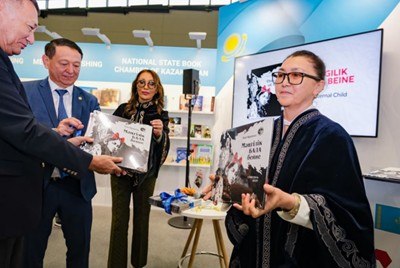
The story of a girl from the Kazakh village of Karaul whose life was shaped by Soviet nuclear testing has reached one of the world’s largest book events. Roza Mukanova’s The Angel of Karaul was presented at the Frankfurt Book Fair, held from October 7 to 11. Originally written in Kazakh as Mäñgilik Bala Beine (The Eternal Child), the work has been reissued in Kazakh and English by publisher Arman-PV.
The launch comes in the year marking the 35th anniversary of the closure of the Semipalatinsk nuclear test site, which was officially shut down on August 29, 1991. Between 1949 and 1989, 456 nuclear tests were conducted there, affecting human health and the environment. For residents of nearby communities, that history did not end when the explosions stopped.
This is precisely what Mukanova’s work explores. Its protagonist, Leyla, lives in the village of Karaul, near the former test site. The consequences of nuclear testing have shaped her fate: although she is a young woman, she has the appearance of a child. Rejected and misunderstood by those around her, Leyla seeks compassion but often finds comfort only in conversations with the Moon, which she associates with her deceased mother.
Through Leyla’s story, the writer portrays the tragedy of those whose lives were altered by the Soviet nuclear program. The protagonist’s loneliness and her desire to be accepted and loved turn the history of Semipalatinsk into a conversation about human dignity and society’s responsibility toward its most vulnerable members.
Mukanova attended the presentation at Kazakhstan’s national stand, where the new edition was introduced to international publishers and readers.
One of Kazakhstan’s best-known contemporary writers, Mukanova is an Honored Worker of Kazakhstan and a recipient of the Abai State Prize and the Alash International Literary Prize. Her writing frequently explores complex human relationships, women’s lives, and moral conflicts, themes that are central to The Angel of Karaul.
Mukanova’s story has long been familiar to audiences in Kazakhstan, where it has been adapted for the stage and continues to appear in theater repertoires. Astana’s State Puppet Theater is among the venues to have staged the work, using Leyla’s relationship with the Moon to explore her isolation and longing for acceptance.
The new Arman-PV edition offers a different way to experience the work. Presented in a book-as-performance format, it draws on the story’s theatrical history while bringing it to English-speaking readers.
Leyla’s story is particularly resonant in this anniversary year marking the closure of the test site. The last nuclear test at Semipalatinsk took place in 1989, but the environmental and humanitarian consequences of decades of explosions continue to be studied. In 2009, the United Nations General Assembly designated August 29 as the International Day against Nuclear Tests.
For international readers, The Angel of Karaul offers an opportunity to see this history through the eyes of someone whose life was changed by events beyond her control. Thirty-five years after the closure of the test site, Leyla continues to pose a question addressed not only to Kazakhstan: how does one live with the consequences of a catastrophe when, for the rest of the world, it has long since become history?