U.S. President Donald Trump has expressed an interest in visiting Uzbekistan, according to one of his special envoys, raising the possibility that Central Asia could eventually receive its first visit by a sitting American president.
Paolo Zampolli, Trump’s Special Envoy for Global Partnerships and long-time Trump associate, made the comment in an interview with Uzbekistan 24 while visiting the country. “I know that he wants to come to Uzbekistan,” Zampolli said, adding that Trump had personally told him he wanted to make the trip. Zampolli said he was encouraging the idea, but gave no timetable, and there has been no announcement that a visit is being scheduled.
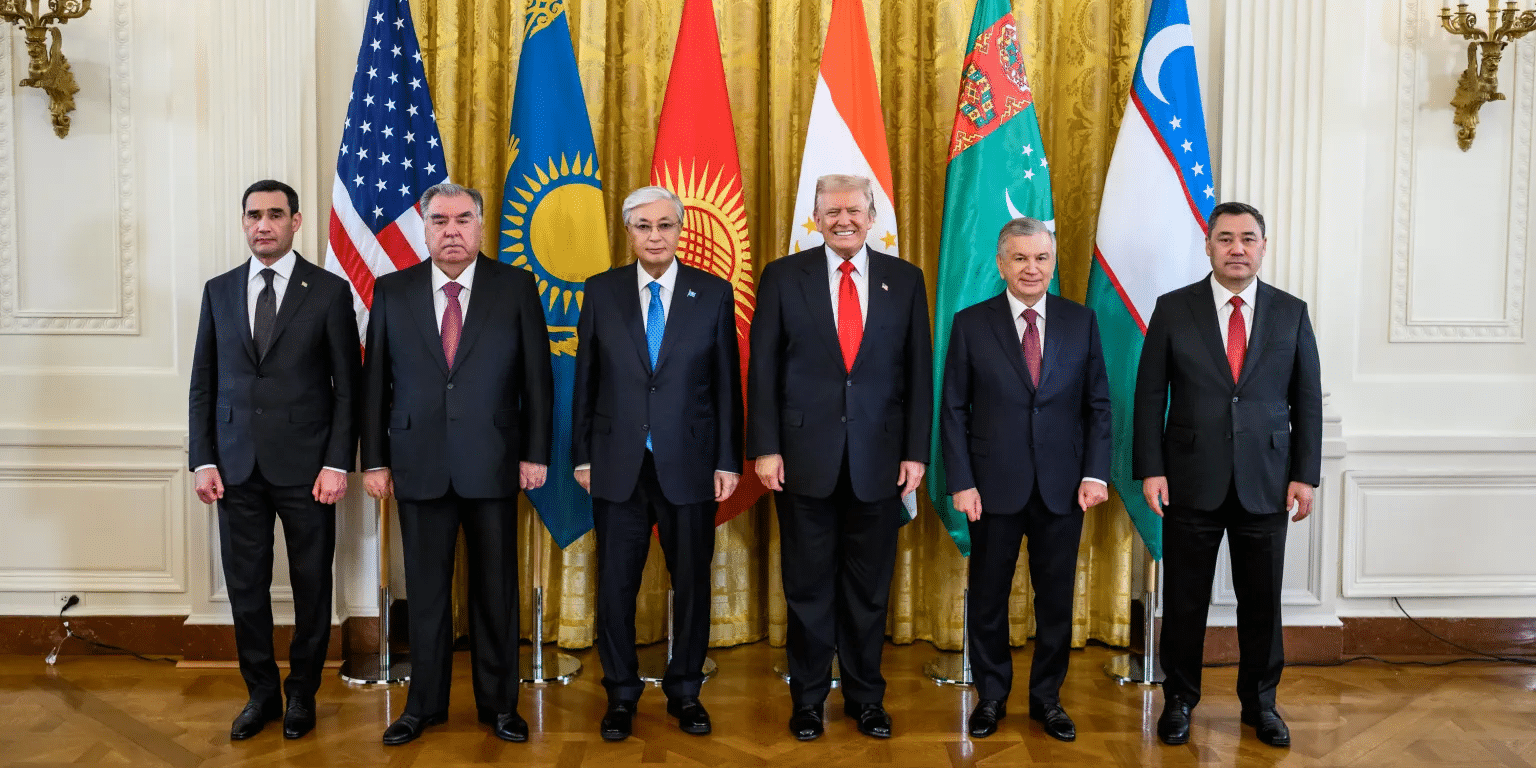
Trump had already publicly indicated that he may visit Kazakhstan. Asked during the November 2025 C5+1 summit if he might become the first U.S. president to visit the country, Trump replied, “I think it’s very possible that we’ll do that.”
The comments come as U.S. engagement with Central Asia is accelerating. Trump hosted all five Central Asian presidents at the White House in November 2025. Kazakh President Kassym-Jomart Tokayev has invited him to Kazakhstan, while Uzbek President Shavkat Mirziyoyev has also invited him to Uzbekistan. Meanwhile, Secretary of State Marco Rubio is reported to be planning a mid-October visit to Samarkand for a C5+1 ministerial, with a delegation expected to include representatives of more than 100 U.S. companies.
Sergio Gor, Trump’s Special Envoy for South and Central Asia, has also been involved in Washington’s engagement across the region. In Uzbekistan, he co-chairs the American-Uzbek Business and Investment Council with Saida Mirziyoyeva, head of the presidential administration.
Kazakhstan and Uzbekistan bring different economic and strategic profiles to Washington’s expanding engagement with Central Asia.
Why Kazakhstan Matters
Kazakhstan is Central Asia’s largest economy. Its GDP reached about $306 billion in 2025, accounting for more than half of the combined economy of the five Central Asian states. Its share of accumulated foreign investment is even larger, with Kazakhstan holding roughly two-thirds of the region’s inward FDI stock, according to The Times of Central Asia’s Central Asia Balance Sheet.
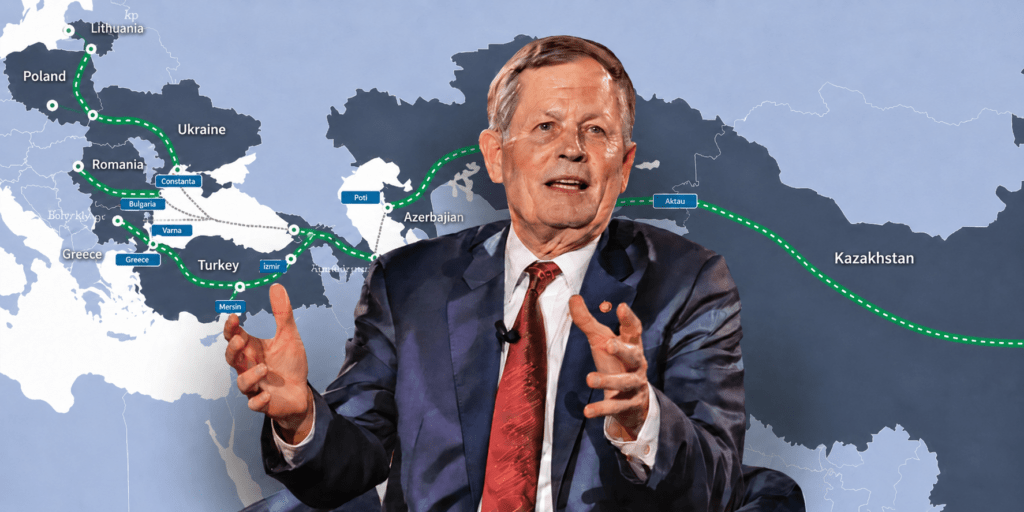
Its strategic importance extends beyond those measures. Kazakhstan produces close to 40% of the world’s uranium and is a major oil producer and exporter, supplying primarily European markets. It also holds substantial critical mineral resources and occupies a central position on the Middle Corridor connecting China and Europe.
Recent U.S.-Kazakh commercial agreements include several large transactions. Wabtec has a $4.2 billion locomotive agreement, while Tau-Ken Samruk and Cove Capital have signed transaction documents for at least $1.1 billion in tungsten development. Other agreements cover agricultural machinery, air-traffic management, and additional Boeing aircraft.
Kazakhstan also has a distinct diplomatic role in Trump’s engagement with the Muslim world. In November 2025, Kazakhstan joined the Abraham Accords, becoming the first Central Asian and first non-Arab Muslim-majority country to join the framework.
Why Uzbekistan Matters
With about 39 million people, Uzbekistan is the most populous country in Central Asia. It is also the only state that borders all four of the other Central Asian republics, as well as Afghanistan, giving it a uniquely central geographic position.
Uzbekistan’s economic relationship with Washington is also expanding. Cooperation and projects announced since 2025 span critical minerals, artificial intelligence, agriculture and industrial projects, with projects at different stages of development. Uzbekistan Airways has ordered 22 Boeing 787-9s in a package valued by the U.S. government at about $8.5 billion, with deliveries to take place over several years.
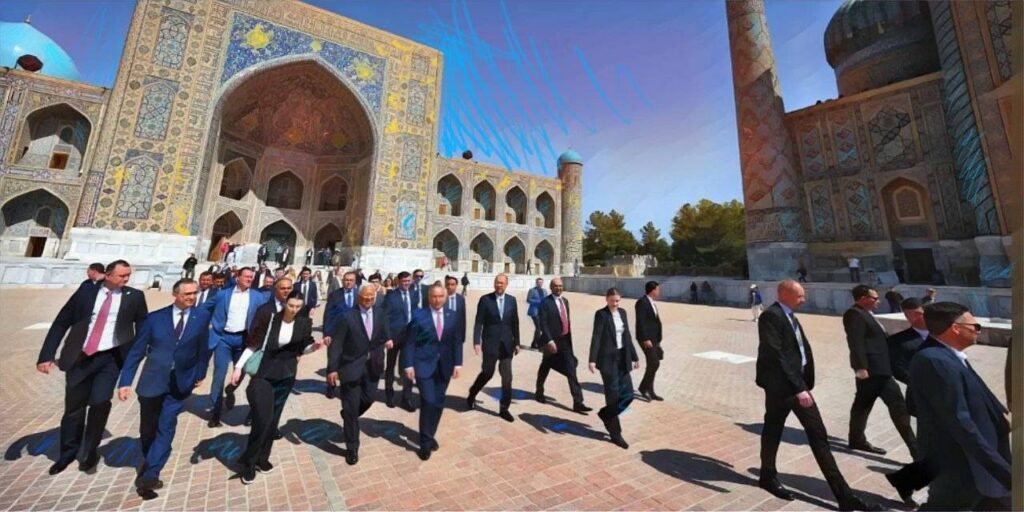
There is also a powerful Islamic historical dimension. Samarkand and Bukhara were among the great cities of the Muslim world, flourishing when Muslim empires were among the world’s leading centers of scholarship, commerce, and political and military power. Bukhara became one of Islam’s great centers of religious learning, while both cities formed part of a wider Persianate Islamic civilization stretching into Iran and across Central Asia.
Samarkand later became the capital of Timur’s empire and one of the Islamic world’s great architectural and cultural centers, while Tashkent is home to the Khast Imam complex and the celebrated Uthman Quran. A presidential visit involving any of these cities could therefore carry symbolism well beyond Central Asia, reflecting engagement with the wider Islamic world and its civilizational heritage.
Which Country Could Host the First Visit?
Kazakhstan and Uzbekistan offer a U.S. president different points of engagement with Central Asia. Kazakhstan brings the region’s largest economy, major energy and mineral resources, substantial accumulated U.S. investment, and an expanding role in transport and digital connectivity. Uzbekistan combines the region’s largest population, a central geographic position, and historic centers of Islamic civilization. Both are deepening their political and commercial ties with Washington.
Zampolli’s comments establish only that Trump has expressed a desire to visit Uzbekistan, not that a trip is being planned or when one might occur. Separately, Trump has said that a visit to Kazakhstan is “very possible,” and Tokayev has invited him. There is currently no announced presidential itinerary for either country, and nothing establishing that the two prospective visits are linked. Either could ultimately become the first visit by a sitting U.S. president to Central Asia.