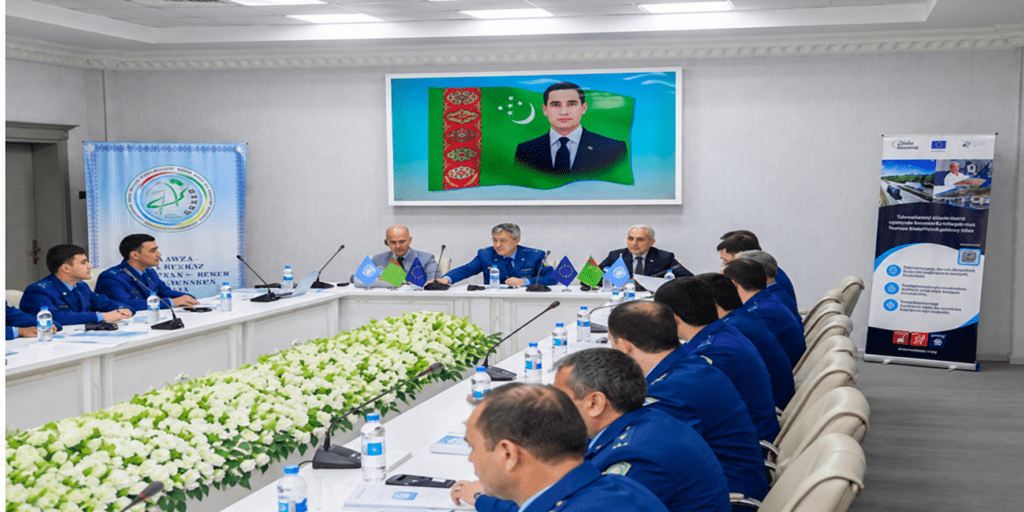
Astana hosted AI & Digital Bridge 2026 on October 1–3, and NVIDIA founder and CEO Jensen Huang is scheduled to visit the capital on October 23 for a fireside chat with Zhaslan Madiyev, Kazakhstan’s Deputy Prime Minister and Minister of Artificial Intelligence and Digital Development.
Speaking to The Times of Central Asia earlier this month, Madiyev described a strategy that goes beyond building data centers. Kazakhstan’s digital development builds on capabilities it already has (a mature digital-government system, an established energy and industrial base, cross-border fiber and data-transit infrastructure, and a growing technology sector) to move beyond carrying data and exporting raw materials toward processing more data and producing more technology at home.
The push aligns with President Kassym-Jomart Tokayev’s call for Kazakhstan to become a fully digital nation, with artificial intelligence (AI) integrated across the economy.
Digital Services and Startup Growth
Madiyev began with what Kazakhstan already does, describing the country as known for advanced government technology, or GovTech. He cited Kazakhstan’s 24th-place ranking in the United Nations E-Government Development Index. More than 90% of public services are available online, around 90% of transactions are cashless, and approximately 40 personal documents have been digitized, he said. Digital documents have the same legal standing as physical ones, allowing people to use their phones when traveling, visiting banks, or accessing government services.
An important part of that development was opening the government’s digital platform to banks rather than keeping public services within a single government application. Banks including Kaspi, Halyk, and Freedom can integrate those services into platforms customers already use, helping expand adoption and making services easier to access.
Madiyev cited vehicle purchases and re-registration completed through an application in three to five minutes, mortgage approvals within a day, and a digital process that helps mothers register newborns and receive eligible benefits directly into their bank accounts. The aim is to organize services around people’s life events, with one completed process triggering the next rather than requiring separate applications to different institutions.
He also pointed to Astana Hub, which has more than 2,500 registered startups and information technology (IT) companies exporting services to more than 100 countries. Its network extends across Kazakhstan and into Silicon Valley, Shanghai, and Dubai, with further expansion planned in Southeast Asia and Europe. Those overseas locations provide working space, access to investors, and acceleration programs to help companies enter international markets.
A venture fund-of-funds, predominantly financed by the private sector and standing at approximately $115 million at the time of the interview, is intended to increase the financing available to regional startups. Madiyev said companies may need to raise capital six or seven times on the way to becoming unicorns, making access to successive funding rounds important.
Connectivity That Serves the Region
Kazakhstan already carries international traffic. Kazakhtelecom’s 2024 annual report records 200 gigabits per second (Gbps) of Europe–Uzbekistan transit capacity and 100 Gbps on the Europe–Kyrgyzstan route, while the Internet Society rates Kazakhstan’s upstream connection diversity as “Very Good.”
Kazakhstan’s international internet capacity stood at about 11.1 terabits per second (Tbps) in 2024, providing an existing base before the new routes come online. The Internet Society’s study of Kazakhstan’s internet infrastructure estimates 17 cross-border fiber-optic connection points with Russia, two with China, three with Kyrgyzstan, two with Uzbekistan, and one with Turkmenistan. Kazakhtelecom has also reported establishing six 100 Gbps China–Russia transit channels with 1+1 redundancy in 2024.
Madiyev said the Trans-Caspian fiber-optic line will add capacity of up to 6 Tbps, while the West–East backbone running across Kazakhstan is designed for at least 12 Tbps. The latter is designed to carry transit traffic across the country rather than representing additional international bandwidth entering Kazakhstan. The ministry’s project description identifies it as an international and interregional data-transit backbone, with commissioning planned for the end of 2026.
These new routes will supplement infrastructure that already carries traffic, Madiyev said, adding capacity, diversification, and redundancy rather than replacing Kazakhstan’s existing international connections. At the time of the interview, he expected the Trans-Caspian project to launch in October.
Madiyev said the new connections could allow cloud and AI infrastructure hosted in Kazakhstan to serve nearly one billion people westward, including in Europe, with latency suitable for inference. Neighboring countries are already prepared to reserve capacity on the new cable, he said, although he did not identify them or quantify their prospective commitments.
The same infrastructure could also supply computing capacity to the region. In his view, companies and institutions in neighboring countries could access Kazakhstan’s AI infrastructure through cloud services, subject to the relevant compliance requirements. He saw a particular opportunity to serve countries that are not developing large-scale AI data-center hubs of their own.
Using OpenAI as a hypothetical example, he explained how placing computing resources in Kazakhstan could improve service for Central Asian users by reducing the distance signals travel between customers and the infrastructure processing their requests.
Kazakhstan also aims to connect more than 90% of villages by fiber within roughly a year and a half to two years, with satellite services covering the remainder.
He identified OneWeb and Starlink as licensed nationwide providers, with gateway stations in Kazakhstan that could also serve neighboring countries. Reaching a regulatory balance between Kazakhstan’s national-security requirements and SpaceX had taken almost a year, he said.
Kazakhstan has also signed an agreement with Amazon Leo, and Madiyev said he hoped service would begin in 2027 as satellite deployment progressed. He named Shanghai SpaceSail as another provider, pointing to the range of operators as evidence of strong competition in Kazakhstan’s satellite-connectivity market.
Computing Capacity Comes Online
Kazakhtelecom reported 23 data centers with more than 1,600 rack spaces in 2024, supporting cloud computing, storage, and other digital services. Its annual report also records the launch of caching servers for Microsoft, Cloudflare, and other platforms, bringing frequently accessed content closer to users.
On top of that existing data-center base, Kazakhstan has added high-performance AI computing capacity. Alem.Cloud and Kazakhtelecom’s AI-Farabium appear in the June 2026 TOP500 supercomputer list at 104th and 122nd, respectively. TOP500 records both systems as installed in 2025 and using NVIDIA H200 accelerators.
Madiyev said the two supercomputers give universities, government bodies, banks, and companies access to capacity they can use to build AI engines and multi-agent platforms, automate back-office functions, and train national or sovereign large language models. Hosting that work domestically supports digital sovereignty while giving Kazakhstan experience ahead of much larger projects now planned.
Building Gigawatt-Scale Computing Capacity
The largest planned expansion is at Data Center Valley in Ekibastuz, where the government has reported construction of an initial 50-megawatt (MW) facility and the acquisition of a 215 MW substation.
A separate package of agreements involving Kazakhstan, Firebird, and NVIDIA outlines $10 billion in planned investment. That announcement also describes 300 MW of available power capacity and phased expansion toward 1 gigawatt (GW). These are infrastructure and investment figures, rather than measures of computing capacity already operating.
Madiyev said the first 50 MW facility should become available in June 2027 and would probably operate as a Kazakhtelecom data center serving multiple tenants. Groundwork has begun on Firebird’s first phase of approximately 125 MW, which he expects to be completed in the third quarter of 2027, followed by another Firebird phase in 2028.
He expects Firebird to be one of several participants. Other demand is emerging as Kazakhstan develops gigawatt-scale computing capacity combining low-latency connectivity, competitively priced electricity, access to land, and a Data Embassy regime. A one-stop-shop process is intended to give investors access to those resources without navigating multiple layers of bureaucracy.
Potential customers include hyperscalers, major AI platforms, startups, and large industrial companies, using the infrastructure for both model training and inference. Madiyev said Kazakhstan has received United States Bureau of Industry and Security authorization covering 45,000 NVIDIA GB300 Blackwell Ultra graphics processing units (GPUs) and is applying for authorization for approximately 65,000 additional latest-generation GPUs.
His goal is to reach approximately 1 GW within two to three years and, in what he explicitly described as a very optimistic scenario, as much as 3 GW by 2030.
“They don’t want to wait for a year until you construct it,” Madiyev said of hyperscalers and major technology companies. “You just need to build infrastructure readily available.”
The Energy Equation
Madiyev described investment in electricity generation as essential to the AI strategy, with more than 13 GW of additional capacity planned by 2030 and an ambition to roughly double current installed capacity by 2035.
Data Center Valley’s initial electricity offer was about 2.5 U.S. cents per kilowatt-hour, he said, explaining that Kazakhstan needed an attractive starting price to bring major companies into the project. That rate would gradually move closer to market terms as the cluster grows to hundreds of megawatts and eventually gigawatt scale.
Madiyev argued that Kazakhstan would remain competitive even after that adjustment, putting domestic grid electricity below 10 U.S. cents per kilowatt-hour. He compared that with approximately 10–12 cents in Virginia and more than 20 euro cents in Europe, adding that the Virginia figure was continuing to rise. The comparison is significant because Northern Virginia is the world’s largest data-center market.
He also cautioned against treating cheap power as the sole investment criterion, estimating electricity at around 10% of an operator’s overall costs. Operators also consider connectivity, regulation, and whether infrastructure is ready when they need it. Madiyev argued that Kazakhstan is competitive on those factors as well, pointing to its expanding cross-border connectivity, Data Embassy and cloud-policy framework, and the effort to have land, power, and computing infrastructure available in advance.
For longer-term supply, Madiyev pointed to coal resources that he said could last more than 200 years. He also cited solar, wind, and hydropower projects, alongside plans for nuclear generation, as part of the additional energy supply Kazakhstan expects to bring online. He argued that this combination provides a basis for medium- to long-term energy security.
Cooling could provide another advantage. Ekibastuz has an average annual temperature of about 3.9°C, or 39°F, based on 1991–2020 climate normals, with monthly mean temperatures below freezing through much of the winter. Those conditions can reduce the amount of mechanical cooling required for data centers during colder periods. Madiyev noted that cooling represents a substantial energy cost.
Attracting Global Technology
Kazakhstan is working with NVIDIA and is in discussions with major hyperscalers and technology companies, Madiyev said. The government is also assessing potential offtake commitments to purchase computing services and identifying companies that could become tenants of the new infrastructure.
Kazakhstan is close to approving cloud-first and data-classification policies, which he expects will make the country more attractive to hyperscalers.
He also pointed to the Data Embassy regime, under which internationally recognized regulation could be applied on Kazakhstan’s territory. The government’s description of the proposed framework envisages foreign states hosting data in Kazakhstan while retaining legal sovereignty over it.
Industrial Data and Critical Minerals
Madiyev said Kazakhstan’s factories, mines, and other heavy industries generate operational data that could support the development of specialized AI models and applications. The aim is to develop this opportunity through partnerships with local enterprises, with appropriate safeguards for data use and a focus on building expertise in Kazakhstan.
Separately, in December 2025, Kazakhmys announced cooperation with Freedom Cloud that included plans for a pilot using AI and predictive analytics to monitor equipment and prevent downtime.
He also linked the technology strategy to critical minerals. In his view, Kazakhstan should avoid repeating a model centered on raw-material exports and instead work with other countries and corporations to develop more processing and manufacturing inside the country.
Madiyev cited Kazakhstan’s uranium production, which he put at approximately 40% of the global market, alongside resources including beryllium, tantalum, niobium, tungsten, gallium, and germanium. Those materials, he said, could give Kazakhstan a larger role in supply chains for batteries, chips, and semiconductors.
“We need to focus on how to move from upstream to midstream at least,” Madiyev said. That would mean building new refineries and industrial facilities rather than relying primarily on the export of raw resources.
Talent and “New Higgsfields”
Madiyev said Kazakhstan is also building the talent base needed for the application layer of its five-part AI strategy. In his model, the country needs people capable of building products and businesses on top of its energy, chips, cloud infrastructure, models, and data.
He highlighted Alatau City, the new city being developed near Almaty, alongside plans for an IT hub that would bring together local and international technology talent in Kazakhstan. The aim is to build technology communities that create highly skilled jobs and develop products for global markets.
He wants to see “new Higgsfields” created in Kazakhstan. By that, he was referring to Higgsfield AI, the fast-growing generative-AI video and image company with Kazakh roots, as the kind of internationally successful AI business Kazakhstan wants to reproduce.
Toward a New Economy
In Madiyev’s account, Kazakhstan’s AI strategy starts with energy and computing infrastructure, then builds upward through chips, cloud services, and large language models to the applications and talent that use them.
He calls the economic model built around that infrastructure an “AI token economy,” in which Kazakhstan converts energy resources into computing output used by AI systems. “AI tokens will be the new currency,” he said, describing them as “a currency for intelligence.”
He placed tokenization and crypto, space technology, local and international technology talent, and critical-mineral processing within the same “new economy.” During the interview, he also described satellite manufacturing and exports, a growing regulatory framework for digital assets, and new refining and industrial capacity.
“This is the new economy that we have to use in order to diversify from oil and gas,” Madiyev said.
For Madiyev, carrying data across Eurasia is only one part of the model. Kazakhstan is already processing more data at home and building the computing, industrial, and talent base around it.