In a legend retold by Kyrgyz writer Chingiz Aitmatov, a mankurt is incarcerated and is forced to forget his name, his origins, and even his mother, becoming an obedient slave to his captors. When his mother comes to find him, he kills her on his master’s orders, unable to recognize her. The mankurt has become a symbol of cultural amnesia and the loss of identity through the severing of ties to one’s past.
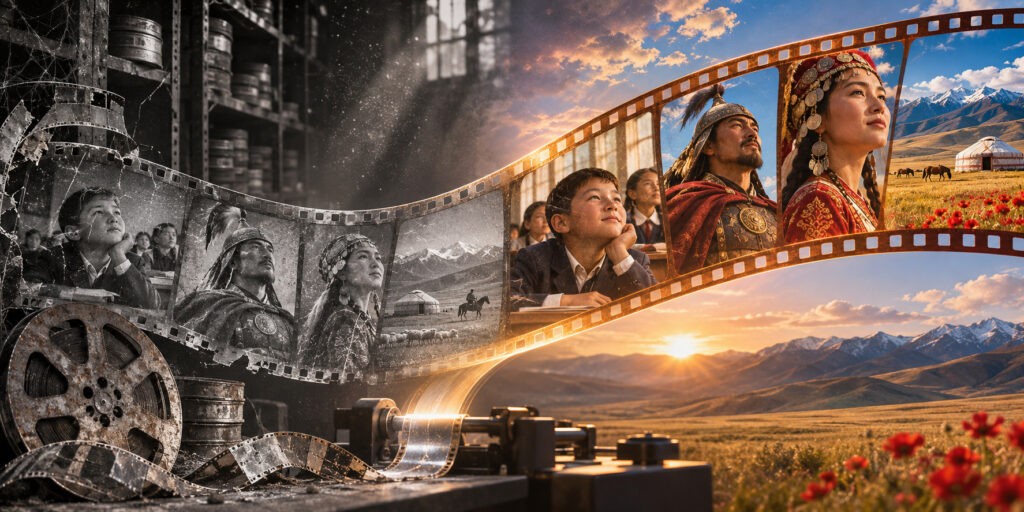
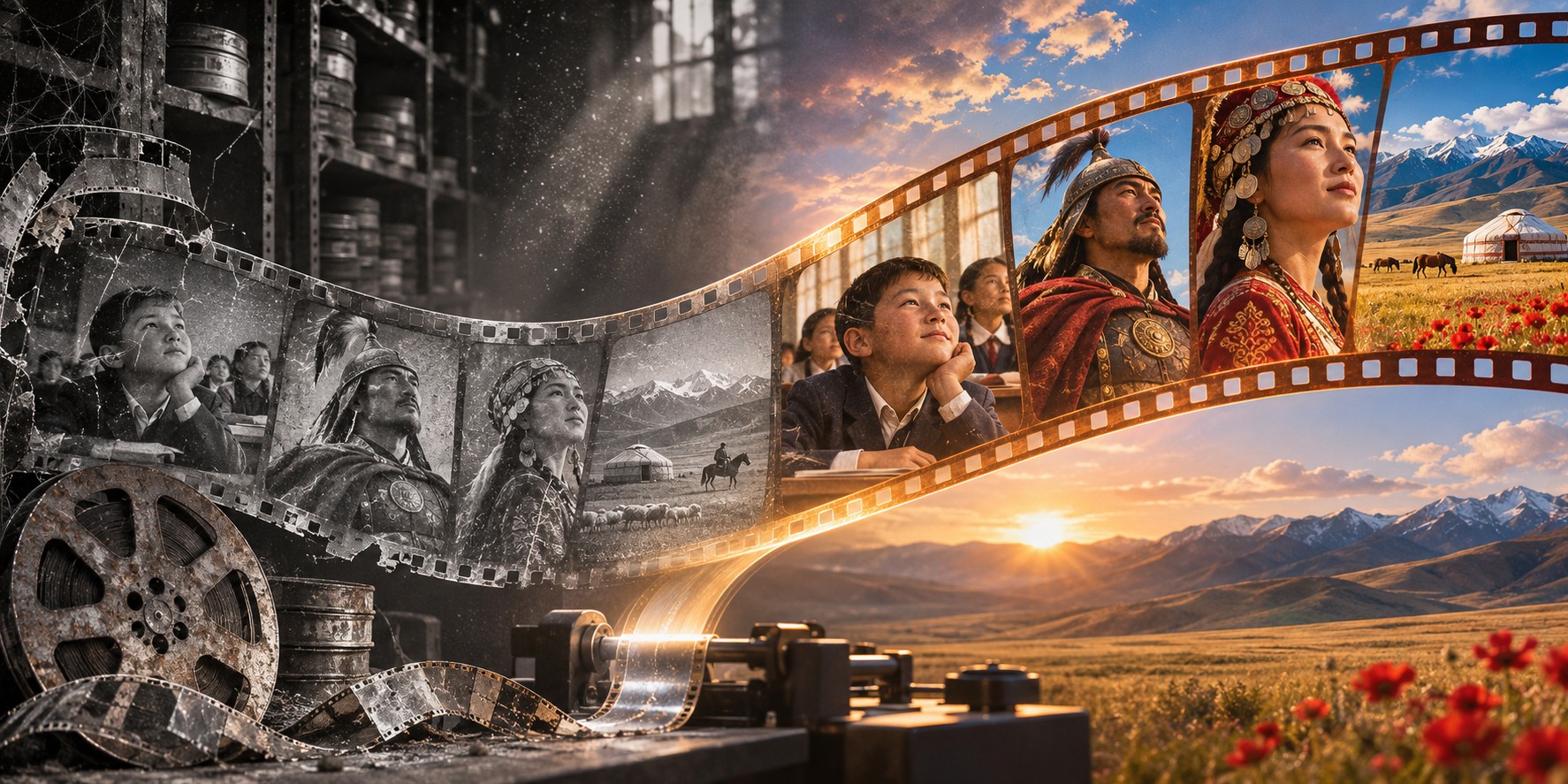
History has other ways of destroying memory. In 1991, as the Soviet Union collapsed, Ardak Amirkulov’s The Fall of Otrar brought another doomed world to the screen: a medieval city besieged by Genghis Khan’s armies. Restored from its original negatives, the film preserves a vision of the past created as an empire fell apart. Across Central Asia, other films lie dormant on aging reels and in forgotten archives.
The restoration began in Almaty, where Amirkulov supervised the scanning of the original camera and sound negatives. Specialists at L’Immagine Ritrovata in Bologna then painstakingly brought the images back to life, with the director approving the final color grading. On December 12, the film will screen in London as part of an Institute of Contemporary Arts season devoted to neglected and rediscovered cinema.
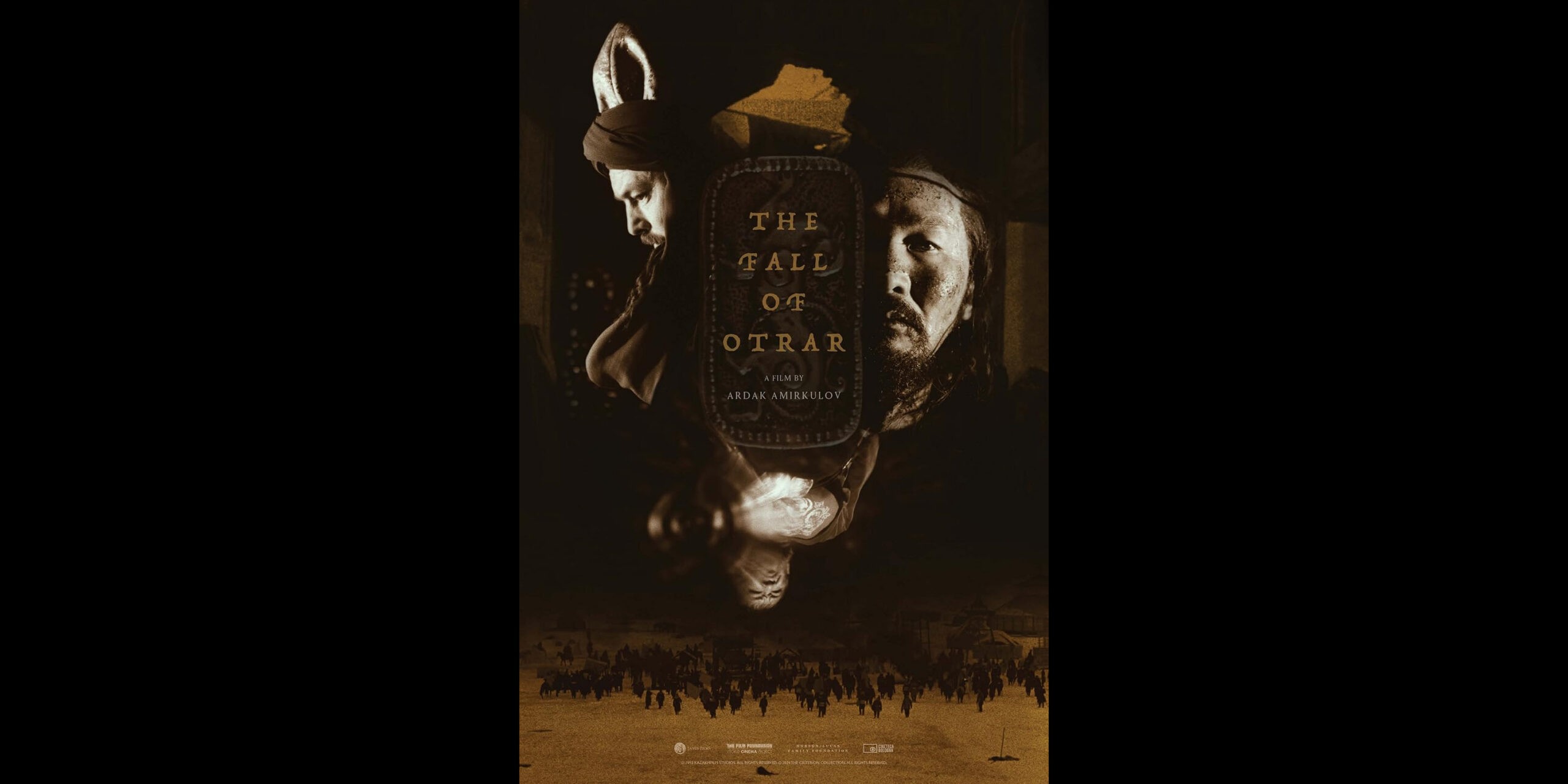
Image: Promotional poster for the restored edition of Ardak Amirkulov’s The Fall of Otrar (1991)
The Legacy of the Soviet Archives
In 2012, a Kyrgyz film preservation initiative reported that copies of ten celebrated films were held by Russia’s Gosfilmofond in Moscow. Their current whereabouts are unclear.
In an interview with The Times of Central Asia, Kazakh film scholar Gulnara Abikeyeva discusses the fate of the region’s films and the challenges of preserving them.
TCA: How did the collapse of the Soviet Union affect the fate of Central Asia’s cinematic tradition? Were important films or original materials lost?
Abikeyeva: In the USSR, the system was organized in such a way that films, specifically their original materials, were kept at Gosfilmofond, the state film archive. On the one hand, this was a good thing because the films were preserved. On the other hand, we, the former Soviet republics, now have to request them or even buy them back. For example, Mazhit Begalin’s first film, It Happened in Shugla (1955), had effectively been lost in Kazakhstan. Film scholar Yevgeny Lumpov found it at Gosfilmofond, raised the money to purchase a copy, presented it in Kazakhstan, and subsequently uploaded it to the internet. Today, we have access to this rare film.
Generally speaking, films in Kazakhstan, for example, are kept at the State Archive of Film and Photographic Documents and at the Kazakhfilm studio. I think the same is true of the other Central Asian countries. But the bulk of the work of preserving films, particularly documentaries, still lies ahead.
Kyrgyzstan’s Cinematic Inheritance
On November 17, 2026, Kyrgyz cinema marked 85 years since a newsreel studio was established in Frunze, now Bishkek. The industry later produced the celebrated films of the 1960s and 1970s, a period often described as the “Kyrgyz Miracle.” Its importance has remained visible in the country’s contemporary creative industries.
Chingiz Aitmatov’s fiction supplied some of its defining stories. Andrei Konchalovsky’s 1965 adaptation of The First Teacher placed a determined teacher in a Kyrgyz village caught between tradition and Soviet change. As TCA examined on the film’s 60th anniversary, its interpretation of Aitmatov’s protagonist was far from straightforward.
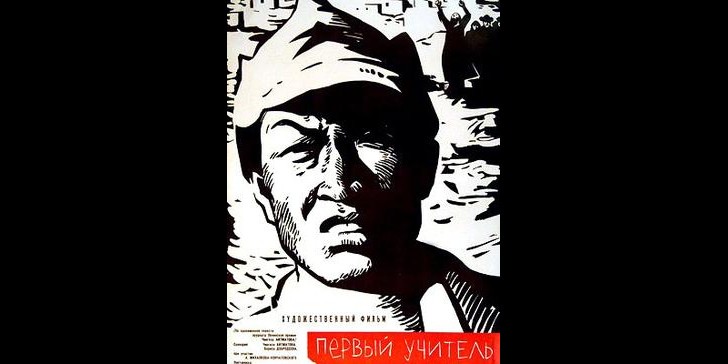
Soviet-era film poster for Andrei Konchalovsky’s The First Teacher (1965).
In February, the Kyrgyz creative association CURLTAI and Kyrgyzfilm reported digitizing more than 100 feature films and documentaries for the studio’s anniversary year. Among the works identified were The First Teacher and A Shot at the Karash Pass, which belong to the country’s cinematic canon.
A Film Is More Than a Digital File
Film restoration involves choices invisible to an audience. A scan transfers images into digital form. Restoration may also repair damage, reconstruct missing elements, and recover color or sound. Even an accurate digital copy requires secure long-term storage. The International Federation of Film Archives distinguishes these processes because each answers a different preservation problem.
Kazakhfilm maintains a specialized digitization and restoration department handling analog film, sound, and archival masters.
TCA: How serious is the threat of deterioration of old film stock today? How do you assess current efforts to digitize and restore films in the region?
Abikeyeva: This is a very serious issue. Everything depends on the efforts of film studios in each individual Central Asian country. As far as I know, Kyrgyzstan has carried out a major program to preserve the heritage of the “Kyrgyz Miracle.” Many restored old Uzbek films are available online. I know little, however, about Tajikistan and Turkmenistan.
There are two sides to your question: preservation and proper restoration. It is no secret that careless restorers often want to “improve” the original, add color, or change something else. Unfortunately, a masterpiece can end up looking like a kitschy folk print. It is extremely important here to preserve the filmmaker’s distinctive style and cinematic language with care.
Who Gets to Watch?
In March 2026, Tajikfilm launched an online viewing platform offering classic and contemporary Tajik films through a paid subscription.
Elsewhere, international collections are reopening regional cinema to local audiences. Berlin’s Arsenal archive holds about 50 films from Central Asia and has presented archival works in Tashkent. It credited Kazakhfilm, Kyrgyzfilm and Uzbekistan’s cinematography authorities for screening permissions.
In August 2026, Almaty’s Tselinny center screened amateur films from Soviet Uzbekistan dating from the 1970s and 1980s, including Valery Nasyrov’s Ballad of a Film Lover and Shavkat Boltaev’s The Cry of the Centuries. The films were preserved in an independent archive, outside the state studio system.
The venue carried a fitting history of its own. Tselinny occupies a restored Soviet-era cinema that reopened as a cultural center in 2025. A building once designed for mass screenings has become a place to recover work that rarely reached such audiences.
For a new generation of artists, old footage is not merely material to conserve. Uzbek filmmaker Saodat Ismailova assembled images from 44 films into her 2025 work, Swan Lake. Half were made in the decade before the Soviet Union collapsed, the remainder in the decade that followed. The work is screening during Budapest’s Verzió festival this November.
TCA: Which Soviet-era films remain unjustly forgotten or inaccessible to audiences? What prevents them from returning to the screen?
Abikeyeva: Practically all of them. I believe in preserving everything, both masterpieces and unremarkable films, which nevertheless remain documents of their era. We film scholars study films from a wide variety of perspectives. Every generation has the right to access this heritage and interpret it in its own way.
The issue is not simply whether films are accessible or inaccessible. The main problem is that our Soviet cinematic heritage has not been reassessed or written about afresh. That is the problem. Young people today are more focused on films from the independence era, which is understandable because every generation is primarily interested in its own time. However, it is quite clear that the national cinemas of Soviet Central Asia have not been reassessed from the perspective of contemporary postcolonial studies.
For a while, there was a debate over whether Central Asia could be considered a colony. But it is now clear that it could: the features of a colonial empire are plain to see. All those Soviet ideological constructs imposed on us shaped our cinema, particularly during its formative years.
Let me give an example: The Pass (1961), directed by Alexei Sakharov. It is considered a Kyrgyz film because it was made in the Kyrgyz SSR and based on Chingiz Aitmatov’s novella My Little Poplar in a Red Headscarf. But what is Kyrgyz about it? Nothing apart from the mountains and the actors. It is an entirely Soviet story about truck drivers and a construction project, filmed in a Russian style.
Then there is Irina Poplavskaya’s film I Am the Tien Shan (1972), based on the same novella, in which everything is completely different. In the first case, the director wanted to tell a Soviet story about the work of truck drivers. In the second, the aim was to make a film that reflected the Kyrgyz mentality, traditions, and way of life. There are many such examples in Central Asian cinema.
Of course, it was only with the arrival of the Khrushchev Thaw and the emergence of local filmmaking professionals that cinema truly flourished and found its own voice. It remains for us, as film scholars and researchers, to determine where Soviet ideology was imposed and where genuinely national cinema emerged.
Reclaiming the Past
TCA: Ardak Amirkulov’s film The Fall of Otrar was recently restored. What is the significance of bringing such films back to audiences? If you could choose one forgotten Central Asian film for urgent restoration, which would it be and why?
Abikeyeva: In 1991, Kazakhstan submitted The Fall of Otrar for Oscar consideration. That is how it ended up in the United States, where Martin Scorsese saw it and asked its director, Ardak Amirkulov, to leave a copy of the film in his collection. In 2025, at Scorsese’s initiative, the copy was restored. In August 2025, it was screened first at Lincoln Center in New York and subsequently at festivals around the world.
I ask myself why Martin Scorsese considered this film so important. I think it is because we know what the ancient Greek and Roman worlds looked like from films such as Troy and 300. We know what ancient or medieval China looked like from Chinese films, and so on. We even know what the Mayan civilization looked like from Mel Gibson’s Apocalypto. But the world does not know what our part of the world looked like, or even what Genghis Khan looked like. The Fall of Otrar opens a window onto the history of this part of the world.

Ardak Amirkulov’s The Fall of Otrar (1991); image: TCA
That is how it looks from the outside. Looking from within, however, practically all historical films in Soviet times were confined to the historical-revolutionary genre, meaning that our history effectively began with the establishment of Soviet power.
During perestroika, our intellectuals who were then in charge of film organizations, namely Murat Auezov, editor-in-chief of the Kazakhfilm studio, and Olzhas Suleimenov, chairman of the State Committee for Cinematography of the Kazakh SSR, understood that this paradigm had to change and that historical films about our ancient past had to be made. This is how Sultan Baybars (1989) and The Fall of Otrar came into being. Many other historical films followed after independence. Incidentally, Kurmanjan Datka also appeared only after independence.

Kyrgyz historical epic Kurmanjan Datka (2014); image: TCA
I would not be able to choose a single film for urgent restoration. This is a task for each Central Asian country individually, and it should not be limited to one film. I can name, for example, five of the most important Kazakh Soviet films: Land of the Fathers (1966) by Shaken Aimanov, Tracks Beyond the Horizon (1965) by Mazhit Begalin, My Name Is Kozha (1963) by Abdulla Karsakbayev, Kyz-Zhibek (1972) by Sultan Khodzhikov, and Kulager (1972) by Bolat Mansurov.
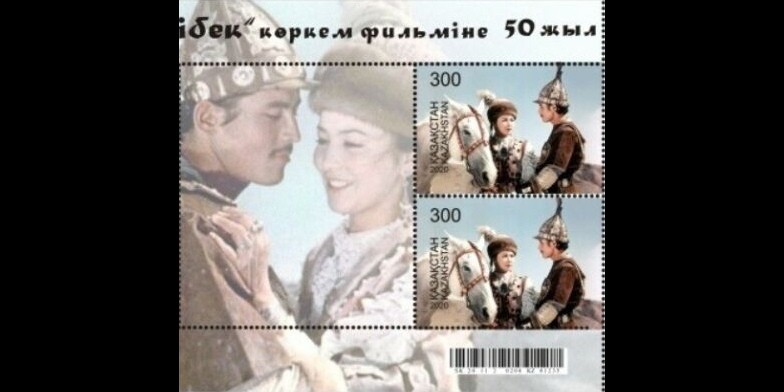
Commemorative stamps issued in Kazakhstan in 2020 marking the 50th anniversary of Sultan Khodzhikov’s Kyz-Zhibek.
For centuries, the tragic love story of Zhibek and Tolegen lived in the voices of Kazakh storytellers. When Sultan Khodzhikov made Kyz-Zhibek in 1970, he gave the ancient epic the faces and voices of his own generation. The film now belongs to two periods of Kazakh history: the age of the legend and the remarkable flowering of cinema that brought it to the screen. Its restoration in 2024 allows another generation to discover both. Perhaps the greatest value of Central Asia’s cinematic inheritance lies in these encounters between different ages, in the discovery of how people once imagined their past and understood their present. Without the work of preservation, future generations will inherit a considerably narrower version of their own history.