Nearly two centuries after his birth, Abai Qunanbaiuly remains a symbol of Kazakh identity, with his poetry and music still familiar across Kazakhstan. Often described as the founder of modern Kazakh written literature, he has been compared in Kazakhstan to Alexander Pushkin in Russia and William Shakespeare in England. On August 10, the country marks the 181st anniversary of his birth and the seventh official Abai Day.
Abai wrote about 170 poems and 56 translations. His best-known prose work, Kara Sozder (Words of Edification), consists of 45 short pieces of philosophical and moral reflection. He was also a composer, and his song Közimniñ Qarasy (The Apple of My Eye) remains among his best-known works.
Poet and Public Figure
Born Ibrahim Qunanbaiuly on August 10, 1845, at the foot of the Shyngystau Mountains near Semipalatinsk, Abai came from the Tobykty clan of the Argyn tribe. His grandfather Oskenbai and great-grandfather Yrgyzbay were prominent biys, or judges. His father, Qunanbai Oskenbaiuly, was a powerful local leader.
His grandmother Zere gave him the nickname Abai, commonly translated as “attentive” or “cautious.”
At age 10, Abai was sent to the Ahmad Riza Madrasah in Semipalatinsk, where he studied religious subjects in Arabic and Persian and read Eastern literature. During his final year there, he also briefly attended a Russian parish school. His father brought him home at 13 and involved him in administrative and judicial affairs.
Abai later deepened his study of Russian and European literature and formed close ties with political exiles in Semipalatinsk. He died in 1904 and was buried at Zhidebai.
Abai’s Views
Abai read Nizami Ganjavi and Alisher Navoi, among other Eastern classics. His translations into Kazakh included work by Alexander Pushkin and Mikhail Lermontov. He also translated Ivan Krylov and Lord Byron. A poem by Johann Wolfgang von Goethe reached Kazakh through Abai’s rendering of Lermontov’s Russian version.
Education and productive work recur throughout Abai’s writing. He criticized corruption and abuses of power, including bribery and sycophancy. He also opposed polygamy and bride price and argued for greater equality for women.
His ideas influenced the emerging Kazakh intelligentsia. Leaders of the Alash movement regarded Abai as an intellectual predecessor. His engagement with Russian culture later became a subject of debate over how his work had been interpreted during the Soviet period.
International Recognition and New Translations
In 1995, Abai’s 150th anniversary was commemorated under UNESCO’s auspices. TURKSOY declared 2020 the Year of Abai to mark the 175th anniversary of his birth. His works have been translated into numerous languages, and monuments to him stand in Kazakhstan and abroad.
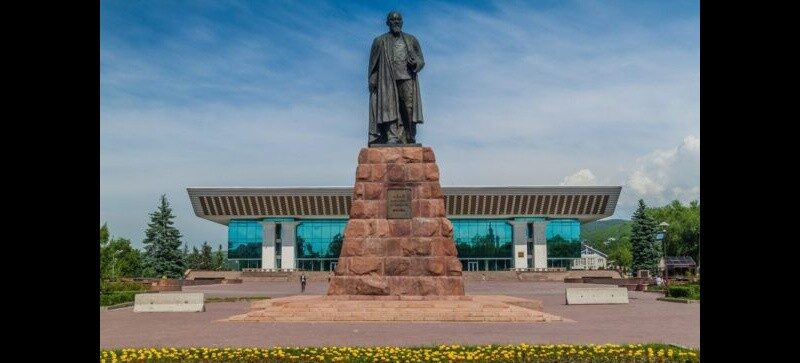
In Almaty, his statue stands at the beginning of Abai Avenue, with the mountains behind it. His name also reached readers in the United States in the late 19th century through American journalist George Kennan, who referred to Abai after visiting Semipalatinsk in 1885.
Debate over how Abai should be translated has continued in the post-Soviet period. In 2021, Kazakh poet and translator Yerbol Zhumagul presented a new Russian translation of Words of Edification. He argued that earlier Russian versions, especially those from the Soviet period, were inaccurate and stylistically flawed, with some passages interpreted too freely.
Zhumagul also said Abai had addressed the work primarily to his relatives and that it was originally conceived as a testament rather than a conventional literary work.
“It was especially important for me to be meticulous about the accuracy of the translation, so that in Russian Abai would sound not like a grumbling old man, but like an aksakal of the steppe. So that through the documentary style, readers could sense the smell of tail fat, dried dung and the aul,” Zhumagul said.
Abai in Modern Politics
In May 2012, Abai’s name became attached to a very different public debate in Moscow. After Vladimir Putin returned to the Russian presidency, protesters established a camp near the monument to Abai Qunanbaiuly on Chistoprudny Boulevard. The gathering became known as “Occupy Abai,” a reference to Occupy Wall Street.
Writers and other public figures joined events around the camp, with novelist Boris Akunin among the most prominent participants. Police cleared the encampment in the early hours of May 16 after a Moscow court ruled it illegal.
More than a century after his death, Abai’s place in Kazakh culture continues to evolve. New translations reopen arguments about his words, while episodes such as Occupy Abai show how his image can acquire meanings far removed from the world in which he lived.