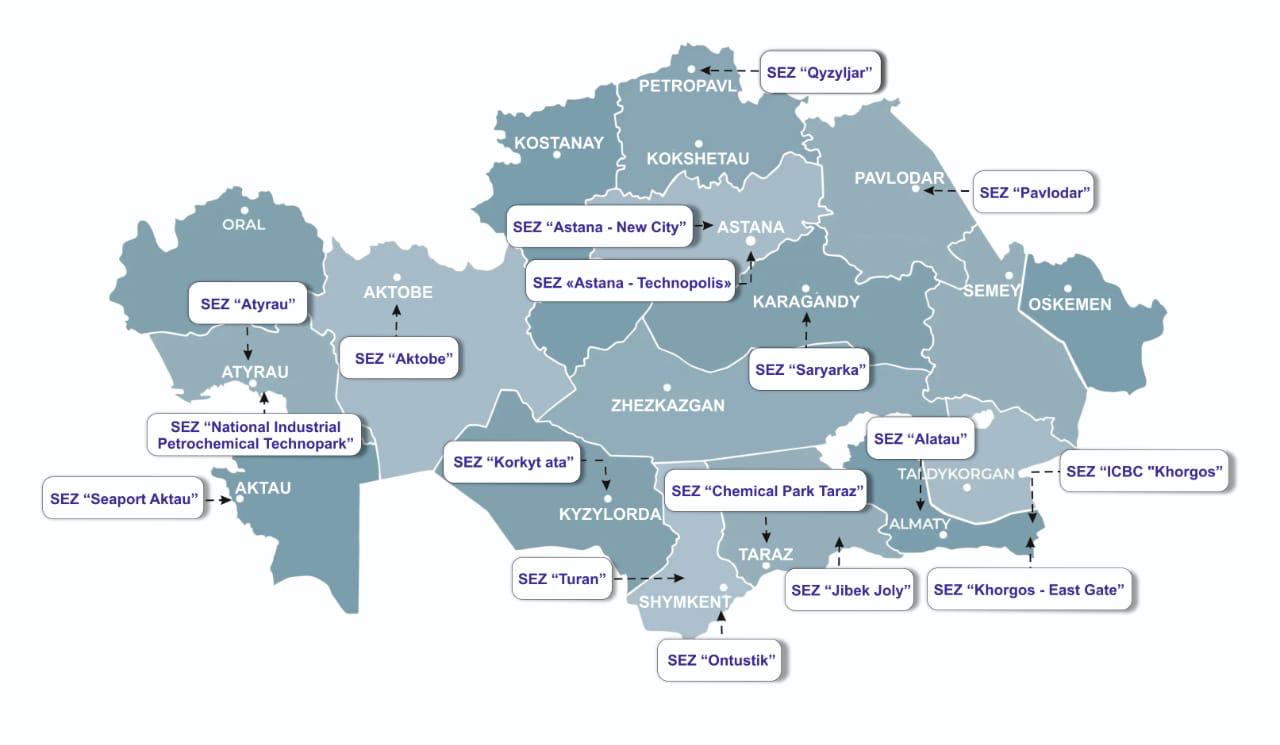
Kazakhstan currently has 17 special economic zones (SEZs) operating across 14 regions, three of which were created in 2025. How effective is this tool for attracting investment, reducing import dependence, and developing exports? And how will the SEZ model evolve within the framework of the Single Coordination Center? Yerlan Kusainov, Deputy Chairman of the Board of JSC Kazakhstan Center for Industry and Export “QazIndustry,” discussed these issues with The Times of Central Asia.
TCA: Kazakhstan currently has 17 SEZs. How many companies operate in them, and what is the total volume of production?
Kusainov: There are 1,144 participants registered in SEZ territories. Of these, 558 projects are already operational, while another 586 are in the implementation stage. Since the establishment of the zones, enterprises have produced goods worth 13.9 trillion tenge (about $28 billion).
The current occupancy rate of the SEZs is 42.4%. This indicator is dynamic and may change as new contracts are signed or as some participants cease operations.
TCA: What types of products are manufactured in the SEZs, and how does this contribute to reducing import dependence?
Kusainov: The SEZs cover a wide range of industries, including manufacturing, construction, transport and logistics, and tourism.
For example, the Aktau Seaport SEZ is implementing projects in the chemical industry, including the production of caustic soda and hydrochloric acid by Topan Chemical Industries. These products are widely used in metallurgy, the oil and gas industry, and water treatment. Previously, a significant portion of such products was imported, but production is now being localized in Kazakhstan.
A major petrochemical cluster is being formed in the Jibek Joly SEZ. Projects there include the production of mineral fertilizers, chemical reagents, and polymer products. Participating companies include HIM-plus, KPM Plast, Chemical Engineering, and C9 Technologies. These projects are expected to supply the domestic market while also supporting exports.
In the Pavlodar SEZ, projects are being implemented in metallurgy and petrochemicals. These include the production of calcined petroleum coke by UPNC-PV, car wheels by Vector Pavlodar, and aluminum ingots and alloys by LeichtMetall KZ and Unimetals. These products are exported to markets in Europe and Asia.
The Ontustik SEZ focuses on the textile industry, where a full cotton-processing cycle has been established, from raw materials to finished products. Enterprises there produce cotton and synthetic yarn, carpets, and other textile goods.
Another important site is the Park of Innovative Technologies SEZ, where projects in digital technologies and electronics are being developed. Key participants include the Institute of Physics and Technology, KT Cloud Lab, which is building a data center, and DS Multimedia CA, which manufactures electronic components.
Together, these projects contribute to reducing import dependence and building export-oriented industries.
TCA: What is the export volume of SEZ enterprises?
Kusainov: The total export volume from SEZ enterprises has reached about $2 billion.
In 2025 alone, exports amounted to approximately $490 million, compared with $148 million in 2021, an increase of 231%.
TCA: How much investment has been attracted through the SEZs?
Kusainov: Over the entire period of operation of the special economic zones, about $9 billion has been invested in SEZ projects overall. Of this total, $6.6 billion was attracted over the past six years.
Foreign direct investment accounts for $2.4 billion of that amount.
In addition, SEZ participants have paid approximately $1.6 billion in taxes and mandatory payments to the state budget.
TCA: How many jobs have been created, and what are the main challenges facing the SEZs?
Kusainov: More than 41,000 permanent jobs have been created through the development of SEZs. One of the key factors for further growth is the availability of ready-made infrastructure. At present, additional financing for SEZ infrastructure is required through 2030.
Around 200 new large-scale projects are expected to be launched, creating more than 19,000 jobs.
To attract investors, three new SEZs were established in 2025: Aktobe, Korkyt Ata, and Atyrau, along with 15 industrial zones.
Priority in SEZs is given to projects involving deep processing in sectors such as agriculture, metallurgy, and the chemical industry.
TCA: How does the differentiated approach to incentives work?
Kusainov: Since 2024, Kazakhstan has applied a differentiated system for providing tax incentives.
Investors can receive tax benefits for periods of 7, 15, or 25 years, depending on the size of their investment.
The principle is simple: the larger the investment, the longer the duration of the tax preferences. The goal of this mechanism is to attract projects with high added value, strong innovative components, and export potential.
The procedure for obtaining SEZ participant status has also been simplified. Investors submit an application and a package of documents. If the requirements are met, an agreement is concluded and a participant certificate is issued.
One of the key advantages of SEZ participation is the availability of ready-made infrastructure, as well as the provision of land plots free of charge for the duration of the incentive period.
Investors also have the right to purchase the land plot after three years of operating a manufacturing project or once the SEZ term expires.
Background
In 2025, three new SEZs were created in Kazakhstan: Korkyt Ata, Aktobe, and Atyrau. The territories of several existing zones were also expanded, including Turan, Aktau Seaport, Pavlodar, Khorgos – Eastern Gate, Saryarka, Jibek Joly, Qyzyljar, and the National Industrial Petrochemical Technopark.
In addition, the government approved the expansion of the Aktau Seaport, Ontustik, Astana-Technopolis, Saryarka, and Alatau SEZs to support airport development and the creation of multimodal air hubs.