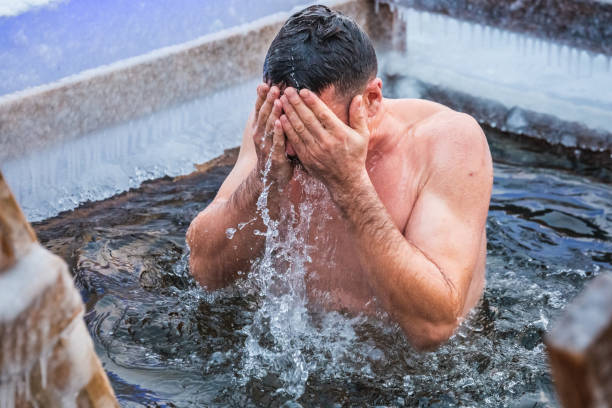
On the night of January 18-19, Orthodox Christians across Central Asia gather at frozen rivers and lakes to celebrate the feast of Epiphany by plunging into icy waters, three times each, in line with tradition. Though rooted in the Christian faith, this ritual has evolved into a broader cultural event, drawing participation from people of many backgrounds.
A Test of Faith and Endurance
In Central Asia, Epiphany coincides with some of the coldest days of the year, often referred to as the “Epiphany frosts.” Despite subzero temperatures, participation in ice bathing continues to grow.
According to Orthodox tradition, Epiphany commemorates the baptism of Jesus in the River Jordan. While the climate in Israel was mild, believers in the region embrace the symbolic cleansing despite the extreme cold.
The Orthodox Church does not consider ice bathing a requirement for the faithful. Instead, the central ritual of the holiday is the Great Blessing of Water, performed both on Epiphany and the evening before. Priests encourage believers to collect holy water from churches, sprinkle it throughout their homes, and drink it in small amounts on an empty stomach. Many believe this brings health and protection for the year ahead.
Nevertheless, in the main Orthodox churches of Central Asia, fonts and pools are prepared for those who wish to immerse themselves. Designated ice holes are also opened in lakes and rivers for traditional bathing.
Strict Safety Measures in Kazakhstan
In Kazakhstan, authorities take extensive precautions to ensure public safety during Epiphany bathing. In Astana, the celebration began with a religious procession from the Constantine and Helen Cathedral to the embankment of the Ishim River, where the water was consecrated despite temperatures dipping to minus 30 degrees Celsius.
Warm changing rooms were provided, and teams from the Ministry of Emergency Situations, along with paramedics and rescue personnel, were on hand throughout the night.
In Almaty, where temperatures hovered around minus 15 degrees, Epiphany fonts were set up at 10 churches. Authorities reminded residents that swimming in non-designated natural bodies of water is prohibited due to the risk of slipping or falling through the ice. However, safety teams and patrols were stationed at approved bathing sites, including the Bolshaya Almatinka, Malaya Almatinka, Butakovka, Goryachiy Istochnik, and Gorenik rivers.
Officials advised those with cardiovascular or endocrine conditions to avoid the ritual and warned against participating while intoxicated.
A Cultural Tradition Embraced by Many
Over time, Epiphany bathing in Central Asia has grown beyond a strictly religious practice. In Kazakhstan, many ethnic Kazakhs and other non-Christian residents eagerly take part, viewing the ritual as a source of health and vitality. It has become a powerful symbol of interethnic and interfaith unity in the region.
While Muslim clerics typically do not encourage participation, they generally refrain from direct criticism, recognizing the tradition’s broader cultural significance. Orthodox priests also emphasize that the ritual is more custom than doctrine, open to anyone.
Some compare Epiphany bathing to the festive atmosphere of Kurban Ait, when Muslims share food in public spaces. Likewise, Orthodox Christians in Central Asia have long celebrated Nauryz, the Turkic and Persian New Year, enjoying traditional dishes such as nauryz kozhe.
Wider Regional Observance
In parts of Central Asia with milder winters, ice does not form thick enough for traditional immersion. In Tashkent, for instance, Metropolitan Vikenty of Tashkent and Uzbekistan consecrated water in a pool at the Tashkent Diocese’s Spiritual and Administrative Center.
In Kyrgyzstan, Epiphany is celebrated with particular ceremony. In the village of Sosnovka in the Zhayyl district of Chui region, hundreds, and often thousands, gather annually to plunge into the Kara-Balta River near the Church of St. Demetrius of Thessaloniki. The tradition, launched in 1995 by Father Alexander Mezentsev, has since become a regional hallmark. Tents are set up along the riverbank, and hot tea is offered to bathers.
As such, the Epiphany ice bath has evolved into more than a spiritual rite, it is now a widely embraced cultural celebration, underscoring the shared traditions and resilience of Central Asia’s diverse communities.