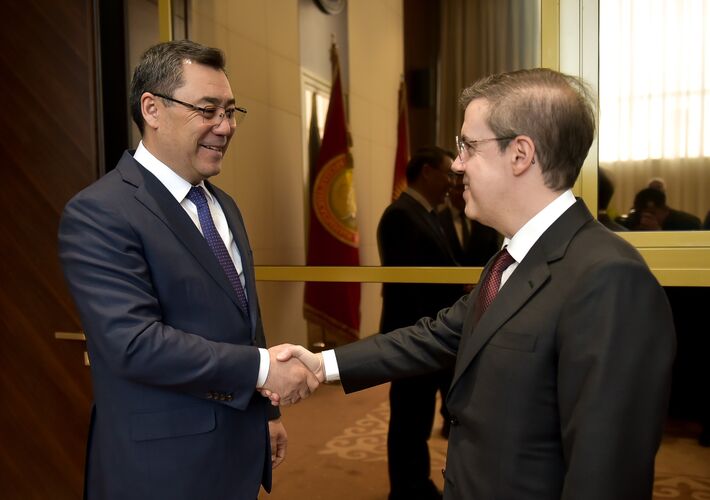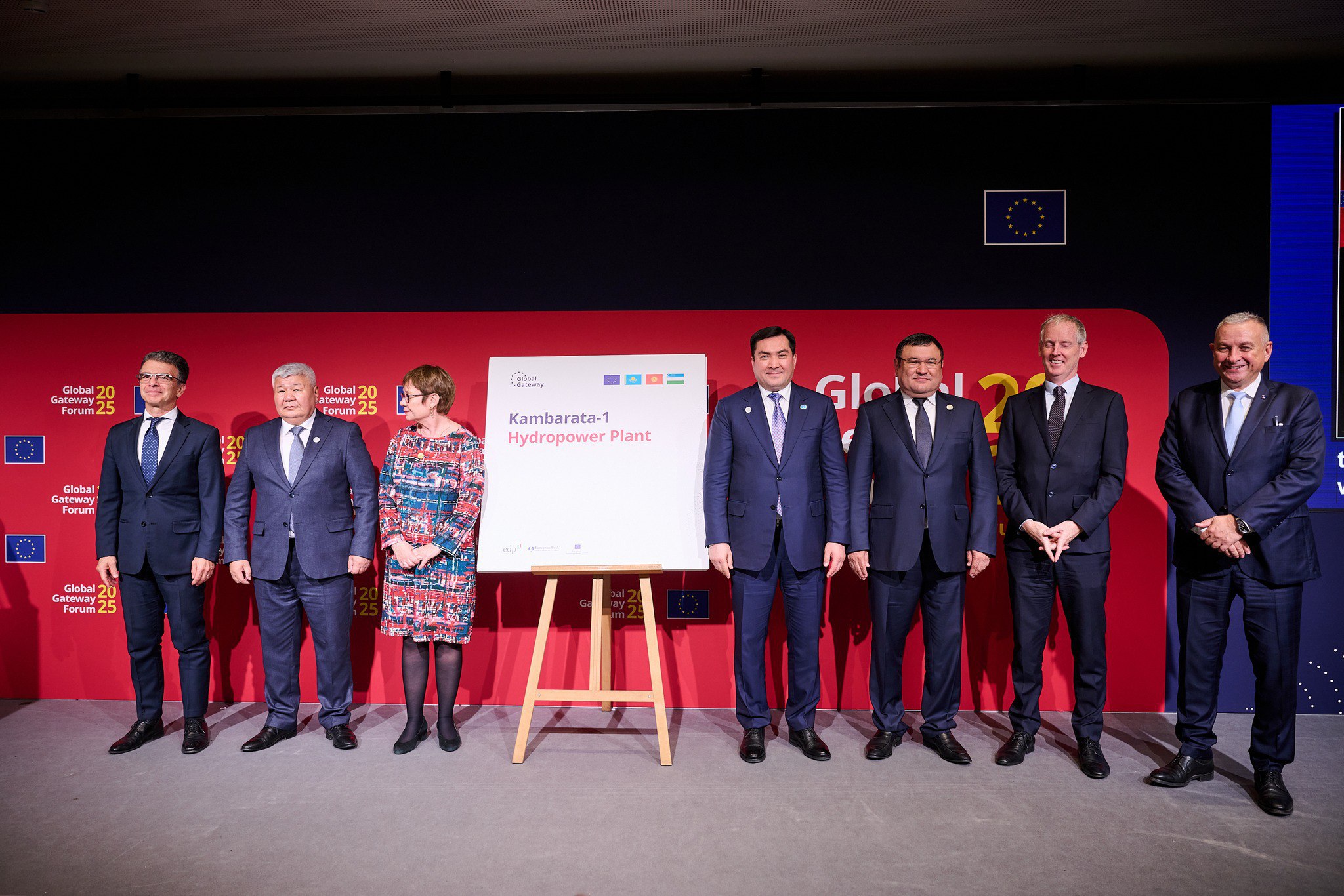
Kyrgyzstan’s Minister of Energy, Taalaibek Ibraev, has signed agreements with European financial institutions to advance the construction of the Kambarata-1 hydropower plant, a flagship regional energy project on the Naryn River. The deals were concluded in Brussels during the Global Gateway Forum, organized by the European Union to mobilize sustainable investment in partner countries.
According to an official EIB statement, the EU and the European Investment Bank (EIB) signed €900 million in memoranda of understanding with Kyrgyzstan, Kazakhstan, and Uzbekistan to support the project, which aims to strengthen regional energy security and accelerate the green transition in Central Asia. The European Bank for Reconstruction and Development (EBRD) also signed parallel agreements with the three governments and is assessing a financing package worth up to €1.3 billion.
At the Brussels forum, Ibraev met with his counterparts from Kazakhstan and Uzbekistan to discuss coordination on implementation, following last year’s intergovernmental agreement establishing the Kambarata-1 project as a trilateral initiative. Under that framework, the countries will cooperate on construction, power-sharing, and environmental safeguards, with additional technical support from the World Bank. The World Bank’s project brief describes Kambarata-1 as a key step toward integrated energy and water management in the region.
The 1,860-megawatt facility – one of the largest planned in Central Asia – will supply clean power domestically and to neighboring markets through regional transmission links. The EIB and EBRD agreements were signed by Minister Ibraev, EIB Global Director General Andrew McDowell, and EBRD Regional Director Hüseyin Özhan. It was reported that each institution has preliminarily earmarked up to $500 million in financing as part of its broader engagement.
European Commission President Ursula von der Leyen said during the forum that the EU’s Global Gateway initiative will mobilize more than €400 billion by 2027 to strengthen sustainable infrastructure worldwide, including renewable energy projects in Central Asia. “This is a great opportunity for Europe, and this year, together with our partners, we are turning this demand into real action,” she said.