Turkmenistan and the United States are working to deepen their economic and diplomatic relationship, with a top American diplomat and a U.S. business delegation visiting Ashgabat this week.
The U.S.-Turkmenistan Business Council had announced a semiannual business mission to Ashgabat on November 4–5, a trip that comes amid a wider effort by the United States and Central Asian countries to expand trade and investment ties with each other. The council is a Washington, D.C.-based nonprofit group led by Eric Stewart, a former U.S. deputy assistant secretary for Europe/Eurasia at the Department of Commerce who has founded more than a dozen similar groups focusing on other countries and regions.
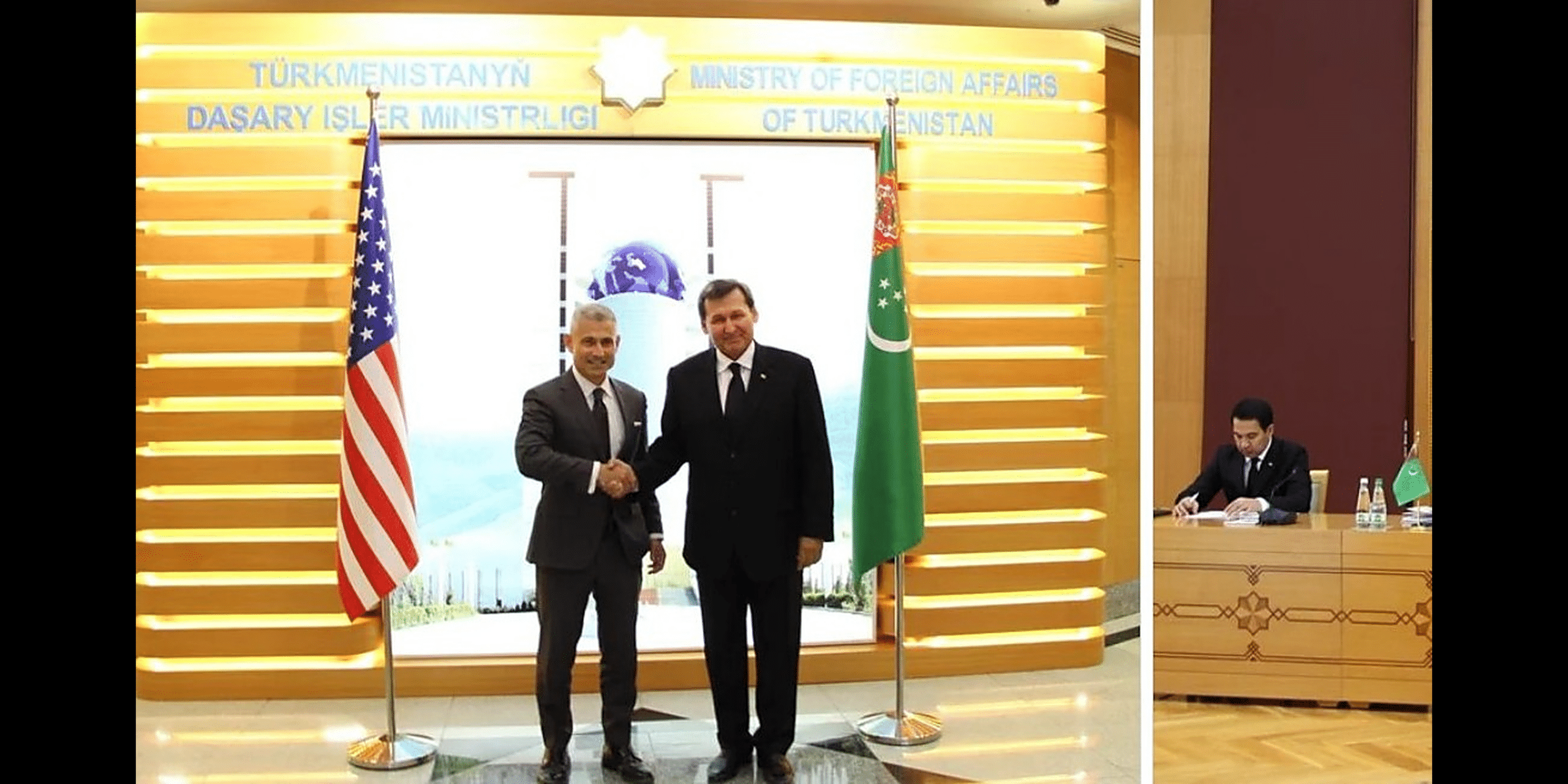
The trip, which was coordinated with the U.S. government, followed a visit to Ashgabat this week by S. Paul Kapur, U.S. assistant secretary of state for South and Central Asian affairs. On November 3, Kapur and Turkmenistan’s Foreign Minister Rashid Meredov talked about “expanding business ties and identifying new opportunities” for partnership, according to Turkmenistan’s embassy in the U.S.
U.S. support for the Turkmenistan–Afghanistan–Pakistan–India (TAPI) gas pipeline was also discussed, the embassy said. That support was also noted in a Turkmen state media report on Kapur’s meeting with Gurbanguly Berdimuhamedov, the former president who still has a powerful leadership role in Turkmenistan.
Turkmenistan recently said there was progress in laying the pipeline in Afghanistan’s Herat province, though the overall TAPI project has faced years of delays and challenges in its implementation.
While U.S.-Turkmen trade and investment are relatively small, Turkmenistan’s strategic location on Caspian Sea trade routes and the fact that it has some of the largest proven reserves of natural gas in the world make it a potentially important partner for the U.S. Turkmenistan mainly exports energy to China but is aiming to diversify export options, including through projects such as TAPI and the planned Trans-Caspian Gas Pipeline.