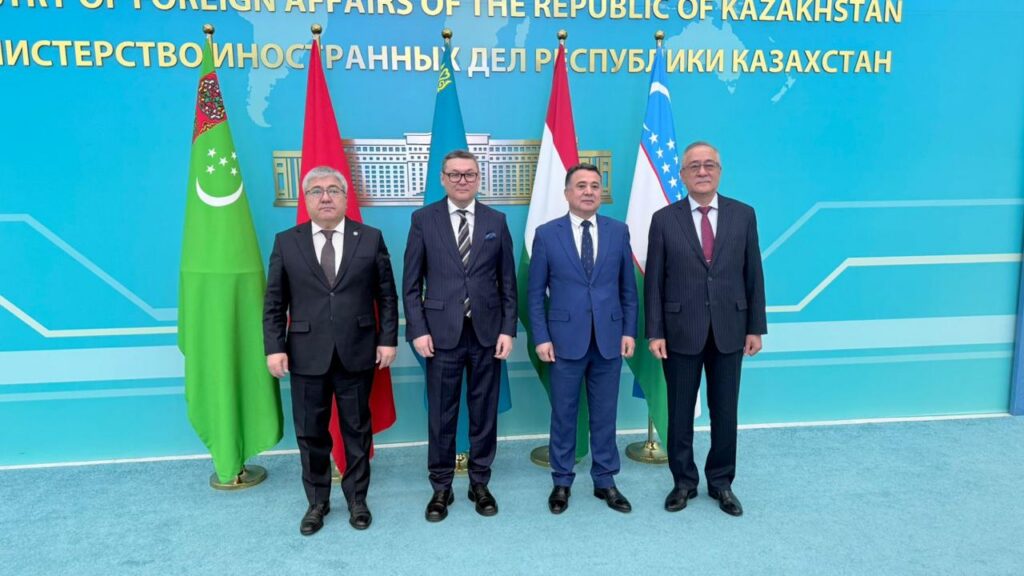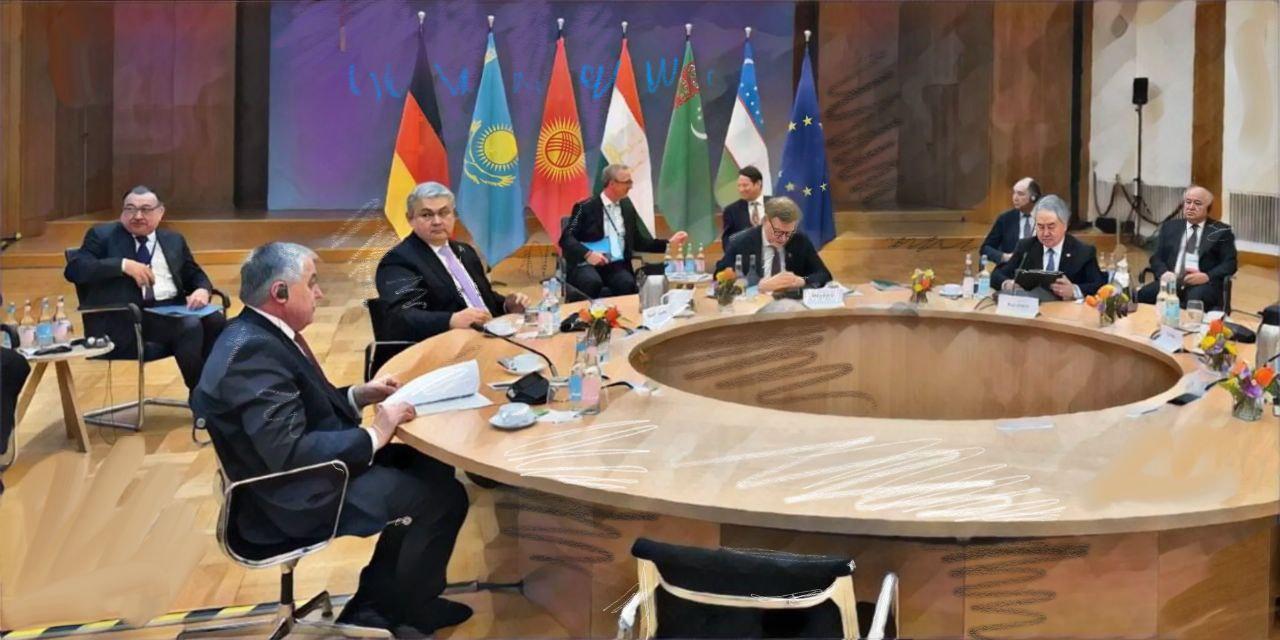
Germany’s meeting on February 11 with the five Central Asian foreign ministers in Berlin formalized the Z5+1 (“Z” for “Zentralasien”) format as a standing work channel. It joins other “plus-one” formats now crowding Central Asia that function as instruments of influence. The United States is using C5+1 to push a more deliverables-oriented agenda, including critical raw materials, and China has institutionalized leader-level summitry with accompanying treaties, grants, and transport-centered integration. The EU has elevated its relationship to a strategic partnership and is putting Global Gateway branding behind connectivity and investment.
Germany’s Z5+1 is best understood as Europe’s effort to add a practical, tool-driven channel that can move faster than EU consensus in some domains while still feeding EU programming rather than competing with it. The concluding Berlin Declaration reads like a program sheet with named instruments, sector priorities, and established a direct link to the EU’s broader “Team Europe” posture through the participation of EU Special Representative Eduards Stiprais. Germany’s Z5+1 fits this competitive field as a European execution lane that can move projects forward with German instruments while staying aligned with EU programs.
Berlin Defines the Tools
The Z5+1 meeting in Berlin drew on a sequence that Germany has been building since its 2023 “Strategic Regional Partnership” and subsequent summits in Berlin (2023) and Astana (2024), with an explicit emphasis on Central Asian regional cooperation as a counterpart to bilateral ties. The Berlin meeting, therefore, did not attempt to invent a new regional architecture but rather added a stable ministerial format for pushing forward project lists, regulatory expectations, and finance conditions between higher-level meetings.
In Berlin, Germany committed €2.7 million to a cooperation platform for the Trans-Caspian Transport Corridor: a small sum by infrastructure standards, but targeted at unglamorous coordination like data-sharing, planning discipline, and institutional continuity, i.e., standards and transborder management regimes where corridor initiatives often stall. This profile complements the EU-backed Trans-Caspian Coordination Platform track, which is explicitly tied to a wider €10 billion commitment announced at the January 2024 Global Gateway investors forum for EU–Central Asia transport connectivity. and which has addressed the corridor less as a construction problem than as a finance-and-sequencing problem.
Berlin also explicitly supported the commercial participation of German rail and logistics firms in transport and consulting projects, aligning with the intent to keep firm-level engagement attached to ministerial diplomacy. The declaration references export credits and investment guarantees, and links them to business-environment expectations. On the same day, the German Eastern Business Association convened a “Wirtschaftsgespräch” (economics talk) in the Foreign Office with the Central Asian delegations. There, the region was framed as strategically significant for Germany’s diversification agenda, and it was signaled that an autumn leaders’ summit is already in view. Germany’s public accounting of its regional engagement in Central Asia stresses its already-deep base of activity in Kazakhstan and Uzbekistan in particular, including dozens of projects and multi-billion-euro volumes.
The energy transition was mentioned, as the Berlin Declaration points to renewables, hydrogen, and climate programming that Germany is already funding and can expand through existing channels. These include the “Green Central Asia” initiative backed by a €250 million commitment and additional regional development cooperation portfolios. Reporting by The Times of Central Asia on green-energy export ideas from Kazakhstan, and on the domestic controversy around the Hyrasia One hydrogen project, illustrates why Berlin’s approach is structured as a portfolio of smaller pilots, grid work, and efficiency projects, rather than as one mega-plan that can fail on permitting, water stress, or local opposition.
Z5+1 in the Competitive “Plus-One” Ecosystem
Berlin also treated sanctions compliance as a practical agenda item by including language on the prevention of circumvention and on coordination on sanctions-related risks. EU deliberations and reporting on possible anti-circumvention measures already include scrutiny of re-export channels. This creates direct exposure for Central Asian economies that have benefited from gray-zone trade since 2022. As a gatekeeper for specific industrial goods and finance tools, Germany is positioned to translate this into concrete expectations of sanctions compliance.
One lever is programming under the “security” rubric that often functions as infrastructure and services in border regions. Berlin has dedicated more than €13 million in financial support for OSCE regional projects since 2022, with a €3 million contribution in 2025 to the OSCE fund responding to Afghanistan-related issues, including water and conflict management. It also reiterates cross-border stabilization programming that has direct local effects in border regions, where hard infrastructure, services, and administrative capacity are often inseparable from “security” labels.
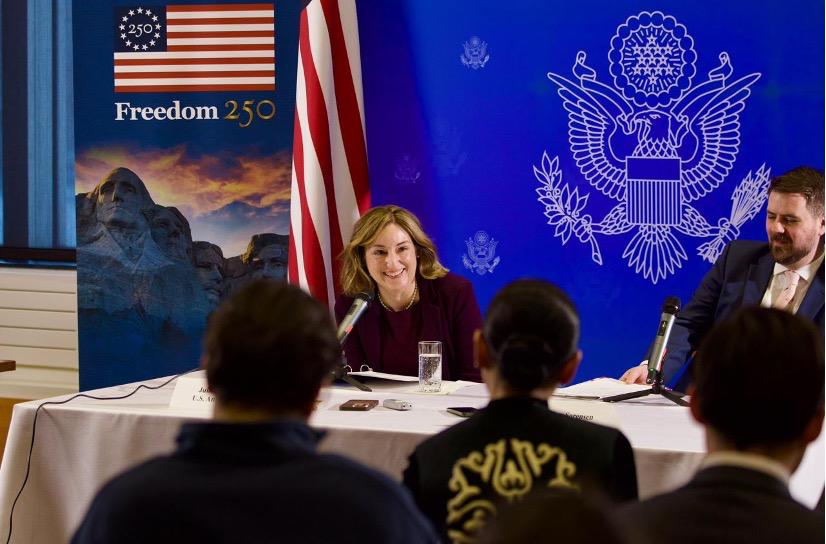
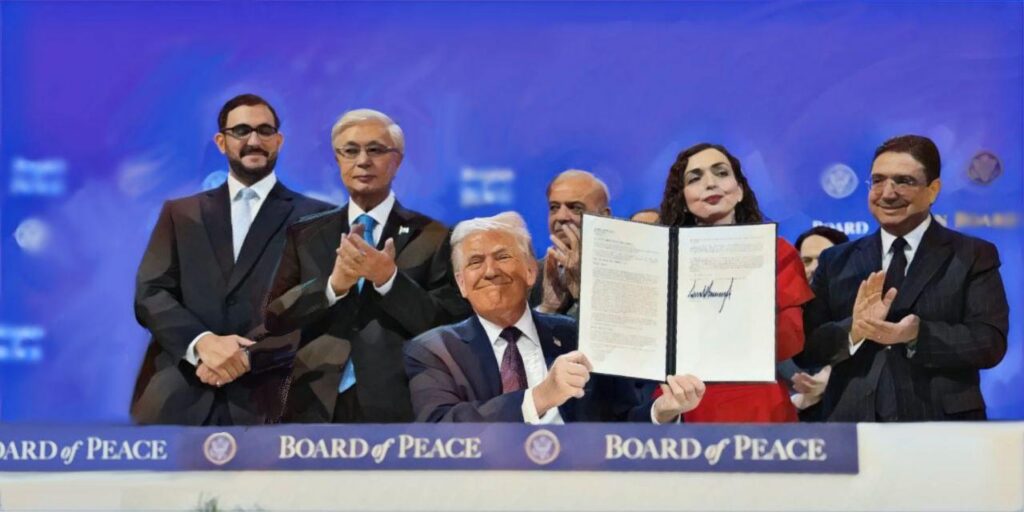
The U.S. channel provides a useful comparison. A more deliverables-oriented U.S. C5+1 track has elevated critical raw materials, and the associated dialogue mechanisms have been presented as a concrete area for practical cooperation, including the launch of the C5+1 Critical Minerals Dialogue. Germany’s Z5+1 is not seeking to replicate the U.S. working-group architecture.
Likewise, Germany will not outspend China, which has used leader-level summitry to consolidate a long-horizon political umbrella for infrastructure and trade integration, including treaty-level upgrading of ties and grant commitments alongside transport projects. China used its first China–Central Asia summit in 2023 to define a new platform and embed security and capacity-building language alongside economics.
Operational Implications
Germany’s Z5+1 is a standing work channel that links German export credits and investment guarantees to corridor governance, critical minerals, and energy-transition project pipelines. It treats sanctions-circumvention risk as a structuring constraint, bringing compliance management into project selection, financing terms, and due diligence rather than leaving it as ambient exposure. For the Central Asian five, this creates an additional diversification venue with more explicit discipline costs than many other “plus-one” tracks.
As “C5+1” formats proliferate, Central Asian bargaining leverage increases, and demands on regional coordination and sanctions-risk management increase as well. Germany competes in that environment without creating a separate EU track, signaling Team Europe alignment through the EU Special Representative’s participation and by linking the channel to EU program pipelines shaped by Global Gateway financing and regulatory expectations. By design, Z5+1 makes corridor sequencing, financing terms, and sanctions-risk practices the locus of operational negotiation. Its practical effects will accumulate in corridor governance capacity, project bankability, and partner diversification under pressure from larger neighbors.